Appendices
Appendix PSC: Precision Audit Scorecard
This appendix provides the consolidated quantitative balance sheet for Geometric Consciousness Theory (GCT). It aggregates the results of the derivations performed across the three volumes, providing a high-resolution comparison between the structural eigenvalues of the 6D hardware and the empirical data measured by the international physics community (CODATA 2022 / PDG 2024). The Z-pole and comparators use PDG 2026; the other PDG comparators use PDG 2024.
The GCT Metric of Success: We evaluate the theory based on its ability to reduce the 26 free parameters of the Standard Model toward a small set of structural commitments: the geometric seed (the Golden Ratio and the icosahedral Coxeter group), the dimensional scale anchor (), the disclosed A3 low-energy anchor used only by measurement-anchored precision-comparison rows (7 declared core inputs in all: 5 structural postulates + 2 anchors, Parameter Ledger §0.1/§0.5; gauge-coupling running uses the imported Standard-Model -functions, which are not counted), and a finite set of Tier 3 integer anchors (notably for the electron mass exponent and the harmonic exponents for the muon and tau) per the Parameter Ledger §0.1. The integer anchors and the A3 precision-comparison input are empirical choices consistent with the framework, not unforced derivations — see V3 Ch07 §7.2.2, App GRF, App ORQ Open Problems O.14/O.5/O.19, and Parameter Ledger §0.1 for the load-bearing closure targets. Tier-discipline (this appendix's headline tier labels) reflects this layered disposition: Tier 2 mechanism + Tier 3 specific exponent/boundary + A3 where the corrected comparison row explicitly imports measured .
PSC.0 Scope of Parametric Closure — Law-Level vs. State-Level
GCT's parametric-closure claim is a claim about laws and mechanisms, not about the state of the universe at the moment of measurement. The distinction is structural and load-bearing for every entry in this scorecard:
| Quantity type | What GCT predicts | What GCT does NOT predict |
|---|---|---|
| Law-level (couplings, ratios, geometric exponents, mechanism shapes) | The functional form, the dimensionless ratios, the icosahedral irrep selection rules, the equation-of-state structure of cosmic-scale fields | — |
| State-level (current values of integrated observables that depend on supplied histories or boundary conditions) | The structure of the observable (asymptotic form, fingerprint, scaling laws, multi-channel composition) | The magnitude fixed by the supplied cosmological history; the current biogenic source ansatz does not derive realizations |
State-level magnitudes generally require measured histories, initial conditions, or boundary data; they are therefore measurement inputs to the theory, not derivation outputs. This is the same scope discipline that QED applies — the theory predicts the electromagnetic coupling structure once its law-level anchors are fixed, but it does not predict the photon occupation number of any specific cavity; the latter is measured. The QED analogy is limited to the distinction between a law and a supplied state; it does not validate any proposed cosmological source. In the biogenic dark-energy branch specifically, the channel-shape template is a Tier 3 phenomenological fit whose population/information history and response amplitude are Tier 3 inputs, while reading that channel as a physical source driven by Selection-Operator events is a Tier 4 interpretation: the manuscript has not shown that physical events exist or source stress-energy. The stochastic character assigned to (V1 Ch16 §16.3, Ch17 §17.4) is an interpretive reason, within GCT's posture, not to expect such magnitudes to be derivable; it is not the ground of the law/state split.
In practice this means scorecard entries fall into three explicit categories:
- Tier 2 mechanisms plus Tier 3/4 anchors, imports, residuals, and tensions across §PSC.1–PSC.8: closed-form geometric eigenvalues under the explicit structural anchors enumerated in the Parameter Ledger. The scorecard entry is the formula; the residual is the precision of the closure under the row's stated tier burden.
- Law-level framework + integer-anchor Tier 3 predictions (electron mass exponent , harmonic exponents ): the framework tier is stated in the row (Tier 2 K-theoretic framework for the electron; Tier 3 harmonic-ladder ansatz for the leptons), and the specific integer anchor is row-local and Tier 3.
- State-level claims (cosmic-scale integrated quantities, e.g., the magnitude of dark-energy acceleration, the total number of historical Polaron-bearing structures, the current matter-radiation ratio): treated as measurement inputs. GCT predicts the framework-level structure of these observables (the equation-of-state shape, the multi-channel composition, the asymptotic behavior, identifiable fingerprints of each contributing channel) but not their state-level magnitude at the present cosmological epoch. A state-level quantity is therefore a measured cosmic-history magnitude; the numerical mismatch of a law-level row (a coupling, a mass ratio or a quark mass) against current data is a law-level residual and is scored as a match, tension or failure of the theory, never as a measurement input; a framework-level methodology claim is the structural rule or discriminator being tested.
Category-3 quantities are flagged explicitly throughout the manuscript (e.g., App ORQ O.13 for biogenic dark energy: the channel contributes to total by an unknown fractional weight; the testable prediction is the fingerprint of the biogenic contribution within the total, not its magnitude in isolation). Frontmatter language ("law-level parametric closure") and the README headline reflect this scope; entries in §PSC.1–PSC.8 are law-level unless explicitly flagged as state-level.
Note on Precision: GCT predictions represent tree-level plus explicitly displayed geometric loop terms. The lepton residuals are Tier 3 formula residuals, not theory-limited agreements. The muon mass is measured to 22 ppb (CODATA 2022, MeV), so the 21.09 ppm muon residual is about in measurement terms (21.09/0.022 ≈ 960). The argument that the measured masses "already incorporate" SM corrections of ~10–40 ppm, giving a GCT "theory floor" that absorbs these residuals, is not made: no GCT higher-loop calculation exists that sets such a floor. The registered 50/55 ppm tau gate and the 100 ppm muon band remain the registered row bands (App FSM P.1, P.1b); they are tolerances, not a derived theory error. The 50.85 ppm tau residual lies 0.85 ppm beyond the 50 ppm edge and is reported as AT-GATE TENSION under the registered tri-state convention.
PSC.1 Lepton Mass Spectrum
The lepton hierarchy uses a Symmetry Octave Harmonics ladder on the dodecahedral core: the harmonic ladder is a Tier 3 harmonic-ladder ansatz (Tier 1 -power arithmetic; Tier 3 -step and posit) (both Tier 3 inputs listed outside the count, Parameter Ledger §0.1), while the specific exponents and coefficient normalizations remain Tier 3 pending the O.5/O.14/O.15/O.26 closure stack.
| Particle | GCT Geometric Formula | Derived Value | Observed (CODATA) | Tier 2 mechanism + Tier 3 coefficient accounting (residual after applying the geometric / drags; truly bare -only residuals are muon, tau) | Tier 3 headline coefficient precision | Type | Provenance | Tier |
|---|---|---|---|---|---|---|---|---|
| Electron (, A1 dimensional anchor) | interpreted as an anchor-normalized Planck-link residual | 0.511513 MeV (engine consistency value, not an independent mass prediction) | 0.5109989 MeV (CODATA 2022; imported A1 anchor) | ~1006 ppm (0.10%) per protocol_exponent_derivation.py (canonical source); the integer exponent is a Tier 3 specific integer anchor (); Tier 2 K-theoretic framework support; Tier 4 physical-interpretation chain pending O.14 (per App TAT row + Parameter Ledger §P2), not a uniquely-forced output (V3 Ch07 §7.2.2, App ORQ O.14). Epistemic note: is the dimensional SI anchor (Parameter Ledger §1, A1); this row audits the closure precision of the bare Planck-mass identification against CODATA , not a prediction of the electron mass itself. | ~1006 ppm (misses the pre-committed 1000 ppm rule by 6 ppm: FAIL of that rule, App FSM P.1c; the 1500 ppm band is later and non-retroactive) | Empirical Anchor + Planck-Link Closure Check | script: protocol_exponent_derivation.py | 2 framework + Tier 3 exponent anchor + Tier 4 physical-link conjecture (P2; the K-theoretic gap-label chain that connects the exact Coxeter-exponent arithmetic to the electron-mass exponent remains Open Problem O.14; exact arithmetic on a Tier 4 chain does not promote the chain — see README + Global Abstract Parametric Structure bullet); Tier 4 as evidence (φ-formula match; App PSC §PSC.9.6) |
| Muon () | for the corrected pole-mass comparison; bare- variant is a separate O.19/O.5 closure target | 105.656 MeV | 105.658 MeV | ~0.24% after ; the Tier 3-selected correction ansatz gives a nominal −21.09 ppm residual conditional on A3 measured | 21.09 ppm Tier 3 formula residual (≈ against the 22 ppb measurement; inside the registered 100 ppm band) | Postdiction | script: protocol_lepton_spectrum.py | 2 mechanism + 3 specific exponent + A3 + Tier 3 pole-mass normalization + Tier 3 formula residual (§PSC.2.1); Tier 4 as evidence (φ-formula match; App PSC §PSC.9.6) |
| Tau () | , where the harmonic exponent is anchored by the symmetry-octave selection rule (V3 Ch08 §8.3.1) applied to the muon's — the next octave is ; see §PSC.9 for statistical significance — and the coefficient is structurally identified as via the load-bearing Shephard-Todd invariant-degree sum (Humphreys 1990 Tables 1 + 3.1; Anchor A in App ORQ O.26), with the 2D-RT-face-in-6D tangent-bundle decomposition entering as a 6D-ambient consistency cross-check (V3 Ch08 §8.3.3; Anchor B, not an independent icosahedral anchor — every 6D-ambient theory with this triple-decomposition yields 18 regardless of icosahedral structure). The integer is the count of irreps (trivial included), and counting them as phason channels is a Tier 3 convention; the RT pentagonal-vertex reading is a separate geometric fact and not the source of the count. This is the single canonical origin of the "5" here and in the muon's coefficient (Parameter Ledger, row). The combination rule that pairs the two integers as a ratio (rather than, e.g., a difference or product) is a Tier 3 combination rule, listed outside the count (Parameter Ledger §0.1), pending App ORQ Open Problem O.26b (first-principles derivation of the combination rule from the phason-vacuum-polarization screening dynamics). The negative sign is not derived: Galois conjugation fixes no physical screening sign, and the polarity is part of the Tier 3 template (App ORQ O.26). | 1776.84 MeV | 1776.93 ± 0.09 MeV (PDG 2024) | ~−51 ppm (−0.0051%) | AT-GATE TENSION (50.85 ppm against the 50 ppm registered edge; hard FAIL at 55 ppm) | Postdiction | script: protocol_lepton_spectrum.py | Tier 2 mechanism + Tier 2 integer + irrep count (Tier 3 as a channel number) + Tier 3 ratio-combination rule Tier 3 headline coefficient pending O.26b; Tier 3 formula residual (§PSC.2.1); Tier 4 as evidence (φ-formula match; App PSC §PSC.9.6) |
Tau tolerance gate: the App FSM/falsifiability-registry tau row treats 50 ppm as a PASS/TENSION boundary, with a registered tri-state edge: 0-50 ppm PASS, >50-55 ppm AT-GATE TENSION, and >=55 ppm hard FAIL under the current convention. The 55 ppm edge was registered in v1.2.0 (ID P.1b); whether it predates knowledge of the ~50 ppm residual is not documented. If it does not, the standard applied to the electron (P.1c) and top (P.24) rows would make the 50 ppm boundary binding, and the 50.85 ppm residual would miss it by 0.85 ppm. The current 50.85 ppm residual, against PDG 2024 ( MeV), is reported as an at-boundary TENSION pending O.26b and QLQCD-1L. Its margin to the 55 ppm edge is 4.15 ppm (about 0.007 MeV), less than a tenth of the PDG 2024 uncertainty (0.09 MeV, about 51 ppm), so a shift of the comparator central value by +0.01 MeV would place the row in hard FAIL; the gate is applied to the named comparator and is not widened.
* Statistical Significance: No global-significance figure is claimed for the numerical matches: the cross-base comparison could not, by construction, credit any base other than φ, and the trial counts behind the quoted σ values were asserted rather than enumerated. The preregistered constant control test that compares φ against other constants under identical formula freedom has reported: v3 is NEGATIVE-FRAGILE (58 of 300 random bases did at least as well as φ on 21 constants); it "excludes, at power ≥ 0.8, an effect in which φ hits at least 6 of the 8 informative rows through a real effect; weaker effects are not excluded." No global significance is claimed for the matches, and as evidence that φ or icosahedral structure is special each φ-formula match is Tier 4 (App PSC §PSC.9.6). The symmetry-octave selection rule (V3 Ch08 §8.3.1), given the muon's , structurally selects as the next octave (); this is the operative structural restriction in the framework. The conditional Galois/gap-label candidate space (App FTH Proposition FTH.5) restricts candidate exponent labels to but does not reduce the search space to Lucas numbers specifically (17 is not in the Lucas sequence ), so a "Lucas-only" constrained significance is not supported by the framework's own structural postulates. No conditional figure (e.g. a depinning-prior result) is cited.
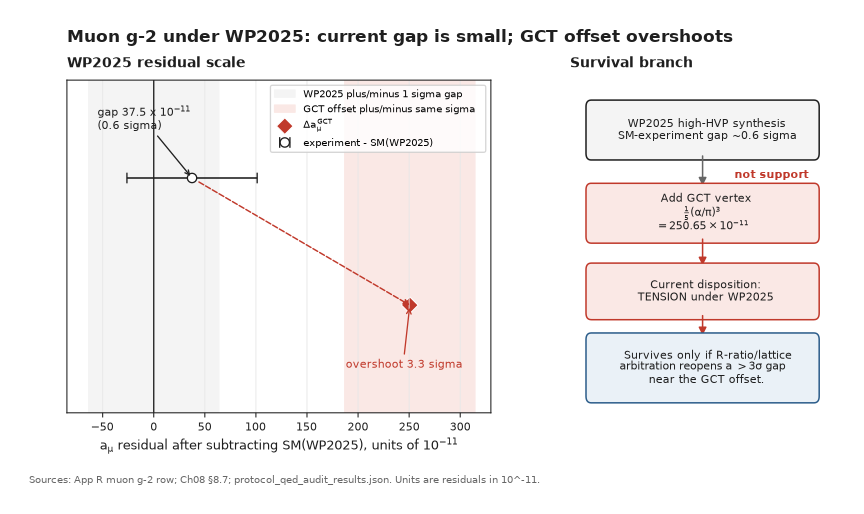
HVP baseline: WP2025 (Aliberti et al. 2025, arXiv:2505.21476) is treated here as the consolidated SM theory/HVP benchmark , dominated by the high-HVP lattice synthesis (BMW, RBC/UKQCD, Mainz, and related inputs) with reduced dispersive-R-ratio weight relative to 2020-era WP. Fermilab E989/BNL supply the external experimental comparison, not an input to the SM benchmark. Engine: protocol_qed_audit.py and verify_independent/verify_g2_muon.py both consume WP2025 values.
[!CAUTION] HVP baseline and channel-disposition status. The GCT muon closure is scored against the consolidated SM White Paper baseline (Aliberti et al. arXiv:2505.21476): , combined against the Fermilab E989 final (2025) experimental value (127 ppb FNAL-combined precision; Aguillard et al. 2025, arXiv:2506.03069). The corresponding FNAL + BNL E821 combined world-average is (124 ppb world-average precision; Aguillard et al. 2025 arXiv:2506.03069 abstract, world-average summary). Comparing the WP2025 SM theory/HVP benchmark with the FNAL-combined and world-average experimental numbers gives the same 0.6σ consolidated residual: .
Under this consolidated baseline, the GCT contribution is adverse evidence: it overshoots the SM+experiment closure by ~3.3σ when added to the WP2025 SM benchmark. The disposition is Tier 3 fitted/equal-weight vertex coefficient + A3 precision input on top of a geometric mechanism class; Tension under WP2025; no robust confirmation. The CMD-3 R-ratio measurement context and lattice-HVP synthesis have reduced the world-average experiment–theory tension, so the row remains a numerological channel in tension unless a future HVP arbitration independently reopens a >3σ gap near the GCT offset.
Binary gate: future CMD-3 + KLOE + BaBar R-ratio reconciliation and refined lattice-QCD HVP (BMW + RBC + ETMC) that opens a >3σ experiment–theory gap near the GCT offset restores the GCT correction to decisive-test status; continued ≤1σ consolidation leaves the closure as a WP2025 tension that does not decisively distinguish GCT from a higher-loop SM calculation.
Status: Tier 3 harmonic-ladder ansatz + Tier 3 law-level residuals. The lepton harmonic ladder (resonant overtones of the 6D hardware at ) is a Tier 3 harmonic-ladder ansatz (Tier 1 -power arithmetic; Tier 3 -step and posit); the absolute precision figures are law-level residuals against pole-mass targets: the electron sits at 1006 ppm against CODATA 2022 (conditional on Open Problem O.14 closure of the K-theoretic gap-label link), the muon at ~21 ppm and tau at ~51 ppm (both against CODATA 2022 / PDG 2024 anchors; Tier 3 formula residuals, not theory-limited agreements — see the Note on Precision and §PSC.2.1). These figures are descriptive arithmetic (Tier 4 as evidence: not distinguishable from numerology for strong effects; App PSC §PSC.9.6).
PSC.2 Fundamental Coupling Constants
These constants define candidate interaction impedances of the force sectors. Residuals here are closure gaps; a radiative-flow direction counts only as an inserted-template compatibility diagnostic until the physical bundle, interaction, sign, and magnitude are derived from the microscopic action. Gauge running uses the imported Standard-Model -functions; the native flow is an abandoned Tier 3 activation ansatz (App GRF §GRF.7), and for and neither run closes the gap.
| Constant | GCT Geometric Formula | Bare Value | Observed ( / low-E) | Residual (Gap) | Type | Provenance | Tier |
|---|---|---|---|---|---|---|---|
| 137.5078 | 137.0359 | 3443 ppm bare; precise closure conditional on O.19/O.5 — the geometric tree-level relation is a Tier 3 numerical relation (Tier 3 600-cell multiplier; mechanism open — no RT solid-angle construction is claimed, V1 §13.2.1–§13.2.2); the +3443 ppm residual relative to CODATA is a Tier 3 numerical gap and a load-bearing closure target. The current phason anti-screening calculation shows only template-direction compatibility after a Berry/Peierls loop template is inserted: periodic locking or a finite point-group quotient does not derive the physical bundle, curvature, loop sign, or magnitude, and the Galois map fixes no physical sign. Those remain open under O.19/O.5. A3 measured is used separately in corrected precision rows and is not evidence that the bare alpha derivation is closed. | Tier 3 numerical relation (mechanism open) + Tier 3 600-cell multiplier + Tier 3 inserted-template residual diagnostic pending QLQCD-1L/O.19 closure — the QED precision target for is sub-ppm; the GCT 3443 ppm bare gap is therefore not a sub-ppm-class "Postdiction" against QED; it is a tree-level identity whose residual closure is conditional on the QLQCD-1L bare-to-physical bridge, which is not yet action-derived | script: protocol_alpha_derivation.py | 3 relation + 3 multiplier/residual; Tier 4 as evidence (φ-formula match; App PSC §PSC.9.6) | ||
| Muon | under the consolidated high-HVP lattice-dominant WP2025 SM theory benchmark compared with Fermilab/BNL experiment, the experiment-theory gap is — no significant residual anomaly; the GCT correction sits above the consolidated closure; the CMD-3 R-ratio measurement context is part of the reduced-tension HVP arbitration, not a GCT confirmation | Tension under WP2025; adverse evidence under the current world-average synthesis | Tier 3 fitted/equal-weight vertex coefficient + A3 precision input on top of a geometric mechanism class; not robust confirmation; reinstatable only if R-ratio + lattice-HVP reconciliation opens a experiment–theory gap near the GCT offset (HVP arbitration condition, App PRG Table PRG.1 row P.5) | protocol_qed_audit.py | 3 coefficient + A3; mechanism class not empirically confirmed | ||
| Electron | at this loop order (Tier 3/4 activation-threshold hypothesis, V3 Ch08 §8.7.4: , so electron at does not activate the cage-depinning loop that gives the muon's vertex correction at ; the threshold exponent remains Tier 3) | (Fan et al. 2023) minus the SM value: with Cs-α (Parker 2018) (3.9σ); with Rb-α (Morel 2020) (2.2σ). The Cs and Rb α determinations disagree with each other by 5.5σ. | PENDING-α-RESOLUTION (the null is in tension with both α inputs, by 3.9σ and 2.2σ; no branch passes) | Tier 3/4 activation-threshold hypothesis (not derived; virtual loops have no rest-mass threshold) + Tier 3 threshold exponent ; α-input contingent | verify_independent/verify_g2_electron.py | 3–4 threshold hypothesis + 3 threshold exponent | |
| raw Galois-frame ratio (coordinate identity) | ; normalized share | 0.38197 (normalized share 0.27639) | — (no physical scale) | 0% (Tier 1 exact arithmetic) | Tier 1 coordinate-frame identity; not a physical boundary (canonical projector shares ) | protocol_electroweak.py::verify_gram_projection | 1 |
| (bare) | 0.23607 | 0.23122 (Z-pole; PDG 2026, ) | 2.1% (cross-scale numerical alignment, not RGE support) | Tier 3 gauge-kinetic hypothesis (H-EW); the raw-frame volume identity of App USS §USS.9 is coordinate arithmetic; Z-pole Tier 3 observational input *** | script: protocol_electroweak.py, protocol_weinberg_uniqueness.py | 3 (H-EW as a hypothesis); Tier 4 as evidence (φ-formula match; App PSC §PSC.9.6) | |
| (Z-pole) | H-EW boundary run to : physical-hypercharge one-loop comparator (full-SM , ) and the abandoned native kernel (App GRF §GRF.7) | 0.136725 (comparator) / 0.16957 (native, abandoned branch) | 0.23122 ± 0.00006 (PDG 2026, ) | −40.87% / −26.66% (no current route closes; V3 Ch04 §4.3.3). The pre-registered gauge-running audit (App GRF §GRF.4.3) is a FAILED check: no declared-input configuration reproduces , or (one borderline two-loop value, which imports the measured , is excluded by a post hoc judgement; App GRF §GRF.4.3). Top-down from A2, H-EW, and GeV with SM -functions gives – (best case 0.0673, −52σ; native kernel 0.16957, −62σ), and reaches zero at 2–6×10⁶ GeV, so is undefined; A2 and H-EW cannot both hold for any SM extension (App GRF §GRF.4.3) | Tier 3 negative consistency result (conditioned on measured couplings, or on the A2 endpoint (an unassigned Ledger ID) for the abandoned native kernel; the target-normalized integrator is an implementation check only) | scripts: protocol_electroweak.py, protocol_rge_native.py; App GRF | 3 |
| (bare) | 26.18 | (PDG 2026 ) | +208.9% inverse-space residual, defined as ; equivalently, in direct-coupling space, is 67.63% above when normalized to . This compares an ultraviolet handle with an value and so mixes scales; the native run from the handle gives , 55.9% low (V3 Ch04 §4.5.5). The RT three-fold-axis count and icosahedral inflation supply a documented strong-sector handle, not a physical precision postdiction; the integer 10 and factor do not close the product rule or native running without O.42 / QLQCD-2 | Tier 3 calibrated handle (10 integer + geometric factor) + Tier 3 running residual pending O.42 / QLQCD-2 | verify_independent/verify_alpha_s_bare.py; protocol_rge_native.py | 3 handle + 3 residual; Tier 4 as evidence (φ-formula match; App PSC §PSC.9.6) | |
| Bare [Tier 3 identification] + transfer correction [Tier 3 pending O.5] | 13.1473° | 13.0035° | 1.11% (angle residual against the PDG mixing anchor , for which . The residual is in §PSC.4; the angle and sine relative residuals differ by the parametrization factor at , so they describe the same comparison in different variables. Corrected value is Tier 3 bare identification + Tier 3 transfer; bare residual ; the load-bearing falsification statistic is the comparison, a 3.6σ CKM tension in §PSC.4) | Contingent Postdiction / Tension | [Model/Geometric] | 3 bare identification + 3 transfer; Tier 4 as evidence (φ-formula match; App PSC §PSC.9.6) | |
| CKM Jarlskog |J| | No current Tier 2 prediction; the value $ | J | \phi^{-22}$ candidate formula is documented in App ORQ but is not load-bearing for this scorecard. | — (no current Tier 2 prediction) | 3.12 × 10⁻⁵ (PDG 2024) | n/a | OPEN RESEARCH (O.7) |
| Strong CP / | Candidate only: an icosahedral chirality-preserving cycle-closure argument for (Tier 3 sketch; not derived) | none — is not a GCT prediction | (2020) → | OPEN-CONDITIONAL: the Strong CP problem is open in GCT (V3 Ch18 §18.5); the present action derives no symmetry or dynamics that suppresses , and respecting the bound is not a PASS | Open problem (candidate mechanism Tier 3) | verify_independent/verify_strong_cp.py | 3 |
| (CODATA 2022) | 0.23% (2273.725 ppm; display 2274 ppm) | Arithmetic only, not a claimed postdiction (App ULA §ULA.8 Step 2 is not made, status: WITHDRAWN) — model-authoritative GCT-bare- branch with CODATA and exact SI ; the all-CODATA- sensitivity branch is 2013.345 ppm. Derived from P.1c (; the 2013.345 ppm branch is the 1006 ppm electron residual doubled), so it is not independent and inherits P.1c's FAIL (App FSM P.16). Tier 3 numerical residual pending O.14 physical-link refinement. This is the Jacobson route only: the elasticity formula of Routes 2/3 is not used and does not enter (App DPS §DPS.7; O.22). The one-nat horizon entropy density of the chain is an assignment: a pre-registered harmonic ground-state computation gives , below the registered lower band 0.5, so the figure is not supported by the declared action and the step is not made (§PSC.9.7; App ULA §ULA.8) | script: protocol_absolute_scale.py (canonical source); independently re-derived in verify_independent/verify_newton_g.py | 2 mechanism + 4 Planck-link + 3 residual/A1; Tier 4 as evidence (φ-formula match; App PSC §PSC.9.6) | |||
| Higgs VEV () | 246.1755 GeV (engine full precision per protocol_higgs_vev_results.json::v_derived_GeV) | 246.21965 GeV (PDG-2024 Fermi-constant anchor) | 179 ppm (full-precision residual 179.15 ppm). OPEN-CONDITIONAL: the Tier 1 product arithmetic inherits the Tier 3 O.38 posit, CODATA-2022 A3 measured , and a Tier 3 calibrated-handle residual. O.20 enumerates factorisations but does not select the physical branch. The spectral-action cutoff belongs to the independent Higgs-mass route. | Conditional postdiction / anchor-normalized comparison | script: protocol_higgs_vev.py (canonical); verify_independent/verify_higgs_vev.py | OPEN-CONDITIONAL: Tier 1 product arithmetic conditional on Tier 3 O.38 + A3 + Tier 3 VEV-handle residual; Tier 4 as evidence (φ-formula match; App PSC §PSC.9.6) | |
| Higgs mass (, bare) | with (Tier 3 bare packing ansatz, V3 Ch05 §5.2.3) | 123.09 GeV (with GeV, the convention of the top-quark row; with the measured GeV it would be 123.11 GeV) | 125.20 ± 0.11 GeV (PDG 2024) | −1.69% (−2.11 GeV; 19σ against the PDG uncertainty) — the bare GCT tree-level value lies below the PDG mass. Standard SM 1-loop radiative corrections to the Higgs pole mass (top-loop quadratic-divergence cancellation under renormalization, to pole conversion at order , , contributions; cf. Buttazzo et al. 2013 JHEP 12:089) generate shifts whose sign depends on the renormalization scheme and is not a free observation from this row — the GCT 1-loop closure that would derive the specific sign and magnitude from the AKN lattice bundles with QLQCD-1L (App ORQ O.5, App TPR §TP-E). See Higgs-sector handle-accounting callout below. | Postdiction (radiative-correction-contingent) — Tier 3 bare packing ansatz ( on an added broken-vacuum completion; V3 Ch05 §5.2.3) + Tier 3 numerical residual (−1.69% bare gap; precise closure conditional on O.5) | verify_independent/verify_higgs_mass.py | 3 bare ansatz / 3 specific value |
[!IMPORTANT] Higgs sector handle accounting [OPEN-CONDITIONAL]: the VEV evaluation depends on the muon-mass formula, the harmonic anchor, CODATA-2022 A3, and the exact product . That product inherits the Tier 3 O.38 posit; O.20 is an enumeration result and does not select the branch. The 179 ppm figure against the sole declared observational anchor GeV is therefore a conditional comparison, not a Tier 2 absolute-scale closure. The Tier 3 bare packing ansatz (no geometric quantity currently fixes it) and the spectral-action cutoff belong to the separate Higgs-mass route.
**** Weinberg boundary: is the exact raw Galois-frame ratio (coordinate-dependent; normalized share ), the canonical projectors give shares , and is the Tier 3 gauge-kinetic hypothesis H-EW (V3 Ch04 §4.3). None of these values is a derived physical Weinberg angle.*
Status: Tier 3 numerical relation for the fine-structure route (mechanism open; no RT solid-angle construction is claimed, V1 §13.2.1–§13.2.2); Tier 3 handles (H-EW, ) and Tier 3 law-level residuals. The icosahedral projection fixes the complementary subspaces but does not by itself assign electroweak coupling strengths. It supplies candidate gauge-coupling handles from the unit cell axes (raw-frame projection ratios are Tier 1 coordinate arithmetic, not physical sector weights; the bare Weinberg angle is the Tier 3 hypothesis H-EW and is a Tier 3 calibrated handle); the specific numerical residuals against current empirical anchors are Tier 3 law-level closure targets. Notably: sits at 3443 ppm bare residual (closure conditional on QLQCD-1L per O.5); has the largest gauge-coupling gap, with the registered bare handle versus the PDG-2026 value , a +208.9% inverse-space residual under the observed-value denominator convention (the separately labelled direct-space comparison is 67.63%; both compare a GUT-scale handle with an value, while the native run gives 55.9% low; pending O.42 / QLQCD-2); the Higgs bare mass lies −1.69% (with ) below the observed mass (closure conditional on O.5 1-loop); muon g-2 carries a "Tension under WP2025; falsification conditional on long-term HVP-synthesis arbitration" disposition under the WP2025 lattice HVP synthesis; PMNS lies inside the NuFIT 6.0 3σ ranges with and without Super-Kamiokande atmospheric data, with the octant unresolved (see §PSC.4). The fine-structure relation keeps its stated Tier 3 row tier; the headline status records that several law-level numerical residuals depend on Open Problem O.5 closure, and no residual in this table counts as evidence for an anti-screening sign. Where a φ-formula in this table matches its target, the match is descriptive arithmetic (Tier 4 as evidence: not distinguishable from numerology for strong effects; App PSC §PSC.9.6), and the pre-registered gauge-running check from the H-EW boundary is FAILED (App GRF §GRF.4.3).
PSC.2.1 Loop-Order Discipline — Radiative-Correction Provenance
The GCT formulas in §PSC.1–PSC.2 (lepton masses, , Cabibbo angle, etc.; tiers as stated per row) are labeled by the order in actually present in the displayed expression (the muon second-order term is a Tier 3 fit handle, not a derived loop correction). The ppm-level residuals quoted for the muon and tau are scored against measured CODATA / PDG masses ( to 22 ppb, to 51 ppm). A measured mass is not a theory quantity: the statement that these targets "already include" SM corrections of ~10–40 ppm, so that a GCT theory floor of that size absorbs the residuals, is not made. No GCT higher-loop calculation exists, so no theory error is assigned. Lepton precision rows are a Tier 3 harmonic-ladder ansatz (Tier 1 -power arithmetic) + Tier 3 formula residual.
| Row | Bare GCT residual | GCT + displayed correction residual | Measured target and residual status |
|---|---|---|---|
| Muon | for | after ; ppm after the Tier 3-selected correction ansatz | Scored against the CODATA 2022 mass (22 ppb); the term is a Tier 3 muon-only fit handle conditional on H-EW, not a derived one-loop heat-kernel term (the same construction applied to the tau would add to the bare value, residual , MeV, ; the tau row is truncated at first order by choice, V3 Ch08 §8.2.3); the 21 ppm residual is ≈ in measurement terms and is a Tier 3 formula residual pending QLQCD-1L (App ORQ O.5); the unpropagated next-order term ppm is the same size, so the row does not test the second-order term |
| Tau | for | ppm against PDG 2024 after the single correction | Scored against the PDG 2024 mass (1776.93 ± 0.09 MeV; the residual is ≈1.0σ in measurement terms); the coefficient carries Tier 2 mechanism + Tier 2 integer + irrep count (Tier 3 as a channel number) + Tier 3 combination rule pending O.26b |
| Electron anchor | is the dimensional anchor | The Planck-link residual is ppm | Physical-link closure depends on App ORQ O.14 / O.5; it is not a lepton-pair prediction residual |
Implication for Tier 2 status: the ppm figures state how far the GCT geometric form plus displayed correction lies from the measured mass. They carry no theory-error model, so they are residuals, not agreements within a theory error. QLQCD-1L closure (App ORQ O.5) is the path that would supply a GCT-internal loop derivation and an error estimate.
PSC.2.2 Hypercharge Assignment and Anomaly Cancellation
The L/R-asymmetric Standard Model hypercharges follow from the assignment of right-handed states as singlets of the candidate internal weak bundle, the Tier 3 chiral-representation assignment of V3 Ch02 §2.4.3 (V3 Ch04 §4.2.3, Theorem 4.2): for such singlets () the Gell-Mann–Nishijima relation reduces to . The full one-generation hypercharge assignment in the convention is therefore:
| Multiplet | |||
|---|---|---|---|
| (LH quark doublet, color triplet) | |||
| (RH up, color triplet) | |||
| (RH down, color triplet) | |||
| (LH lepton doublet) | |||
| (RH electron) |
The four Standard Model gauge-anomaly cancellation conditions on this one-generation assignment evaluate to zero algebraically:
The colour multiplicity 3 enters quark contributions; the doublet multiplicity 2 enters the gravitational and traces via LH-doublet components. Coefficient signs (+ for LH, − for RH via chirality flip) reflect the anomaly-trace convention. Engine verification computes all four traces and the right-handed-singlet identity in a single L_∞ residual: GCT_Physics_Engine/verify_independent/verify_hypercharges.py reports machine-precision PASS (max residual from float roundoff).
Tier discipline (two distinct claims must be separated). The vanishing of the four anomaly traces given the standard one-generation L/R-asymmetric hypercharge assignment is a textbook SM identity (Bilal 2008 arXiv:0802.0634 §7.3 for the gauge anomalies and §11.3 for the mixed gravitational anomaly; standard QFT references); calling that arithmetic Tier 2 GCT-specific would be inflation. Two distinct claims live in this subsection:
-
The four-trace cancellation given the standard hypercharge assignment is Tier 1 textbook algebraic identity — it does not depend on GCT-specific content. We list it here for completeness, to demonstrate that the verifier
verify_independent/verify_hypercharges.pyreproduces the textbook result to machine precision (max residual ), not to claim GCT-specific credit for it. -
The L/R-asymmetric hypercharge assignment itself is the Tier 2 GCT assignment mechanism of V3 Ch04 Theorem 4.2, whose physical realization (right-handed states as singlets of the candidate internal weak bundle) is the Tier 3 chiral-representation assignment of V3 Ch02 §2.4.3. Given that assignment, is the Tier 1 identity at , which holds for any singlet. The load-bearing GCT content of this section is that Tier 3 singlet assignment; the subsequent anomaly arithmetic is included for completeness against the standard SM consistency check.
PSC.3 Hadron Sector
The Proton mass is modelled as the global energy minimum of the icosahedral projection, obtained from the winding sum of the Baryonic Triad (Tier 2 mechanism + Tier 3 sheet/exponent handle pending AKN-action closure).
Proton mass — three values guide:
- Formula prediction (the GCT value): MeV. This is the tree-level output of the baryonic-triad mechanism evaluated against the CODATA . The residual against the CODATA is ppm. Disposition: Tier 2 mechanism + Tier 3 sheet/exponent handle pending AKN-action closure, not hadron-mass closure from the current postulate set.
- CODATA observation: MeV. The empirical anchor against which the prediction is scored.
- Ratio formula: vs CODATA observed . Same residual, expressed as a dimensionless ratio.
The residual is the current tree-level precision of the -power formula under the layered Tier 2 mechanism + Tier 3 sheet/exponent disposition; closure to higher precision and promotion of the sheet-doubling handle are QLQCD-1L / AKN-action targets (App QLA). Ppm-level display is not used as evidential precision for this offset-fitted handle. As evidence that φ or icosahedral structure is special, this match is Tier 4 (constant control test v3, NEGATIVE-FRAGILE; App PSC §PSC.9.6); the number is kept as descriptive arithmetic.
Quark masses are renormalized QCD parameters, not invariant rest masses. The comparison convention is therefore explicit in the table: use at 2 GeV; use at ; is compared with the PDG 2024 direct-measurement mass (not a pole mass), with the mass-scheme question retained as a Tier 3 residual. Besides their row bands, the quark rows are scored by one common rule: the prediction is compared with the PDG 2024 value and its quoted uncertainty, and a miss of more than 5σ is a FAIL. Only the top (5.18σ) and bottom (6.9σ) rows fail it.
| Particle | GCT Geometric Formula | Derived Value | Empirical Convention | Scale | Observed (CODATA/PDG) | Precision (Residual) | Type | Provenance | Tier |
|---|---|---|---|---|---|---|---|---|---|
| Proton () | 938.417 MeV | Bound-state rest mass | CODATA 2022 | 938.272 MeV | ~0.015% (+155 ppm, inside the 500 ppm postdiction band) | Postdiction | (CODATA) ; Tier 3 sheet/exponent handle pending AKN-action closure; ppm display suppressed for this offset-fitted handle | 2 mechanism + 3 handle; Tier 4 as evidence (φ-formula match; App PSC §PSC.9.6) | |
| Top Quark () | with (Tier 3 input, Ledger H5) * | 174.072 GeV | Direct-measurement mass | PDG 2024 direct measurements (not a pole mass) | 172.57 ± 0.29 GeV | +0.871% (law-level mass-scheme residual; 5.18σ, a FAIL of the written P.24 ±5σ rule, by the same standard as the electron row; against PDG's pole mass from cross sections, 172.4 ± 0.7 GeV, it is ≈2.4σ, and the mass-scheme question is open — the registered comparator is not swapped after the result) | Postdiction / FAIL of the written rule | scripts: protocol_higgs_vev.py, protocol_quark_mismatch.py | Tier 3 input + Tier 3 law-level mass-scheme residual |
| Bottom Quark () | 4134.69 MeV | running mass | 4183 ± 7 MeV (PDG 2024) | −1.15%; 6.9σ low (more if PDG's ±7 MeV is read as the 90% CL interval it is labelled as). By the rule applied to the top quark this is a FAIL. A window "4130–4230 MeV" centred on the measurement, not on the prediction, cannot test the prediction; it is not used as a test. The residual stays a Tier 3 law-level residual pending O.5, and the mass-scheme question is open | Postdiction / FAIL | script: protocol_quark_mismatch.py | 3 absolute state-value; Tier 4 as evidence (φ-formula match; App PSC §PSC.9.6) | ||
| Charm Quark () | (Mixed-Harmonic Area Law heuristic at ; K-theoretic gap-label derivation pending O.5) | 1263.45 MeV | running mass | 1273.0 ± 4.6 MeV (PDG 2024) | −0.75% (2.1σ low) | Postdiction | script: protocol_quark_mismatch.py | 3; Tier 4 as evidence (φ-formula match; App PSC §PSC.9.6) | |
| Strange Quark () | 92.79 MeV | running mass | 2 GeV | 93.5 MeV (PDG 2024) | 0.76% | Postdiction | script: protocol_quark_mismatch.py ( drag coefficient is Tier 3 under the Ledger) | 3; Tier 4 as evidence (φ-formula match; App PSC §PSC.9.6) | |
| Down Quark () | as the FK-determinant infinite-volume-limit closed form; rigorous convergence proof conditional on O.5 | 4.716 MeV | running mass | 2 GeV | 4.70 ± 0.07 MeV (PDG) | 0.33% — POSTDICTION-CONSISTENT conditional, inside the 11% shell-resonance gate. Tier 2 FK-determinant computation + Tier 3 identification of the shell median (infinite-volume limit open, O.5); closed-cage deep-tail mean (sample std ), with sequence-mean signed error vs PDG . Single-cage values oscillate inside the 11% band with empirical decaying envelope, so the match is a central tendency rather than a single clean value. | Postdiction | script: protocol_quark_mismatch.py + protocol_md_fk_ih_closed_cages.py | 2 mechanism + 3 conditional; Tier 4 as evidence (φ-formula match; App PSC §PSC.9.6) |
| Up Quark () | 2.16 MeV | running mass | 2 GeV | 2.16 MeV | 0.21% | Postdiction | script: protocol_quark_mismatch.py | Tier 2 geometric motif + Tier 3 QCD scheme/running bridge; Tier 4 as evidence (φ-formula match; App PSC §PSC.9.6) |
* Calculated using the absolute GCT Higgs-VEV pipeline value GeV from protocol_higgs_vev.py; the measured electroweak VEV is not used as an input to this row.
The ratio is exact representation theory, but its use as the bottom-quark mass coefficient is a Tier 3 handle (V3 Ch10 §10.4; Parameter Ledger §2; App ORQ O.43), and the absolute bottom-quark prediction imports the Tier 3 input and is therefore Tier 3 as a law-level residual conditional on O.5; the row fails the ±5σ rule (App FSM P.23).
The exponents (), (), and (CKM , ) match observed values through irrational offsets (integer , or ) found by postdictive search; no trial factor is applied for that family of offsets, so these rows are postdiction-search results and are not counted as evidence. Each exponent, step and FK input of these rows is a declared Tier 3 Ledger input (Parameter Ledger §0.2, rows H1, H2a, H2b, H6–H9).
Status: Tier 3 inputs and identifications in every row, on Tier 1 arithmetic and one Tier 2 computation, + Tier 3 law-level residuals. Every exponent, step and FK input of the hadron rows is a declared Tier 3 Ledger input (Parameter Ledger §0.2). Only the down-quark row uses the Fuglede–Kadison pseudo-determinant of the cage adjacency (row H9): the determinant is a Tier 2 computation on the declared adjacency (finite-cage values; infinite-volume convergence open under O.5), and its use as and the identification of its shell median with are Tier 3. The charm, strange and bottom rows are -power or step handles found by postdictive search (Tier 3); the proton row has a Tier 2 baryonic-triad mechanism with a Tier 3 sheet/exponent handle, which fixes its numerical value; and the top row takes . The chain starts at , i.e. at the A1 anchor ; the – link is a Tier 4 conjecture that fails its pre-registered 1000 ppm rule (App FSM P.1c). The down-quark row uses the primary infinite-volume-limit closed form and is POSTDICTION-CONSISTENT at inside the registered shell-resonance band, conditional on O.5 for rigorous convergence and algebraic-field identification. Two quark rows fail the ±5σ rule: top (5.18σ) and bottom (6.9σ). The φ-formula quark matches (, , , , ) are descriptive arithmetic (Tier 4 as evidence: not distinguishable from numerology for strong effects; App PSC §PSC.9.6); the top row contains no φ and is not relabelled.
PSC.4 Mixing Geometry Matrices
[Tier 3 candidate identification]: CKM and PMNS matrices are CANDIDATELY identified with the topological tunneling and axis sliding operations; closure pending O.5/O.7.
| Observable | GCT Geometric Formula | GCT Prediction | Observed (PDG) | Precision (Residual) | Type | Tier |
|---|---|---|---|---|---|---|
| Cabibbo Angle () | Bare [Tier 3 identification] + transfer correction [Tier 3 pending O.5] | 0.2275 | 1.09% (bare residual ; corrected is a 3.6σ tension under the registered comparison) | Contingent Postdiction / Tension | 3 bare identification + 3 transfer; Tier 4 as evidence (φ-formula match; App PSC §PSC.9.6) | |
| CKM | 0.0414 | −1.05% (0.6σ; −0.98% vs the rounded engine comparator 0.0418 used in App FSM/GPE) | Ansatz | 3; Tier 4 as evidence (φ-formula match; App PSC §PSC.9.6) | ||
| CKM | 0.003732 | 0.0076% (Tier 3 offset-fit ansatz; ppm display suppressed) | Ansatz | 3; Tier 4 as evidence (φ-formula match; App PSC §PSC.9.6) | ||
| PMNS | 33.40° | ° (NuFIT 6.0) | −0.85% (0.4σ) | Postdiction | 3; Tier 4 as evidence (φ-formula match; App PSC §PSC.9.6) | |
| PMNS | 45.00° | NuFIT 6.0, normal ordering: ° with SK atmospheric data (3σ range 41.3°–49.9°); ° without (3σ range 41.0°–50.5°) | inside both 3σ ranges: with SK and without (≈1.4σ and ≈2.0σ); octant unresolved † | Prediction (open) | 3 | |
| PMNS | 8.39° | ° (NuFIT 6.0 with SK; ° without) | −2.0% (1.6σ) / −1.5% (1.2σ) | Postdiction (θ₁₃ was measured in 2012) | 3; Tier 4 as evidence (φ-formula match; App PSC §PSC.9.6) | |
| CP Phase () | 222.49° | NuFIT 6.0, normal ordering: ° with SK; ° without (non-Gaussian) | +0.4σ with SK; +2.4σ without — the tension depends on the data set | OPEN_CONDITIONAL | 3; Tier 4 as evidence (φ-formula match; App PSC §PSC.9.6) | |
| CKM 3×3 Unitarity Diagnostic ‡ | Diagnostic exact by construction; max residual | Unitary (PDG 2024 fit) | Tier 1 algebraic bookkeeping for a matrix built in the standard unitary parameterization; physical CKM content sits in the mixing-angle comparison rows, with residuals pending O.7/O.5 rather than a unitarity defect | Diagnostic | 1 algebraic | |
| PMNS 3×3 Unitarity Diagnostic ‡ | Diagnostic exact by construction; max residual | Unitary by construction in the standard 3×3 PMNS parameterization (PDG 2024; NuFit-6.0, Esteban-Gonzalez-Garcia-Maltoni-Martinez-Soler-Pinheiro-Schwetz 2024, arXiv:2410.05380) | No independent unitarity test; the θ₂₃ comparison belongs to the angle row above | Diagnostic | 1 algebraic / 3 angle ansatz |
† PMNS disposition status — octant unresolved. The bare GCT prediction is , the maximal-mixing boundary between the two octants. NuFIT 6.0 (Esteban, Gonzalez-Garcia, Maltoni, Martinez-Soler, Pinheiro & Schwetz 2024, arXiv:2410.05380; JHEP 12 (2024) 216), normal ordering, places inside the 3σ range both with Super-Kamiokande atmospheric data (best fit , 3σ range –) and without it (best fit , 3σ range –). From the published one-dimensional projections, with SK and without, i.e. about 1.4σ and 2.0σ. is not in tension, and the octant is unresolved. The MSW matter effect for NOvA (L = 810 km) shifts by only and plays no role. DUNE / Hyper-K octant data remain the decisive test: a exclusion of without a closing GCT-side derivation of the deviation would falsify the bare prediction. The prediction is held at Tier 3; the residual is bundled with the QLQCD-1L research debt (App ORQ §ORQ.5 Open Problem O.5).
‡ 3×3 Unitarity check: The individual mixing-angle predictions above are not independent — they are constrained by the full unitarity of the CKM and PMNS matrices (, nine real constraints from three row-norms, three column-norms, and three off-diagonal sum rules). The CKM and PMNS diagnostic rows check the constructed matrices after applying the standard unitary parameterization: unitarity is exact by construction to machine precision. The real CKM support/constraint sits in the mixing-angle comparison rows, where the mismatches against PDG global-fit central values remain pending O.7; they are not a unitarity defect. The PMNS angle comparisons sit in the angle rows above; a determinant or row-norm check of a standard 3×3 parameterization cannot independently validate or falsify that angle. Verifier: verify_independent/verify_mixing_unitarity.py and verify_independent/verify_pmns.py.
Status: Tier 3 bare identification + Tier 3 transfer-correction residual; PDG miss for the corrected Cabibbo formula is 3.6σ (residual 0.00245 / PDG uncertainty 0.00068); for the bare formula the miss is 16.3σ (residual 0.01106 / 0.00068). CKM precision closure pending. PMNS lies inside the NuFIT 6.0 3σ ranges with and without SK atmospheric data ( and ); the octant is unresolved pending DUNE / Hyper-K (§PSC.4 footnote †). CKM 3×3 unitarity is exact by construction under the standard unitary parameterization; the precision issue is the mixing-angle comparison rows, not a unitarity defect.
PSC.5 Neutrino Sector
The Neutrino sector provides the "Risky Predictions" required to distinguish GCT from standard particle physics.
[!WARNING] Neutrino Mass Tension: The Planck 2018 + DESI BAO 2024 combined constraint yields < 0.072 eV (95% CL), and DESI DR2 tightens the ΛCDM-context bound to < 0.064 eV. These bounds put the GCT prediction of 0.085 eV in active tension, not in a falsified state. The registered lower exclusion boundary is < 0.075 eV at definitive precision (above the normal-hierarchy oscillation floor near 0.059 eV) or > 0.15 eV. The DR2 95% bound (0.064 eV) already lies below that 0.075 eV gate; it is reported as a tension rather than a gate crossing because definitive precision needs two qualifying ΛCDM analyses with independent large-scale-structure data (App NSM §NSM.1), and DESI DR2 + CMB is the only such leg so far. The 0.072/0.064 eV ΛCDM bounds are compared under a likelihood that reports the independent P.4 neutrino and P.6 dark-energy templates together because the posterior is cosmology-dependent; the conditional template is expected to leave the bound near 0.064 eV. This is an active falsification risk in the GCT framework.
| Observable | GCT Geometric Formula | GCT Prediction | Observed / Bound | Status | Type | Tier |
|---|---|---|---|---|---|---|
| Floor | 0.0153 eV | < 0.45 eV (KATRIN 2025, 90% CL) | Conditional value currently allowed; cosmological sum in tension below | Tier 3 conditional hypothesis (inherits the Tier 3 P3b/O.15 stiffness map , squared, plus the electron-mass anchor; only the integer is Tier 2) | 3 | |
| 0.0853 eV ** | < 0.064 eV (Planck + DESI DR2 CDM); < 0.072 eV (Planck + DESI 2024 CDM); historic < 0.12 eV (Planck-only) — see App PRG/FM cosmology rows | Active adverse tension (ΛCDM-context; conditional likelihood pending) | Independent P.4 neutrino template; P.6 cannot activate a causal channel | 3 | ||
| Ordering | Generation-ordering assignment (Tier 3) | Normal Only | Not Yet Proven | Risky | Prediction (Tier 3 conjecture, V3 Ch09) | 3 |
*** CRITICAL NOTE: The 0.0853 eV neutrino floor is in CDM-context tension with current model-dependent cosmological bounds. Reassessment requires a GCT-native likelihood that jointly fits the registered dark-energy fingerprints; invoking alone is insufficient to claim compatibility.*
[!IMPORTANT] Neutrino Floor and Dark-Energy Scope
The eV prediction is in tension with DESI DR2's eV CDM bound. Any relief requires a GCT-NATIVE CMB+BAO+LSS likelihood that is sign-opposite to the DESI-preferred CPL quadrant (DESI: , ; GCT: throughout). Generic dynamical-DE rescue is not available without an explicit GCT-native likelihood; this is registered as Open Problem O.13 closure-path C1. The neutrino bound and the multi-channel EoS are NOT co-immune.
PSC.6 Astrophysics & Cosmology
This sector establishes macroscopic falsification targets tracking vacuum geometry properties and biological thresholds.
| Observable | GCT Geometric Formula | GCT Prediction | Observed / Bound | Status | Type | Tier |
|---|---|---|---|---|---|---|
| PTA Icosahedral Structure () | unique rotational-icosahedral scalar harmonic | first nonconstant scalar at ; orientation | no physical PTA response or normalization has been derived | Physical transfer open | Structural theorem / response program | 1 theorem + 2 conditional symmetry + 3 transfer |
| Dark Energy () | Tier 3 correlation/model coordinate conditional on the shared-phason-field ansatz; no typed, normalized information-to-metric causal map | throughout the modeled low- branch (conditional single-channel biogenic-DE coordinate; is an adopted evaluation redshift, not a transition) | DES-Dovekie recalibrated DESI DR2 + CMB target (arXiv:2511.07517): , joint dynamical-DE significance 3.2σ — sign-opposite to the conditional GCT phantom template | Registered-menu closure-to-DESI claim falsified under its registered >3σ rule (DES-Dovekie 3.2σ; DESI DR2 3.1σ BAO+CMB, 2.8–4.2σ with SNe); branch-level verdict. The single-channel phantom template is a separate stipulated coordinate (phantom direction Tier 4, V2 Ch14 §14.3.1). Multi-channel shape-proxy partition CLOSURE-FAILS in protocol_de_multichannel.py with respect to the registered five-channel menu — best-fit diagonal diagnostic score ≈ 4.861, flat to within 0.0446 diagnostic-score units across the swept range; the score ignores DESI covariance and is not a likelihood distance or physical multi-fluid background model; the convex-combination ceiling is partly tautological under the Tier-3 channel-menu choice , open at the framework level pending closure path C1 thawing-phason slow-roll or a no-go, see Ch14 §14.6.3) | Tier 3 conditional correlation/model coordinate; phantom direction Tier 4 (no ghost-free action; V2 Ch14 §14.3.1); physical shared-field coupling, normalization, and causal map open; registered menu falsified at branch level (see §PSC.8 row 8 + Ch14 §14.6.3 + App ORQ O.13) | 3–4 |
| Dark Energy () bare biogenic-coordinate overshoot [Tier 4 illustrative; §PSC.6.1 callout contains the extraction guard] | evaluated as a conditional model coordinate before any unproved holographic-displacement suppression | see §PSC.6.1 illustrative-only callout | J/m³, a Planck-parameter-derived reference | Tier 4 illustrative pre-suppression magnitude; not a state-level prediction or physical mechanism. No typed, normalized information-to-metric map or derived suppression law is supplied. | Pre-suppression illustrative — see §PSC.6.1 | 4 |
| (V2 Ch14 §14.1.3 condensate form; App ULA §ULA.4.1; Parameter Ledger C7, a declared candidate route that is not evaluated: the curvature, the quartic coupling and are unspecified (App ORQ O.1), so the relation is one equation in two unknowns and fixes neither; the value is the Tier 3 operative quartic scale of Parameter Ledger §4) | eV (Tier 3 operative input, Parameter Ledger §4) | none: no GCT value of follows; the operative J/m³ uses the C4 imports (Planck-parameter reference ) | Not evaluated (App ORQ O.1) | Declared Input | 3 | |
| External biological/phason activation-scale scenario; no action-derived coupling or gap | eV | Registered as the body-temperature thermal-noise scale (Prediction/Postdiction Firewall). The external radical-pair coupling scenario eV cannot be compared with : without a type-correct, action-normalized spin–phason coupling the comparison is dimensionally invalid (Firewall §3 rule 6; V1 Ch17 §17.1.3). No eV-scale freezing energy is registered, and no qualified macro-coherence or Level-II threshold follows | Underdetermined | Scenario provenance only | 1 thermal-scale arithmetic + 3/open scenario identification | |
Protocol D — Anaesthetic Isotope Shift (P.13; mirrors App PRG Table PRG.1 P.13 + engine protocol_isotope_experiment.py) | Spin-Entropy Modulation via bound-water O hyperfine (Ch16 §16.3.2 + App NSP §NSP.4); central branch at pending O.21, with conditional O.21/O.33 sensitivity band at (; ≈ lumen waters per dimer) | Central branch gives no LORR shift. The conditional sensitivity branch supplies an ordinary material-proxy scenario between O-substituted and O-control bound-water populations (lower anesthetic threshold under O substitution; engine convention (C50_H2_17O - C50_H2_16O)/C50_H2_16O = -f_bound); none of these values is a phason, Selection-Operator, or Level-II prediction | Drosophila O LORR assay window after systematics-gate redesign; no current power claim is registered because the §16.3.4 systematic budget rejects the operative gate | No operative falsification gate under the §16.3.4 systematic budget. (57.65× the 0.10% naive gate), and halving S2/S4 reduces by only 1.20×; until a systematics-validated gate is specified, the quantitative gate is deferred. A future controlled result constrains this material scenario only; an inconclusive result preserves no framework-level mechanism. Neither outcome is a verdict on GCT as a whole: the measurement tests an ordinary material proxy, and no phason, Selection-Operator or Level-II inference follows from it (V1 Ch17 §17.1.3). With no operative gate, no null can reject the branch until a systematics-validated gate is registered. | Material-proxy pilot | Tier 3 material hypothesis (Spin-Entropy Modulation via O hyperfine) tested only through an ordinary material proxy pending O.21/O.33 + Tier 4 quantitative gate operationally unfalsifiable under registered systematic budget; no GCT or phenomenal inference |
Operational thresholds for the dark-energy row (P.6). Row P.6 has two separate decision rules. The state-level CPL-fit gate fires on a or stronger preference from current DESI-class analyses; it has fired (DES-Dovekie 3.2σ; DESI DR2 3.1σ BAO+CMB), giving the branch-level failure verdict above. Euclid DR1 and later registry-approved likelihood updates are robustness checks on that verdict, not a precondition for it. The separate IMP-01 pipeline gate (C_IMP01_PIPELINE_GATE) requires DESI DR2 plus Euclid DR1 and has not fired. The "no biogenic-channel fingerprint" clause is not observable at current precision (the registered amplitude is ) and is carried by the separate fingerprint gate below. The biogenic-channel fingerprint gate is the Roman/Stage-V low-redshift test of the Class-2 envelope with the asymptote-from-below sign; excluding that envelope at covariance-aware sub- precision falsifies the registered single-channel fingerprint. The current protocol_de_multichannel.py score is a diagnostic registered-menu closure failure, not a covariance-aware likelihood threshold.
[!NOTE] §PSC.6.1 Illustrative-only callout — bare biogenic-coordinate overshoot. The conditional model expression produces a value approximately times the Planck-parameter-derived reference J/m³ before any proposed holographic-displacement suppression. This figure is Tier 4 illustrative only: it exposes the failure of the unsuppressed coordinate and does not predict a state-level number, establish a physical coupling, or supply an independent observation. The absolute magnitude of is a state-level quantity per §PSC.0. Both a typed, normalized information-to-metric map and a derived suppression law remain absent; no load-bearing causal mechanism is claimed. See §PSC.7 row 3 for the model-coordinate-versus-magnitude scope split.
* The exact scalar theorem does not determine a pulsar-timing amplitude, a separation-only response, a finite angle mask, or a frequency law. A physical test requires a specified action, propagator, polarization/source/pulsar transfer, generalized overlap-reduction functions, and a normalization before an empirical threshold can be registered.
PSC.7 Epistemic Summary
- Sector Closure Status: The bare lepton-mass ratios (the harmonic ladder) use the 5-postulate-plus-1-dimensional-anchor subsystem enumerated in Parameter Ledger §0.1, conditional on the Tier 3 -step and the Tier 3 posit, both listed outside the count; the bare relation additionally uses the Tier 3 360 multiplier, and its mechanism is open (V1 §13.2); the corrected lepton rows additionally need A3 (measured ), the Tier 3 coefficient rules (the normalisation, the selection, whose exponent choice inherits the Tier 3 H-EW boundary, and ). The bare electroweak angle H-EW and the SU(3) factor are open Tier 3 inputs outside the subsystem, and the P3b stiffness map is likewise a registered Tier 3 hypothesis listed outside the count; only the integer is Tier 2. Gauge-coupling running uses the imported Standard-Model -functions, which are standard physics and not counted (the Ledger IDs A2 and A4–A6 are unassigned; App VHX §VHX.6); corrected precision comparisons use A3, measured low-energy . The present gauge + lepton + precision-comparison accounting is 5 postulates + 2 continuous anchors. The named precision/gauge comparison subset contains seven calibrated Tier-3 discrete coefficient handles (, , , , , , ); this is not a manuscript-wide handle total, and O.38 plus other sector-specific handles are separately catalogued. The hadronic, biophysical, and cosmological sectors carry additional calibrated parameters per Parameter Ledger §0.2–0.4. See Parameter Ledger §0.5 for the aggregate accounting and §0.6 for the terminal-target ambition.
- Systemic Reliability: No aggregate precision score is claimed across the mixed Tier 2/Tier 3/Tier 4 rows. The scorecard is row-local: precision statements include or exclude calibrated handles, active tensions, and external anchors only where that row explicitly says so.
- Iron Rule Note: The Electron Mass Planck-link row () carries a Tier 2 framework + Tier 3 integer anchor + Tier 4 physical-link conjecture disposition (see §PSC.1 row 1 + README + V3 Ch07 §7.2.2). The exponent is a canonical exact arithmetic identity of (, unique to among finite irreducible Coxeter groups) identified with the electron-mass scaling under the Tier 4 K-theoretic gap-label-action physical-link conjecture from the -side Coxeter invariant to the 6D trace-image projection pending Open Problem O.14; exact arithmetic on a Tier 4 chain does not promote the chain. The non-reduced Planck-mass convention is a Tier 3 scale assignment, chosen because under it the exponent is an integer (with the reduced the same ratio needs ); the discrete-cage motivation of V3 Ch07 §7.2.2 is a Tier 3 reading, not a derivation. Planck-mass convention choices are made per row (the assignment uses the reduced mass), and each is a separate Tier 3 scale assignment listed outside the count (Parameter Ledger §0.1, P2). The ~1006 ppm precision (engine output against CODATA 2022) is conditional on this Tier 3 anchor (Tier 4 as evidence: not distinguishable from numerology for strong effects; App PSC §PSC.9.6).
- Anomalies Under Disposition Per Row:
- Hierarchy Problem: Candidate account via holographic screening ( force gap; Tier 2 mechanism; Tier 4 Planck normalization, O.14); not a resolution.
- Hadron Mass Gap: Dispositioned via the Baryonic Triad eigenvalue (), with row-specific hadronic residuals and open QLQCD closure paths retained above.
- Vacuum Energy: The Cosmology-of-Zero statement is distinct from the Tier 3 shared-field correlation/model ansatz used for the biogenic coordinate. The absolute magnitude of is a state-level quantity under §PSC.0 and is not a derivation output. The §PSC.6 row reports the unsuppressed coordinate's overshoot as a Tier 4 illustration relative to the Planck-parameter-derived reference J/m³. Neither that comparison nor the proposed holographic restriction establishes a physical information-to-metric coupling, explains why is small or dynamic, or supplies a typed normalization; those bridges remain open. The multi-channel shape-proxy partition closure path to the DES-Dovekie recalibrated DESI CPL fit has been evaluated explicitly in
GCT_Physics_Engine/src/protocol_de_multichannel.pyand CLOSURE-FAILS for the registered five-channel menu across the swept cosmological range — the shape menu is a convex combination of channels all carrying , not a physically evolved multi-fluid background model, so cannot reach the DES-Dovekie (Ch14 §14.6.3, App ORQ O.13 amplitude gap; C1/C2/C3 remain open); the registered-menu closure-to-DESI claim is therefore falsified under its registered >3σ rule (DES-Dovekie 3.2σ; DESI DR2 3.1σ BAO+CMB, 2.8–4.2σ with SNe); this is a branch-level verdict. The single-channel phantom template is a separate stipulated coordinate (phantom direction Tier 4, V2 Ch14 §14.3.1). - Dark Matter: Dispositioned via the 3.55 keV Lattice Fracture signature and Topological Glass, subject to the XRISM and linewidth gates listed in App PRG.
Summary: Selected gauge/lepton quantities reach sub-percent residuals under the disclosed Tier 3 ansätze with Tier 1 arithmetic (the lepton harmonic ladder among them) plus Tier 3 specific anchors of Parameter Ledger §0.1, with the electron exponent additionally inheriting the O.14 Tier 4 physical-link conjecture. These residuals are descriptive arithmetic. As evidence that φ or icosahedral structure is special, the matches are Tier 4: the preregistered constant control test (v3, NEGATIVE-FRAGILE; App PSC §PSC.9.6) found φ's pattern of matches on 21 constants not distinguishable from that of random constants (58 of 300 random bases did at least as well); the test "excludes, at power ≥ 0.8, an effect in which φ hits at least 6 of the 8 informative rows through a real effect; weaker effects are not excluded." No global-significance figure is claimed (§PSC.9); the tier labels and open-problem conditionalities that qualify each row are enumerated in §PSC.0–§PSC.2 and App ORQ.
PSC.8 Falsification Criteria
Each item below names a registered branch that would be falsified if the stated observation is made. The verdict applies to that registered branch, not to GCT as a whole:
- Lepton Hierarchy Violation:
- Pole-mass consistency gate: the displayed corrected muon formula remains inside its registered 100 ppm band (App PRG P.1) under the §PSC.2.1 loop-order discipline.
- Falsification: If precision measurements drive the corrected-formula residual outside the registered 100 ppm band (App PRG P.1). The band is a registered ppm tolerance, not a σ gate, and not a free prediction of .
- Current Status: Muon 21 ppm residual: a Tier 3 formula residual inside its registered 100 ppm band, not a σ-level agreement (it is ≈ against the 22 ppb measurement); tau 50.85 ppm TENSION at the 50 ppm registry gate pending O.5/O.26b closure. See §PSC.2.1 Loop-Order Discipline caveat: the first-order precision is ≈0.24% (bare alone ≈3.75%); the ppm figures are Tier 3 formula residuals against measured masses with no theory-error model (the "SM corrections already incorporated, ~10–40 ppm theory floor" argument is not made; no σ-level agreement is claimed). As evidence that φ is special they are Tier 4 (App PSC §PSC.9.6).
- Dark Matter Line Absence:
- Prediction: Emission line at 3.50-3.60 keV from galaxy clusters
- Falsification: Protocol C terminal no-line falsification is rule (a): a one-sided 95% upper limit (below the Bulbul-level normalization) in a Ms equivalent stacked exposure. At 94 Ms the reference-stack scaling of the XRISM 3.75 Ms limit gives , so the rule applies when (false rejection 0.05; probability 0.91 of applying with no line present) [Tier 3 Gaussian estimate]. The 26 Ms / stack remains the linewidth/flux milestone, not the terminal no-line falsifier and not powered for rule (c). The background-limited calculation at Resolve and residual background corresponds to , but that is a theoretical ceiling, not the operative gate, unless aperture overlap, continuum subtraction, K-XVIII line-model degeneracy, and stack-efficiency losses are controlled. The remaining branches are eV FWHM after instrument/kinematic deconvolution and morphology vs smooth- templates in mass-weighted stress-gated above- cluster regions. The registered keV cm stress gate is suspended pending re-registration, because its Bullet-pressure input is overstated 20–90× (V3 Ch11 §11.1.4), so these cluster branches are not executable, and at the registered value the listed shock and relic cells fall below the cut, so the registered aperture is expected to be empty (V3 Ch15 §15.1.3). See Ch15 §15.2 + App PRG P.3 +
falsifiability_registryP.3 + App FSM P.3 for the full preregistration parity. - Current Status: SENSITIVITY-LIMITED. The current 3.75 Ms stack is too shallow relative to the registered sensitivity floor; the test is not yet decisive. A line with eV (within the XRISM Resolve eV FWHM instrument floor) is spectrally compatible but not discriminated against particle-decay or systematic interpretations (Ch15 §15.2); eV disfavours a cluster-virialised particle-decay line, because retains emitter bulk motion, but does not by itself identify the emitter (Ch15 §15.1.4), while the Milky-Way halo blank-sky null (Dessert, Rodd & Safdi 2020, Science 367:1465) imposes an independent flux/background-modeling constraint. Linewidth alone is not decisive; morphology, flux floor, background model, and K-XVIII subtraction remain load-bearing.
- Neutrino Mass Floor Violation:
- Conditional hypothesis (Tier 3): eV (absolute floor), inheriting the Tier 3 P3b/O.15 stiffness map and the electron-mass anchor; it is not a Tier 2 numerical prediction
- Falsification: eV at definitive precision (below the prediction's exclusion boundary while staying above the normal-hierarchy oscillation floor) OR eV (above the inverted/high-mass branch)
- Current Status: DESI 2024 eV and DESI DR2 eV place the 0.0853 eV floor in TENSION, not compatibility and not falsification; the GCT-native likelihood path is expected to remain near eV because the registered dark-energy amplitude is too small to reproduce the generic CPL relaxation.
- Proton Mass Formula Breakdown:
- Prediction: Current operative formula gives a residual of against PDG ( MeV). This is a Tier 2 mechanism (icosahedral cage structure) + Tier 3 sheet-exponent handle, with closure pending AKN-action (O.5) and QCD-scale radiative corrections. The exponent additive is a candidate Berry-phase identification (PSC.9.1), not a closed derivation; ppm-level display is not used as evidential precision for this offset-fitted handle.
- Falsification: If the residual leaves the registered 500 ppm postdiction band (registry P.2; current residual 155 ppm) and the deviation survives QLQCD-1L closure
- Current Status: Open precision closure (~0.015% match attributed to uncalculated QCD-scale radiative corrections per §PSC.9.1; falsification gate fires on a deviation surviving QLQCD-1L closure). The match is descriptive arithmetic (Tier 4 as evidence: not distinguishable from numerology for strong effects; App PSC §PSC.9.6).
- Weinberg Angle at Unification:
- Hypothesis (Tier 3, H-EW): Bare at the crystallization scale
- Falsification: Not yet registerable as a sharp test: a normalized 6D gauge action must first fix the relative / kinetic coefficients and the matching scale (V3 Ch04 §4.5.4)
- Current Status: Bare angle lies 2.1% from the Z-pole value 0.23122 ± 0.00006 (PDG 2026, ; cross-scale alignment, Tier 4 as evidence, App PSC §PSC.9.6); the convention-correct one-loop comparator from this boundary is 40.87% low and the abandoned native kernel (App GRF §GRF.7) 26.66% low → open Tier 3 hypothesis, no current RGE support. The pre-registered gauge-running audit (App GRF §GRF.4.3) is a FAILED check: no declared-input configuration reproduces , or (one borderline two-loop value, which imports the measured , is excluded by a post hoc judgement; App GRF §GRF.4.3) (best case , −52σ; undefined; App GRF §GRF.4.3). H-EW remains a Tier 3 hypothesis at an unspecified scale.
- 3.55 keV Line Shape (Protocol C):
- Prediction: Protocol C looks for a stress-gated 3.55 keV line at from the Tier 3 vacuum lattice-fracture mechanism of V3 Ch11 (conditional on the O.38 cage posit), with flux tracking the registered stress-gated cluster apertures (V3 Ch15 §15.1.3)
- Falsification: Deconvolved intrinsic linewidth eV after instrument, kinematic, K-XVIII, and stacking systematics are inside the frozen budget, or a smooth or template preferred over the stress template by (rule (c), Ch15 §15.2). The width falsifier tests only the lattice-bound emitter reading, whose kinematics are open (V3 Ch11 §11.2.3). No width band confirms the branch: a eV line is spectrally compatible but not discriminated against particle-decay or systematic interpretations, and a narrow line alone does not confirm the branch (Ch15 §15.1.4); discrimination requires the registered stress-aperture morphology () and flux-floor conditions.
- Current Status: Awaiting decisive intrinsic-linewidth measurement; the stress-aperture gate is suspended pending re-registration (V3 Ch15 §15.1.3)
- Lorentz Violation Upper Limits:
- Prediction: The registered GCT photon dispersion is quadratic only (): , with no linear () term (App FSM P.46;
protocol_lorentz_violation.pyreports the linear branch as excluded). Within the App TPF model only the inversion-odd linear part cancels (generically, by Friedel's law); the absence of every term rests on the Tier 3 CPT/helicity assumption (App TPF §TPF.5). - Falsification: P.46's gate: a detected energy-dependent GRB photon delay s at GeV (the quadratic benchmark is s) falsifies the registered quadratic-only branch. Current Fermi-LAT timing resolves only s, so at present only a large detected delay, such as one from a linear term, could trigger the gate; reaching the s gate needs about times better timing, and resolving the s quadratic benchmark itself about times.
- Current Status: Linear time-of-flight bounds (GRB 090510: –, depending on the analysis) would already exclude a linear term at , which is why the registered branch is quadratic. The quadratic bounds ( GeV ≈ , Vasileiou et al. 2013) are far from probing → not constrained by current data
- Phantom Dark Energy Crossing:
- Prediction: remains below throughout the modeled low-redshift branch; is an adopted evaluation redshift, not a transition redshift.
- Falsification: A 3σ+ CPL preference for AND (quintessence-today + more-phantom-into-past trajectory, opposite to GCT's phantom-asymptote-from-below) from current DESI-class analyses falsifies the registered five-channel state-level menu; Euclid DR1 is a robustness check, and the biogenic-channel fingerprint () is not observable at current precision and is tested separately (Roman/Stage-V). It does not by itself prove a no-go theorem against every possible GCT dark-energy channel; that stronger statement remains O.13. The separate IMP-01 pipeline gate (C_IMP01_PIPELINE_GATE) requires DESI DR2 plus Euclid DR1 and has not fired.
- Current Status: Registered-menu closure-to-DESI claim falsified under its registered >3σ rule (DES-Dovekie 3.2σ; DESI DR2 3.1σ BAO+CMB, 2.8–4.2σ with SNe); branch-level verdict. The single-channel phantom template is a separate stipulated coordinate (phantom direction Tier 4, V2 Ch14 §14.3.1). (Epistemic note: DES-Dovekie recalibrated DESI DR2 + CMB (arXiv:2511.07517) reports , sign-opposite to the registered conditional phantom template, with joint dynamical-DE significance 3.2σ. The engine CPL summary is the non-operative broad logistic reference (a stipulated normalization, not a GCT prediction; the registered amplitude is ); it and the convex-combination ceiling are reproducible model-internal arithmetic conditional on the stipulated kernel, channel menu, and weights. They do not preserve or establish a Tier 2 biogenic physical mechanism: the single-channel shape, allocation, and coefficient are Tier 3 model coordinates, while the typed information-to-metric coupling, normalized source map, and causal bridge remain open. Observations can support, disfavor, or exclude the registered template/menu, not confirm a biological causal mechanism.)
Summary Table:
| Prediction | Status | Falsification Timeline |
|---|---|---|
| Lepton Hierarchy | Mixed: muon 21 ppm inside the registered 100 ppm band (a Tier 3 formula residual, ≈ against the measurement); tau 50.85 ppm AT-GATE TENSION at the 50 ppm registry edge; no theory-error model pending O.5 | Ongoing precision tests |
| 3.55 keV X-ray Line | Under Test (Data Inconclusive) | XRISM deeper survey pending; stress gate suspended pending re-registration (V3 Ch15 §15.1.3) |
| Neutrino Mass Floor | TENSION (conditional survival pending GCT-native likelihood under O.13b) | Planck/DESI 2025+ |
| Proton Mass | Open precision closure (~0.015%; QCD-scale radiative corrections per §PSC.9.1; falsification gate fires on deviation surviving QLQCD-1L closure) | Future lattice QCD |
| Down-quark mass (App FSM P.20) | ✓ POSTDICTION-CONSISTENT conditional: primary output MeV, +0.33% against PDG central and inside the 110,000 ppm shell-resonance band. The FK sequence centers on with closed-cage deep-tail mean and empirical decaying envelope; rigorous convergence proof and algebraic-field identification remain O.5. | App ORQ Open Problem O.5 convergence proof / algebraic-field identification |
| Wavefunction-overlap suppression (App FSM P.36) | Arithmetic check: the three routes to agree to about 0.3%. The quantity is a Tier 3 wavefunction-overlap identification resting on the Tier 3 healing length ; the 107,190 ppm figure is only the gap between the computed value and its rounded display value , not a cross-route difference | App ORQ O.10 convention closure |
| Weinberg Angle | Bare is a Tier 3 hypothesis; RGE audits 40.87% / 26.66% low (no closure); pre-registered gauge-running check FAILED (−52σ best case; App GRF §GRF.4.3) | Action-level gauge-kinetic derivation (V3 Ch04 §4.5.4) |
| 3.55 keV line shape (Protocol C) | Pending; width alone is not decisive, morphology and flux floor are load-bearing; stress gate suspended pending re-registration (V3 Ch15 §15.1.3) | Protocol C 2027+ |
| Lorentz Violation | Quadratic-only branch not constrained by current data (linear term excluded) | Ongoing LIV tests |
| Phantom Crossing | Registered-menu closure-to-DESI claim falsified under its >3σ rule (branch-level verdict; single-channel phantom template a separate stipulated coordinate, phantom direction Tier 4); multi-channel shape-proxy partition CLOSURE-FAILS w.r.t. the registered five-channel menu per protocol_de_multichannel.py; convex-combination ceiling partly tautological per Tier-3 channel-menu choice; see §PSC.8 row 8 for disposition) | Gate met (DES-Dovekie; DESI DR2); Euclid DR1 robustness check; the separate fingerprint gate needs Roman Year-10 / Stage-V single-bin precision below , beyond Roman + DESI Year-5 joint-bin precision (V2 Ch14 §14.6.3) |
Note on conditional rows. P.20 down-quark is POSTDICTION-CONSISTENT conditional on O.5: the primary output sits inside the registered shell-resonance gate, while rigorous convergence proof and algebraic-field identification remain open. P.36 is a separate Tier 3 arithmetic-consistency row (three routes agree to 0.3%). POSTDICTION-CONSISTENT means the value lies inside the registered band; as evidence that φ is special, the P.20 match is Tier 4 (App PSC §PSC.9.6). See App FSM for the full per-prediction status, row codes, and tolerance derivations.
PSC.9 The Look-Elsewhere Effect and Statistical Significance
[!IMPORTANT] Statistical significance of the numerical matches
No global-significance figure is claimed for the numerical matches: the cross-base comparison could not, by construction, credit any base other than φ, and the trial counts behind the quoted σ values were asserted rather than enumerated. The preregistered constant control test that compares φ against other constants under identical formula freedom has reported (§PSC.9.6): v1 and v2 failed their own validity checks and issued no verdict; v3 is NEGATIVE-FRAGILE (58 of 300 random bases did at least as well as φ on 21 constants). The test "excludes, at power ≥ 0.8, an effect in which φ hits at least 6 of the 8 informative rows through a real effect; weaker effects are not excluded." No global significance is claimed for the matches, and as evidence that φ or icosahedral structure is special every φ-formula match is Tier 4; the numbers are kept as descriptive arithmetic.
No per-pair probability, trial-factor σ or cross-base bound is claimed (§PSC.9.2, §PSC.9.4).
protocol_global_significance.pyrecords both of its constructions as non-informative and emits no σ figure.
Critics may argue that the mass formulas (e.g., ) are numerological coincidences found by searching a large parameter space. The GCT search space is restricted, under a Tier 3 heuristic, by the Symmetry Octaves of the icosahedron ().
- Search rule [Tier 3 heuristic, not forced]: resonances are sought at (the proposed "near-octave" stability points).
- Result: The Muon () and Tau () fall on these nodes.
- Scope: the rule was formulated with both masses already measured, so the coincidence of two masses with this cadence is not scored as a probability here; see the note above.
PSC.9.1 The Proton Mass Formula
The formula yields a match to observation with relative error of ~0.015% (Tier 4 as evidence: not distinguishable from numerology for strong effects; App PSC §PSC.9.6).
Search Space Analysis: Consider the space of simple formulas of the form:
- (pure power)
- (power + correction)
- (multiplicative correction)
For integer and considering that:
- The base exponent 15 is topologically motivated (3 quarks × 5-fold symmetry)
- The correction term yields ~155 ppm (0.015%) precision
Probability Estimate:
- Probability of random integer yielding precision:
- Probability of additive correction improving to :
- Combined single-trial probability: ; with the stated 100-trial factor,
Status of this estimate: the two probabilities above are guessed, not enumerated, and the search space was chosen after the formula was known. Formally, would correspond to 3.72σ and to 2.33σ (one-sided), but no significance is claimed from this estimate (see the note at the head of §PSC.9).
Critical Caveat on Radiative Corrections: While the base is motivated by the 15 gluonic bonds in the baryonic triad (a reading that rests on the Tier 3 colour/gluon identification, V3 Ch03), the additive correction term is a candidate Berry-phase identification rather than a closed derivation. The remaining (+155 ppm) error is attributed, pending QLQCD-1L / AKN-action closure, to uncalculated QCD-scale radiative corrections.
PSC.9.2 The Lepton Mass Hierarchy
§LEA Lepton Exponent Anchor (LEA) — The corrected lepton-mass postdiction is built from the geometric base plus tier-disclosed radiative corrections: muon + (Tier 3 phason-channel count, five irreps + Tier 3 pole-mass normalization and loop discipline, see App PSC lepton row), tau with tau O.26b pending. The bare pure- residuals are (muon) / (tau); the corrected residuals are ppm (muon) / ppm (tau against PDG 2024). No joint significance is claimed for the pair (see the note at the head of §PSC.9); under the strict Firewall the corrected lepton pair is a Tier 3 harmonic-ladder ansatz + Tier 3 calibrated-radiative-correction postdiction, not a closed exponent prediction from the current postulate set.
Why no pair significance is computed. A per-pair probability for the lepton pair would be computed against tolerance windows equal to the observed residuals (about 21 ppm for the muon and 51 ppm for the tau), i.e. windows fixed after the data were seen; the trial counts a significance would need are not enumerated; and no base other than φ is evaluated. No per-pair probability or σ figure is claimed (see the note at the head of §PSC.9). Placement: The indices (11, 17) sit on the nodes:
- : Corresponds to the second symmetry octave ()
- : Corresponds to the third symmetry octave () This pattern is consistent with the proposed icosahedral shell-filling template; the selection of the specific nodes is Tier 3 (App USS §USS.4), so the pattern is not by itself a definitive signature of icosahedral resonance.
PSC.9.3 The Fine-Structure Constant
The formula yields , with residual error ppm (Tier 4 as evidence, as is the bilayer-corrected 41.5 ppm residual: not distinguishable from numerology for strong effects; App PSC §PSC.9.6).
Parameters:
- : 600-cell antipodal edge count () [Tier 2 topological count; its role as the exact fine-structure multiplier remains layered with the Tier 3 O.19/O.5 magnitude closure]
- : divisor, not derived (V1 §13.2)
- : Tier 3 dodecahedral-cage posit pending O.38; is an exact arithmetic check
- Status: Tree-level baseline; phason anti-screening of the 0.34% residual is an inserted-template direction-compatibility target, not a derived one-loop correction.
Compatibility diagnostic. For , achieving ppm precision gives the rough scan fraction under that discrete interval. This is a conditional diagnostic over a chosen integer handle range, not a headline significance for the fine-structure row, because the interval, 600-cell multiplier, bilayer factor, and residual target are framework-conditioned handles rather than a prior-free experiment.
QLQCD 1-Loop Pathway (41.5 ppm): The 41.5 ppm residual is an inserted-template target for a proposed QLQCD one-loop phason vacuum-polarization calculation (Appendix QLA.5), not a derived correction. Bosonic statistics alone does not fix the sign of the physical contribution, the Galois map is an algebraic automorphism that fixes no physical sign, and the finite icosahedral quotient does not supply a Berry bundle or curvature. The present template is direction-compatible with anti-screening only after its coupling and phase structure are inserted (template-direction compatibility); the physical bundle, interaction vertex, sign, and magnitude—including any non-back-solved (the back-solved value is )—remain open under O.19/O.5. The 3443 ppm and 41.5 ppm quantities are therefore residual diagnostics, not calibration inputs or sign-validated predictions. This 41.5 ppm gap is formally classified as a Tier 3 open computational item (QLQCD-1L), awaiting exascale non-perturbative lattice integration.
PSC.9.4 Cross-Base Monte Carlo and Expanded Lepton Grid (non-informative constructions)
protocol_global_significance.py contains two constructions. Neither yields a significance or is used as evidence; the engine records them as non-informative (status field WITHDRAWN_NON_INFORMATIVE) and emits no σ figure.
- Cross-base Monte Carlo. 100,000 bases are drawn uniformly from , excluding a ±0.01 window around φ, and each is tested with the bare forms (muon, tau; 0.1%), (proton; 0.5%) and (; 0.3%). The condition alone is satisfiable only for (Tier 2 arithmetic: a 0.3% tolerance on is 0.15% on around ), and that interval lies entirely inside the excluded window . No non-φ base can therefore pass, whatever the lepton or proton results, and the zero-hit result carries no information about φ. The bound is not claimed either (as a 95% upper bound on zero hits in draws it would in any case be ). The test also credits φ with corrected formulae while other bases receive only bare forms; bare φ itself misses the muon and tau bands.
- Expanded lepton grid. A grid over and coefficients (step 0.2), (step 1) in , scored at 21 ppm. It evaluates φ only; its 21 ppm window equals the observed muon residual (post hoc); its grid is effectively a covering (the step is comparable to the window width , so almost any base with a power near a target scores hits); and its scored run does not use the PDG 2024 tau mass. It yields no valid significance, and none is claimed.
Cross-reference: protocol_global_significance.py, output protocol_global_significance_results.json (status fields cross_base_monte_carlo.status and lepton_lea.lepton_exponent_pair.status).
PSC.9.5 Exhaustive Base-and-Formula Sweep [carried out as the preregistered control test, §PSC.9.6]
The cross-base analysis of §PSC.9.4 cannot credit any base other than φ. A valid comparison of φ against other constants requires an exhaustive, identically constrained sweep, which §PSC.9.4 does not carry out. Closure requires four things to be fixed in advance:
- The observable set. §PSC.9.4 uses four targets (muon, tau, proton, ). An exhaustive figure requires the full registered observable list rather than a chosen subset.
- The formula family. The admissible functional forms must be enumerated, with the admissibility rule stated, so the search space is countable rather than open.
- The base distribution. Sampling over candidate bases must be replaced by exhaustive enumeration over a declared range, or by a stated measure on it.
- The tolerance rule. One tolerance ladder must apply to every observable, fixed before evaluation rather than chosen per target.
These four requirements set the design of the preregistered constant control test referred to at the head of §PSC.9. That test has been run: v1 and v2 were invalid and issued no verdict, and v3 is NEGATIVE-FRAGILE. Its full account, and the Tier 4 evidential relabel that follows from it, are in §PSC.9.6. No global look-elsewhere significance is claimed.
PSC.9.6 Constant Control Test: Result and Tier 4 Evidential Relabel
The preregistered constant control test scores φ against random constants ("bases") under identical formula freedom on 21 measured constants. It was frozen three times; only v3 is valid. The freeze dates are recorded in App VHX §VHX.3.
| Version | Validity check | Verdict |
|---|---|---|
| v1 | INVALID: the scrambled-target negative control favoured φ systematically (KS ) because the description-length score trended with the size of the base; also underpowered (power 0.06 and 0.10) | None issued |
| v2 | INVALID: self-calibration fixed the v1 problem (scrambled control KS 0.23), but 300 random bases scored on the real targets did not give uniform -values (KS ); the test failed its own validity check | None issued |
| v3 | Valid and powered | NEGATIVE-FRAGILE |
v3 result. : 58 of 300 random bases do at least as well as φ on the 21 constants.
Power is 1.00 for a planted effect on 6 of the 8 informative rows. φ hits 18 of the 21 rows; it misses
, and . The verdict is FRAGILE because, when GCT's own integers get cheap
codes (variant V2 of v3), φ ranks first of 101 (); that variant measures how much φ's fit
depends on GCT's after-the-fact choice of integers and is not a positive signal. Scope: the test
"excludes, at power ≥ 0.8, an effect in which φ hits at least 6 of the 8 informative rows through a real effect; weaker effects are not excluded."
v3 is non-confirmatory: it re-analyses public data, and its statistic was chosen after v1 and v2.
Confirmatory evidence can only come from formulas registered before their targets are compared.
Disclosure: the test froze the PDG 2024 comparator 0.23129 for , while this manuscript
uses the PDG 2026 value 0.23122 (§PSC.2); no claim is made here about the effect of
that difference. The frozen design data, bundle hashes and verdicts of v1–v3 are published in the
repository folder verification/constant_control_test/, and those of the separate observer-correction
test (Rule A refuted) in verification/observer_test/.
Tier 4 evidential relabel. Every row or claim that presents a φ-based constant or mass formula match as evidence that φ or icosahedral structure is special is Tier 4 as evidence. The numbers are kept as descriptive arithmetic; the arithmetic itself is not demoted. The affected rows are the 19 φ rows of the test plus one derivative: the Planck link (), , , , , , , , , the Higgs VEV , (and the bilayer factor ), the bare alignment (the "2.1%"), , , , , , , , and Newton's (the electron row inverted). In the tables of §PSC.1–§PSC.4 these rows carry the tag Tier 4 as evidence (φ-formula match; App PSC §PSC.9.6) after their existing tier.
Not relabelled: (i) exact group theory, arithmetic and topology (the Coxeter sum , the degree sum , irrep counts, McKay, the K-theory/gap-labelling framework, knot and braid theorems, the FK determinant as mathematics, raw-frame identities); (ii) formulas that contain no φ (, , , the muon coefficient ); (iii) forward registered predictions outside the 21-row test (the neutrino floor , , 3.55 keV, dark energy, Zeno); (iv) declared inputs as inputs: P1–P5, A1, A3 and the H rows keep their accounting status and tier as inputs, while their numerical success as evidence is Tier 4; (v) hypothesis and mechanism labels (H-EW stays a Tier 3 hypothesis; the Tier 3 harmonic-ladder ansatz stays a statement about the ansatz), provided no sentence cites the numerical match as support.
The control test supplies no significance figure for any individual match, and none is computed from §PSC.9.2 or §PSC.9.4.
PSC.9.7 Pre-registered Derivation Tests: Negative Results
Four derivation-first tests asked whether the declared geometry or action fixes quantities that
the manuscript otherwise takes as inputs or leaves open. Each was pre-registered (rules, gates and
nulls frozen and hashed before any calculation) and returned a negative verdict. The frozen
pre-registrations, code and machine outputs are published in verification/koide_a5_test/,
verification/rule_a_e8_test/, verification/o47_dilution_test/ and
verification/eta_entropy_density_test/.
| Test | Question | Pre-registration (SHA-256) | Verdict |
|---|---|---|---|
| Koide/ | Do // data force the Koide ratio and Brannen's phase for the charged leptons? | 1b8f11bf…fd312 | NOT DERIVED |
| exponents (rule a) | Do the Coxeter exponents of , which contain the lepton anchors 11 and 17, predict the held-out fermion rows (e, u, d, s, c, b, t, p) within their registered gates? | 8046b600…c42809 | NOT SUPPORTED |
| O.47 dilution law | Does frozen phason strain, in the declared phason action, dilute as with like cold dark matter? | e3a78bd7…c7f3c2 | FAIL |
| Horizon entropy density | Does the harmonic ground state of the declared action carry the one nat of horizon entropy per that the Newton- chain assigns ()? | b697fc87…023324 | FAIL |
Koide/ [Tier 1 computation; verdict NOT DERIVED]. Five pre-registered mechanisms were evaluated (856 variants). None derives . The four geometric mechanisms never place inside its band (nearest approaches 136σ and 406σ away); only the target-informed control hits, and the pre-registration bars it from a DERIVED verdict (look-elsewhere-penalised – against a 0.01 gate). The obstruction for is general [Tier 1]: acts irreducibly on and , so by Schur's lemma the singlet/doublet norm ratio that fixes is not a group invariant; needs an added equipartition rule, a Tier 3 input equivalent to assuming Koide's relation (V3 Ch08 §8.6.1). The verdict covers the five registered mechanisms and their ingredient list; a mechanism outside that list is not excluded.
exponents [Tier 1 computation; verdict NOT SUPPORTED; blind check 65/65]. No principle reaches the pre-registered minimum of 3 of 8 held-out hits. The best is 1 hit (the strange quark), which reuses the training exponent 11 and is matched by every null (). An independent implementation written from the pre-registration alone agreed on all 65 compared quantities. The verdict holds in all four frame/sign combinations (App USS §USS.5.4).
O.47 dilution law [Tier 2 conditional on the Tier 3 covariant reading; verdict FAIL]. In the covariant reading of the declared phason action (continuum of App ULA §ULA.2, Lorentz covariant with , stress tensor by metric variation) every static configuration has pointwise, so ; pressureless is excluded for any pinning, form or defect size. Symbolic and numerical checks reproduce each case (smooth strain , wall network , -dominated ). The only declared-ingredient component is a coherently oscillating gapped phason, which is not frozen strain (App ORQ O.47). The verdict covers static configurations in that reading; it does not test galactic or cluster phenomenology.
Horizon entropy density [Tier 1 computation on the computed approximants; verdict FAIL]. The registered quantity is , the area-law coefficient of the half-space entanglement entropy of the harmonic ground state of the App ULA §ULA.2 Hamiltonian (, all six components) on the window-accepted icosahedral tiling. On the largest periodic approximant computed (3/2), with –; the code reproduces both registered validations (massless chain, planar cut) to 0.5%. The value lies below the registered lower band 0.5, so the one nat per of App ULA §ULA.8 is an assignment that the declared action does not support, and the 2274 ppm figure is not supported by it. The anisotropy clause of the rule is triggered formally by one unstable fit and is not a robust finding, and convergence of the approximant series is not shown. Identifying the horizon entropy with ground-state entanglement entropy is Jacobson's Tier 3 assumption, and nonlinear corrections are not included. Under the pre-registered consequence §ULA.8 Step 2 is not made (status: WITHDRAWN), and the chain gives no value of .
Neither result changes an input count, a tier or a registered verdict: P4 () and P5 () stay Tier 3 inputs, and the Koide relation is not used as an input. Neither test is cited as support for any formula, and near-coincidences found in them (for example , or 11 and 17 being exponents) carry no evidential weight [Tier 4 as evidence].
Remaining Epistemic Debt: We acknowledge that certain elements (e.g. higher-order radiative background models) are phenomenological fits pending microscopic derivation. The lepton drag coefficients and the proton Berry phase carry Tier 2 mechanism status where stated; the electron exponent is Tier 1 Coxeter arithmetic with a Tier 3 identification, the lepton ladder is a Tier 3 ansatz with Tier 1 arithmetic, and the Strange Quark drag and the CKM exponents are Tier 3 handles and ansätze. The Higgs VEV row retains only Tier 1 product arithmetic conditional on the Tier 3 O.38 posit, A3, and its calibrated handles; it is OPEN-CONDITIONAL, not an absolute-scale closure. The Jackiw-Rebbi CP Phase is Tier 3 in the PMNS-sector magnitude row pending the holonomy-to-observed-PMNS map. Specific coefficients and ppm/percent residuals remain Tier 3 or Open-Problem-conditional per their row-level dispositions; O.20 closes only the enumeration of 1440 factorisations.
PSC.10 Registry Disposition Mirror
This block is the Appendix PSC source-of-truth mirror for narrative disposition text. Each line is emitted from GCT_Physics_Engine/falsifiability_registry.json::entries[*].disposition_text so Appendix PSC and Appendix FSM preserve identical registry dispositions.
P.1/muon_mass: POSTDICTION-CONSISTENT alignment check inside the registered 100 ppm band. Tier 3 harmonic-ladder ansatz (Tier 1 phi-power arithmetic; Tier 3 phi-step and N=144 posit) + Tier 3 integer/residual: the nominal -21.09 ppm residual is a Tier 3 formula residual (about10^3sigma against the 22 ppb CODATA 2022 measurement); the 'SM corrections already incorporated, 10-40 ppm theory floor' argument is not made. The tau row is AT-GATE TENSION at -50.85 ppm, with hard FAIL at 55 ppm. This settled PDG/CODATA row is a postdictive alignment check, not prospective detection evidence. As evidence that phi or icosahedral structure is special, this phi-formula match is Tier 4: the preregistered constant control test (v3, NEGATIVE-FRAGILE; App PSC §PSC.9.6) found phi's pattern of matches on 21 constants not distinguishable from that of random constants; it "excludes, at power ≥ 0.8, an effect in which φ hits at least 6 of the 8 informative rows through a real effect; weaker effects are not excluded." The number is kept as descriptive arithmetic.P.1b/tau_mass: Tier 2 mechanism + Tier 2 integer D=18 + N=5 A5 irrep count (Tier 3 as a channel number) + Tier 3 combination rule c = -D/N pending O.26b. Engine residual is about 50.9 ppm against the 50 ppm scorecard target, so the row emits AT-GATE TENSION pending O.5/O.26b/QLQCD-1L. The registered tri-state gate is 0-50 ppm PASS, >50-55 ppm AT-GATE TENSION, and>=55ppm hard FAIL under the current convention. The 55 ppm edge was registered in v1.2.0 (ID P.1b); whether it predates knowledge of the ~50 ppm residual is not documented. If it does not, the P.1c/P.24 standard would make the 50 ppm boundary binding, and the row would miss it by 0.85 ppm. As evidence that phi or icosahedral structure is special, this phi-formula match is Tier 4: the preregistered constant control test (v3, NEGATIVE-FRAGILE; App PSC §PSC.9.6) found phi's pattern of matches on 21 constants not distinguishable from that of random constants; it "excludes, at power ≥ 0.8, an effect in which φ hits at least 6 of the 8 informative rows through a real effect; weaker effects are not excluded." The number is kept as descriptive arithmetic.P.1c/electron_mass: Tier 2 framework + Tier 3 dimensional/integer anchor + Tier 4 K-theoretic physical-link conjecture pending O.14. Thephi^{-107}arithmetic identity is Tier 1 as anH_3Coxeter fact, but the electron-mass derivation chain inherits the O.14 physical-link conjecture. The Dixmier-trace type-check protocol is expected to reporttype_check_pass=true,dixmier_trace_pass=false,status=open_problem_O.14until the Connes-Moscovici residue computation closes. Under the pre-committed 1000 ppm rule the 1006 ppm residual misses by 6 ppm, so the row is reported as a FAIL of that rule; the 1500 ppm band is a later, non-retroactive band. As evidence that phi or icosahedral structure is special, this phi-formula match is Tier 4: the preregistered constant control test (v3, NEGATIVE-FRAGILE; App PSC §PSC.9.6) found phi's pattern of matches on 21 constants not distinguishable from that of random constants; it "excludes, at power ≥ 0.8, an effect in which φ hits at least 6 of the 8 informative rows through a real effect; weaker effects are not excluded." The number is kept as descriptive arithmetic.P.1d/alpha_inverse_bilayer_corrected:alpha^-1!=137.0303 within 50 ppm (LOCKED pre-commitment,config/falsification_thresholds.json; would falsify the bilayer correction); current 41.5 ppm residual is the QLQCD-1L research debt (App QLA §QLA.5–§QLA.6 open programme). As evidence that phi or icosahedral structure is special, this phi-formula match is Tier 4: the preregistered constant control test (v3, NEGATIVE-FRAGILE; App PSC §PSC.9.6) found phi's pattern of matches on 21 constants not distinguishable from that of random constants; it "excludes, at power ≥ 0.8, an effect in which φ hits at least 6 of the 8 informative rows through a real effect; weaker effects are not excluded." The number is kept as descriptive arithmetic.P.2/proton_mass: Tier 2 mechanism + Tier 3 sheet/exponent handle pending AKN-action closure. 500 ppm postdiction band, not a live lattice-QCD falsifier: the formula output 1836.437m_evs CODATA 1836.153m_e(+155 ppm) sits inside the band. The ~0.015% residual is the current tree-level mechanism precision, not hadron-sector closure from the current postulate set; ppm display is suppressed for this offset-fitted handle. As evidence that phi or icosahedral structure is special, this phi-formula match is Tier 4: the preregistered constant control test (v3, NEGATIVE-FRAGILE; App PSC §PSC.9.6) found phi's pattern of matches on 21 constants not distinguishable from that of random constants; it "excludes, at power ≥ 0.8, an effect in which φ hits at least 6 of the 8 informative rows through a real effect; weaker effects are not excluded." The number is kept as descriptive arithmetic.P.3/dm_line_width_morphology: P.3 Protocol C XRISM 3.55 keV conditional preregistration design. Operative forward observables are Gamma/exposure sensitivity,W_int, and stress-aperture morphology;W_intis the deconvolved intrinsic line-width residual after instrument and registered kinematic/turbulence deconvolution, and centroid agreement is not scored here. The registered Protocol C stress-gated line branch is falsified if any registered branch condition holds at that condition's stated exposure: (a) the stackedabove-sigma_critfit gives a one-sided 95% upper limit on the 3.55 keV decay rate below the Bulbul-level normalization,Gamma_95< 2.0e-28s^-1, in>=94Ms equivalent stacked exposure; under the reference-stack scaling the 1 sigma decay-rate uncertainty at 94 Ms issigma_Gamma~= 6.7e-29s^-1((1.0e-27/3)sqrt(3.75/94)), so rule (a) applies when the fitted rate isGamma_hat< 0.90e-28s^-1; it rejects a true Bulbul-level line with probability 0.05 and, with no line present, applies with probability 0.91 (Tier 3 Gaussian estimate; the per-cell table carries the real-stack values); a fit between this edge and a 3 sigma detection is sensitivity-limited, neither a falsification nor a detection, (b)W_int> 20 eV FWHM (tests the lattice-bound emitter reading; emitter kinematics open, V3 Ch11 §11.2.3), or (c) at the exposure 94/(1 -corr^2) Ms at which the frozen mask reaches Deltachi^2= 9 for a Bulbul-level line, with the frozen mask passingD_sep>=0.25, a smooth template (rho orrho^2) fits the detected line flux better than the stress-gatedrho_above_sigma_crit^2template by Deltachi^2>=9; a stress-gated improvement of Deltachi^2>=9 over both smooth templates is the morphology-compatible outcome, and any result between these edges, or a mask withD_sep< 0.25, is morphology-underpowered (neither a falsification nor a confirmation), inside the numerically frozensigma_crit= 0.53 keVcm^-3aperture. The 26 Ms / Gamma<=3.8e-28s^-1stack remains a linewidth/flux milestone (not powered for rule (c)). Frozen candidate cells are Bullet bow-shock/Mach shell, Coma merger or radio-relic shells, A2142 cold-front/merger shell, A3667/A2256/A2319 shock or merger shells, and Perseus/A2029/A1795 off-core annuli, each admitted only where its pre-line pressure/shear proxy passes the same cut; on the corrected pressures no listed cell is expected to pass, so the registered aperture is expected to be empty and the cluster branch carries no verdict under it; relaxed cool cores are sub-threshold calibrators unless their pre-line maps exceed the cut. The ideal background-limited calculation givesF_3sigma~= 1.1e-8ph/cm^2/sand Gamma<=1.2e-30s^-1, but this is non-operative unless a real stack demonstrates those losses are controlled. The preregistration must include a per-cell ARF/RMF/background/effective-mass exposure table; nominal equivalent exposure alone is not decisive. Until that table is frozen, the terminal no-line branch is preregistered but not executable as a completed decisive falsifier; the package supports sensitivity-limited constraints plus linewidth/flux milestones. Preregistered budget: S1 RMF/ARF residuals < 2%; S2 K-XVIII subtraction < 1e-5s^-1; S3 gain drift < 0.3 eV; S4 split-stack scatter < 0.5 eV; S5 random-effects width < 1 eV; S6 cross-exposure calibration < 2%. Low-shear dSph branch remains as registered infalsification_second_branch.P.3-centroid-context/dm_line_3p55keV: Centroid agreement at 3.5486 keV is a Tier 3 postdiction-context row. It may be reported only as context for a line that has already passed the blindedW_intand morphology gates; it cannot by itself confirm or falsify P.3.P.4/neutrino_sum: The 0.0853 eV floor is in TENSION with the DESI DR2 + CMB LambdaCDM bound Sigmam_nu< 0.064 eV (95%), which already lies below the 0.075 eV gate; it is reported as a tension rather than a gate crossing because definitive precision (App NSM sec NSM.1) requires two qualifying LambdaCDM + Sigmam_nuanalyses with independent large-scale-structure data, each giving a one-sided 95% bound below 0.075 eV on its baseline likelihood and stated prior; DESI DR2 + CMB is one such leg and the second leg is open. App NSM reports P.4 beside the Tier 3 conditional P.6 coordinate because the posterior is cosmology-model dependent, not because a physical coupling has been derived. Each template is adjudicated independently; matching P.6 cannot confirm a biogenic causal mechanism.P.4b/neutrino_m1_floor: Open-conditional: no directm_1observation exists, and respecting the KATRIN upper bound is not a measurement. Them_1=m_ephi^-36scale inherits the Tier 3 P3b stiffness map (O.15) and the electron anchor; it is a conditional value, not a Tier 2 numerical prediction.P.5/g2_muon: Tier 3 revival path requires a reopened >3sigma experiment-theory gap near the GCT correction scale under R-ratio/lattice arbitration. A consolidated high-HVP lattice-dominant WP2025-class baseline collapses the anomaly and is adverse evidence, not a survival path. Current WP2025 baseline registers as adverse evidence because Deltaa_mu^GCT~= 2.51e-9 overshoots the consolidated gap by ~3.3sigma.P.5b/g2_electron: Electron g-2 is registered as a null at this loop order under a Tier 3/4 activation-threshold hypothesis (V3 §8.7.4): the null is in tension with QFT decoupling, which gives Δa_e ~ (m_e/m_μ)²Δa_μ ≈ 6×10⁻¹⁴ rather than zero, and carries no Tier 2 support; the numerical thresholdE_res= inherits the Tier 3 N=11 exponent. Falsified if any future measurement establishes > 10⁻¹² at >3σ ROBUSTLY across α-input choices (Cs-α2 + Rb-α2 + matter-wave gradiometry agreement). Current state (a_e from Fan et al. 2023): with Cs-α (Parker 2018) Δa_e ≈ -1.01e-12 (3.9σ); with Rb-α (Morel 2020) Δa_e ≈ +0.34e-12 (2.2σ). The null is in tension with both α inputs and no branch passes. Status PENDING-α-RESOLUTION until the Cs/Rb α discord (5.5σ) resolves.P.5c/no_verifier: Long-horizon theoretical extrapolation / consistency check: GCT computesDelta_a_tau~ 2.50655e-9 from the same 5-channelA_5averaging applied to the above-threshold tau usingalpha_CODATA(the tau at 1776.93 MeV sits17.5x above the N=11 activation threshold). Current PDG bound1e-1 is ~8 OOM weaker than the value; FCC-ee tau-g-2 program target sensitivity ~1e-6 is ~3 OOM short. Operationally UNFALSIFIABLE at near-term and FCC-ee-target sensitivities, so this is not an operative falsifiable prediction until a plausible discriminator exists. Closure of the form-factor-universality sub-problem of O.26 would tighten the extrapolation; the channel-count universality across leptons is the load-bearing Tier 3 assumption.|Delta_a_tau|<P.6/no_verifier: Registered-menu closure-to-DESI claim falsified under its registered >3σ rule (DES-Dovekie 3.2σ; DESI DR2 3.1σ BAO+CMB, 2.8–4.2σ with SNe); branch-level verdict. The single-channel phantom template is a separate stipulated coordinate (phantom direction Tier 4, V2 Ch14 §14.3.1). This tests the conditional template/menu only; Euclid/Roman cannot confirm a biogenic causal mechanism without a typed coupling, normalized source history, and information-to-metric causal map. The separate IMP-01 pipeline gate(C_IMP01_PIPELINE_GATE)requires DESI DR2 plus Euclid DR1 and has not fired.P.6b/no_verifier: Tier 3 operative biogenic-DE quartic mass scalem_phason_operative= 1.7e-5 eV conditional on O.1 closure; the w = -1 baseline is the imported LambdaCDM input (Parameter Ledger C4), not a GCT mechanism. The Weinberg candidateM_Pphi^-147≈ 2.3 meV is separate O.37 reconcile-or-discard material; hbar H0 is the Hubble energy scale, not a direct phason mass constraint.P.7/no_verifier: The exact l=6 scalar invariant is established. A null PTA result does not falsify the exact angular theorem, because symmetry permits the l=6 coefficient to vanish. PTA, kSZ, and FRB channels require independent response maps and do not inherit one common amplitude.P.7c/no_verifier: RETIRED, not empirically falsified. Peak l=6 angular correlation deviationDeltaGamma_max=phi^-18= 1.73e-4, with a 5% SKA-PTA gate. This gate is non-operative; scalar symmetry does not derive it.P.7d/no_verifier: RETIRED, not empirically falsified. Linear coefficientC_hat_6= 1.67e-4, with a 5% SKA-PTA or 1e-4 combined-PTA null gate. This gate is non-operative; scalar symmetry does not derive it.P.7e/no_verifier: RETIRED, not empirically falsified. Squared ratioC_6/C_0=(4pi/13)phi^-36= 2.89542e-8, with a factor-two or 1e-9 SKA-PTA null gate. This gate is non-operative; scalar symmetry does not derive it.P.7f/no_verifier: An m-resolved l=6 template search may be phenomenological; no GCT kSZ coefficient is presently derived.P.7g/no_verifier: An m-resolved l=6 template search may be phenomenological; no GCT FRB-DM coefficient or equality with PTA/RM amplitudes is presently derived.P.8/no_verifier: Protocol A-Prime uses the full half-open [32,200) MHz scan with adaptive spacingDelta_nu<=1/(4*pi*T2_eff). The 5 kHz baseline is valid only throughT2_eff=15.915us and gives 33,600 samples per cell. The six-cell experimental-design premise is L-chiral, R-chiral, and achiral/racemic crossed with RF scan and matched sham/no-drive; bare diamond is an auxiliary calibration outside the multiplier. M=201,600 baseline bin-cells. Raw and executable budgets are 5012.64 and 5013 shots per bin-cell, 1,010,548,224 and 1,010,620,800 total shots, and 280.70784 h and 280.728 h at 1 kHz. These are spin-projection-limited shot counts at 1 kHz only. As specified the scan is not executable (V3 Ch13 §13.3.5): per-shot overheads of 10-100 ms and room-temperature single-NV readout noise(sigma_R^2 ~ 10^2-6x10^3)make the same shot count take years, so the shot unit, scan, cell count or effect size must be re-budgeted before execution. Budgets scale linearly if the cell factorial changes and are recomputed if the adaptive grid tightens. F1 remains the accepted Branch A + Branch B + chirality joint null. A clean F1 rejects the registered biophysical branch (protected-subspace / polarity / Zeno-substrate) as registered. The amplitude is not derived (O.23/O.24): F1 rejects the registered branch windows at the achieved sensitivity, not the coupling hypothesis as such. Neither outcome is a verdict on GCT as a whole: the measurement tests an ordinary material proxy, and no phason, Selection-Operator or Level-II inference follows from it (V1 Ch17 §17.1.3). The 150 MHz sign is unfixed and diagnostic-only outside F1 and Holm primary decisions.P.8b/no_verifier: Material-proxy row (derivation pending O.10). The 380 +/- 20 GHz window is an external scenario target; no action-derived GCT frequency or source amplitude exists. Detectability is not claimed either way: the cavity-floor margin, the cavity xQ enhancement and the modulation-differential design (N_shots >= 1e5 anaesthetic cyclesat >3sigma) are not used pending O.10 re-derivation of the source/transfer model and noise budget; no decisive gate is licensed. A null rejects only the registered source scenario as registered; a positive signal would be an ordinary material response. Neither outcome is a verdict on GCT as a whole, and no Zeno-Drive, phason, Identity-Polaron, Selection-Operator or Level-II inference follows (V1 Ch17 §17.1.3).P.8c/no_verifier: Declared open programme — non-diagnostic as designed (Waldherr et al. 2011 NV Leggett–Garg violation; no ns QND single-pair readout); not a gate. The prepared-state LGI decision rule (K_3(nu_c) <= 1 at 3sigma, n>=1.7e7 triplets, scenario effect sizeK_3= 1 +phi^-9/pi= 1.0042) is not used as a test. Neither outcome is a verdict on GCT as a whole, and no phason, Selection-Operator or Level-II inference follows (V1 Ch17 §17.1.3).P.9/no_verifier: Tier 3 conditional source-proxy/template test. A registered-band null excludes this template only; a match supports the template only. No physical biogenic-strain, normalized-coupling, or causal-source inference is licensed.P.10/no_verifier: Alias row only. See P.8 for the authoritative Protocol A-Prime thresholds, full-scan statistic, exact sample-size budget, Branch A/B/chirality joint-null, S0-S7 acceptance, measured per-capP_CISSacceptance floors, post-transfer CISS retention, and six-cell experimental-design premise. The 150 MHz sign is unfixed and diagnostic-only outside F1 and Holm primary decisions. Readiness and verifier/package-freeze status are identical to P.8. A single-branch null remains sensitivity information and rejects no branch; a clean F1 rejects the registered biophysical branch as registered. The P.8 scope clause applies unchanged. Neither outcome is a verdict on GCT as a whole: the measurement tests an ordinary material proxy, and no phason, Selection-Operator or Level-II inference follows from it (V1 Ch17 §17.1.3).P.11/no_verifier: Derivation pending; amplitude underdetermined. Icosahedral symmetry permits the oriented l=6 scalar template, but no CMB polarization-rotation coefficient is derived, so no falsification threshold is licensed. The 0.1-degree TB+EB gate, its 0.05-0.1 degree gray zone and the six-bin Bonferroni protocol are not used: they are amplitude-underdetermined, for the same reason as the P.7c-e PTA amplitudes and the P.46 RM subclaim. Closure requires a photon/phason action, primordial propagation and recombination transfer, an m-resolved TB/EB response and an orientation treatment.P.12/no_verifier: Derivation pending; amplitude underdetermined. Icosahedral symmetry permits the oriented l=6 scalar template, but no FRB rotation-measure coefficient is derived, so no falsification threshold is licensed. The 0.05rad^2six-fold amplitude gate and its 0.025-0.05rad^2gray zone are not used: they are amplitude-underdetermined (cf. the P.7c-e PTA amplitudes and the P.46 RM subclaim). Closure requires a photon/medium action propagated through electron density, magnetic fields, redshift, Galactic/host foregrounds and selection functions, plus an m-resolved sky estimator.P.12b/ckm_jarlskog: No current Tier 2 GCT prediction for the CKM Jarlskog invariant J. The candidateJ_GCTproportional tophi^-nawaits first-principles closure (Open Problem O.7, bundled with QLQCD-1L research debt O.5). Thedelta_CP= 360 deg *phi^-1value is independent of J and stands as a Tier 3 PMNS-sector phase ansatz pending O.7 (the Jackiw-Rebbi twist is the gauge-chirality result of Ch02 SS2.4.2, not thedelta_CPvalue).P.13/protocol_d_mc_systematics: No operative falsification gate under the §16.3.4 systematic budget. Central branchn_rp=0givesf_bound=0and no predicted LORR signal pending O.21. Sensitivity branchn_rp=1givesf_bound=[0,2.7e-4](n_contact in [0,1], buried Trp21)and signed endpoint shift [-0.03%,0], indistinguishable from the central value. The systematic-only SD is 0.0577, 57.65x the 0.10% naive gate; halving S2/S4 reducessigma_systby 1.20x and does not recover power. Until a systematics-validated gate is specified, the quantitative gate is deferred, and an inconclusive result preserves no framework-level mechanism. A future controlled result constrains only the ordinary isotope/anaesthetic material scenario. Neither outcome is a verdict on GCT as a whole: the measurement tests an ordinary material proxy, and no phason, Identity-Polaron, Selection-Operator or Level-II inference follows from it (V1 Ch17 §17.1.3).P.13b/alpha_inverse: Bare predictionalpha^-1= 360phi^-2differs from the independent CODATA 2022 targetalpha^-1= 137.035999177 by more than 5000 ppm. The current 3442.6 ppm comparison is inside this broad registered band but remainsOPEN_CONDITIONAL, not a precision validation; reproducing 360phi^-2is a separate internal implementation regression. As evidence that phi or icosahedral structure is special, this phi-formula match is Tier 4: the preregistered constant control test (v3, NEGATIVE-FRAGILE; App PSC §PSC.9.6) found phi's pattern of matches on 21 constants not distinguishable from that of random constants; it "excludes, at power ≥ 0.8, an effect in which φ hits at least 6 of the 8 informative rows through a real effect; weaker effects are not excluded." The number is kept as descriptive arithmetic.P.13c/verify_p13c_nmr_polarity: Held pending redesign. The gate's isotope x activity interaction statistic is not yet protected against ordinary activity-dependent proton-exchange, pH or temperature effects, which can produce an interaction of either sign. The sign-aware rule — reject the registered sign-positive branch on a powered, significant negative isotope x activity interaction in water-1H DeltaT_2— applies only after the redesign; until then no outcome supports or rejects the branch. The gate is not decisive until the measurement nucleus (water-1HT_2), the DeltaT_2definition and the systematic floor are fixed in the redesign. Design-sketch verifier bound to P.13c. Primary statistic: 99% bootstrap CI(10^4 resamples)of DeltaT_2, defined once as the isotope x activity interaction on water-1HT_2:[T_2(17O,active)-T_2(17O,inactive)]-[T_2(16O,active)-T_2(16O,inactive)]. A rule requiringT_2(17O)>T_2(16O)without naming the nucleus is not used (V3 Ch16 §16.5). The redesign needs an interaction test with a systematic floor stated as a fraction ofT_2. Neither outcome is a verdict on GCT as a whole: the measurement tests an ordinary material proxy, and no phason, Selection-Operator or Level-II inference follows from it (V1 Ch17 §17.1.3). Design sketch: n=24 independent biological preparations per isotope condition, three repeated NMR acquisitions per preparation, two-sided alpha=0.01, beta=0.20, pilot variance acceptance below the verifier-returned sigma ceiling, dominant 17O-1H scalar-relaxation (proton-exchange) systematic bounded to sigma < 2e-7 ofT_2(a '0.2 ppm' floor restated as a fraction ofT_2) under the frozen relaxation model, S1-S8 systematics required, preregistration package/code/synthetic-data budget frozen before unblinding, and a first run would be planned for 12-18 months after protocol freeze and isotope-logistics validation. The n=24 / 99%-CI /2e-7-of-T_2numbers are a design sketch for the redesign, not a frozen preregistration; statusOPEN_CONDITIONAL(sensitivity-limited pending redesign).P.14/weinberg_bare: Cross-scale numerical alignment only:phi^-3lies 2.1% from the Z-pole value 0.23122, inside a 5% cross-scale window that is not an operative gate. This is not RGE support: the one-coupling-conditioned one-loop comparator from thephi^-3boundary misses the Z pole by 40.87% and the abandoned native kernel (App GRF §GRF.7) by 26.66% (V3 Ch04 §4.3.3). Deciding H-EW requires the relative SU(2)/U(1) gauge-kinetic coefficients from a normalized 6D action. The pre-registered gauge-running check from this boundary is FAILED (App GRF §GRF.4.3): with SM beta functions the declared inputs givesin^2theta_W(M_Z)at -52 sigma against the PDG 2026 MS-bar value 0.23122 +/- 0.00006, andalpha_s(M_Z)is undefined becausealpha_3^-1reaches zero near 2-6 x10^6GeV (App GRF §GRF.4.3). The FAILED verdict belongs to the H-EW boundary check, not to this bare-alignment row: the row carries OPEN-RESEARCH, it is not one of the five FAIL rows of the matrix summary, and the engine closure classes, which have no FAIL bucket, file the check as a tension (expected outcomeFAILED_CHECK__H_EW_HYPOTHESIS_OPEN). As evidence that phi or icosahedral structure is special, this phi-formula match is Tier 4: the preregistered constant control test (v3, NEGATIVE-FRAGILE; App PSC §PSC.9.6) found phi's pattern of matches on 21 constants not distinguishable from that of random constants; it "excludes, at power ≥ 0.8, an effect in which φ hits at least 6 of the 8 informative rows through a real effect; weaker effects are not excluded." The number is kept as descriptive arithmetic.P.15/weinberg_gut: Machine-precision raw Galois-frame ratiorho_rawdiffers fromphi^-2, or its normalized share differs from 0.27639320225.rho_rawis coordinate-dependent (it changes under row rescaling) and the canonical row-isometric projectors give shares 1/2+1/2; neither value is a physical Weinberg-angle prediction.P.16/newton_g: Tier 2 thermodynamic mechanism + Tier 4 Planck-link conjecture (inherits O.14) + Tier 3 dimensional anchor. Derived from P.1c, not independent: G is the electron Planck-link row inverted (G proportional tom_e^-2), so its all-CODATA-alpha residual 2013.345 ppm is the electron residual doubled; the model-authoritative 2273.725 ppm (display 2274 ppm) adds 260.38 ppm fromalpha_GCT. It inherits P.1c's FAIL of the pre-committed 1000 ppm rule (2001 ppm on G) and is not counted as a pass while P.1c fails. Because it inverts the electron phi-formula row, its evidential reading is likewise Tier 4 (constant control test v3, NEGATIVE-FRAGILE; App PSC §PSC.9.6). Theone-nat-per-a_6^2horizon entropy density of the chain is an assignment, not an output of the declared action: a pre-registered harmonic ground-state computation (spec SHA-256 b697fc87…023324) gives R =eta_Ja_6^2of about 0.45, below the registered lower band 0.5, so the 2273.725 ppm figure is not supported by the declared action. Under the pre-registered rule App ULA §ULA.8 Step 2 is not made (status: WITHDRAWN): this row states the arithmetic of the chain and no GCT value of G (App ULA §ULA.8).P.16b/polaron_healing_length: xi = hbar c /(alpha^2 m_e c^2)=a_0/alphais Tier 1 arithmetic (about 7.25 nm); its identification as the vacuum/polaron healing length is Tier 3; microtubule lumen identification2*xivs lumen ID is the Tier 3 biological-scale match and is falsified if cryo-EM measurement falls outside 13-17 nm at 5sigmaP.17/higgs_vev: Higgs VEV v =m_mu* 1440 * phi is an OPEN-CONDITIONAL scale evaluation. The 1440 = 144 x 10 product is exact arithmetic only after supplying the Tier 3 O.38N_cage=144posit; O.20 enumerates factorisations but does not select this branch. The row also inherits CODATA-2022 A3 measured alpha and a Tier 3 calibrated-handle residual, so the ~179 ppm agreement against the sole declared v=246.21965 GeV anchor is not an independent geometric closure of v; O.5/O.14/O.15/O.19 remain upstream. As evidence that phi or icosahedral structure is special, this phi-formula match is Tier 4: the preregistered constant control test (v3, NEGATIVE-FRAGILE; App PSC §PSC.9.6) found phi's pattern of matches on 21 constants not distinguishable from that of random constants; it "excludes, at power ≥ 0.8, an effect in which φ hits at least 6 of the 8 informative rows through a real effect; weaker effects are not excluded." The number is kept as descriptive arithmetic.P.17b/higgs_mass_bare:m_H^bare= v ·sqrt(2 lambda_bare)= v/2 from lambda = 1/8 (Tier 3 bare packing ansatz on an added broken-vacuum completion; the H3-invariant lattice action does not select this normalization). Bare prediction 123.09 GeV (v_GCT = 246.1755 GeV; withthe measured v it would be 123.11 GeV) vs PDG 2024 125.20 +/- 0.11 GeV: -1.69% gap (prediction - observation = -2.11 GeV; ~16900 ppm; 19 sigma against the PDG uncertainty). The gap is not attributed to a computed correction: lambda = 1/8 lies near the SM MS-bar valuelambda(m_t)~ 0.126, and the scale at which 1/8 applies is not derived. The row staysOPEN_CONDITIONALwhile the bare-to-physical gap stays within the registered 5% band; the band is a tolerance, not a prediction of the correction's sign or size. Falsified if observedm_Hdrops below the bare prediction at >3sigma, or if the full GCT 1-loop computation (TP-E) yields a correction with the wrong sign or magnitude to close the gap. Promotion of the physical-mass value beyond Tier 3 requires TP-E delivering a derived correction matching PDG within ~100 ppm.P.18/cabibbo_angle: Cabibbo uses the Tier 3 bare identificationsin(theta_C)^bare=phi^{-3}(a reuse of the raw-frame value, not a derived invariant); the correcteds_12=phi^{-3}(1-5 alpha)value is Tier 3 bare + Tier 3 lepton-to-hadron transfer pending O.5 and is a live 3.6 sigma CKM tension under the registered PDG comparison. One observable carries one precision gate: the 0.5% gate shared with P.25(ckm_s12)makes the 1.11% residual a TENSION; the 5% band is kept only as the falsification band, which a 1.11% miss does not cross. As evidence that phi or icosahedral structure is special, this phi-formula match is Tier 4: the preregistered constant control test (v3, NEGATIVE-FRAGILE; App PSC §PSC.9.6) found phi's pattern of matches on 21 constants not distinguishable from that of random constants; it "excludes, at power ≥ 0.8, an effect in which φ hits at least 6 of the 8 informative rows through a real effect; weaker effects are not excluded." The number is kept as descriptive arithmetic.P.19/up_quark:m_uoutside PDG 2024m_u= 2.16 +/- 0.07 MeV at mu=2 GeV for the registeredm_e* geometric exponent; comparison inherits a Tier 3 QCD scheme/running bridge until QLQCD matching closes. As evidence that phi or icosahedral structure is special, this phi-formula match is Tier 4: the preregistered constant control test (v3, NEGATIVE-FRAGILE; App PSC §PSC.9.6) found phi's pattern of matches on 21 constants not distinguishable from that of random constants; it "excludes, at power ≥ 0.8, an effect in which φ hits at least 6 of the 8 informative rows through a real effect; weaker effects are not excluded." The number is kept as descriptive arithmetic.P.20/down_quark: POSTDICTION-CONSISTENT conditional:m_d=m_u*phi^phi= 4.716 MeV, +0.33% against the PDG central value, inside the registered 11% shell-resonance band. Mechanism: Tier 2 FK-determinant computation + Tier 3phi^phiidentification of the shell median (infinite-volume limit open, O.5). The FK sequence centers onphi^phi: closed-cage deep-tail meandet_FK/phi^phi= 0.9976 (sample std 0.0253), with sequence-mean signed error vs PDG +0.09%. Single-cage values oscillate within the 11% shell-resonance band with empirical decaying envelope; rigorous infinite-volume convergence is not proved and bundles with O.5. Them_dmatch is the central tendency of an oscillating sequence rather than a single clean value, a notch weaker than the up/strange rows. As evidence that phi or icosahedral structure is special, this phi-formula match is Tier 4: the preregistered constant control test (v3, NEGATIVE-FRAGILE; App PSC §PSC.9.6) found phi's pattern of matches on 21 constants not distinguishable from that of random constants; it "excludes, at power ≥ 0.8, an effect in which φ hits at least 6 of the 8 informative rows through a real effect; weaker effects are not excluded." The number is kept as descriptive arithmetic.P.21/strange_quark: The strange-quark area-law scaling is retained as the mechanism, but the specific 12α drag coefficient is a Tier 3 handle per the Ledger; falsification remainsm_soutside the PDG +/- 5sigma gate for this registered expression. As evidence that phi or icosahedral structure is special, this phi-formula match is Tier 4: the preregistered constant control test (v3, NEGATIVE-FRAGILE; App PSC §PSC.9.6) found phi's pattern of matches on 21 constants not distinguishable from that of random constants; it "excludes, at power ≥ 0.8, an effect in which φ hits at least 6 of the 8 informative rows through a real effect; weaker effects are not excluded." The number is kept as descriptive arithmetic.P.22/charm_quark:m_coutside +/- 3% ofm_uphi^(13+phi^-3)heuristic (Tier 3 promotion path via QLQCD-1L K-theoretic gap label). Current residual -0.75% (2.1 sigma below PDG 2024 1273.0 +/- 4.6 MeV); the irrational exponent offset was found by postdictive search with no trial factor, so the row is not counted as evidence. As evidence that phi or icosahedral structure is special, this phi-formula match is Tier 4: the preregistered constant control test (v3, NEGATIVE-FRAGILE; App PSC §PSC.9.6) found phi's pattern of matches on 21 constants not distinguishable from that of random constants; it "excludes, at power ≥ 0.8, an effect in which φ hits at least 6 of the 8 informative rows through a real effect; weaker effects are not excluded." The number is kept as descriptive arithmetic.P.23/bottom_quark: Exact A5 ratio dim(H)/dim(G) = 5/4 used as a Tier 3 coefficient handle + Tier 3m_cinput → Tier 3 absolute prediction. Prediction 4134.69 MeV vs PDG 2024m_b(m_b)= 4183 +/- 7 MeV: 6.9 sigma low (more if PDG's +/-7 MeV is read as the 90% CL interval it is labelled as). By the rule applied to the top quark (P.24: outside PDG +/- 5sigma of the prediction) the row is reported as a FAIL. A window of 4130-4230 MeV centred on the measurement, not on the prediction, cannot test the prediction; it is not used as a test. The residual stays a Tier 3 law-level residual pending O.5, and the mass-scheme question is open. As evidence that phi or icosahedral structure is special, this phi-formula match is Tier 4: the preregistered constant control test (v3, NEGATIVE-FRAGILE; App PSC §PSC.9.6) found phi's pattern of matches on 21 constants not distinguishable from that of random constants; it "excludes, at power ≥ 0.8, an effect in which φ hits at least 6 of the 8 informative rows through a real effect; weaker effects are not excluded." The number is kept as descriptive arithmetic.P.24/top_quark: Top-quark absolute mass is Tier 3 as a law-level residual conditional on O.5/QCD pole-mass closure. The written falsification rule, registered in v1.2.0 (ID P.24), ism_toutside the PDG +/- 5sigma gate for the geometric prediction. The verifier applies it: (174.07 - 172.57)/0.29 = 5.18 sigma, so the row is reported as a FAIL of the written rule, by the same standard as the electron row (P.1c); it is not re-described as a tension. A pole/MS-bar uncertainty model would be a new pre-registered band, not applied retroactively. The registered comparator 172.57 +/- 0.29 GeV is PDG 2024's direct-measurement mass, not a pole mass. Against PDG's pole mass from cross-section measurements (172.4 +/- 0.7 GeV) the prediction sits at about 2.4 sigma; the mass-scheme question is open, and the comparator registered in v1.2.0 (ID P.24) is not swapped after the result, so the FAIL of the written rule stands.P.25/ckm_s12: CKMs_12/ Cabibbo uses a Tier 3 bare identification (the raw-frame valuephi^{-3}) and a Tier 3 lepton-to-hadron transfer correction through (1-5 alpha) pending O.5. Neither the bare nor the corrected value is a Tier 2 prediction. As evidence that phi or icosahedral structure is special, this phi-formula match is Tier 4: the preregistered constant control test (v3, NEGATIVE-FRAGILE; App PSC §PSC.9.6) found phi's pattern of matches on 21 constants not distinguishable from that of random constants; it "excludes, at power ≥ 0.8, an effect in which φ hits at least 6 of the 8 informative rows through a real effect; weaker effects are not excluded." The number is kept as descriptive arithmetic.P.26/ckm_s23: CKMs_23outside Tier 3 ansatz envelope; closure path via TP-F (O.5). As evidence that phi or icosahedral structure is special, this phi-formula match is Tier 4: the preregistered constant control test (v3, NEGATIVE-FRAGILE; App PSC §PSC.9.6) found phi's pattern of matches on 21 constants not distinguishable from that of random constants; it "excludes, at power ≥ 0.8, an effect in which φ hits at least 6 of the 8 informative rows through a real effect; weaker effects are not excluded." The number is kept as descriptive arithmetic.P.27/ckm_s13: CKMs_13outside Tier 3 ansatz envelope; closure path via TP-F (O.5). As evidence that phi or icosahedral structure is special, this phi-formula match is Tier 4: the preregistered constant control test (v3, NEGATIVE-FRAGILE; App PSC §PSC.9.6) found phi's pattern of matches on 21 constants not distinguishable from that of random constants; it "excludes, at power ≥ 0.8, an effect in which φ hits at least 6 of the 8 informative rows through a real effect; weaker effects are not excluded." The number is kept as descriptive arithmetic.P.28/pmns_theta12: PMNStheta_12is a Tier 3 axis-sliding ansatz in the joint PMNS sector. NuFIT 6.0: 33.68 (+0.73/-0.70) deg; the prediction 33.395 deg is -0.85% (0.4 sigma). The row cannot be promoted independently while thetheta_23octant is unresolved. As evidence that phi or icosahedral structure is special, this phi-formula match is Tier 4: the preregistered constant control test (v3, NEGATIVE-FRAGILE; App PSC §PSC.9.6) found phi's pattern of matches on 21 constants not distinguishable from that of random constants; it "excludes, at power ≥ 0.8, an effect in which φ hits at least 6 of the 8 informative rows through a real effect; weaker effects are not excluded." The number is kept as descriptive arithmetic.P.29/pmns_theta13: PMNStheta_13is a Tier 3 axis-sliding ansatz in the joint PMNS sector and a postdiction(theta_13 was measured in 2012). NuFIT 6.0: 8.56 +/- 0.11 deg with SK atmospheric data (prediction 8.389 deg: -2.0%, 1.6 sigma) and 8.52 +/- 0.11 deg without (-1.5%, 1.2 sigma). The row cannot be promoted independently while thetheta_23octant is unresolved. As evidence that phi or icosahedral structure is special, this phi-formula match is Tier 4: the preregistered constant control test (v3, NEGATIVE-FRAGILE; App PSC §PSC.9.6) found phi's pattern of matches on 21 constants not distinguishable from that of random constants; it "excludes, at power ≥ 0.8, an effect in which φ hits at least 6 of the 8 informative rows through a real effect; weaker effects are not excluded." The number is kept as descriptive arithmetic.P.30/pmns_theta23: The bare GCT value is 45 deg. NuFIT 6.0 (normal ordering) places 45 deg inside the 3 sigma range both with Super-Kamiokande atmospheric data (best fit 43.3 deg, 3 sigma 41.3-49.9 deg; Deltachi^2(45 deg)about 2.0) and without it (best fit 48.5 deg, 3 sigma 41.0-50.5 deg; Deltachi^2(45 deg)about 4.2). 45 deg is not in >3 sigma tension, and the octant is unresolved. DUNE/Hyper-K octant data remain the decisive test.P.31/pmns_delta_cp:delta_CPoutside the 360 degphi^-1parametric phase by > 5sigma in DUNE / Hyper-K would falsify the registered Tier 3 phase ansatz; numerical PMNS-sector magnitude remains Tier 3 pending O.7 and thetheta_23octant resolution; the eEDM estimate of V3 Ch09 §9.6.3 usesJ_CKM, not this phase. NuFIT 6.0 (normal ordering): 212 (+26/-41) deg with SK atmospheric data (prediction 222.49 deg: +0.4 sigma) and 177 (+19/-20) deg without (+2.4 sigma); the errors are non-Gaussian. As evidence that phi or icosahedral structure is special, this phi-formula match is Tier 4: the preregistered constant control test (v3, NEGATIVE-FRAGILE; App PSC §PSC.9.6) found phi's pattern of matches on 21 constants not distinguishable from that of random constants; it "excludes, at power ≥ 0.8, an effect in which φ hits at least 6 of the 8 informative rows through a real effect; weaker effects are not excluded." The number is kept as descriptive arithmetic.P.32/strong_cp_theta_bar: theta-bar = 0 is not a GCT prediction: the Strong CP problem is open in GCT (V3 Ch18 §18.5), and the present action derives no symmetry or dynamics that suppresses theta. An icosahedral chirality-preserving cycle-closure argument for theta-bar = 0 is recorded only as a Tier 3 candidate sketch. Current bound|d_n|< 1.8e-26 e·cm → |theta-bar| <~ 1e-10; respecting it is not a PASS. If a future derivation registers theta-bar = 0, a next-generation nEDM detection attributed to theta-bar (|theta-bar| > 1e-10 at >3sigma; SNS, n2EDM) would falsify it.P.33/cage_node_count_N144: N=144 remains a Tier 3 structural posit pending O.38. Discrete Gauss-Bonnet closes exactly as 12(pi/3)=4pi for the icosahedron and 20(pi/5)=4pi for the dodecahedron, but does not determine the inner 12-fold resolution or the physical cage size.P.34/phason_stiffness_ratio: Only the integer D = 18 is Tier 2 (H3 invariant-degree sum). The mapK_perp/K_para=phi^-18is the Tier 3 P3b hypothesis (O.15), registered outside the count; the raw-frame Gram ratiodet(G_perp)/det(G_para)=phi^-6is frame-dependent and the canonical, isotropic action gives 1, so the Gram-cube route is not a derivation. NoK_perp/K_paraobservation is registered: the cited i-AlPdMn papers reportK_2/K_1anisotropy and phason relaxation kinetics, not this scalar ratio, and no chemical-bonding floor is claimed (App DPS §DPS.4b; its DFT citation, DOI 10.1103/PhysRevB.88.144102, is a CaIrO3 study). A statistically resolved deviation fromphi^-18for the same canonically normalized observable, after the tensor-to-scalar observable map of O.41 is derived, would falsify the P3b numerical hypothesis, not GCT as a whole.P.35/verify_independent/verify_hypercharges.py::hypercharges_and_anomaly_cancellation:Y_R!=2Q for right-handed singlets (would falsify the Gell-Mann-Nishijima identity itself); exact algebraic identity given SM charges andI_3=0for singlets, Tier 2 attaches to theE_parallel/E_perpsplit premiseP.36/fbio_jacobian: Tier 3 wavefunction-overlap identification (it rests on the Tier 3 healing length xi). The three routes to(ell_P/xi)^3agree to about 0.3%; the engine's about 107000 ppm figure is the gap between the computed 1.107e-80 and the rounded display value 1e-80, not a cross-route difference. The row is an arithmetic-consistency check inside the 200000 ppm convention band pending a single declared Bohr-Compton/xi convention, not a hard biological-overlap falsifier.P.37/f_bound_conservative_geometry: Operative central branch isf_bound=0undern_rp=0pending O.21 closure. Sensitivity branch is [0,2.7e-4] undern_rp=1conditional on O.21 (n_contact in [0,1] from theburied Trp21 side chain, 9.4A^2solvent-accessible surface in PDB 1JFF chain B). Non_rp=2branch is carried: no second beta-tubulin Trp supplies lumen first-shell water.N_bound=n_rpxn_contact(no factor 12); lumen water per dimer about 3.6e3 (4.7e4 per 13-dimer ring).P.38/nu_zeno_van_Hove: Bare-vs-renormalized frequency channel: the engine PASS is protected by construction against the O.12/O.23 branch logic, but O.23 protected-subspace renormalization is required before the bare scale (TrpH•+ effective hyperfine ≈27 MHz, above FAD•− ≈20 MHz; the 30 MHz figure is the 3-term FAD rms placeholder) and the 112 MHz registered Tier 3 branch value (not an observation) can be treated as the same physical frequency channel. Protocol A-Prime still tests the branch through the registeredT_2feature, with the 5-200 MHz tubulin-EPRDelta_ST/hband disclosed as the S0 systematic floor. This row is subordinate to the authoritative P.8 three-conjunct F1 rule; it is not a separate single-branch rejection rule. A clean F1 rejects the registered biophysical branch as registered. Neither outcome is a verdict on GCT as a whole: the measurement tests an ordinary material proxy, and no phason, Selection-Operator or Level-II inference follows from it (V1 Ch17 §17.1.3).P.39/chi_holographic_susceptibility: chi = pi(c/H_0 ell_P)^2deviates from 2.27e122 by > 5% onceH_0is fixed via Planck 2018 (67.4 km/s/Mpc)P.40/w_z_phantom_crossing_z028: The pipeline validates arithmetic conditional on the stipulated Class-2 allocation andP_evolve. Source normalization, typed coupling, and causal identification remain open; DESI tension is not direct support.P.41/alpha_s_inv_bare: Tier 3 calibrated handle:alpha_s^-1(bare)= 10phi^2= 26.18 combines a geometric integer and geometric factor, but the strong-sector boundary is pending O.42 / QLQCD-2 derivation. Thebare->PDGgap is documented open problem, not current support. As evidence that phi or icosahedral structure is special, this phi-formula match is Tier 4: the preregistered constant control test (v3, NEGATIVE-FRAGILE; App PSC §PSC.9.6) found phi's pattern of matches on 21 constants not distinguishable from that of random constants; it "excludes, at power ≥ 0.8, an effect in which φ hits at least 6 of the 8 informative rows through a real effect; weaker effects are not excluded." The number is kept as descriptive arithmetic.P.42/E_perp_E_para_amplitudes:|E_perp|^2/|E_para|^2!=phi^-2in the declared raw frame. This is an arithmetic identity of theH_4/H_3cut-and-project frames; the canonical projector shares are 1/2 + 1/2, so the ratio is not a physical sector weight.P.43/imp01_biogenic_DE_pipeline: Pipeline consistency gate. The modeled w(z) stays below -1 with no direct w = -1 crossing(continuous_phantom_no_direct_crossing = true). The CPL crossing redshiftz_cross(about 0.39 at default) is only where the two-parameter CPL fit to that curve crosses -1; it is a parametrisation diagnostic, not a test of this branch, and thez_crossin [0.3, 0.5] criterion is not used. The gate fails if the CPL summary is internally inconsistent(cpl(a_cross) != -1 within 1e-3)or if a direct w = -1 crossing appears in the modeled range.P.43b/de_multichannel_partition: Registered-menu closure-to-DESI claim falsified under its registered >3σ rule (DES-Dovekie 3.2σ; DESI DR2 3.1σ BAO+CMB, 2.8–4.2σ with SNe); branch-level verdict. The single-channel phantom template is a separate stipulated coordinate (phantom direction Tier 4, V2 Ch14 §14.3.1). Registered-menu no-go verdict: CLOSURE-FAILS for the five-channel shape-proxy menu (closure paths C1/C2/C3 of App ORQ O.13 open). The 4032-point sensitivity sweep over(Omega_Lambda,0, f_ext, f_chiral, f_pert, z_chiral)returns best-fit diagonal diagnostic score ~4.861 against the DES-Dovekie recalibrated DESI DR2 + CMB CPL target (arXiv:2511.07517), flat to within 0.0446 score units across the sweptOmega_Lambda,0range; DESI covariance is not included, so this is diagnostic only and not a likelihood distance, physical multi-fluid background model, or closure threshold. DES-Dovekie reports(w_0, w_a)= (-0.803 +/- 0.054, -0.72 +/- 0.21) at joint significance 3.2sigma. Sweep envelope is pinned atw_0in [-1.009, -0.991],w_ain [-0.012, +0.045]. Analytically, every registered menu item satisfiesw_c<=-0.9, sow_total<=-0.9. Stipulated channels are phantom-directed (Tier 4; no ghost-free action produces w<-1) or the w=-1 baseline; the nonphantomw_pert=-0.9item is a Tier 3 menu assumption, not a law-derived channel. Closure requires a law-derived dark-energy channel with quintessence-today behavior over z in [0, 1.5].P.44/anti_zeno_upper_crossover: Declared open programme (V3 §13.4.7); not a gate. The engine evaluates the bare Misra-Sudarshan crossover at approximately 5.3e11 Hz (528837.091 MHz) as a model diagnostic only; an applied drive frequency is not a measurement rate, so this scalar is not placed against any drive window and fixes no operational sign at 150 MHz, which remains an O.23/O.24 diagnostic outside F1 and Holm primary decisions. Against the 112 MHz reference, the prediction/reference ratio is 3172.372843 and the declared (pred-obs)/obs x10^3convention gives 3171372.84 (display arithmetic, not a comparison). The 50 kHz drive-window comparison is not used as a test. Neither outcome is a verdict on GCT as a whole, and no phason, Selection-Operator or Level-II inference follows (V1 Ch17 §17.1.3).P.45/yield_strain_epsilon_y:epsilon_y!=phi^-5within 1% (would falsify the AKN tiling-flip proposal)P.46/ch20_liv_delay_and_rm_coefficient: GRBDelta_t> 1e-15 s at E~100 GeV would falsify the quadratic-only LIV claim (the quadratic benchmark is ~2e-17 s). Current Fermi/LAT timing resolves ~1e-1 s, so at present only a large detected delay (for example one from a linear, n = 1 term) could trigger the gate; reaching the 1e-15 s gate would need about 1e14 times better timing (resolving the ~2e-17 s benchmark itself, about 5e15). Linear time-of-flight bounds (GRB 090510:E_QG,1> 1.2-7.6E_Planck) already exclude a linear term at the Planck scale; quadratic bounds(E_QG,2 > 1.3e11 GeV)do not probexi_2~ 1. The inversion-odd linear summand of the TPF structure-factor sum forxi_1cancels generically (Friedel's law, G->-G; not theI_hcenter-inversion) [Tier 1 within the TPF model]; excluding every n = 1 term is a Tier 3 assumption on the CPT and helicity structure of the emergent electromagnetic action (V3 Ch20 §20.2), and the quadratic-only form is conditional on it. The RMphi^-18amplitude/null subclaim is not claimed; no RM empirical gate is registered before its channel-specific transfer and normalization are derived.P.47/polaron_unity_trefoil: Tier 3 conditional:D_Kis the inverse limit of complement-compatible full-fibre supports, andPi_Kis an inverse-limit pro-group of generally infinite knot groups, not a profinite group. Proposition PUP.1(ii) (Hilbert-space non-factorizability) is not claimed: an exact A5 regular/GNS counterexample refutes its bridge. For the trefoil the represented groupB_3has the nontrivial amenable centre<Delta^2>, so O.35 as posed is false andL(B_3)is not a factor (O.36); both hold for the further central quotientB_3/Z(B_3)=C_2*C_3, and whether any physical sector is that quotient's regular representation is open (Tier 3, O.18).F_selremains the canonical non-unitary branch selector. The ceiling is an algebraic unity candidate, with no subject count, owner or Level-II verdict. General-prime extension adds Anderson-Putnam, canonicity, and O.32.C.IIT/no_verifier: Tier 3 toy-TPM example on standalone small networks; values Tier 3:max_kPhi(k<=5) = 1.124900 > 0 for standalone networks with the connectivity of induced sub-graphs of the icosahedron, each under its own re-thresholded noisy majority-vote TPM. They are not subsystems of the 12-node icosahedral network (no 12-node TPM or background state is defined) and give no bound onPhi_max(k=12); the full k=12 numerical computation is the residual of Open Problem O.28. Numerical values are PyPhi-environment-pinned and should be compared only under the registered PyPhi configuration.S.ckm_unitarity_3x3/verify_independent/verify_mixing_unitarity.py::ckm_unitarity_3x3: Tier 1 algebraic identity; no falsification band applies — the standard parametrization is unitary for any real angles and phase, so the check fails only if the matrix assembly is modified. Element-level agreement with PDG is tracked separately.S.hypercharges_and_anomaly_cancellation/ \linebreakverify_independent/verify_hypercharges.py::\linebreakhypercharges_and_anomaly_cancellation: Tier 1 algebraic identity; no falsification band applies — the claim is provable from definitions and fails only if the hypercharge assignments are modified.S.pmns_unitarity_3x3/verify_independent/verify_mixing_unitarity.py::pmns_unitarity_3x3: Tier 1 algebraic identity; no falsification band applies — the standard parametrization is unitary for any real angles and phase, so the check fails only if the matrix assembly is modified. Element-level agreement with PDG is tracked separately.S.pta_l6_first_scalar_invariant/ \linebreakverify_independent/verify_pta_l6_invariant.py::\linebreakpta_l6_first_scalar_invariant: No nonconstant rotational-icosahedral scalar harmonic occurs at l=1..5; exactly one occurs at l=6.S.pta_l6_orientation_requirement/ \linebreakverify_independent/verify_pta_l6_invariant.py::\linebreakpta_l6_orientation_requirement: The invariant requires an orientedA_6(R n), with R in SO(3)/I. A separation-only zonalP_6is not the derived invariant.S.pta_l6_transfer_open/verify_independent/verify_pta_l6_invariant.py::pta_l6_transfer_open: No empirical gate: action, propagator, polarization/source/pulsar transfer, generalized ORFs and normalization remain required.
END OF APPENDIX PSC