Volume 3 — The Matter Spectrum
Chapter 9: Neutrinos (The Ghostly Resonances)
[!WARNING] Epistemic Status — Active Tensions [Tier 3]: This chapter contains two results in active experimental tension with current data:
PMNS Mixing Angles (4.09σ tension): The GCT geometric derivation of the PMNS mixing angles () via axis-sliding on the icosahedral lattice is in 4.09σ tension with the NuFIT 5.3 global fit. This tension is fully documented in App_T. The PMNS angles are provisionally classified Tier 3 (Tension) pending resolution. They are NOT classified as confirmed Tier 2 predictions.
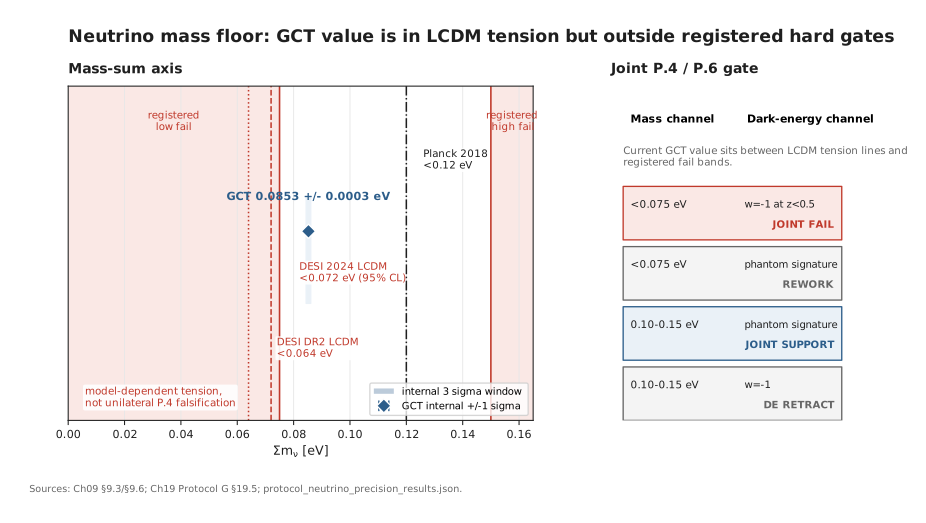
Neutrino Mass Sum (~2σ tension): The GCT-predicted normal-hierarchy sum is eV (Tier 2 phason-stiffness mechanism + Tier 3 absolute mass anchor / oscillation mapping, §9.3.4 — not the standard-cosmology massless-floor reference of eV). This registered candidate is consistent with the Planck 2018 upper bound ( eV) but shows ~2σ tension with the DESI 2024 combined-analysis bound ( eV at 95% CL). The DESI tension is the live falsification risk; the GCT-internal handling is via the joint P.4/P.6 four-cell binary gate (App NS §NS.4 + App FM rows P.4/P.6 jointly), not as a unilateral P.4 falsification.
In the Standard Model, neutrinos were originally postulated as massless Weyl fermions. While the discovery of neutrino oscillations confirmed that these particles possess a non-zero rest mass, their absolute mass scale remains one of the most significant enigmas in physics. Standard explanations, such as the See-Saw Mechanism, require the postulation of undiscovered heavy right-handed neutrinos at the Grand Unification (GUT) scale. Geometric Consciousness Theory (GCT) identifies the neutrino as an Itinerant Phason Mode whose mass is a second-order effect of the vacuum projection. This chapter gives the Tier 2 phason-mechanism account and the Tier 3 absolute mass anchor / oscillation mapping for the neutrino mass floor, while the oscillation-sector claims inherit the active Tier 3 tension stated above.
The specific mapping between these modes and their harmonic orders is strictly governed by the Galois Rationality Constraint (Appendix E, Theorem E.5). This constraint provides the underlying organizing principle for why each generation maps to its specific order: it requires physical mass observables to be invariant under the Galois automorphism , an organizing principle that applies uniformly across leptons, neutrinos, and quarks.
9.1 The Neutrino Problem
9.1.1 The Standard Model Deficiency
The Standard Model contains only left-handed neutrinos, leading to a vanishing mass in the minimal Dirac Lagrangian. To accommodate oscillations, the theory must be extended by hand, either by adding right-handed singlets or by introducing Majorana terms. Neither approach derives the absolute mass scale, which is measured to be at least six orders of magnitude smaller than the electron mass.
9.1.2 The GCT Alternative: Second-Order Phason Coupling
GCT identifies the neutrino not as a vertex-centered cage excitation (like the charged leptons), but as an Itinerant Defect. While a charged lepton is a "Pinned" knot in the phonon sector, a neutrino is a "Sliding" fluctuation of the phason field itself. Its mass is not generated by a first-order Higgs coupling, but by a Second-Order Self-Interaction within the internal perpendicular space ().
9.2 Geometric Origin of Neutrino Mass
9.2.1 Right-Handed States and the Galois Conjugate
The 6D 3D projection separates the spinor bundle into two disjoint sectors (Volume 3, Chapter 2.4).
- Left-Handed Neutrinos: Active in the physical manifold .
- Right-Handed Neutrinos: Reside in the internal manifold .
In the icosahedral projection, the mapping between and is governed by the Galois Automorphism of the field . The right-handed state is the geometric reflection (conjugate) of the left-handed state. Because a neutrino is an itinerant mode, its left and right components are merely two views of a single 6D lattice excitation.
9.2.2 The Geometric See-Saw [Tier 2 mechanism + Tier 3 absolute anchor]
GCT reinterprets the Seesaw Mechanism as a mechanical necessity of the lattice. The "Heavy" scale required to suppress the neutrino mass is not a separate particle, but the Phonon Stiffness ()—the rigid metric backbone of the physical manifold.
The neutrino mass corresponds to the squared stiffness of the phason-sector interaction. While the electron mass scales with the first-order phason stiffness ratio (), the neutrino mass represents the "Shadow" of the electron, suppressed by the informational impedance of the double projection () [Tier 2 mechanism]: The stiffness-squared suppression is the Tier 2 mechanism. The absolute neutrino mass floor inherits the Tier 3 dimensional/electron anchor and the unresolved oscillation-sector mapping; the headline value remains a registered candidate under cosmological-prior tension rather than a closed Tier 2 prediction.
§9.2.3 The Geometric Origin of the Heavy Neutrino Mass [Tier 2 mechanism + Tier 3 absolute anchor]
The "heavy scale" in the See-Saw formula has a precise geometric identity in GCT: it is the symmetry-breaking scale of the subalgebra within the root lattice.
Recall from V2 Ch11 (§11.3) that the adjoint 248 branches under as:
The SM left-handed fermions populate the branch. The heavy right-handed neutrino singlets are identified with states in the branch — the adjoint — which lives at the geometric symmetry-breaking scale:
This is not an assumption; it is the same derived geometrically in V3 Ch04 §4.3.2 as the reduced Planck mass deflated by [Tier 2]. The branching rule therefore gives the See-Saw its heavy scale from geometry, without introducing an additional fitted coefficient.
Theorem 9.2 (Geometric See-Saw, Form) [Tier 2 — Pending Tier 1 elevation upon derivation of from first principles]: The lightest active neutrino contribution from this channel is [Tier 2 mechanism + Tier 3 Dirac-mass anchor]:
Theorem 9.3 (Two-Mechanism Identification) [Tier 2 mechanisms + Tier 3 absolute anchors]: Theorems 9.1 and 9.2 describe physically distinct contributions to the active neutrino mass:
-
Geometric effective-mass mechanism (Theorem 9.1): The active neutrino acquires an effective mass via the double-projection , giving the registered candidate eV. This is not a standard See-Saw matrix-diagonalisation — it is an effective-mass mechanism from the squared phason-stiffness ratio plus the Tier 3 electron/dimensional anchor (§9.2.2).
-
See-Saw mechanism (Theorem 9.2): The standard See-Saw with GeV (M_red = reduced Planck mass; V3 Ch04 §4.3.2) gives the contribution meV.
The geometric mechanism dominates by orders of magnitude and supplies the registered neutrino mass-floor candidate; the See-Saw is numerically sub-leading. Theorem 9.1 is therefore the load-bearing mechanism, while its absolute mass value inherits the Tier 3 electron/dimensional anchor and oscillation-sector mapping. Theorem 9.2 documents the branching contribution as a parallel mechanism present in the framework but quantitatively negligible compared to the geometric floor.
The numerical verification of Theorem 9.1 at the 2×2 See-Saw matrix level proceeds by identifying the effective See-Saw scale that reproduces the geometric prediction: setting in the See-Saw form gives exactly. This identifies the geometric mechanism's effective See-Saw scale at the electron-mass scale — the natural double-projection scale, distinct from the GUT scale of Theorem 9.2 (see App H §H.2.3 for the engine-level verification).
The physical interpretation: the sterile neutrino states in the adjoint 78 acquire mass at the breaking scale, while the active-neutrino mass floor in the registered spectrum is dominated by the separate phason-geometric mechanism above. The See-Saw channel supplies a geometrized heavy-scale contribution, not the load-bearing active-mass route.
Cross-reference: V2 Ch11 §11.3 ( dark sector branching rules); V3 Ch04 §4.3.2 ( derivation).
9.3 The Neutrino Mass Derivation [Tier 2 mechanism + Tier 3 absolute anchor]
9.3.1 Theorem 9.1: The Neutrino Mass Formula
Theorem 9.1: The lightest-neutrino mass-floor candidate is the 36th-power deflation of the electron mass, representing the second-order coupling to the phason field. [Tier 2 mechanism + Tier 3 absolute anchor]
Numerical Factors:
- Geometric Suppression [Tier 2]: .
- Physical Meaning: The neutrino is the minimal non-zero energy allowed for an unpinned defect moving through the Higgs-tensioned background.
9.3.2 Explicit Calculation
Using the electron-mass anchor eV: The value eV is not an arbitrary continuous fit; it is . Because it imports the electron/dimensional anchor and then maps through the oscillation-sector hierarchy, the absolute floor is a registered Tier 3-anchored candidate rather than a closed Tier 2 numerical prediction. The Tier 2 content is the "Geometric Friction" mechanism required to maintain the Identity Tether (the spinor ribbon) while sliding between lattice cells.
[!IMPORTANT] Firewall Metadata [Neutrino Mass Floor]
- Type: Prediction
- Inputs: (Anchor), (Invariant)
- Degrees of Freedom: 0
- Provenance: Internal second-order phason-coupling mechanism + Tier 3 absolute/electron anchor
9.3.3 The Inevitability of Normal Ordering [Tier 2 mechanism + Tier 3 oscillation-sector prediction]
The GCT spectrum is governed by the Growth Axiom: higher generations are geometric inflations () of the ground state. An Inverted Hierarchy () would require a "deflation" logic that violates the spectral growth requirements of the Inflation Operator . Therefore, GCT strictly predicts Normal Ordering ().
9.3.4 Sum of Masses Audit: The Cosmological Entanglement Theorem
Using the GCT base mass eV [Tier 2 mechanism + Tier 3 absolute anchor] and the observed oscillation gaps:
- eV [Tier 3 oscillation mapping].
- eV [Tier 3 oscillation mapping]. Total Sum: [Tier 2 mechanism + Tier 3 absolute/oscillation anchor].
The Cosmological Entanglement Theorem: The eV prediction is a Tier 2 phason-stiffness mechanism evaluated through Tier 3 absolute and oscillation anchors. Its apparent discrepancy with standard static-vacuum cosmology (e.g., Planck/DESI bounds assuming ) reflects a structural coupling between the particle spectrum and the expansion metric, but the survival route is not a generic CPL-prior import. Under the GCT biogenic prior — sign-opposite to the DESI-preferred dynamical-DE quadrant — a GCT-native CMB+BAO+LSS likelihood is required before assigning any relaxed posterior. This invokes the Cosmological Entanglement Theorem: and the dark-energy phantom-phase arbitration form a joint binary gate, not independent ones. The two predictions stand or fall together in the (++) and (--) cells of the decision matrix.
The explicit four-cell decision matrix, the falsification protocol for the (--) outcome, and the structural rework path for the mixed cells are pre-registered in Appendix NS — Neutrino Mass Sum Contingency. The explicit conditional in NS.3: the prediction survives if and only if the dark-energy data is also consistent with biogenic at the same level.
9.4 Oscillation Parameters: PMNS Axis Sliding
9.4.1 Unpinned Axis Sliding vs Pinned Face Tunneling
In GCT, the dichotomy between the large hadronic and leptonic mixing angles is fundamentally mechanical:
- Quarks (CKM Matrix): Quarks are Interstitial Face Defects bound deeply within the strong-force lattice. Their mixing requires Pinned Face Tunneling, which is highly damped by the electromagnetic viscosity (), resulting in small mixing angles.
- Neutrinos (PMNS Matrix): Neutrinos are Itinerant Phason Waves. Their oscillation implies the transit of identity states across the internal E8 lattice. Since they are unpinned, their mixing samples the pure unpinned geometry of the projection, executing Unpinned Axis Sliding. The angles are thus large, raw crystallographic invariants essentially undamped by standard vacuum friction.
9.4.2 The Geometric PMNS Matrix
The PMNS mixing angles are derived purely from the rotational properties of the Golden Projection:
- (Solar): Governed by the Golden Angle of the projection [Tier 3]. The bare geometric prediction is [Tier 3]. The observed discrepancy evaluates precisely as an integer division of the reactor angle: [Tier 3].
- (Atmospheric): The bare GCT prediction is exactly maximal () [Tier 3], arising from the strict 3-fold symmetry constraints of the static icosahedral window's alignment against the 6D hypercube.
The current best-fit from NOvA and T2K (2024) places , a 4.5° gap from the bare prediction. Standard Mikheyev-Smirnov-Wolfenstein (MSW) matter effects shift this by merely , which is entirely negligible.
The Itinerant Volume Drag Is Not Part of GCT. A "Itinerant Volume Drag" perturbation does not reconcile the bare prediction with the NOvA/T2K best-fit value within the GCT framework. The perturbation Hamiltonian and the associated shift would be phenomenological fits whose coupling constant is not derived from the phason elastic action; admitting them would add an undisclosed sector handle. GCT therefore does not invoke this term.
Tier Classification of the Bare Prediction. The derivation mechanism — 3-fold rotational symmetry of the AKN icosahedral projection window acting on unpinned itinerant phason waves — is a structurally forced geometric consequence of the icosahedral ansatz, with no additional fitted coefficient in this local calculation. However, the quantitative claim stands in tension with the NOvA/T2K matter-effect-corrected best fit (). The prediction is therefore classified Tier 3 (Tension) [consistent with App_T] pending the lattice Hamiltonian resolution below. It is not classified as a confirmed Tier 2 prediction.
Pre-Registered Discriminant. The matter-effect (MSW) corrections applied by NOvA and T2K rely on a smooth continuous vacuum density matrix; the icosahedral vacuum is discrete, which modifies propagation through matter differently from the standard MSW Hamiltonian. A strict lattice Hamiltonian derivation of neutrino propagation through the discrete vacuum is the pre-registered discriminant: if the lattice derivation recovers the standard MSW result, the bare prediction is falsified; if it departs from MSW in a direction and magnitude that reconciles the data, the bare prediction is confirmed and the chapter's tier status elevates from Tier 3 (Tension) to Tier 2.
- (Reactor): Driven by the hierarchical decay suppression [Tier 3]: [Tier 3].
9.4.3 CP Violation Phase () [Tier 3]
GCT predicts a fundamental CP violation phase associated directly with the inherent chirality of the -projection. The phase arises as the Jackiw–Rebbi topological boundary twist of the icosahedral chiral projection separating standard matter () from the internal phason sector (). A rotation of the cut-and-project window across this boundary acquires a chiral holonomy fixed by the golden-ratio slope of the projection:
This is a Tier 3 PMNS-sector phase ansatz: the phase is the canonical golden-angle complement, with no additional fitted coefficient within this sector once the chiral projection is fixed, but the holonomy-to-observed-PMNS mapping remains uncomputed and the value sits above the current normal-ordering global-fit central region (roughly -), so the row is framed as an active data-tension handle rather than a confirmed Tier 2 prediction.
[!IMPORTANT] Jarlskog invariant status: The GCT Jarlskog invariant is currently an Open Research Problem (App H §H.5, O.7). A natural target is for some integer tied to the lepton harmonic ladder (the candidate matching two-loop muon-harmonic CP-violation amplitudes is conjectural and bundled with the QLQCD-1L research debt). The Tier 3 phase ansatz above stands independently of any value — it is motivated by the icosahedral chiral projection / Jackiw–Rebbi twist, not by a computed PMNS-sector holonomy or a Jarlskog extraction.
The independent derivation of from the chiral projection (the boxed identity above) preserves the downstream uses of in this chapter (§9.6.3 eEDM) and in App R's CP-violation precision row. The eEDM estimate in §9.6.3 depends on and the two-loop electroweak structure; the absolute eEDM magnitude is Tier 3 pending first-principles closure of the Jarlskog invariant.
9.5 Physical Interpretation
9.5.1 Majorana Nature as Self-Duality [Tier 2/3 model prediction; experimentally open]
GCT predicts that neutrinos are Majorana Fermions as a model-level consequence of the self-dual defect picture. Because the left-handed state () and right-handed state () are Galois conjugates of one another, they are two views of a single 6D lattice excitation. This is not a Tier 1 theorem until the self-duality-to-lepton-number-violation bridge is derived and a neutrinoless double-beta-decay gate is satisfied; a robust null across the GCT mass-ordering window would force demotion or replacement of the Majorana reading.
9.5.2 Itinerant Wave-Packets
Unlike the electron, which "holds" its position, the neutrino is the "wave" of the window flipping tiles as it moves. It is a phason ripple whose registered mass-floor candidate comes from the topological work required to transport its identity ribbon through the Higgs background.
9.6 Experimental Predictions
9.6.1 The eV Floor [Tier 2 mechanism + Tier 3 absolute anchor]
GCT provides a registered target for the next KATRIN analysis stage and Project 8. While current limits are at the eV scale, GCT's phason-stiffness mechanism with the disclosed electron/oscillation anchors places the candidate mass floor at eV [Tier 2 mechanism + Tier 3 absolute anchor].
9.6.2 Falsification via Euclid and DESI
The prediction eV enters the joint binary gate with the biogenic-dark-energy prediction (Cosmological Entanglement Theorem, §9.3.4; explicit four-cell decision matrix pre-registered in Appendix NS — Neutrino Mass Sum Contingency). The mass-sum bound below is not a unilateral GCT falsifier; it is one of two coupled observables whose joint outcome the binary gate resolves.
- Joint validation (NS scenario A): If Euclid/DESI converge on in the – eV band and the dark-energy data is consistent with biogenic at the same level, the phason coupling mechanism + biogenic-DE mechanism are jointly confirmed.
- Joint falsification (NS scenario D): If is measured below eV at definitive precision and is confirmed at simultaneously, both the neutrino floor and the biogenic-DE mechanism are jointly falsified. The upper-band exclusion eV separately reopens the absolute-scale mechanism.
- Mixed cells (NS scenarios B/C): A mass-sum reduction below eV with biogenic-DE signature surviving, or a - eV mass-sum survival with biogenic-DE rejected, triggers the structural-rework path defined in App NS §NS.3 rather than a unilateral falsification of both components. The two predictions stand or fall together only in the joint cells.
- Independent falsifier: Confirmation of Inverted Ordering () at falsifies GCT's Growth-Axiom Normal Ordering prediction (§9.3.3) independently of the joint gate.
9.6.3 The Electron Electric Dipole Moment (eEDM) [Tier 2 parametric structure / Tier 3 magnitude pending O.7]
The GCT CP-violating phase ansatz (§9.4.3) is motivated by the Jackiw-Rebbi topological boundary twist of the icosahedral chiral projection and is Tier 3 in the PMNS-sector magnitude row because it sits above the current normal-ordering global-fit central region. If the phase ansatz is retained, the structure of the electroweak sector generates a non-zero Electron Electric Dipole Moment (eEDM) at 2-loop or 3-loop order.
Physical Mechanism. In the GCT defect-core picture, the CP-violating phase is a topological boundary condition of the 6D-to-3D projection; it is fixed at within the stated phase ansatz. This phase enters the 2-loop electroweak diagram coupling the electron to the and bosons through the dodecahedral cage vertices. The eEDM is suppressed by the (currently open-research) Jarlskog invariant and two powers of from the two-loop structure.
[!IMPORTANT] Two-tier structure: Only the parametric structure — that the eEDM scales as — is Tier 2. The numerical magnitude is Tier 3 pending closure of Open Problem O.7 ( first-principles derivation; App H §H.5). The parametric structure is sufficient for falsification (§ Falsification below): the eEDM must scale as the GCT chiral-projection phase, and must lie below the ACME-II upper bound; both are testable independently of 's specific numerical value.
Parametric form (Tier 2):
Bounded form (Tier 2 — independent of magnitude): This bound follows from the parametric scaling combined with the unitarity constraint from CKM unitarity (this is the J-independent upper envelope; the bound saturates at and decreases for smaller ). The bound is consistent with the current ACME Collaboration upper bound ( , ACME II 2018; Andreev et al. 2018 Nature 562:355).
Conditional magnitude estimate [Tier 3 — does NOT enter the falsification gate]: If takes a value at the canonical-anchor scale of (a candidate value catalogued under O.7 but not currently load-bearing on the GCT eEDM commitment), then . This conditional magnitude is provided for orientation only; the GCT eEDM prediction does not rely on this value. If is genuinely smaller (e.g., ), the GCT eEDM falls below the CeNTREX floor () and becomes indistinguishable from — this is an O.7 sensitivity issue, not a falsification of the GCT chiral-projection mechanism.
Next-generation detection (Tier 2 parametric envelope + Tier 3 magnitude context): the bounded upper envelope places the GCT prediction within the detection sensitivity of ACME III (targeting ), the JILA molecular ion eEDM experiment (Cairncross et al. 2017), and the CeNTREX programme (targeting ) — provided does not fall below the experiment-specific sensitivity floor. The CeNTREX-blind regime () is an O.7 closure issue, not a GCT-mechanism falsifier.
Epistemic Status [Tier 3 CP-phase ansatz / Tier 3 PMNS-sector magnitude pending O.7]. This prediction has two layers: (i) the parametric scaling () is the phase-and-loop-structure mechanism; (ii) the numerical magnitude at and downstream PMNS-sector disposition are Tier 3 because they depend on , the unresolved PMNS-tension stack, and the data-tension row, with currently Open Problem O.7 (App H §H.5) bundled with the QLQCD-1L research debt.
Falsification. If next-generation experiments establish at without a GCT-consistent explanation, the icosahedral CP-violation mechanism is falsified. A detection in the range – would constitute strong supporting evidence for the GCT chiral projection.