Volume 1 — The Operating System
PART I: THE LOGIC OF BEING
Chapter 1: The Staircase of Certainty
1.1 The Problem of the Starting Point
1.1.1 The Crisis in Foundational Physics
Modern physics finds itself in a paradoxical state. On the one hand, it possesses two theories of unparalleled predictive power: Quantum Mechanics (QM), which governs the subatomic realm, and General Relativity (GR), which governs the cosmic realm. On the other hand, these theories are mutually incompatible at their core. QM describes a probabilistic world of discrete quanta evolving against a fixed background, while GR describes a deterministic world of continuous geometry where the background itself is dynamic.
Attempts to unify them into a Theory of Everything (TOE) have stalled for half a century. The symptoms of this stagnation are well-known:
- The Measurement Problem: Quantum mechanics provides no mechanism for how a probability wave collapses into a definitive event, requiring the ad-hoc insertion of an observer.
- The Problem of Time: The Wheeler-DeWitt equation (), the canonical result of quantizing gravity, implies that the universe is static and timeless, contradicting our most basic experience.
- The Parameters Problem: The Standard Model relies on ~26 arbitrary constants (masses, couplings) whose values must be measured rather than derived. [Tier 3 — Phenomenological count; exact number depends on definition of independent parameters]
Geometric Consciousness Theory (GCT) posits that these are not separate problems, but symptoms of a single methodological error: the attempt to derive the Observer from the Observed.
1.1.2 The Hard Problem as a Category Error
The "Hard Problem of Consciousness" arises from the assumption that matter is primary and consciousness is derivative. GCT inverts this hierarchy. We posit that the failure of physicalism to account for subjective experience is not a gap in our knowledge, but a result of the initial axioms. By treating the "Object" as fundamental and the "Subject" as emergent, standard physics creates an unbridgeable explanatory gap.
1.1.3 The Geometric Alternative
Instead of trying to squeeze consciousness into a materialist framework, we ask: What geometry is required to support a universe where the Subject is irreducible? This shift from "How does the brain make a mind?" to "What geometry unifies Mind and Matter?" is the core of the GCT program.
The standard Materialist alternative commits the following errors:
-
The Something-from-Nothing Error: The claim that subjective experience emerges from sufficiently complex arrangements of non-experiential matter is akin to claiming that stacking enough zeroes eventually yields a one. It introduces an unexplained miracle into the causal chain — a discontinuity of ontological kind with no mathematical grounding.
-
The Circular Causation Error: Physics is an activity performed by conscious agents. We infer the existence of particles based on observations made within consciousness. To then claim that the particles create the consciousness is to confuse the map with the territory — the measurement presupposes the measurer.
1.1.4 The Requirement for Epistemic Inversion
To resolve the crisis, we must perform an Epistemic Inversion. We cannot start with the objects of our theory (quarks, strings, branes), because those objects are inferred. We must start with the instrument of inference itself.
We require a foundation that is not a hypothesis, but a certainty. We must identify the Ontological Primitive—the one thing that cannot be an illusion. Only by anchoring our physics in this absolute datum can we build a structure that does not rely on discontinuities of emergence. We must construct the universe Top-Down, not Bottom-Up.
1.2 The Cartesian Anchor
1.2.1 Radical Skepticism: Discarding the Doubtable
To find the true starting point, we employ the method of Radical Skepticism. We systematically discard every belief that could theoretically be false, no matter how unlikely.
- The External World? Could the physical universe be an illusion? Yes. The Simulation Hypothesis or the "Brain in a Vat" scenario demonstrates that our sensory data could be a coherent fabrication. Therefore, the existence of matter is a hypothesis (). [Tier 3 — Philosophical Framework]
- The Ego/Personality? Could "I" be an illusion? Yes. The sense of being a continuous person with a name and history is interrupted by sleep, amnesia, and psychedelic dissolution. The "Ego" is a narrative construct (). [Tier 3 — Philosophical Framework]
- The Past? Could history be fake? Yes. The "Last Thursdayism" argument (or Boltzmann Brain hypothesis) suggests the universe could have fluctuated into existence one second ago with false memories implanted. The past is an inference (). [Tier 3 — Philosophical Framework]
What remains when the world, the self, and time are stripped away?
1.2.2 The Zero-Point: Experience as the Datum
Even if the world is a simulation, the experience of the simulation is happening. Even if the pain is hallucinatory, the feeling of pain is real. Even if "I" do not exist, there is a "There" where the doubting is occurring.
This is the Zero-Point. To deny it is to affirm it, for one must be there to do the denying. This is not a logical proof; it is a phenomenological fact. It is the only datum in the universe that possesses absolute probability. [Tier 1 — Axiom of Presence]
1.2.3 Axiom 1: The Axiom of Presence
We formally state the first axiom of the theory. This is the bedrock upon which the entire mathematical structure of GCT rests.
Axiom 1 (The Axiom of Presence): Experience is the non-negotiable zero-point of reality. Before we can measure a particle, define a law, or doubt a theory, there must be a field of Presence where the data appears. We take this field—not the matter it perceives—as the fundamental substrate of the universe.
Probability: [Tier 1 — Axiom of Presence]
Scope Note: Axiom 1 asserts Qualitative Presence as the irreducible ontological primitive. GCT derives the Quality Space (the topological structure of experiential similarity) from RT geometry. The bare fact of Qualitative Presence is not derived — it is the ground from which all derivation proceeds.
Clarification on "Field": We use the term "Field" here not to imply immediate 3D spatial extension, but to denote a Domain of Variation. Presence is not a geometric point; it has capacity. It can sustain multiple distinct qualia (e.g., sound and color) simultaneously. It is a manifold of potentiality.
This axiom redefines the task of physics. We are not trying to explain how a brain generates consciousness. We are trying to explain how a fundamental field of consciousness generates the appearance of a brain.
[!IMPORTANT] Scope note on the "" framing across volumes. The certainty above applies strictly to the Axiom of Presence — the bare phenomenological fact that something is felt — and to nothing downstream. Every derived claim in this manuscript carries an explicit epistemic tier label (Tier 1 through Tier 4 per Global Frontmatter §0.0). In particular: Volume 1 Chapters 16-17 develop the biophysical substrate of the Identity Polaron (microtubule Tryptophan radical-pair Zeno mechanism, ~100 MHz coherence, derivation), and every quantitative claim there is at Tier 2 or Tier 3 with explicit Open Problem cross-references (O.16, O.21, O.12, O.10). The high-confidence Bayesian rhetoric of this chapter applies only to Axiom 1; readers should not infer that the substrate biophysics shares the same epistemic status. The bare fact of experience is at ; the GCT account of how experience is instantiated in biological matter is Tier 2/3 hypothesis under active experimental falsification (Protocol A-Prime, Protocol D).
1.3 The Axiom of Intelligibility
1.3.1 Phenomenology of Distinction and Sequence
Having established that something exists (Presence), we ask: What is its nature? Is it a featureless void? Is it chaotic noise?
We observe that our experience—whether veridical or hallucinatory—possesses inherent characteristics:
- Distinction: We perceive differences. Red is not Blue. Pain is not Pleasure. This thought is not that thought. Distinction is the seed of Topology. If A is distinct from B, there is a "boundary" or "relation" between them. This implies discreteness.
- Sequence: We perceive order. There is a "Before" and an "After." Causality flows.
1.3.2 Structure vs. Chaos
Consider the hypothesis of Pure Chaos—a state of total randomness with no pattern, no distinction, and no stability. Could we be experiencing Pure Chaos? No. To experience "Chaos" requires distinguishing it from "Order." To experience "Nothing" requires distinguishing it from "Something." While a state of pure undifferentiated awareness (Void/Nirvana) may theoretically exist as , Physics begins with the departure from null identity. To have a "Universe" (an observable manifold) requires structure. The very fact that there is "Something" rather than "Uniformity" implies that the Field of Presence has entered a structured state. It is not vapor; it is geometry. [Tier 1/2 — Structural Postulate: Axiom of Intelligibility]
1.3.3 Clarification: Intelligibility vs. Specific Aristotelian Logic
We do not claim that the universe must obey specific human logical rules (like the Law of Excluded Middle, which Quantum Mechanics violates). We claim only that it possesses Internal Consistency. The Field has a nature. It holds patterns. It sustains correlations. This capacity for self-consistency is what we call Intelligibility. If reality were not intelligible, science would be impossible, and the regularity of experience (the sun rising, gravity pulling) would be a miraculous accident.
1.3.4 The Dream Question: Weak Causality vs. Strong Causality
Critics might argue: "What about dreams? Dreams are illogical." GCT responds: Dreams possess Weak Causality, but they are not chaotic. In a dream, a door might lead to a beach (violating spatial logic), but the door is still distinct from the beach (Distinction), and the opening precedes the arriving (Sequence). Even the most surreal hallucination relies on a substrate of pattern recognition. The difference between "Dream Logic" and "Waking Logic" is a difference in the Rigidity of the Consensus Protocol (to be derived in Chapter 11), not a difference in the fundamental intelligibility of the substrate.
1.3.5 Axiom 2: The Axiom of Intelligibility
We formally state the second ontological axiom of the theory.
Axiom 2 (The Axiom of Intelligibility): The Field of Presence is not chaotic vapor. It contains distinction and sequence. Therefore it possesses internal consistency—it is intelligible. The Universe can be known.
Probability: [Tier 1/2 — Axiom of Intelligibility]
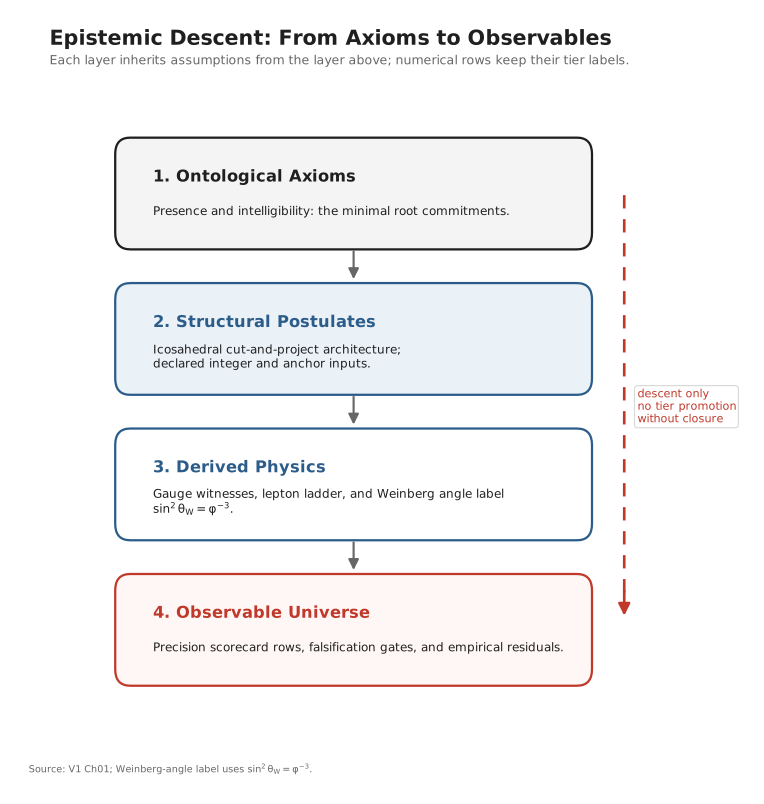
From these two ontological axioms—Presence (Existence) and Intelligibility (Structure)—we begin the construction of the GCT architecture. While the ontological root is minimal, it is supplemented by explicit structural postulates (e.g., the 6D lattice, discreteness) to map reality to the observed Standard Model. These are enumerated in the Axiom & Postulate Ledger.
Scope-note on Axiom 1: mathematical objects do not have Level I presence. A natural misreading of Axiom 1 — "if every configuration of the Field has Level I presence, then mathematical objects (integers, theorems, abstract structures) must have presence too" — is incorrect. Mathematical objects are patterns in the Russellian sense (Chapter 6): extrinsic structure, abstractly specified, multiply instantiable. They are not Field configurations. Axiom 1 applies to the substrate (the Field), not to descriptions of substrate. The instantiation of doing mathematics in a Class 2 Polaron is a Field configuration and has presence in the ordinary way; the abstract integer 7 does not. This distinction is load-bearing — collapsing it would dissolve the Field/Pattern split that the entire ontology rests on, converting GCT into Tegmark's Mathematical Universe Hypothesis (a position GCT explicitly rejects; see §6.4.5 for the formal contrast).