Front Matter
Parameter Ledger
This ledger provides the authoritative enumeration of all numerical values used as inputs, anchors, or calibrated fits within Geometric Consciousness Theory (GCT). In accordance with the Prediction/Postdiction Firewall, all values are classified by their technical provenance. The Gauge, Lepton, and native-RGE endpoint sectors are determined by a small, fully-enumerated set of structural postulates, one dimensional anchor, one gauge-flow endpoint anchor, and one low-energy fine-structure anchor used only by measurement-anchored precision-comparison rows (Section 0 below). The remaining Open Parameters are explicitly quarantined in Section 4 (Tier 3) pending exact geometric derivation.
0. Free Parameter Accounting (Summary)
This section aggregates every structural postulate, integer exponent, and calibrated parameter that enters the manuscript's quantitative claims. It is the authoritative replacement for any informal closure shorthand: GCT's gauge-and-lepton sector is impressively constrained, but the constraint is explicit, finite, and partitioned by epistemic tier.
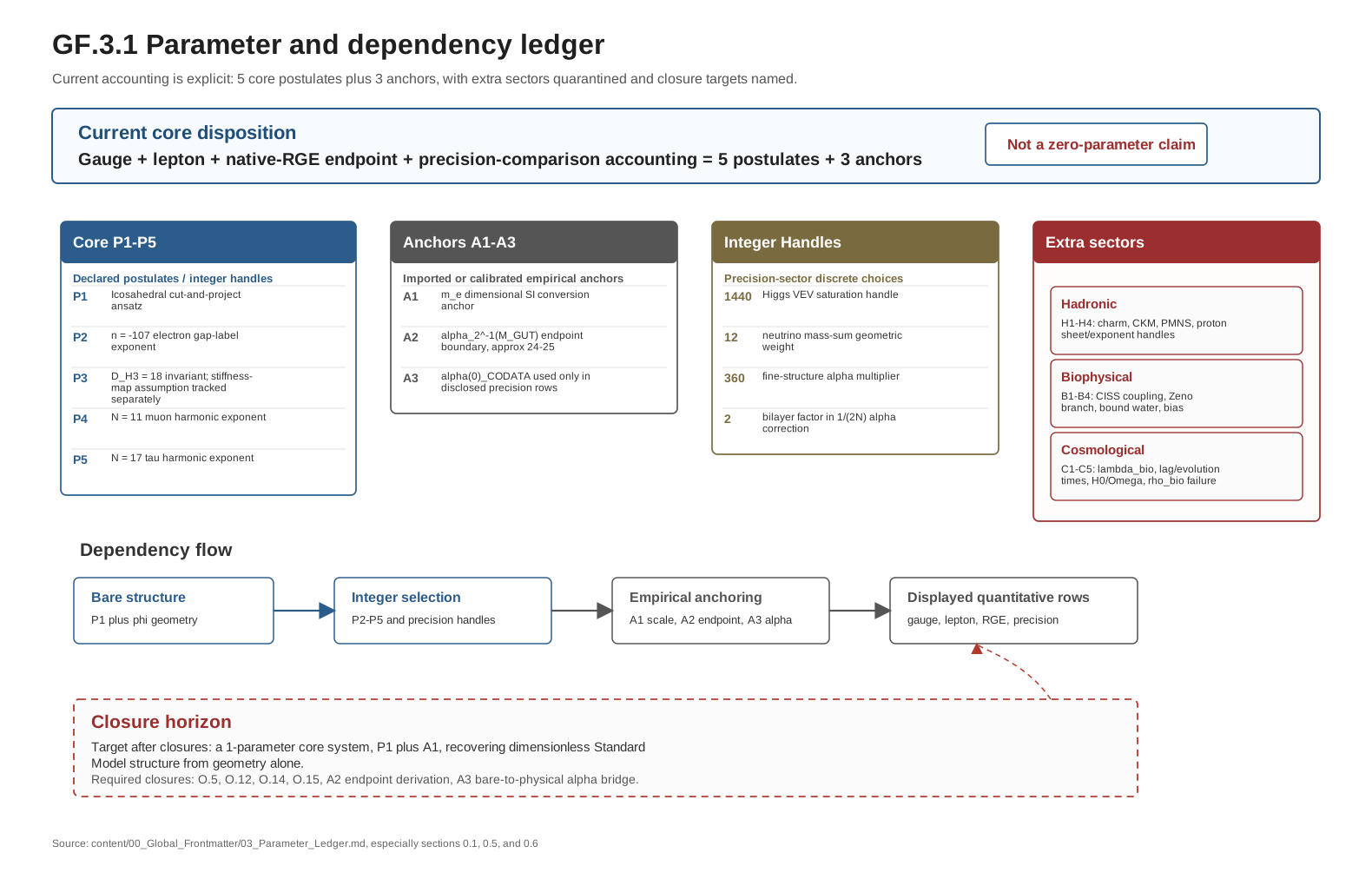
0.1 Core Gauge + Lepton + Dimensional + Native-RGE Endpoint Sector — 5 postulates + 3 anchors
| # | Symbol / Postulate | Type | Tier | Status | Cross-Reference |
|---|---|---|---|---|---|
| P1 | Icosahedral cut-and-project ansatz ( projection of onto ) | Structural postulate | Tier 1/2 axiomatic | Foundational; not a fitted parameter | V1 Ch04 §4.1 |
| P2 | — K-theoretic gap-label exponent for | Integer exponent | Tier 2 K-theoretic framework support + Tier 3 specific integer anchor + Tier 4 physical-interpretation chain (per O.14) | is supported by, and coincident with, the Coxeter-exponent power-sum invariant (unique to among finite irreducible Coxeter groups; Humphreys 1990; engine: protocol_o14_coxeter_exponent_squares.py). The physical trace-image transfer that would select this integer as the electron projection's gap-label remains unconstructed and open under Open Problem O.14 (Tier 4 conjecture). CODATA match at 1006 ppm. Convention dependence (disclosed): the integer is specific to the non-reduced Planck-mass convention ; under the reduced Planck mass the same ratio requires exponent , which is non-integer and carries no Coxeter-invariant identification. The anchoring is therefore convention-dependent, and the non-reduced convention is the one under which the geometric identification holds — stated wherever the exponent is used as load-bearing. | V3 Ch07 §7.2.2, V3 Ch08 |
| P3a | — Shephard-Todd invariant-degree sum | Integer invariant | Tier 2 Coxeter integer | is the unique icosahedral anchor: the Shephard-Todd invariant-degree sum , sum (uniquely among rank-3 Coxeter groups: , , ). The 2D-RT-face-in-6D tangent-bundle decomposition enters as a 6D-ambient consistency cross-check, not as a second independent icosahedral anchor (every 6D-ambient theory with this triple-decomposition yields 18 regardless of icosahedral structure; see App H O.26 and V3 Ch08 §8.3.3). | V2 Ch04, App K, V3 Ch08 §8.3.3 |
| P3b | — physical stiffness-ratio map from | RG-map assumption / numerical heuristic (not an independent postulate) | Tier 3 pending O.15 | The sharper claim that the Coxeter integer maps to the physical phason stiffness ratio by at the renormalization-flow level is separately tracked at Open Problem O.15(b) (Tier 3 sharpening pending QLQCD closure). This row is not counted as an additional independent core postulate beyond P3a; it is the current physical-map assumption attached to P3. | V2 Ch04, App K, V3 Ch08 §8.3.3; App H O.15 |
| P4 | — muon harmonic exponent | Integer exponent | Tier 2 mechanism + Tier 3 specific exponent | Linear Hessian does not produce spontaneously; postulated from representation count. The harmonic-ladder mechanism is Tier 2; the specific integer is a Tier 3 anchor pending the integer-side closure (the analogue of the electron Coxeter-exponent identification) | V3 Ch08 |
| P5 | — tau harmonic exponent | Integer exponent | Tier 2 mechanism + Tier 3 specific exponent | Second-harmonic of dodecahedral resonance; same postulational status as P4 — Tier 2 mechanism, Tier 3 specific integer pending integer-side closure | V3 Ch08 |
| A1 | — dimensional anchor (SI conversion) | 1-DOF anchor | Tier 3 import | CODATA 2022; required to convert dimensionless ratios to SI units | V3 Ch08 |
| A2 | - — gauge-coupling-flow endpoint anchor | Continuous endpoint anchor | Tier 3 calibrated anchor | Calibrated against observed via SM-equivalent SU(5)-like unification (Langacker-Polonsky scale) in protocol_rge_native.py. It is not a first-principles GCT prediction; the closure target is to derive this boundary value from the icosahedral irrep activation schedule plus bare boundary structure under QLQCD-1L / App ZN. | V3 Ch04 §4.5; App ZN; protocol_rge_native.py |
| A3 | — low-energy fine-structure constant | Continuous empirical input | Tier 1 empirical anchor for precision-comparison rows | Used where the displayed row explicitly requires the measured low-energy electromagnetic coupling: corrected charged-lepton mass residuals (21 ppm muon), Higgs VEV residual (181 ppm), and QED audit. The Tier 2 geometric tree-level derivation remains separate and yields the 3442 ppm bare residual independent of A3. A3 is not used to claim the bare derivation. | V3 Ch08; App R §R.2; verify_muon_mass.py; verify_higgs_vev.py; protocol_qed_audit.py |
The fine-structure constant has two distinct roles. The bare GCT tree-level derivation is the Tier 2 impedance form with a Tier 3 600-cell multiplier in and a 3442 ppm residual attributed to phason anti-screening; that residual is an O.19/O.5 closure target, not a tuned coefficient. The measured low-energy value is A3, a Tier 1 empirical anchor used only in precision-comparison rows whose displayed formulas are explicitly measurement-anchored: corrected lepton masses, Higgs VEV, and QED checks. The bare Weinberg angle enters via at Tier 1 (App U §U.9 uniqueness theorem) with a 2.1% tree-level RGE-running gap. Those bare geometric quantities are derived from via the icosahedral postulate P1. The native-RGE Z-pole endpoint reconstruction additionally uses A2, the Tier 3 calibrated anchor above; therefore the RGE endpoint check is a shape-and-boundary check, not a zero-anchor prediction. The O.19 alpha-residual protocols treat 3442 ppm and 41.6 ppm as verification/closure targets, not coefficients used to tune the result. Cosmology, Zeno, and systematics constants are classified as external empirical priors, verification targets, MD-derived bands, or already-disclosed B/C-sector Tier 3 parameters. The full current anchor set is A1, A2, and A3, with A3 confined to measurement-anchored precision comparisons. The down-quark Fuglede–Kadison determinant route is a Tier 2 mechanism with Tier 3 infinite-volume-limit identification conditional on O.5: the primary output is MeV, postdiction-consistent at inside the registered 11% shell-resonance band. The FK-determinant sequence centers on , with closed-cage deep-tail mean , sequence-mean signed error vs PDG, and single-cage oscillations within the 11% band under an empirical decaying envelope. The mechanism introduces no additional fitted coefficient.
Tier-3 integer-factor handles in the precision sector (calibrated discrete choices):
- 1440 (Higgs VEV saturation; App H O.20)
- 12 (12-fold neutrino mass-sum geometric weight)
- 360 (fine-structure 360 multiplier)
- 2 (bilayer factor in the correction; App H O.5)
Total: 4 calibrated discrete-integer choices in the precision sector.
0.2 Hadronic Sector — Tier 3 ansätze beyond the down quark
| # | Symbol | Status | Cross-Reference |
|---|---|---|---|
| H1 | — charm-quark gap label at second harmonic | Tier 3 Mixed-Harmonic Law ansatz | Open Problem O.5 |
| H2 | — higher CKM mixing angles | Tier 3 face-tunneling ansatz | V3 Ch10 |
| H3 | — PMNS mixing angles | Tier 3 (4.09σ tension noted) | V3 Ch09 |
| H4 | — proton baryonic-triad exponent | Tier 2 mechanism + Tier 3 sheet/exponent handle pending AKN-action closure | V3 Ch10; V3 Ch18; App R §R.3 |
0.3 Biophysical Sector — Tier 3 calibrated parameters
| # | Symbol | Description | Tier | Cross-Reference |
|---|---|---|---|---|
| B1 | Per-spin CISS coupling | Tier 3 calibrated | V3 Ch13 §13.1.1 | |
| B2 | branch centers: primary MHz; fallback MHz | Zeno operating branch frequency | Tier 2 mechanism + Tier 3 branch-specific values | V3 Ch13 §13.1.2b; Open Problem O.12 |
| B3 | ( pending O.21); ( conditional) | Bound-water fraction | Tier 3 biological substrate value: O.21 identifies Trp21 only as a local-inward wall-patch candidate pending assembled-MT lumen-axis closure, and O.33 treats the dodecahedral lumen-water arrangement as a candidate ansatz pending MD/NMR/free-energy validation. NOE is not the 100 MHz locking mechanism. | V3 Ch16, V1 Ch17, App F §F.4 |
| B4 | V | Zeno steering bias | Tier 3 calibrated | V3 Ch13 |
0.4 Cosmological Sector — Tier 3 / Tier 4
| # | Symbol | Description | Tier | Cross-Reference |
|---|---|---|---|---|
| C1 | Biogenic-DE coupling | Tier 3 phenomenological correlation | V2 Ch14 | |
| C2 | Gyr | complexity lag time | Tier 3 calibrated | V2 Ch14 |
| C3 | Biogenic-kernel timescales | Tier 3 calibrated | V2 Ch14, protocol_imp01_pipeline.py | |
| C4 | Observational imports | Tier 3 imports (Planck 2018 / CODATA 2022) | Global | |
| C5 | overshoot | Bare biogenic-DE magnitude (pre-suppression) | Tier 4 known failure | V2 Ch14 §14.2 |
0.5 Total Accounting
- Core sector (P1-P5 with A1, A2, and A3): 5 structural postulates + 1 dimensional anchor + 1 gauge-flow endpoint anchor + 1 low-energy fine-structure empirical anchor for precision-comparison rows. The icosahedral postulate (P1) is foundational; the four integer exponents (P2-P5) are explicitly enumerated above with their tier status and corresponding Open Problems; the dimensional anchor (A1) is required for SI-unit conversion; the native-RGE endpoint anchor (A2) is required for the present flow check and remains Tier 3 pending QLQCD-1L/App ZN closure; A3 is used only where corrected lepton, Higgs VEV, or QED rows explicitly import measured . The precision sector separately carries 4 calibrated discrete-integer handles (1440, 12, 360, 2) listed above.
- Hadronic sector (H1-H3): 3 Tier 3 ansätze pending O.5 closure.
- Biophysical sector (B1-B4): 4 calibrated biophysical parameters; the Zeno operating frequency mechanism is Tier 2. Higgs/VEV handles are not biophysical parameters and are counted separately in the precision/Higgs-sector handle inventory.
- Cosmological sector (C1-C5): 5 parameters; is a Tier 3 phenomenological correlation; the bare magnitude is a Tier 4 known failure resolved by holographic displacement suppression.
The aggregate is ~16-19 free parameters across the full theoretical scope (with the exact count depending on whether the Tier 4 known failures are counted as parameters or as open problems). The closure target is a 1-parameter core system — P1 plus the dimensional anchor — recovering the dimensionless Standard Model from geometry alone. The current bare Gauge + Lepton sector before native-RGE endpoint running is determined by 5 postulates + 1 dimensional anchor; the native-RGE endpoint reconstruction adds the disclosed A2 gauge-flow anchor, and measurement-anchored precision rows add A3. The current gauge + lepton + native-RGE + precision-comparison accounting is therefore 5 postulates + 3 anchors. This is impressively constrained for a theory of this scope, while remaining distinct from the 1-parameter closure target. Closure of Open Problems O.5, O.12, O.14, O.15, A2's QLQCD-1L/App ZN boundary derivation, and the A3 bare-to-physical alpha bridge would reduce this count toward the 1-parameter target.
0.6 The Ambition (Target State)
The structural postulates enumerated in §0.1 are not intended as permanent additions to GCT. They are integers awaiting first-principles derivation from the icosahedral cut-and-project framework itself. The theory's terminal target — toward which the present accounting is the current state of the path — is:
| Sector | Target state | Required closures |
|---|---|---|
| Core (gauge + lepton + dimensional + native-RGE endpoint) | 1-parameter limit AFTER closure of O.14 + O.15 + N=11/N=17 derivations + A2 endpoint derivation + A3 bare-to-physical alpha bridge: P1 (icosahedral postulate) + A1 ( as the unique SI anchor) — current state is 5-postulate-plus-3-anchor; the 1-parameter target is the closure horizon, not the present disposition. App H O.14 enumerates 10+ routes attempted as candidate uniqueness proofs (orbifold Euler-characteristic; APS -invariant via Connes-Moscovici; 42-orbit-union cage-uniqueness search; explicit Bellissard gap-labels; AKN dimension group; stringy/Hodge Euler characteristics; icosahedral subgroup orbit counts; group-theoretic invariants of ; anomaly polynomials; Fibonacci-pair trace evaluation; sum of squared Coxeter exponents of ). Path (l) — sum of squared Coxeter exponents — produces $ | n |
| Hadronic | Tier 2 closure including charm-quark gap label + higher CKM mixing | O.5 (QLQCD-1L) |
| Cosmological | promoted from Tier 3 correlation to Tier 2 first-principles derivation; derived rather than imported | O.13 ( first-principles derivation); QLQCD-1L for |
| Biophysical | Tier 2 closure of specific value; experimental confirmation of via Protocol A-Prime | O.12 (chiral phonon-polariton renormalization); Protocol A-Prime + Protocol D experimental returns |
In the limit where every Open Problem above is closed, the dimensionless content of the Standard Model collapses to icosahedral geometry alone, with retained only as the SI-unit anchor. This is the theory's final ambition. The current parametric accounting (§0.1–0.5) measures the distance between the present state and this target; it is not a statement that the present state is the target.
1. Physical Anchors (Imported/Convention)
These values are taken from external empirical measurements (CODATA) to anchor the geometric ratios to SI units. GCT derives the ratios between these values, but the absolute scale is a convention.
| Symbol | Name | Type | Value | First Appearance | Used In | Notes |
|---|---|---|---|---|---|---|
| Speed of Light | Convention | m/s | V1 Ch13 | Global | GCT derives . | |
| Electron Mass | Dimensional Anchor (1-DOF; SI import) | V3 Ch08 | Absolute Scale | Dimensional Anchor: GCT derives a dimensionless mechanism for , but the SI-scale electron mass is imported from CODATA as the single dimensional anchor. The K-theoretic framework is Tier 2, the integer is a Tier 3 anchor with Tier 2 Coxeter support, and the physical-link chain from the invariant to the 6D trace-image projection remains Tier 4 pending O.14. | ||
| Gravitational Const | Mixed tier | V2 Ch09 | V2 Ch09 | Tier 2 thermodynamic mechanism + Tier 4 Planck-link conjecture (inherits O.14) + Tier 3 dimensional anchor; 2274 ppm postdiction. Inputs: (anchor), , (all CODATA 2022). Precision: 2274 ppm (0.23%) against CODATA 2022 () on CODATA-2022 inputs throughout. Alternative figures of ~1771 ppm, ~1500 ppm, or ~0.1% sometimes cited informally are not reproducible from any single consistent input set. Independently re-derived in GCT_Physics_Engine/verify_independent/verify_newton_g.py. |
2. Structural/Geometric Invariants — Gauge and Lepton Sectors: Current Accounting; Down-Quark Mechanism Requires R=4 Engine Implementation; Charm + Higher CKM at Tier 3 Ansatz (Tier 2 / Tier 3)
These values are consequences of the 6D 3D icosahedral projection under the 5-postulate-plus-3-anchor accounting of §0.1: P1 is the cut-and-project ansatz, P2-P5 are integer exponents, A1 is the dimensional anchor , A2 is the native-RGE endpoint anchor , and A3 is the measured low-energy used only by precision-comparison rows. The bare gauge + lepton exponent sub-sector uses no additional continuous fitted coefficient, but the integer choices in P2-P5 remain Tier 3 anchors pending O.5/O.14/O.15 first-principles derivation, the native-RGE endpoint check inherits A2 until QLQCD-1L/App ZN derives it, and corrected lepton/Higgs/QED precision comparisons inherit A3 until O.19/O.5 derives the bare-to-physical alpha bridge. The down-quark mass has a Tier 2 Fuglede-Kadison-determinant mechanism, but the current R=2 baseline remains a registered band-violation; the R=4 lattice implementation is the engine-side closure path (App R §R.8; App TP §TP-B). The charm-quark gap label at the second-harmonic mode and the higher CKM mixing angles (, ) remain Tier 3 Mixed-Harmonic Law ansätze pending resolution of Open Problem O.5.
| Symbol | Name | Type | Value/Ratio | First Appearance | Used In | Notes |
|---|---|---|---|---|---|---|
| Golden Ratio | Invariant | V1 Ch02 | Global | The fundamental slope. | ||
| Node Count | Invariant | V1 Ch13 | Lepton masses | 12th Fibonacci number. | ||
| Planck Mass | Tier 2 framework + Tier 3 exponent anchor + Tier 4 structural-link conjecture | V3 Ch08, V3 Ch07 §7.2.2 | Gravity | The K-theoretic gap-labeling framework (Bellissard + Connes-Moscovici + Pimsner-Voiculescu, Ch07 §7.2.2) is rigorous Tier 2. The integer is canonically identified with the sum of squared Coxeter exponents of (, unique to ; Humphreys 1990 Table 3.1; engine protocol_o14_coxeter_exponent_squares.py) as an exact group-arithmetic anchor, but the specific electron exponent remains Tier 3 until O.14 selects it from the trace-image candidate family. The structural-link chain remains Tier 4 conjectural, recorded as the residual of Open Problem O.14. CODATA match at 1006 ppm; verified by verify_electron_mass.py. | ||
| Stiffness Ratio | Tier 2 integer-identification (H_3 Shephard-Todd anchor) + Tier 3 physical-link conjecture (pending O.15(b) RG derivation) | V2 Ch04, App K | Speed of Light | The GCT prediction that phason modes are parametrically softer than phonons by a -power ratio is a Tier 2 mechanism of the icosahedral cut-and-project framework. The specific exponent is the unique icosahedral anchor: the Shephard-Todd invariant-degree sum , sum (uniquely among rank-3 Coxeter groups: , , ; Humphreys 1990). The 2D-RT-face-in-6D tangent-bundle decomposition enters as a 6D-ambient consistency cross-check, not as a second independent icosahedral anchor (every 6D-ambient theory with this triple-decomposition yields 18 regardless of icosahedral structure; see App H O.26 and V3 Ch08 §8.3.3). The sharper RG-running claim at the renormalization-flow level is the residual Tier 3 physical-link conjecture, separately tracked at Open Problem O.15(b) pending QLQCD-1L closure. The cube-power-of-Gram-determinant-ratio derivation in §K.3 is a postulate, not a derivation from standard quasicrystal elasticity (Lubensky-Ramaswamy-Toner; Socolar-Lubensky-Steinhardt), which treats phason constants as independent parameters. Empirically, i-AlPdMn measurements (de Boissieu 1995; Francoual 2006) give to — 100-1000× larger than the GCT prediction; the i-AlPdMn 100-1000× gap is registered as Open Problem O.41 (phason-stiffness gap reconciliation between GCT canonical ratio and i-AlPdMn experimental band). See App K §K.4 + §K.4b. Symbol disambiguates from (V2 Ch11) and (V2 Ch13). | ||
| Polaron Healing Length | Tier 1 formula (Bohr-Compton); GCT-internal Route 2 closed negatively under O.25 | nm | V1 Ch7, V3 Ch13 | Zeno Force | Tier 1 formula — is the standard Gross-Pitaevskii / Bohr scaling for a Coulomb-bound polaron (App K §K.5); not a GCT-specific prediction. Both CODATA ( nm) and GCT bare ( nm) give the same value to — the formula is -input-insensitive at the percent level. The GCT-internal phason-elastic Route 2 substitution chain (, , in ) yields m, off the Tier 1 target by ; it cannot reproduce the Coulomb-bound-state enhancement and Open Problem O.25 is therefore negatively closed (App K §K.5). The operative value is at Tier 1 textbook status. The identification with the microtubule lumen (Ch07 §7.3.3: polaron diameter nm vs lumen ID nm, 3% match) remains a Tier 3 biological correlation. | |
| Bare Rotation | Tier 1 algebraic value (Uniqueness Thm U.9) + Tier 2 physical identification (coupling-to-volume postulate) | V2 Ch02 | Electroweak, Cabibbo | Tier 1 algebraic value + Tier 2 physical identification / Tier 3 endpoint. The bare geometric value is Tier 1 algebraic (App U §U.9) — the specific value is uniquely forced by composition of three independent Tier 1 inputs (dim(E_⊥)=3, Gram length ratio=, vol=); no other rational power of permitted. The physical identification rests on the GCT-specific coupling postulate that couples proportionally to and proportionally to (Ch04 §4.3.1 step (c)) — itself Tier 2. The 2.1% gap to Z-pole is the expected tree-level RGE-running gap; geometric RGE recovers Z-pole shape with 0.23% error after importing observed IR boundary . Endpoint Tier 3 (not a free prediction at tree level); full IR autonomy = QLQCD-1L Open Research Debt. | ||
| Gram Boundary Scalar | Tier 1 algebraic scalar + Tier 2 physical identification boundary | ; normalized Cartan share | V3 Ch04 §4.3.2 | Electroweak | Level 1 (Exact Algebraic Derivation) via Gram Projection Theorem. This is the unnormalised Cartan/Gram boundary scalar, not the physical bare Weinberg angle; the latter remains by the volume-coupling postulate. Machine-precision verified in protocol_electroweak.py. | |
| Z-pole Weinberg | Tier 3 Import + A2 endpoint anchor | (OBSERVED) | V3 Ch04 §4.5 | RGE shape check | Level 3 Observational Import. Used as RGE endpoint only. The 2345 ppm shape match verifies flow geometry plus the disclosed A2 boundary -, not a closed prediction from the current postulate set. Full autonomy requires QLQCD-1L/App ZN derivation of A2 and the native flow coefficients. Inputs: (Tier 1+2); A2 (Tier 3 calibrated); observed endpoint (Tier 3). | |
| Unification Scale | Invariant | GeV | V3 Ch04 | Electroweak | . Exact match. | |
| Fine-Structure Constant | Tier 2 mechanism (bare impedance form) + Tier 3 specific 600-cell multiplier pending O.19/O.5; A3 observed used separately in precision comparisons | bare; is A3 | V1 Ch13 | Electromagnetism; corrected lepton/Higgs/QED comparisons | Tree-Level Bare Impedance. The impedance form is the Tier 2 geometric mechanism; the specific integer multiplier is the 600-cell antipodal edge-count selection and remains a Tier 3 integer anchor until the O.19/O.5 phason-vacuum-polarization closure derives why this multiplier, rather than a neighbouring icosahedral count, is selected. The 3442 ppm discrepancy identifies the sign-correct phason anti-screening target, not a closed magnitude derivation. Corrected lepton masses, Higgs VEV, and QED audit rows import measured as A3 and must not be counted as bare-alpha predictions. | |
| F_bio Jacobian | Tier 2 | V3 Ch13 | Zeno Force | Wavefunction overlap suppression (derived §13.2.1). . | ||
| Phason Drag | Tier 2 mechanism + Tier 3 coefficient normalization + A3 for corrected precision rows | in corrected-pole comparisons; bare-alpha variant remains an O.19/O.5 target | V3 Ch08, App H O.5 | Muon mass | The phason-channel multiplicity is Tier 2. Converting the five channels into the equal-weight pole-mass self-energy coefficient is a Tier 3 physical-normalization rule pending first-principles GCT self-energy closure. The 21 ppm muon and 181 ppm Higgs VEV rows use A3 measured ; using the bare alpha instead gives a larger Tier 3 residual and is not the canonical precision-comparison row. | |
| Phi-Alpha Correction | Tier 2 mechanism + Tier 3 SM-equivalent radiative-discipline residual | V3 Ch08 | Muon mass | Derived as from the displayed single 1-loop GCT heat-kernel self-energy with electroweak mixing projection factor . Exponent 8 = 11 - 3 is algebraically exact (verified computationally; see Appendix Q). Achieves the documented 21 ppm residual conditional on SM-equivalent higher-loop discipline. | ||
| Alpha Shielding | Tier 2 mechanism + Tier 2 integer-pair + Tier 3 combination rule pending O.26b — headline coefficient is Tier 3 | V3 Ch08, App H O.26, App R §R.1 | Tau mass | with from the unique icosahedral anchor — the Shephard-Todd invariant-degree sum , sum (uniquely among rank-3 Coxeter groups; Tier 2 load-bearing). The 2D-RT-face-in-6D tangent-bundle decomposition enters as a 6D-ambient consistency cross-check, not as a second independent icosahedral anchor (every 6D-ambient theory with this triple-decomposition yields 18 regardless of icosahedral structure; see App H O.26, App R §R.1 tau-row footnote, V3 Ch08 §8.3.3). from RT pentagonal vertex enumeration (Tier 2; same anchor as muon ). Negative sign from anti-screening sector (Galois-conjugate slope ). The ratio-combination rule that selects over alternatives ( or ) is itself a load-bearing Tier 3 postulate pending App H Open Problem O.26b; stacking the Tier 3 combination rule on the Tier 2 integer pair yields Tier 3 for the headline coefficient . The sharper RG-running claim is separately tracked as Open Problem O.15(b) and is logically independent of the integer-counting argument that fixes the coefficient. | ||
| Quark Masses (mixed mechanism/residual disposition) | Tier 2 mechanism / Tier 3 absolute predictions | Mixed-Harmonic Law | V3 Ch10 | Hadron Bound | is a Tier 2 Fuglede-Kadison mechanism, but the current primary engine baseline is a registered band-violation and the absolute prediction is Tier 3 until the implementation becomes the primary output. The strange-quark coefficient is a separate Tier 3 coefficient handle pending O.43. remains Tier 3 heuristic at the harmonic pending O.5 closure. | |
| Bottom Quark representation ratio / bottom-use handle | Tier 2 ratio + Tier 3 absolute-mass deployment | V3 Ch10 | Bottom Mass | A₅ representation ratio: dim(H)/dim(G) = 5/4 (canonical Schoenflies labels for the icosahedral 5- and 4-dimensional irreps; Cotton, Chemical Applications of Group Theory 3rd ed. Table A.15; Altmann-Herzig 1994). The rational ratio itself is exact and introduces no additional continuous fitted coefficient. Its deployment in the absolute row inherits the Tier 3 /quark-sector closure burden and remains falsified if falls outside 4130-4230 MeV at 5σ. | ||
| CKM Mixing Angles | Tier 2 bare + Tier 3 transfer (Cabibbo ) / Tier 3 () | Face Tunneling | V3 Ch10 | Flavor Shift | Cabibbo has a Tier 2 bare prediction and a Tier 2 bare + Tier 3 lepton-to-hadron transfer correction ; the corrected 0.82% residual inherits the transfer assumption pending Open Problem O.5 (QLQCD-1L). Higher-generation and are Tier 3 ansätze with irrational exponents pending O.5. Consistent with Ch10 §10.6 + App R §R.4 + Ledger §0.2 H2. | |
| PMNS Mixing Angles | Tier 3 (Tension) | Axis Sliding | V3 Ch09 | Neutrino Shift | Tier 3 ( tension explicitly noted). | |
| CP Phase | Tier 3 PMNS-sector phase ansatz; hadronic CP-amplitude transfer pending O.7 | V3 Ch09 | CP phase anchor | Geometric phase candidate with active data tension; the value sits above the normal-ordering global-fit central region and the PMNS holonomy map remains uncomputed. Matter-asymmetry amplitude requires CKM/Jarlskog closure under Open Problem O.7. | ||
| Higgs VEV Scale | Tier 2 mechanism + Tier 3 calibrated-handle residual (see Higgs sector handle accounting callout below §2) | GeV | V3 Ch05 | Absolute Scale | GeV is a Tier 2 mechanism + Tier 3 calibrated-handle residual (~181 ppm). O.20 is an enumeration-level closure: is non-unique in factorisation but canonically anchored to the muon-defect pathway with 3 independent cross-checks; uniqueness load-bearing factors remain O.5/O.14/O.15 upstream. | |
| Quadrupole Shielding Time | Tier 2 | V3 Ch16 | Isotope Tests | Derived from O quadrupole moment and the icosahedral EFG asymmetry parameter . Note: is distinct from the coordinate time and from the tau lepton mass . The subscript (quadrupole) is always explicit in formulae. | ||
| , , | Right-Handed Hypercharges | Tier 2 (Geometric) | V3 Ch04 | Hypercharge | Exact Algebraic Derivation via topological charge conservation () for -sterile states (V3 Ch04). Tier 2 because it assumes the split of the icosahedral architecture; the result is exact algebraically given that split. See V3 Ch04 §4.3 for the full derivation. |
3. Calibrated Parameters (Tier 3 Phenomenological)
These are "knobs" that are currently adjusted to match experimental data. They represent areas where a Tier 2 derivation is pending or where environmental factors dominate. Biophysical rows are restricted to biophysical quantities; cross-cutting precision handles such as are accounted for separately below.
| Symbol | Name | Type | Value/Range | First Appearance | Used In | Notes |
|---|---|---|---|---|---|---|
| Biogenic DE Magnitude | Tier 4 | overshoot | V2 Ch14 | Accelerated Exp | KNOWN FAILURE: Overshoots observed by 220 orders of magnitude. The resolution requires the full Holographic Displacement suppression mechanism (V2 Ch14 §14.2); the suppressed prediction converges to the Tier 3 equation of state. This failure is not a falsification of the Tier 2 gauge sector results. | |
| Equation of State | Tier 3 calibrated channel fingerprint; inputs include Tier 3, Tier 2 functional form / Tier 3 numerical evaluation, and Tier 3 absolute magnitude | throughout; principled load-bearing under combined §14.5.2 + §14.6.2 axioms with Kardashev-band Gyr (Class-2 strict baseline + intra-Class-2 corrections). Geometric mean . CPL-extrapolated – (linear-fit artifact, not literal crossing). | V2 Ch14 §14.5.2/§14.6.2/§14.6.3 | Phantom Phase | Biogenic-DE model produces continuous phantom phase ( for all , asymptoting to from below); does NOT literally cross the phantom divide. The fingerprint depends on two axiomatic modeling commitments: (a) §14.5.2 Class-2-only criterion — only intelligent biospheres source the coupling; (b) §14.6.2 intra-Class-2 dynamics — per-biosphere complexity intensifies exponentially post-emergence with . The intra-Class-2 exponential intensification re-weights early-formed biospheres in the cosmic-mean integral, reducing the deviation relative to the broad ansatz envelope; the load-bearing principled envelope is the band. Stage-hierarchy variants with pre-Class-2 weights are outside the registered channel fingerprint. Engine: protocol_imp01_pipeline.py (empirical-reference pipeline), protocol_o13_closure_class2_strict.py (Class-2 strict baseline), protocol_o13_intra_class2_dynamics.py (intra-Class-2 Kardashev-band closure). Distinguishability requires Roman Year-10 / Stage-V single-bin precision . | |
| complexity Lag | Calibrated | Gyr | V2 Ch14 | Dark Energy | Integration timescale. Fitted to match acceleration onset timing. ~5 Gyr | |
| Yield Strain | Tier 2 candidate derivation + Tier 3 registered stress-gate value | engine stress-gate value ; candidate AKN value | V3 Ch11 §11.1.3; Protocol C | Dark Matter | Ch11 §11.1.3 derives the candidate from the AKN tiling-flip condition. The current Protocol C engine constant remains the conservative Tier 3 alloy-like value used in until the AKN-action/phason-elastic derivation is promoted into the stress-gate source. Closure target: replace the 0.1 prior with the AKN-derived value or an experimentally calibrated stress-gate threshold. Verified derivation check: verify_independent/verify_epsilon_y.py. | |
| Bound Fraction | Tier 3 biological substrate value under O.21/O.33 conservative closure discipline | operative central ( pending O.21); sensitivity branch ( conditional on O.21) | V3 Ch16, V1 Ch17, App F §F.4 | Protocol D | The central branch remains zero until O.21 closes on assembled-microtubule lumen-axis radical-pair geometry. The Trp21 local-wall-patch result is carried only as the sensitivity branch. O.33 treats the dodecahedral water arrangement as a candidate geometric ansatz rather than a thermodynamic ground state at 310 K. Nuclear Overhauser cross-relaxation is too slow to supply the 100 MHz Zeno lock; the load-bearing 100 MHz scale is Trp radical-pair hyperfine / singlet-triplet dynamics. | |
| Zeno Bias | Calibrated | V | V3 Ch13 | Protocol A | Steering signal. | |
| Zeno Freq | Tier 2 mech / Tier 3 value | primary branch MHz; fallback branch MHz | V3 Ch13 §13.1.2b | Protocol A | Mechanism Tier 2: magnon-polaron avoided crossing where MHz is the canonical Trp radical-pair zero-field hyperfine-induced singlet-triplet manifold splitting used by the engine (Ch13 §13.1.2b; App X §X.12). Specific branch values Tier 3: reaching the primary MHz branch requires a chiral phonon-polariton frequency renormalization factor of (Open Problem O.12, App H §H.5; analogous to the ~41× coupling renormalization of App Q); the MHz fallback branch is frozen for negative O.12 closure. Nuclear Spin regime (ATP budget compliant; quantum energy at 112 MHz eV per Ch17 §17.1.2). | |
| Topological Field | Prediction | Geometric | V3 Ch13 | Protocol A | Phason gradient field. | |
| Higgs Scale | Tier 3 (Fit) | V3 Ch05 | Higgs Mass | Absolute scaling calibration anchor for Higgs potential. See Higgs sector handle accounting callout following §3. |
[!IMPORTANT] Integer-handle tier taxonomy. Geometric integers do not automatically promote the downstream physical formula to Tier 2. Registered dispositions: electron exponent is Tier 2 hierarchy mechanism + Tier 3 corrected-formula anchor; lepton integers are Tier 2 ladder mechanism with Tier 3 ppm radiative discipline; proton is Tier 2 baryonic-triad mechanism + Tier 3 sheet/exponent handle pending AKN-action / QLQCD closure; Higgs is Tier 2 mechanism + Tier 3 calibrated-handle residual after O.20 canonical anchoring; A2 is a Tier 3 endpoint anchor; the strong bare handle is Tier 3 (10 integer + geometric factor) pending O.42 / QLQCD-2 strong-boundary derivation.
[!IMPORTANT] Higgs sector handle accounting (cross-cuts §2 and §3) [Tier 2 mechanism + Tier 3 calibrated handles]: the bare derivation (entered in §2 as the Higgs VEV Scale row, with Tier 2 mechanism status) and the bare Higgs mass involve at least four structural choices that must be enumerated jointly across §2 and §3:
(a) the integer factor 1440. Per Open Problem O.20's combinatorial enumeration, is the canonical icosahedral factorization anchored on the muon-defect-saturation derivation (V3 Ch05 §5.2.1; this is the load-bearing engine path in
verify_higgs_vev.py); three additional independent icosahedral factorizations — , , — serve as order-of-magnitude consistency cross-checks rather than competing derivations. The Higgs VEV derivation is a Tier 2 mechanism through the canonical muon-defect pathway with a Tier 3 integer-handle residual; the additional factorizations provide dimensional support rather than independent physical channels;(b) the packing-efficiency identity (Ch05 §5.2.3);
(c) the calibration anchor (the row directly above);
(d) the inheritance of the ~21 ppm muon-mass closure into the residual via the pre-factor.
The headline precision claims ( to ~181 ppm in App R §R.2; to 1.6% in App R §R.2) inherit from this combined handle-count, not from a single Tier 2 closure. The Ledger's split presentation — entered at Tier 2 mechanism in §2 (Structural / Geometric Invariants) and entered at Tier 3 fit in §3 (Calibrated Parameters) — together account for the Higgs sector's law-level mechanism plus calibrated-handle disposition; neither row in isolation captures the four-handle structure. O.20 closes only the enumeration of the canonical muon-defect pathway while recording non-unique 1440 factorisations as cross-checks; closure of O.5/O.14/O.15 would reduce the upstream uniqueness load to the icosahedral postulate (P1) and the dimensional anchor (A1).
4. Open Parameters (Tier 3 — Derivation Pending)
These parameters represent the frontier of GCT. While their mechanical origins within the lattice are identified, their absolute magnitudes currently require calibration to empirical anchors. Until derived natively from 6D geometry, they prevent the claim of 100% parametric closure for the entire Standard Model. The closure target is to reduce the present 5-postulate-plus-3-anchor core accounting toward a smaller first-principles basis; the current state remains the tiered ledger above.
| Symbol | Name | Value | Mechanical Origin | Needed for Tier 2 |
|---|---|---|---|---|
| Consensus Decay Constant | Not yet derived | Phason stiffness ratio of the vacuum quasicrystal (V1 Ch7 §7.6.3, Ch11 §11.2.1). Scales as where is the decoherence rate and is environmental redundancy (V1 Ch11 §11.2.4). Proportionality constant estimated at OOM level from microtubule decoherence timescale (V3 §13.4) [Tier 4]. | First-principles derivation of from the phason stiffness ratio ; deferred to Volume 2 (V1 Ch7 §7.6.3). Until derived, is a Tier 3 Open Parameter. | |
| Operative Biogenic-DE Quartic Mass Scale | eV | Tier 3 operative quartic scale used by Ch14/App R/engine; distinct from the Tier-3 Weinberg-coincidence candidate meV (O.37) and from the Hubble energy . | First-principles derivation of the locking-potential curvature, quartic coupling, and condensate normalization from lattice dynamics; O.37 must reconcile-or-discard the Weinberg-coincidence candidate without changing the operative scale. | |
| Susceptibility | (using Planck 2018 km/s/Mpc and CODATA constants) | Tier 2 functional form + Tier 3 numerical evaluation: Holographic entanglement entropy ratio derived in V2 Ch14 §14.1.5. | The Tier 2 substance is the identification of the de Sitter area ratio with the GCT critical susceptibility. The numerical value inherits Tier 3 status because is imported pending O.4/O.1. The associated dark-energy density is the standard Friedmann expression , so is Tier 2 in area-law form but Tier 3 in absolute magnitude until and are derived internally. |
5. Heuristic Coefficients & Screening
Heuristic and calibrated quantities are enumerated across §0.1, §0.2, §2, and §3; §3 is the biophysical calibrated-parameter ledger rather than the complete manuscript-wide inventory.
Scope: Every numerical term used in the manuscript is enumerated in this ledger. Coefficients absent from this enumeration fall outside the framework's rigor protocols.