Volume 3 — The Matter Spectrum
PART I: THE GEOMETRY OF FORCES
Chapter 1: The Phase Sector (U(1))
The existence of electromagnetism is traditionally treated in the Standard Model as an axiomatic requirement of local gauge invariance. In Geometric Consciousness Theory (GCT), the electromagnetic field is not an independent entity added to the vacuum, but the direct hydrodynamic consequence of the vacuum's superfluid phase dynamics. This chapter separates the Tier 1 gauge-invariance statement that the bare photon is massless from the GCT-specific phason-sector realization: a Tier 2 mechanism whose full photon-as-second-sound derivation inherits the Tier 3 stiffness / phason-anchor closure described in Ch06 §6.1.2 and Parameter Ledger §0.1.
1.1 The Superfluid Vacuum Condensate
1.1.1 The Order Parameter:
The vacuum ground state is a supersolid condensate described by a macroscopic wavefunction, or order parameter, . This order parameter represents the collective state of the consciousness field after its crystallization into the 6D hyper-lattice. We express this state in its polar form: where:
- is the Superfluid Density, corresponding to the amplitude of the lattice projection and the "presence" weight of the vacuum.
- is the Superfluid Phase, a scalar value representing the internal degree of freedom of the phason field.
1.1.2 Global Phase Symmetry
The fundamental action of the consciousness field is invariant under a global rotation of the phase. If we transform the field by a constant phase : the physical observables—specifically the lattice density and the Hamiltonian constraints—remain unchanged. This invariance constitutes the Global Symmetry of the vacuum. It reflects the fact that the absolute phase of the universal wavefunction is unobservable; only relative phase differences (gradients) generate physical dynamics.
1.1.3 Spontaneous Symmetry Breaking (SSB)
Crystallization requires the field to select a specific configuration from the manifold of degenerate energy minima. When the consciousness field condenses into the supersolid quasicrystal, it undergoes Spontaneous Symmetry Breaking. The vacuum selects a specific phase at every point in the manifold.
This process settles the field into the "rim" of the Landau-Ginzburg potential (the "Mexican Hat"). The broken symmetry transforms the global invariance into a dynamical degree of freedom: the vacuum acquires the capacity to sustain phase gradients and oscillations.
1.1.4 The Second-Sound Phason Mode
According to Goldstone's Theorem, the breaking of a continuous global symmetry results in massless excitations. In a standard liquid superfluid, this gives a scalar phonon. In the GCT supersolid, that scalar phase mode is not identified with the Maxwell photon by itself. The electromagnetic mode is the transverse phason displacement sector protected by the unbroken gauge redundancy of the hydrodynamic description (Ch06 §6.1.2).
This coupling transforms the scalar phase wave into a Transverse Vector Mode known as Second Sound. Light is not merely a phase oscillation; it is the wave of phase-lattice synchronization. The "Photon" is the quantized excitation of this hybrid vector mode.
1.2 The Berry Connection as Electromagnetic Potential
1.2.1 Helmholtz Decomposition of the Gauge Potential [Tier 2]
We derive the electromagnetic gauge potential by examining the transport of a local Agent. In the GCT supersolid, the potential admits a Helmholtz Decomposition: where:
- is the Longitudinal component (pure gradient), representing the hydrodynamic velocity of the phase.
- is the Transverse component satisfying , representing the elastic phason shear.
The magnetic field is generated solely by the transverse component: . The two transverse polarizations of the photon are explicitly tied to the two independent degrees of freedom of within the icosahedral acceptance window. The "Gauge Field" is revealed to be the Geometric Connection required to maintain identity-coherence across the phason-lattice interaction.
1.2.2 Theorem 1.1: Berry Connection as Gauge Field
Theorem 1.1: The geometric connection arising from the adiabatic transport of a topological defect through the superfluid vacuum condensate transforms identically to a gauge potential, and its curvature has the algebraic form of the Maxwell field-strength tensor.
1.2.3 Proof: Holonomy around a closed loop
If an Agent is transported around a closed path in the physical manifold , it accumulates a Geometric Phase (Berry Phase) proportional to the holonomy of the full connection: On ordinary simply connected patches, is a pure gauge and contributes no local curvature: . A nonzero loop integral is restricted to defect-supported patches where is multivalued or singular at the core. The ordinary Maxwell curvature is carried by the non-exact transverse phason connection . By Stokes’ Theorem, this loop integral is equal to the integral of the curvature over the surface enclosed by the path: where is the Field Strength Tensor. This proves that the "Magnetic Flux" is the measure of the topological "twist" or phase-mismatch accumulated by an observer traversing the vacuum lattice.
1.2.4 Connection to Maxwell’s Equations: Curl of A
Within the gauge-fixed consistency construction, the Maxwell equation pairs are represented by the hydrodynamic equations of the phase fluid.
- The Magnetic Field (): on ordinary patches. The longitudinal component has zero curl away from defects; defect-supported singular patches carry quantized winding, while the propagating Maxwell field uses the non-exact transverse phason potential.
- The Electric Field (): . This corresponds to the total acceleration of the phase (the pressure gradient of the condensate).
1.3 Charge Quantization from Phase Single-Valuedness
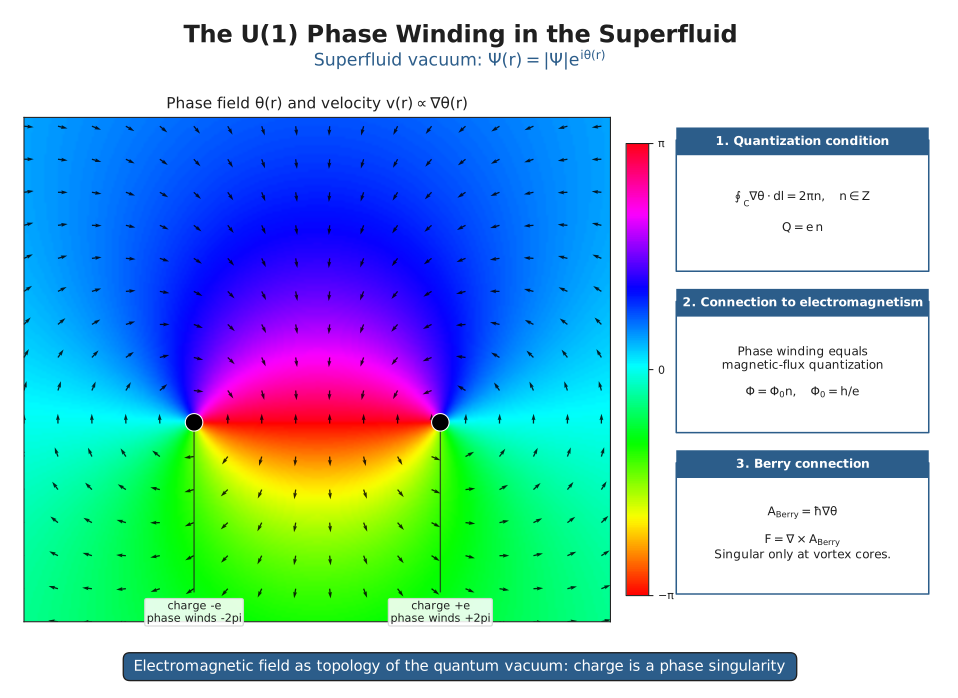
1.3.1 The Loop Integral and Topological Winding [Tier 1]
Because the order parameter must be single-valued (), the phase can only change by integer multiples of around any closed loop that encloses a singularity. Substituting our dimensional definition of the potential (), we find that the magnetic flux is quantized in units of the flux quantum : This identifies Electric Charge as the Topological Winding Number of the vacuum phase.
1.3.2 Theorem 1.2 [Tier 2]: Constraint-Based Fractional Charge
Theorem 1.2: The existence of fractional charges () is a structural requirement of the icosahedral projection, arising from the linear dependence of the 10 three-fold axes in the acceptance window.
1.3.3 The 1/3 Unit from the Geometric Sum Rule
In the icosahedral projection, the internal space is spanned by 10 axes of three-fold symmetry. Due to the icosahedral point group symmetry, these 10 axes are not linearly independent; they satisfy a Geometric Sum Rule. Specifically, the basis vectors of the 6D lattice project into the 3D internal space such that they sum to zero in triplets (e.g., ).
To form a stable, closed-loop defect in the 6D parent lattice (a color singlet), the total winding must sum to an integer unit of the 6D lattice period. Because the axes are constrained in triplets, a defect winding around a single three-fold axis represents exactly one-third of the displacement required for loop closure. Consequently, the fundamental unit of winding for a quark (a face defect) is of the unit winding of a lepton (a vertex defect). In the manuscript's convention, this supports the standard hypercharge normalization (, , , , ); the often-seen values belong to the alternate convention and are not the convention used here.
1.4 The Massless Photon
1.4.1 Gauge-Symmetry Protection [Tier 1]
The photon is exactly massless in this construction as a consequence of unbroken gauge symmetry in the underlying phason hydrodynamics (Ch06 §6.1.2). The broken global phase supplies the scalar second-sound degree of freedom, but the Maxwell photon is the transverse gauge-protected phason mode, not the scalar Nambu-Goldstone mode of a broken global symmetry.
1.4.2 Gauge Invariance Protection
Mass corresponds to a term in the Lagrangian of the form . In GCT, such a term would be proportional to . This would imply that the vacuum energy depends on the absolute value of the phase, which violates the Axiom of Intelligibility (which requires laws to be independent of the arbitrary internal "clock" of the vacuum).
1.4.3 The Topological Necessity of
The masslessness of the photon is further protected by the Compactness of the identity fiber . The identity fiber is the universal solenoid, a compact topological group formed as an inverse limit of circles (App B §B.1). A mass term () requires a parabolic potential , which is non-compact and extends to infinity. Gauge invariance, however, requires a periodic potential consistent with the solenoidal topology of the fiber. Since the identity space is compact, the potential must be flat in the angular direction, forcing as a topological identity within the gauge-protected construction.
1.5 Physical Interpretation
1.5.1 The Coupling Constant and Superfluid Density
We identify the square of the elementary charge as the measure of the Superfluid Stiffness of the vacuum. A "Charge" is a point that acts as a topological sink or source for the phase current. The strength of the electromagnetic interaction is the measure of the work required to deform the vacuum phase against its own coherence density .
1.5.2 Electromagnetic Force as Gradient Minimization
The electromagnetic force is the phenomenological registration of the vacuum seeking to minimize its Total Gradient Energy [Tier 2]: When two vortices approach, their phase gradients interact via interference:
- Repulsion: Two electrons possess the same winding sign (). Between them, the phase gradients add constructively. This increases the local energy density. The system exerts a pressure to push the vortices apart, reducing the high-energy overlap.
- Attraction: An electron and positron possess opposite winding signs (). Between them, the gradients add destructively, canceling the phase strain. The system pulls them together to maximize this cancellation, eventually leading to the total "healing" of the lattice (annihilation).
The phason-stiffness derivation of (Ch06 §6.1.2) makes and two views of the same material constant: sets the Propagation Speed of the phase wave, while sets the Interaction Strength of the phase vortex. The unity of and in the Fine-Structure Constant (Ch07 §7.2) is therefore a tiered structural interpretation of light and matter as two aspects of a single supersolid medium, conditional on the Ch06 Maxwell bridge and the O.19/O.5 bare-to-physical closure rather than a final theorem-grade proof.
1.6 Dynamical Consistency of the Gauge Action [Tier 3 consistency check pending O.15]
1.6.1 The Kinetic Term from Phason Hydrodynamics
In standard Quantum Field Theory (QFT), the Yang-Mills kinetic term is postulated to enforce gauge invariance. In GCT, the gauge kinetic term is shown to be consistent with the bilinear map from phason hydrodynamics (Tier 3 consistency check; full Tier 2 derivation requires tile-dynamics derivation of the antisymmetric Maxwell kinetic term, the two-polarization gauge redundancy, and a Lorentz-invariant action with specified — pending O.15).
Consider the internal displacement field of the quasicrystal. The energy density of this field is dominated by the Elastic Stiffness of the tiling rearrangements. The strain energy density is proportional to the square of the gradient of the displacement:
1.6.2 The Identification of Curvature
Section 1.2 defines the gauge potential as the Berry connection generated by the local twist of the icosahedral frame and its transverse phason component. The field strength tensor is the Curvature of this connection, representing the Vorticity of the phason fluid:
The elastic energy of the phason condensate, when expressed in terms of this curvature, gives the registered Tier 3 consistency form of the Maxwell Lagrangian:
1.6.3 Physical Interpretation of the Fields
This identification provides a rigorous mechanical definition for the electric and magnetic fields:
- Magnetic Field (): The curl of the phason displacement ().
- Electric Field (): The time derivative of the phason strain ().
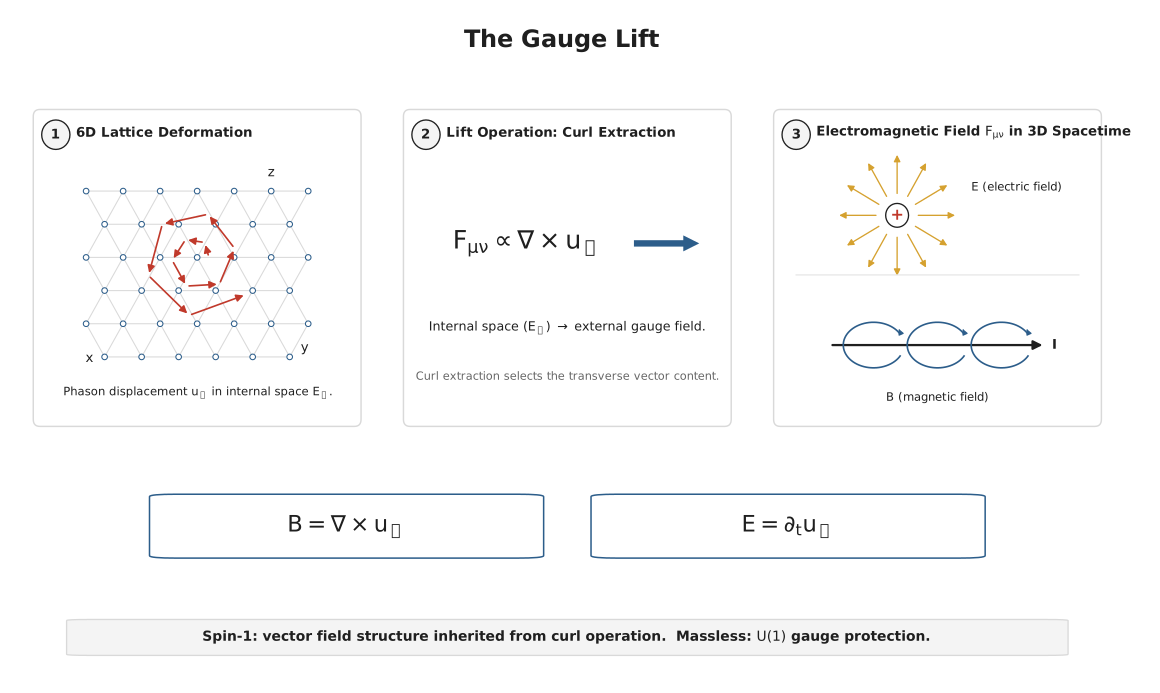
This identification is not merely formal; it explains why the photon is massless (unbroken gauge protection in the phason hydrodynamic sector) and why it has spin-1 (it is the transverse vector mode of ). An electric field represents the rate at which the phason nodes are flipping states to accommodate a charge imbalance.
Thus, the "Movement" of the gauge field () is simply the Isotropic Elasticity of the 6D lattice projected into the internal space. The "Force" is the back-reaction of the lattice trying to unwind its topological defects.