Front Matter
Axiom & Postulate Ledger
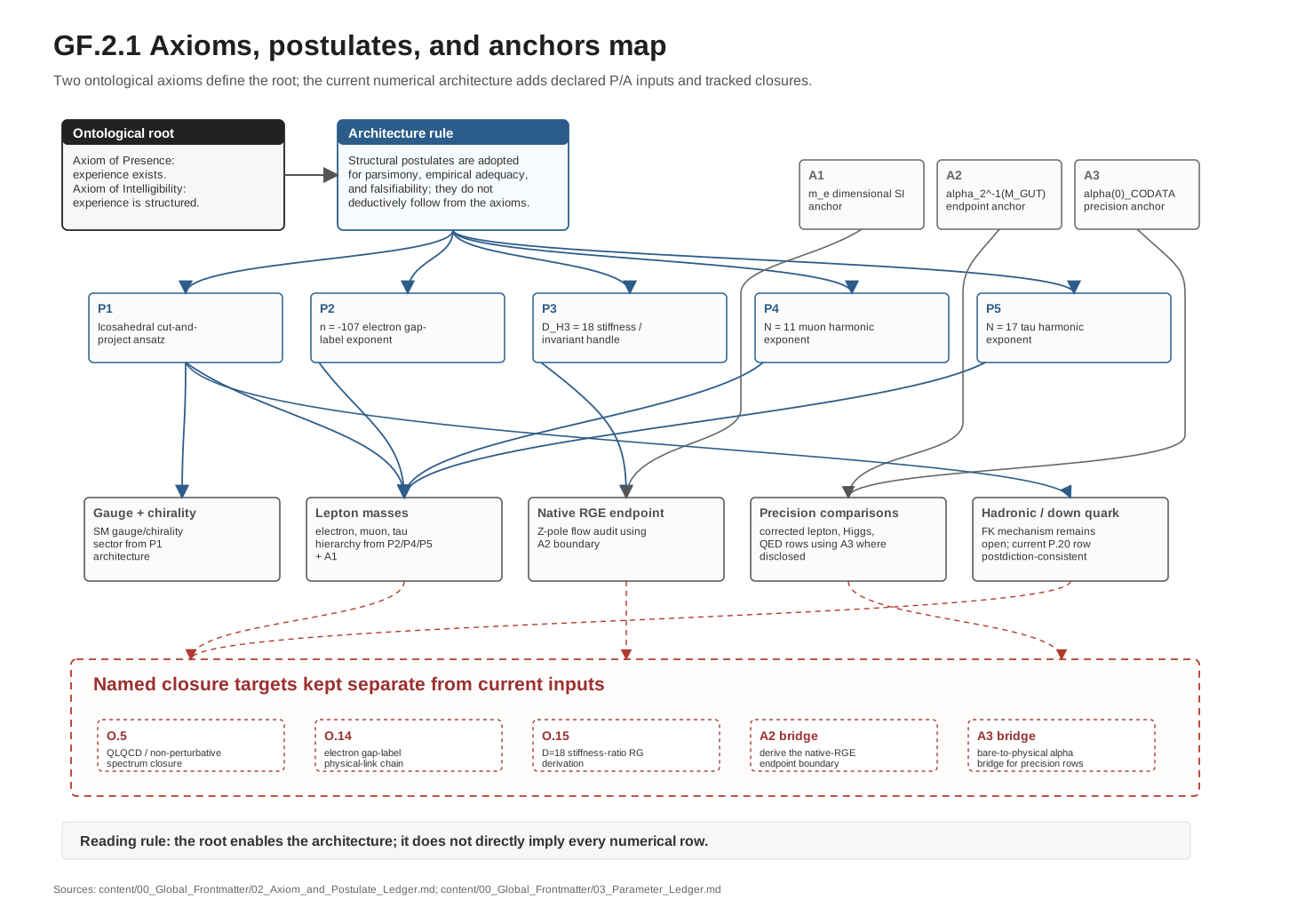
This document serves as the authoritative enumeration of the foundational assumptions used in Geometric Consciousness Theory (GCT). We distinguish between the Ontological Root, which defines the field of inquiry, and the Structural Architecture, which specifies a concrete physical implementation.
1. Ontological Axioms (The Root)
These axioms constitute the minimal starting point for any intelligible world-model. They are taken as self-evident or performatively necessary.
- Axiom of Presence: Experience exists. Subjective awareness is the zero-point of certainty.
- Axiom of Intelligibility: Experience is structured. Awareness contains distinctions and sequences that obey consistent rules.
2. Structural Postulates (The Architecture)
These postulates are explicitly adopted as an architecture for a concrete physical model. They are justified by minimum additional complexity (algorithmic parsimony), empirical adequacy, and falsifiability. They do not follow deductively from the Axioms alone.
- Discreteness Postulate [Tier 1/2 — Structural Postulate]: The information content of any finite volume of the physical universe is finite. Reality is sampled/quantized at the planck scale.
- Maximal Finite Point Symmetry [Tier 1/2 — Structural Postulate]: Isotropy alone is insufficient to select the substrate symmetry: and also satisfy macroscopic finite-point isotropy. The architecture therefore adopts the maximal-finite-point-symmetry axiom, selecting the largest finite rotational order compatible with three-dimensional point symmetry, namely the icosahedral group. This is an architectural axiom, not a deduction from Presence and Intelligibility alone.
- 6D Euclidean Parent Lattice [Tier 1/2 — Uniqueness-Justified Structural Postulate]: The 6-dimensional parent lattice is a derived necessity, obtained from the Binary Icosahedral Group via the McKay Correspondence () and the Elser–Sloane projection (). See Theorem T-McKay (Appendix U §U.7), which is now established by a modular reduction in which four of five forcing lemmata (T-McK.1a Schur cover; T-McK.2 McKay correspondence; T-McK.3 Elser–Sloane projection; T-McK.4 from the Cartan/root metric) are closed at Tier 1 in the published literature, and the single remaining open step (Lemma T-McK.1b, App U §U.7.6.3) is reduced to a finite APS spectral-flow computation of the icosahedral -invariant on the boundary of the rhombic-triacontahedron acceptance window. The tier is 1/2 rather than 1 because (a) the polyhedral premise itself — the requirement that the vacuum admit a discrete 3D point-group symmetry — is an architectural commitment not deductively forced by Presence and Intelligibility alone, and (b) the analytic gap of Lemma T-McK.1b remains open. Closure of T-McK.1b under premise H1 would elevate the chain to Tier 1; closure of premise H1 itself would require an axiom-level derivation of polyhedral symmetry from Intelligibility, which is the deeper open problem.
- 6D φ-slope [Tier 1 Derived]: The golden ratio enters the geometry through the off-diagonal Cartan entry between the pentagonal simple roots, the golden-ratio metric of the icosahedral root system, and the irrational cut-and-project slope in the Elser–Sloane map. The Coxeter-element eigenvalues themselves are roots of unity on the unit circle; is therefore not the magnitude of any Coxeter eigenvalue. See Theorem T-McKay.
- Wheeler–DeWitt Constraint Postulate: The total energy/Hamiltonian of the configuration space of the universe — comprising all matter and gravitational degrees of freedom — is Zero (). This is a timeless constraint on the space of all geometries, not a conservation law for a dynamically evolving system. See Chapter 5 for the philosophical motivation.
- Born Rule [Tier 3 conditional compatibility theorem]: The Born Rule () follows from Gleason's Theorem only if the GCT Selection Operator is independently shown to define a countably additive, noncontextual probability measure on the phason projection lattice. Those two proof obligations are App H O.40a and O.40b; Appendix D §D.1–D.6 gives the conditional structure without defining the measure by the Born quadratic in advance.
- Postulate G (Galois Observable Constraint): All physically observable GCT mass predictions must be expressible as elements of that are invariant under the Galois automorphism . The Prediction/Postdiction Firewall gives the canonical admissibility rule for mass exponents.
3. Methodological Commitments
Non-ontological rules that govern the derivation and validation process.
- Parsimony as Heuristic Prior: Simpler models (lower Kolmogorov complexity) are preferred over complex ones, but parsimony is a heuristic for discovery, not a replacement for proof.
- Tier System Rule: All claims must be classified by the Epistemic Tier System (Tier 1: Structural Axiom / Logical Necessity; Tier 1/2: Uniqueness-Justified Structural Postulate; Tier 2: Geometric / Derived from the icosahedral ansatz; Tier 3: Phenomenological / Calibrated; Tier 4: Speculative / Order-of-Magnitude, with explicit OOM bounds). See the Global Front Matter Epistemic Tier System for complete definitions.
- Calibration Rule: All fundamental constants must be derived from dimensionless geometric ratios. SI units are only used via a declared experimental anchor (e.g., the electron mass).
4. Physical Modeling Postulates (EFT-Level)
Specific assumptions used for mapping geometric structures to Standard Model entities.
- Defect/Soliton Matter Model: Particles are modeled as topological defects or solitons within the lattice strain field.
- Phonon/Phason Split: The separation of degrees of freedom into "Standard Physics" (Phonons) and "Dark/Information Physics" (Phasons).