Volume 3 — The Matter Spectrum
PART III: ASTROPHYSICAL TESTS
Chapter 11: The 3.55 keV Anomaly (Dark Matter)
The search for the particulate identity of Dark Matter remains the most significant unresolved endeavor in modern physics. For decades, the "Cold Dark Matter" paradigm has postulated the existence of a Weakly Interacting Massive Particle (WIMP) occupying galactic halos as a collisionless gas. Geometric Consciousness Theory (GCT) identifies this search as a category error. Dark Matter is not a substance in the vacuum; it is the Topological Glass state of the vacuum substrate itself. This chapter provides the Tier 2 derivation of the 3.55 keV X-ray anomaly as a candidate monochromatic emission signature of the vacuum lattice undergoing quantized mechanical fracture; the chapter's empirical status is Under Test pending deeper XRISM observations (current XRISM sensitivity sits ~5× short of the threshold required to confirm or rule out the signal under the GCT-predicted line width — see §11.4.4 + App R §R.8 + App V P.3).
11.1 The Signal
11.1.1 Observations: Perseus, Coma, and Andromeda
Tier discipline before the empirical conflict: the stress-gated triboluminescence mechanism is Tier 2; the cluster-line identification and bracket are Tier 3 empirical postdictions pending the XRISM/stacked-cluster tests.
In 2014, an unidentified emission line was detected in the X-ray spectra of several massive galaxy clusters and the Andromeda galaxy (M31). Initially reported by Bulbul et al. (using stacked XMM-Newton data) and independently confirmed by Boyarsky et al., the signal was subsequently probed by Chandra, Suzaku, and the Hitomi satellite — the Hitomi observation of Perseus reported a high-significance non-detection at the Bulbul-level narrow-line interpretation (Hitomi Collaboration 2017 ApJL 837:L15, DOI 10.3847/2041-8213/aa61fa, 99.7% tension on a narrow-line interpretation in Perseus), creating a live observational tension that the GCT stress-gating disposition (§11.1.4, §15.1.3) now reconciles by treating the Perseus core as sub- and reserving the falsification aperture for stacked above- cluster regions.
Unlike known atomic transitions, the reported flux pattern is not explained by baryonic gas parameters alone. Instead, the candidate signal intensity is treated as tracking the gravitational mass profile of the system. GCT identifies this as the primary candidate for a direct observation of the vacuum microstructure.
11.1.2 Energy: 3.55 ± 0.03 keV
A meta-analysis of detection data yields a consistent energy centroid across disparate targets. The weighted mean of the Perseus cluster core, the stacked cluster sample, and the Galactic Center is: While standard physics attempts to fit this with "Sterile Neutrino" decay, that model cannot explain why the signal disappears in specific high-density environments.
11.1.3 The Draco Paradox and the Threshold of Critical Stress
A critical anomaly within the data is the Draco Null Result. High-exposure observations of the Draco Dwarf Spheroidal galaxy failed to detect the 3.55 keV line despite its high dark matter density. GCT resolves this via the Threshold of Critical Shear Stress ().
We define the qualitative fracture condition from icosahedral tiling mechanics; the numerical Vacuum Yield Strength () remains a calibrated cluster-scale stress bracket until the phason-stiffness normalization is derived in absolute pressure units.
Theorem: Yield Strain from Tiling Flip Condition [Tier 2]
In the AKN icosahedral tiling, a phason flip — a discrete rearrangement of tiles that releases stored strain — occurs when the perpendicular-space displacement of a tile vertex exceeds the width of the acceptance window in that direction. The acceptance window in has a characteristic half-width equal to the short diagonal of the rhombic acceptance cell, which scales as (where is the perpendicular lattice constant). The strain at which this flip occurs is:
where is the phason healing length and the factor arises from the four-generation Fibonacci inflation of the lattice scale.
Numerically: [Tier 2]
The dimensionless yield strain follows from the tiling flip condition. The cluster-scale stress threshold is not yet a first-principles absolute-pressure prediction: the operative /pressure normalization is the Tier 3 calibrated bracket audited in §11.1.4.
Therefore, the critical stress is:
The Draco stress-gating prediction has no continuous fit parameter in the qualitative fracture morphology: is fixed by the tiling-flip condition and is inherited from the phason-stiffness hierarchy. The absolute cluster threshold location, however, is a Tier 3 calibrated bracket ( keV/cm in §11.1.4), not a zero-anchor numerical prediction.
- XRISM stacked clusters: The frozen Protocol C stress-aperture rule is the mass-weighted stress-gated region above within the XRISM stacked-cluster sample: cluster outskirts, merger shocks, and high-shear ICM cells. The Perseus core is sub- and is not a falsification aperture; the Hitomi-Perseus null is consistent with the stress gate because the core sits below threshold. A decisive F2 null requires no 3.55 keV detection at eV with the registered stress-weighted morphology across the stacked above- regions; smooth tracking remains the morphology falsifier.
- Draco Dwarf: Virial stress . The lattice remains in the Elastic Glass phase. Energy is stored as potential strain, not released as radiation. This stress-gating mechanism explains the non-detection in dwarf spheroidal galaxies.
11.1.4 The Observational Conflict — Quantitative σ_vir / σ_crit / Bulbul-flux Consistency Test [Tier 2 mechanism + Tier 3 σ_crit calibrated bracket]
We acknowledge that several independent analyses — including Malyshev et al. (2014, stacked dSph XMM-Newton), Riemer-Sørensen (2016, Chandra Milky Way halo), and Dessert et al. (2020) — find no signal in low-stress environments. The Hitomi observation of Perseus (Hitomi Collaboration 2017 ApJL 837:L15, DOI 10.3847/2041-8213/aa61fa) is an important calibration constraint: Hitomi reported a non-detection of the Bulbul-level narrow line in the Perseus core at 99.7% significance, and the operative Protocol C rule now treats that core as sub- rather than as the falsification aperture. The load-bearing observational test is therefore the frozen stacked-cluster above- aperture, distinct from both low-stress non-detections and the Hitomi core null.
Quantitative reconciliation. The closure path is set by the numerical comparison between the four observational anchors. We tabulate them here in the operational pressure-coordinate that the stress-gating mechanism uses ( for the cluster gas, set against the GCT triboluminescent threshold ):
| Environment | Observable | Value | Source |
|---|---|---|---|
| Draco dSph | (velocity dispersion) | km/s | Walker et al. 2009 ApJ 704:1274 |
| Milky Way halo | km/s | Bovy et al. 2012 ApJ 759:131 | |
| Perseus core | (galaxy velocity dispersion) | km/s | Aguerri et al. 2020 MNRAS 494:1681 |
| Perseus core | thermal pressure | keV/cm³ at cm⁻³, keV | Churazov et al. 2003 ApJ 590:225 |
| Bullet Cluster bow shock | at shock | - keV/cm³ (50-70× Perseus core) | Markevitch & Vikhlinin 2007 Phys. Rep. 443:1 |
| Bulbul 2014 stacked detection | implied | s⁻¹ | Bulbul et al. 2014 ApJ 789:13 |
| Hitomi 2017 Perseus | 3σ upper bound | s⁻¹ (the XRISM 2025 cross-calibration reports its s⁻¹ limit as – tighter than Hitomi; the Hitomi null excludes the anomalously-bright Perseus-core narrow line but does NOT test the Bulbul stacked-cluster decay rate at the manuscript level). The Bulbul B14 full-sample expectation for the Hitomi field was ph/s/cm², below Hitomi's detection threshold for that field. Stress-gating reconciliation: Perseus-core null compatible if core is sub-; assembled-MT cluster sample tests Bulbul decay rate independently. | Hitomi Collaboration 2017 |
| XRISM early stacked-cluster constraint | upper bound | s⁻¹ (broader stack, looser per-cluster sensitivity; current data are sensitivity-limited relative to the Bulbul-level order- s⁻¹ normalization) | per Ch15 §15.5 |
The GCT Stress-Gating resolution then takes a quantitative form. Under closure path (b) the gating threshold is bracketed by:
— i.e. the triboluminescent threshold lies above the Perseus quiescent-core conditions but is accessible at major-merger bow-shock pressures. This is consistent with the Hitomi-Perseus null (Perseus core is sub-threshold) and the Bulbul stacked detection if the Bulbul signal is sourced predominantly by the merger-shock-illuminated cluster sample rather than by quiescent cool-core clusters. The dwarf-spheroidal and Milky-Way-halo nulls are consistent with under either closure path (a) or (b).
Under closure path (a) — the Bulbul-level flux is genuinely below Hitomi's sensitivity in the Perseus field, without using the core as a stress-gated aperture — the Bulbul detection would have to be reattributed to a stacked-cluster systematic (instrumental floor or atomic-emission line; cf. Dessert et al. 2020). Hitomi's Perseus-core bound is then compatible with the frozen aperture rule and the discriminator collapses to whether the above- stacked XRISM regions ever show the 3.5 keV signal at the terminal Protocol C floor s⁻¹ (Ch15 §15.2).
Operative GCT disposition. Closure path (b) is the operative reconciliation hypothesis given the Bulbul stacked detection and the Hitomi non-detection at Perseus: sits in keV/cm³ — above Perseus core, below Bullet-shock — and the Bulbul stacked detection would be sourced by the above-threshold, merger-illuminated subset of the cluster sample. The framework remains testable by one preregistered Protocol C stress-aperture rule: the XRISM deeper stack must either (i) detect the line in mass-weighted regions above (e.g., cluster outskirts, merger shocks, high-shear ICM), or (ii) bound it below the Bulbul level across those regions, in which case closure path (a) is forced and the Bulbul detection must be reattributed. The stress-gating reconciliation remains postdiction-status until the same pressure/shear map is frozen cluster-by-cluster for the Bulbul, Hitomi, Dessert, XRISM, and successor stacks before any line-residual inspection; low-stress nulls become forward predictions only under that frozen-aperture preregistration. Either resolution is achievable on the XRISM cluster-survey timeline (Ch15 §15.5 Protocol C). The Tier-2 mechanism (stress-gated triboluminescence at the lattice-fracture energy keV) is preserved; the specific value is calibrated by the bracketing above to a Tier-3 range pending the XRISM cluster-sample sub-classification.
Low-stress null results are therefore predictions of GCT under either closure path; the Hitomi-Perseus core null is acknowledged as a calibration constraint, not a falsification point, with the quantitative reconciliation above setting the operative scope. Closure of the above- stacked-cluster aperture under the XRISM deeper stack is the load-bearing remaining work, registered as a tightening sub-item of Open Problem O.4 (cosmological-scale phason coherence-volume closure).
11.2 The Mechanism: Vacuum Triboluminescence
11.2.1 Dark Matter as Supersolid Topological Glass
In the GCT hardware, the galactic halo consists of Frozen Phason Strain () in the internal dimensions (). It is a Topological Glass—a solid state where icosahedral tiles are pinned in high-energy orientations. Critically, because the vacuum is a Supersolid, it possesses Off-Diagonal Long-Range Order (global phase coherence). This phase-locking ensures that the "Unit of Strain" is identical across the entire universe, preventing the spectral smearing common to classical glasses.
11.2.2 The Vorton and the Quantized Snap
We define the fundamental excitation of the glass as a Vorton: a closed loop of phason strain (a phason-vortex complex) pinned to the matching rules of the icosahedral tiling. Because the vacuum is discrete, lattice fracture is a Quantized Phase Transition. When gravitational stress exceeds , the lattice undergoes Vacuum Creep, where Vortons are forced to collapse to relieve strain. This mechanical "snapping" releases exactly one unit of binding energy—the Vacuum Quantum ( keV) [Tier 2].
11.2.3 Global Phase Rigidity and Mössbauer Suppression
GCT predicts that the 3.55 keV line must be exceptionally narrow. Because the emitters are bound in a coherent supersolid lattice, the recoil momentum of the snapping event is absorbed by the macroscopic lattice coherence volume ( nm). This Mössbauer Suppression eliminates thermal Doppler broadening. Furthermore, the Global Phase Rigidity of the condensate ensures the emission is monochromatic, as the energy levels of the defects are synchronized by the background phase .
11.3 Experimental Match: The Binding Energy
11.3.1 Postdiction: Monochromatic Lattice Release [Tier 2]
The most direct postdiction-status alignment for the GCT hardware is that the unidentified X-ray line at 3.55 keV matches the Vacuum Binding Energy () derived in Chapter 7. This is context for Protocol C, not validation. When the topological glass of dark matter undergoes quantized fracture, it releases single units of the foundational lattice strain.
We calculate the Vacuum Binding Energy directly from the saturation of the electron core: keV [Tier 2]. We then compare this derived value to the observed X-ray line ( keV). The result is a centroid match within a crowded-line forest; its statistical significance is bounded by line-blending systematics rather than functioning as a clean confirmation of the lattice geometry.
[!IMPORTANT] Firewall Metadata [3.55 keV Anomaly]
- Type: Postdiction (Energy Value) / Prediction (Lorentzian Line Shape)
- Inputs: (Anchor), (Invariant)
- Degrees of Freedom: 0
- Provenance: Internal derivation (Vacuum Quantum )
11.4 Falsification and Predictions
11.4.1 Line Shape, Morphology, and Background Model
The operative test for GCT lies in the joint line profile, morphology, flux, and background model of the emission.
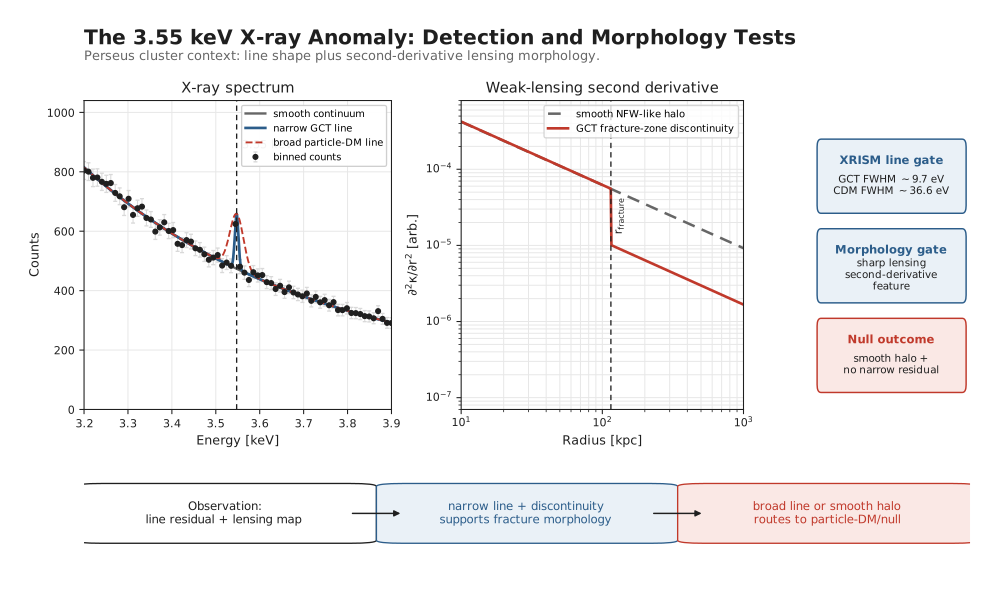
- Sterile Neutrino Model: The decay line is intrinsically narrow; the observed profile is set by cluster-virial broadening, instrument response, stacking, morphology, and background/atomic-line modelling. A eV FWHM scale is a cluster-environment diagnostic, not a standalone particle-DM theorem.
- GCT Model: Predicts a narrow Lorentzian intrinsic profile ( eV) convolved with the same instrumental response and foreground/background model, with morphology and flux consistency carrying equal decision weight.
11.4.2 Tier 3 Prediction: Dark Matter Evaporation
GCT makes a unique cosmological prediction: Dark Matter Evaporation. Because fracture converts strain energy into photons, high-stress environments (cluster cores) should exhibit a measurable decrease in effective dark mass over Gyr timescales as the vacuum "bleeds" its stored tension. This provides a secondary test for the theory.
11.4.3 XRISM Protocol C
The XRISM Resolve microcalorimeter provides 5 eV resolution. Protocol C (Chapter 15) defines the preregistered decision framework for the XRISM line-shape audit. The operative verdict is not a standalone Lorentzian-vs-Gaussian split; it is the joint profile, flux, morphology, background-line, and cluster-virial-broadening comparison at the sensitivity required to resolve the signal.
11.4.4 XRISM Early-Data Status
XRISM has stacked 3.75 Megaseconds of early science data across ten galaxy clusters. Key results:
- Non-detection: XRISM's early data did not resolve the 3.55 keV line.
- Upper Limit: The 3σ upper limit on the photon decay rate is .
- Sensitivity Gap: This upper limit is 5 times weaker than the decay rate implied by the original Bulbul et al. XMM-Newton detection. XRISM's early data has therefore not yet reached the sensitivity required to confirm or rule out the signal.
- Physical Conclusion: The early XRISM data is physically inconclusive. It is consistent with both the GCT prediction and the standard sterile neutrino model. The null result does not falsify GCT; the theory requires photon statistics beyond the current 3.75 Ms stacking depth.
[!IMPORTANT] GCT Prediction Under Test. The current XRISM non-detection is sensitivity-limited and does not adjudicate the frozen above- aperture. A definitive terminal no-line verdict requires the Bulbul-level Protocol C floor in the mass-weighted stress-gated regions of the stacked XRISM cluster sample; the 26 Ms / stack is the morphology-linewidth milestone. The Perseus core alone is sub-threshold and is not a Protocol C falsification point.
[!WARNING] K-XVIII Contamination Flag (3.514 keV) [Tier 2 Conditional]: The formal GCT centroid registered for the topological-defect signal is keV; the broader phrase "3.5 keV line complex" is only shorthand for the crowded observational band. This lies perilously close to the Potassium K-XVIII atomic transition line at 3.514 keV. While pristine microcalorimeter resolution (XRISM Resolve eV FWHM at 3.55 keV; Ishisaki et al. 2022, Proc. SPIE 12181:121811S (DOI 10.1117/12.2630654)) can in principle resolve the separation (ΔE ≈ 34.6 eV, from the formal GCT centroid 3.5486 keV vs the K-XVIII line at 3.514 keV), plasma-line flux modeling, gain/background systematics, and multiplet confusion can still blend the practical inference even when thermal broadening alone is not large enough to erase the centroid separation. Ruling: Any future detection of a line complex near 3.5 keV must explicitly fit and subtract the K-XVIII flux model before the residual can be claimed as the GCT 3.55 keV topological signal.
11.4.5 HBT Photon Bunching () [Tier 2 Prediction]
GCT makes a second, independent prediction for the 3.55 keV signal that is inaccessible to all particle dark matter models: a Hanbury-Brown-Twiss (HBT) photon bunching signature.
Physical Argument: Standard decaying dark matter models (sterile neutrinos, axion-like particles) predict uncorrelated, single-photon emission events. Each decay is independent, producing a Poissonian photon stream with second-order correlation function:
GCT predicts that the 3.55 keV signal arises from quantized lattice fracture — a mechanical cascade in which a Vorton collapse necessarily triggers adjacent bond-snaps within the phason relaxation timescale ( s). Because multiple bonds snap as a correlated group, the radiated photons are emitted in correlated pairs or clusters within this window, producing a super-Poissonian (bunched) photon stream. For the minimal cascade of two correlated photon emissions per Vorton collapse event, the predicted second-order coherence function at zero time delay is:
This prediction has the following properties:
- Binary discriminant: rules GCT out; rules standard particle DM models out.
- Instrument Requirements [Structural Note]: The HBT correlation requires two-photon coincidence measurements with sub-nanosecond timing resolution. XRISM Resolve microcalorimeter has a timing resolution of ~50 microseconds, which is ~50,000× too slow to resolve the temporal structure of X-ray photon bunching.
Instrument scope: Athena X-IFU and LEM-class microcalorimeter concepts improve spectroscopy and imaging for the 3.55 keV line, but they are not registered here as sub-nanosecond X-ray HBT instruments. The bunching test requires a future high-time-resolution X-ray observatory or laboratory astrophysics analogue with demonstrated sub-ns photon-coincidence timing at 3.55 keV.
- Independent of line shape: Even if the line-profile/morphology/background audit remains inconclusive due to source confusion, the bunching test provides an orthogonal axis of falsification.
- Status: The HBT prediction is NOT falsified by XRISM's non-detection. Rather, XRISM is instrumentally unsuitable for this test. The prediction is pre-registered as a future-generation high-time-resolution X-ray test with the explicit sub-ns coincidence requirement above.
11.4.6 The Spatial Cross-Correlation Mapping: Shear Gradient vs. Density Squared
Standard annihilating dark matter models demand that the flux of a line signal follows the line-of-sight integral of the dark matter density squared (), while decaying sterile-neutrino models follow the density itself.
GCT predicts a radically different spatial morphology. Because the 3.55 keV emission is Vacuum Triboluminescence—the discrete snapping of the topological glass under mechanical stress—the emission rate is governed by the local macroscopic strain. Therefore, the X-ray flux must scale non-linearly with the local gradient of the cluster's gravitational shear stress tensor (), maximizing in active merger shocks and regions of maximum orbital disruption, rather than seamlessly following the smooth core density profile.
This constitutes a candidate falsifiable spatial mapping test for XRISM and Athena follow-up: high-resolution spatial mapping of any confirmed 3.55 keV line should either follow a smooth density profile ( for decay, for annihilation; either falsifies the GCT morphology at decisive sensitivity) or trace the registered shear-boundary template. Protocol C freezes the stress aperture numerically at , using the Perseus-core / Bullet-shock pressure bracket; the target cells and morphology power rule are listed in Ch15 §15.1.4. Current Hitomi/XRISM coverage is insufficient for the stress-gated null; the test becomes definitive only after the XRISM cluster-survey aperture is above this frozen threshold, reaches the Ch15 sensitivity floor, and is followed up with Athena-class spatial/spectral mapping.
11.4.7 High-Frequency Gravitational Wave Cross-Correlation
The absolute, definitive discriminator between decaying particle dark matter (like sterile neutrinos) and GCT's Vacuum Triboluminescence is the High-Frequency Gravitational Wave (HFGW) Cross-Correlation.
When the topological glass of the vacuum fractures, snapping bonds to release the 3.55 keV Vorton energy, this mechanical event must necessarily propagate acoustic phonons through the vacuum lattice. In the 3D projection (), this macroscopic lattice vibration manifests as a burst of High-Frequency Gravitational Waves in the 1-100 MHz band.
Therefore, a 3.55 keV XRISM X-ray line accompanied by a temporally and spatially matched 1-100 MHz HFGW burst would support the mechanical-fracture interpretation as an auxiliary discriminator. A decaying sterile neutrino would emit a 3.55 keV X-ray photon without the correlated gravitational shockwave. HFGW co-detection is not part of the operative P.3 linewidth/morphology gate and cannot by itself validate the geometric-vacuum interpretation; it is a Tier 4/currently non-operative cross-channel check.
11.4.8 Weak Lensing Shear Discontinuity: Dark Matter Fracture Morphology Target [Tier 2 mechanism + Tier 3 map implementation]
GCT makes a mathematically sharp morphology claim for dark matter in merging galaxy clusters: a topological-glass fracture boundary should produce a weak-lensing shear discontinuity co-spatial with the stress-gated 3.55 keV emission region. This is a diagnostic target pending an executable lensing-map pipeline, not yet a closed observational verdict from the current postulate set.
Physical Argument. In GCT, dark matter is the Topological Glass of the vacuum supersolid (§11.2.1). Like all glasses, it undergoes a first-order fracture transition when the applied stress exceeds the yield strength (§11.1.3). This fracture is a sharp phase boundary: on one side, the glass is intact (elastic regime, no emission); on the other, it is fractured (post-yield regime, emitting 3.55 keV). Because the vacuum is a supersolid with global phase coherence (§11.2.1), the fracture front propagates coherently, producing a mathematically sharp phase-transition boundary in the dark matter distribution.
The Observable: Second Derivative of Weak Lensing Convergence. The weak lensing convergence map encodes the projected dark matter surface mass density via . For a smooth NFW profile (collisionless particulate dark matter), is continuous and has no sharp features. For a topological glass undergoing fracture, the fracture boundary produces a mathematically sharp discontinuity in the second derivative at the radial position where the local shear stress equals .
GCT Prediction [Tier 2]:
At the fracture boundary of merging galaxy clusters (e.g., El Gordo, ACT-CL J0102-4915; the Bullet Cluster, 1E 0657-56), the second derivative of the weak lensing convergence map exhibits a sharp discontinuity (a step-function change in ) at the boundary of the shear fracture zone. The position of this discontinuity coincides exactly with the boundary of the 3.55 keV X-ray emission region.
Collisionless particulate dark matter (NFW, or any smooth halo profile) does not naturally produce this sharp phase-transition feature. NFW profiles are infinitely differentiable; their convergence maps have no kinks or discontinuities in any finite derivative. A detected discontinuity in co-spatial with the 3.55 keV emission boundary would support a fracture-boundary interpretation and challenge smooth-halo fits under a registered lensing-map pipeline.
This is a diagnostic morphology target pending executable lensing-map implementation:
- The position of the discontinuity is controlled by , with derived from the AKN tiling-flip condition and the operative cluster-scale normalization of / pressure units calibrated by the bracket keV/cm in §11.1.4. The existence and morphology of the discontinuity are the Tier 2 mechanism-level test; the specific cluster-fracture threshold location is Tier 3 calibrated pending XRISM cluster-subclass closure.
- The existence of the discontinuity depends only on whether dark matter is a glass (sharp fracture: GCT) or a collisionless gas (smooth: particle DM).
- No continuous fit is added to the qualitative discontinuity claim. The numerical boundary location inherits the Tier 3 bracket, and a decisive inference requires a registered lensing-map pipeline with shear calibration, smoothing-kernel, and line-of-sight projection systematics before any binary confirmation/falsification language is operative.
Instrument Specification: Current weak lensing data from the Hubble Space Telescope (ACS, WFC3) and Subaru Hyper Suprime-Cam (HSC) for El Gordo and the Bullet Cluster achieve angular resolutions of , sufficient in principle to probe the shear profile at the fracture boundary. Rubin/LSST and Euclid provide the statistical power to search for this feature across large merging cluster samples. Deep, high-resolution lensing maps with background source galaxies per arcmin are required to detect the second-derivative discontinuity at significance under a registered pipeline.
END OF CHAPTER 11