Front Matter
The Epistemic Tier System
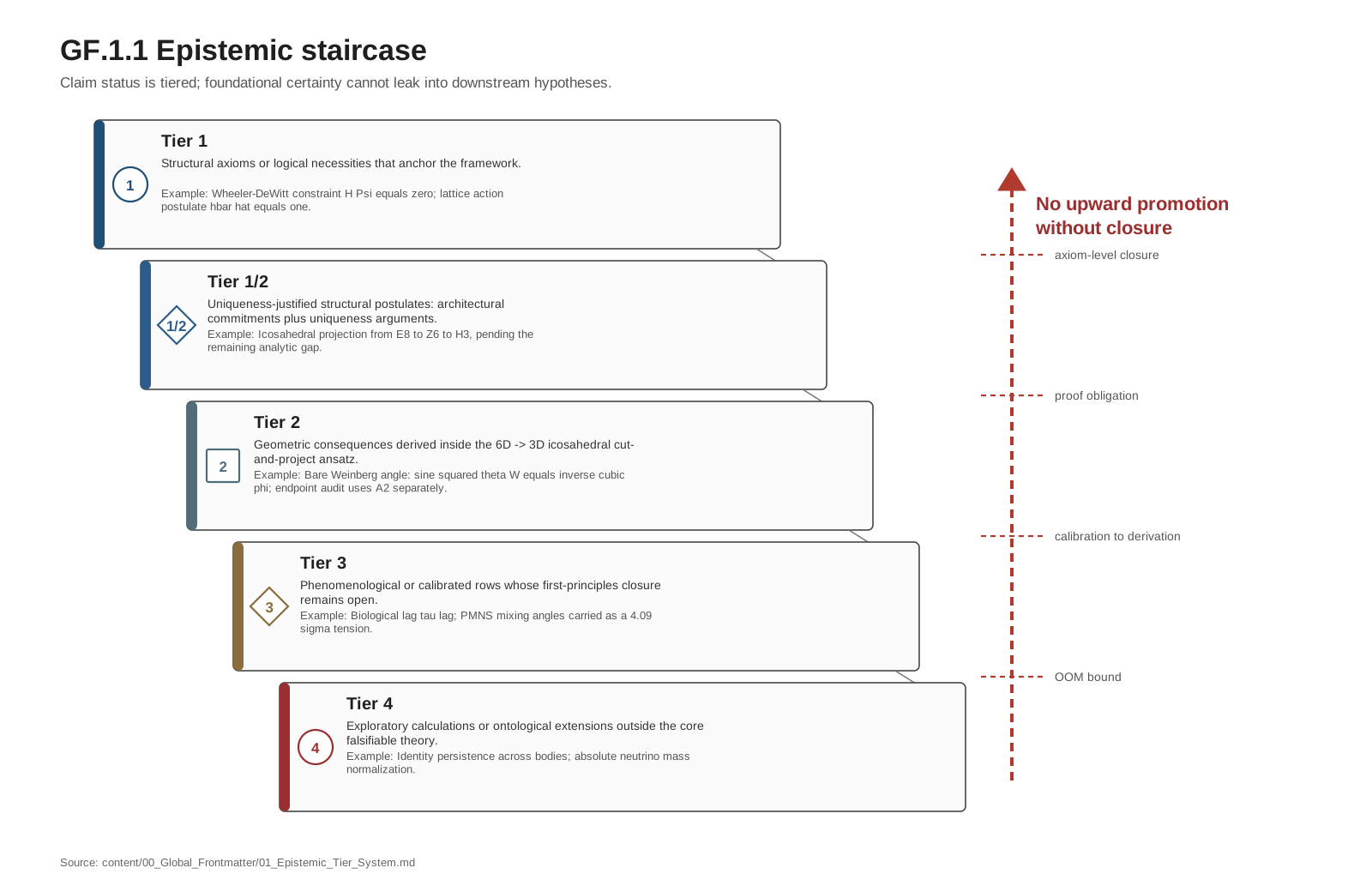
In the interest of scientific rigor and epistemic discipline, we categorize the claims in this text according to a strict epistemic hierarchy. We distinguish between what is logically forced by the axioms, what follows robustly from the specific geometric projection ansatz, and what remains calibrated phenomenology.
-
Tier 1 (Structural / Axiomatic): Foundational axioms and logical necessities that define the GCT framework. These are either postulated as irreducible starting assumptions, or proven by contradiction to be the unique consistent solution. If these axioms are true, the subsequent Tier 2 results must follow.
-
Examples: The Wheeler–DeWitt constraint ; the Lattice Action Postulate (); the masslessness of the photon ().
-
Note: Tier 1 denotes either a structural axiom or a proof of logical necessity. These are the irreducible assumptions and forced conclusions that anchor the entire theoretical edifice.
-
Tier 1/2 (Uniqueness-Justified Structural Postulate): Results that are uniquely forced by a combination of parsimony, empirical adequacy, and the Uniqueness Absolute, but where the requirement to impose those constraints is itself an architectural commitment not deductively forced by the Ontological Axioms alone.
-
Examples: The Icosahedral Projection (): justified by the Uniqueness Absolute (§12.6); the unique discrete projection satisfying parsimony, spinoriality, empirical adequacy, and maximal finite point symmetry — but the choice to require those constraints is itself a Structural Postulate. Isotropy alone does not select , since and also satisfy macroscopic finite-point isotropy.
-
Tier 2 (Geometric / Derived): Rigorous mathematical consequences derived from the Tier 1 axioms combined with the specific 6D3D icosahedral cut-and-project ansatz. These results are structurally robust within the quasicrystalline vacuum identification.
-
Examples: The Gauge Group Structure (): a candidate mechanism from the icosahedral RT-window ansatz plus Tier 3 numerical-control gauge-uniqueness sweep; theorem-grade uniqueness over the full Cartan-Killing classification remains App H O.39, and the spectral-triple identification with the physical Standard Model remains conditional on O.32. The Weinberg Angle bare prediction is Tier 1 algebraic value (App U §U.9) plus Tier 2 physical identification, with the Z-pole RGE endpoint check separately using the disclosed Tier 3 A2 boundary. The Fine-Structure Constant bare mechanism is Tier 2 mechanism with the specific 360 multiplier and anti-screening closure tracked under O.19/O.5. The Electron Mass chain is Tier 2 mechanism plus the Tier 4 O.14 physical-link conjecture. The Lepton Mass Ratios have a Tier 2 harmonic-ladder mechanism plus Tier 3 specific integer anchors and pole-mass residuals pending O.5/O.14/O.15. The Proton Mass is Tier 2 mechanism plus a Tier 3 sheet/exponent handle pending AKN-action closure. Newton's G has a Tier 2 thermodynamic/acoustic mechanism, but its numerical Planck-link inherits the Tier 4 O.14 physical-link conjecture and the Tier 3 dimensional anchor. The Higgs VEV is Tier 2 mechanism plus Tier 3 calibrated integer factor and inherited numerical residual. The Light Quark Mass Hierarchy and CKM Mixing Angles are mixed Tier 2/3 sector claims, with the down-quark route in current R=2 tension and higher CKM angles remaining Tier 3 ansätze. The Spin-Statistics Theorem is Tier 2; the algebraic-topology step (WZW evaluation, normalization of the generator of ) is closed at Tier 1, and full Tier 1 elevation of the complete result is reduced to a single bounded analytic step (Lemma T-McK.1b, App U §U.7.6.3 — APS spectral-flow computation of the icosahedral -invariant on ). The Dark Energy Coupling () is Tier 3 (Phenomenological) per the Prediction-Postdiction Firewall — it is a calibrated fit, not a first-principles derivation.
-
Born-rule example: The Born Rule is a Tier 3 conditional compatibility theorem pending O.40a/O.40b additivity and noncontextuality closure. The PMNS mixing angles are provisionally Tier 3 (Tension) pending resolution of the tension documented in App_T.
-
Tier 3 (Phenomenological / Calibrated): Models calibrated to observation where a first-principles derivation is currently incomplete (e.g., requiring full non-perturbative simulation of defect ensembles or horizon-scale boundary conditions). Applies to any sector — biophysical, cosmological, or phenomenological — where free parameters are adjusted to match empirical anchors and a geometric derivation is pending.
-
Examples: Biological lag calculations (); Chiral Enhancement Factors in tubulin; the Consensus Decay Constant (, pending derivation from phason stiffness ratio , V1 Ch11 §11.2.4); the PMNS mixing angles (Tier 3 Tension, ); the equation of state (sustained phantom phase asymptoting to from below; observational distinguishability threshold at per V2 Ch14 §14.6.3).
-
Tier 4 (Speculative / Exploratory): Claims that are either (a) exploratory calculations where the dimensional structure is correct but the numerical coefficient is uncertain by >1 order of magnitude (with explicit OOM bounds), or (b) ontological extensions that lie outside the core falsifiable theory (identity persistence after biological termination, trans-temporal identity correlations). All Tier 4 claims are omitted from journal submissions.
-
Examples (Exploratory): Biogenic dark energy driving force magnitudes; neutrino mass scale absolute normalization.
-
Examples (Ontological): Identity persistence across bodies; consciousness continuity in reversible computational states.
Note on Computational Closure: The Tier 2 analytic derivations of the lepton and quark mass hierarchies remain subject to computational verification via the full non-perturbative spectrum of the defect cage Hessian. The pathway to Tier 1 computational certainty is defined in Chapter 13 (Open Problem O.5).
This classification ensures that the framework is transparent regarding its levels of certainty, separating axiomatic assumptions from geometric derivations, phenomenological fitting, and exploratory/ontological extensions.