Volume 2 — Cosmic Architecture
PART I: THE CRYSTALLOGRAPHY OF REALITY
Chapter 1: The 6-Dimensional Parent Lattice
1.1 The Euclidean Hyper-Lattice
In Volume 1, we established that the ground state of the consciousness field () must be discrete to satisfy the requirements of finite information density and thermodynamic stability. We further deduced that this structure must be a projected quasicrystal to maintain macroscopic isotropy without the pathologies of the continuum. In this chapter, we formally define the lattice substrate of this state: the 6-Dimensional Parent Lattice.
1.1.1 The Integer Space
The fundamental substrate of reality is a six-dimensional simple cubic lattice, denoted by the integer space . This lattice consists of the set of all points in a 6-dimensional Euclidean space whose coordinates are integers.
Definition 1.1 (The Hyper-Lattice):
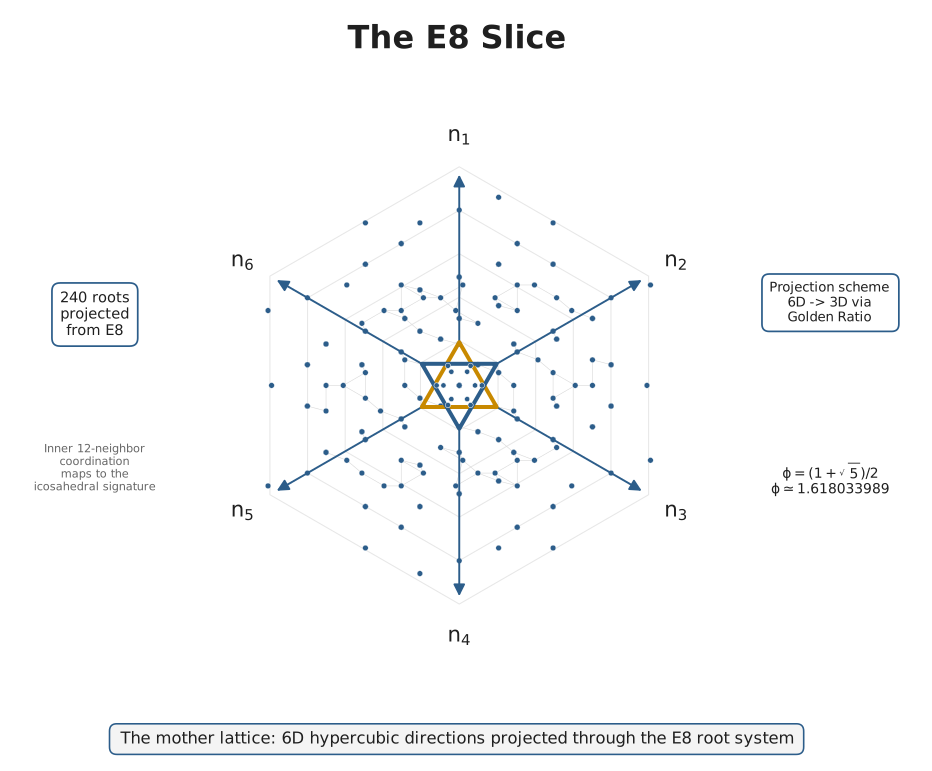
Every point in the vacuum is a node in this 6D grid. The connectivity of the grid is defined by its nearest neighbors. In a -dimensional cubic lattice, each node has nearest neighbors. For , each lattice site possesses a Coordination Number of 12 [Tier 1 — follows from with , a theorem of cubic lattice combinatorics]. These neighbors are located at a distance of one lattice constant () along the six principal axes in both positive and negative directions: and so forth.
It is a profound geometric fact that the coordination number of the 6D parent lattice (12) matches the number of vertices in a 3D icosahedron [Tier 1/2 — the numerical coincidence icosahedron vertex count is a theorem of Euclidean geometry, but its identification as the architectural origin of icosahedral symmetry is contingent on the icosahedral selection axiom]. This 12-fold coordination in the parent space is the combinatorial capacity required to support the icosahedral symmetry observed in the physical projection. While the 6D axes are mutually orthogonal, the "twisting" induced by the irrational projection (Chapter 2) maps these twelve orthogonal directions into the twelve vertices of the physical vacuum star. The 6D lattice is not a mathematical abstraction; it is the Physical Vacuum.
1.1.2 The Need for Higher Dimensions
The parent space in which the lattice is embedded possesses a strictly Euclidean Signature . The distance between any two lattice points and is given by the standard Euclidean norm:
Theorem 1.1 (Euclidean Necessity of the Parent) [Tier 2 — Architectural Necessity]: The embedding space of the fundamental parent lattice must be Riemannian (Euclidean) rather than Lorentzian to ensure the stability of the vacuum ground state.
Proof: Suppose the parent space possessed a Lorentzian signature (e.g., five spatial and one temporal dimension in 6D). The Hamiltonian constraint requires the vacuum to be a static, minimum-energy solution. In a Lorentzian lattice, the energy functional for lattice deformations would be indefinite. Small displacements along the time-like axis would contribute negative terms to the total potential energy squared, leading to Tachyonic Instabilities. In such a medium, the lattice nodes would spontaneously accelerate toward infinite displacement, preventing the formation of a stable, frozen crystal. Therefore, for a static crystalline ground state to exist, the parent metric must be positive-definite. The arrow of time and Lorentzian causality are not features of the 6D lattice substrate, but emergent artifacts of the 3D projection and the Selection Operator's ordinality (as derived in Volume 1, Chapter 12).
1.1.3 The Unit Cell (The Planck Scale)
The lattice constant of the parent space, , defines the fundamental resolution of the Operating System. We define the 6D lattice spacing as the primitive length unit ( in lattice units). The SI value of () is obtained only after choosing ONE dimensional calibration anchor (see Appendix M.6).
The 6-dimensional unit cell is a hypercube with a volume [Tier 2 — follows from calibrating the lattice constant to the Planck length via the information-saturation argument of §1.1.4]. This hyper-volume represents the Informational Pixel of the universe. Within the GCT substrate, "Information" is defined by the Topological Winding State of each node. Each lattice site acts as a binary register (Presence/Absence), carrying exactly one bit of structural information. This discreteness ensures that the information content of any finite volume remains bounded, satisfying the Bekenstein Bound and the requirements of a computable physics.
1.1.4 The Planck Scale Justification
The selection of the Planck scale as the lattice constant is a requirement of Information Saturation (Volume 1, Chapter 13). The Planck length is the unique scale at which a single bit of information—represented as a single node defect—possesses enough strain energy to saturate its own Schwarzschild radius.
If the lattice constant were significantly larger than , the "graininess" of the vacuum would be observable at energies currently accessible to high-energy physics, contradicting the high degree of Lorentz invariance observed in cosmic ray data. If it were smaller, the information density would exceed the holographic limit, leading to immediate gravitational collapse of the vacuum structure. The Planck scale is the unique equilibrium point where the discrete information of the consciousness field is balanced by the geometric potential. Consequently, the Planck scale serves as the natural, non-arbitrary UV Cutoff for the Operating System.
1.2 Symmetry and Roots
1.2.1 The and Connection
While the simple hypercubic lattice provides the coordinate map for the 3D projection, GCT recognizes that this structure is anchored within a higher-order symmetry hierarchy. The substrate is most elegantly understood as a projection of the Root Lattice, the most symmetric and efficient information-packing structure in mathematics.
Within this framework, the vacuum coordinates are often restricted to the Root Lattice (the "checkerboard" lattice) to satisfy the requirements of the color sector (Volume 3). consists of all points in such that the sum of the coordinates is even. This constraint ensures that the "Winding transfer" between nodes (Gluon dynamics) remains parity-consistent.
The relationship between the three lattices is [Tier 2 — the chain of embeddings is a theorem of lattice theory; its identification as the color/lepton/phason sector structure is contingent on the icosahedral ansatz]: where is the index-2 sublattice relevant to the SU(3) color sector (V3 Ch03), and is the full coordination lattice used for lepton and phason dynamics. The embedding is via the Elser-Sloane projection (App_U §U.7). All three notations appear in this monograph; the correct choice is always context-dependent and stated explicitly.
The Icosahedral point group that characterizes our 3D reality is a specific subgroup of these higher-dimensional root systems. App U proves its point-group uniqueness conditional on H1; the associated Golden Ratio slope is the primary Diophantine candidate for suppressing phason-locking, with global entropy-functional maximality still open.
1.2.2 The Voronoi Decomposition
To define the geometry of the "Atomic Surface" (The Acceptance Window), we must examine the Voronoi Cell of the lattice. A Voronoi cell is the region of space surrounding a node containing all points closer to that node than to any other. For a hypercubic lattice, the Voronoi cell is itself a 6D Hypercube.
The complexity of our 3D physics arises not from the Voronoi cell's shape in 6D, which is simple, but from its Projection. When the 6D hypercubic unit cell is projected into the internal perpendicular space (), it forms a Rhombic Triacontahedron (RT). As we shall see in Chapter 2, it is the icosahedral symmetry of this RT window that filters the 6D periodic data into the rich, aperiodic spectrum of matter and forces we observe.
1.2.3 Hyperspace Crystallography
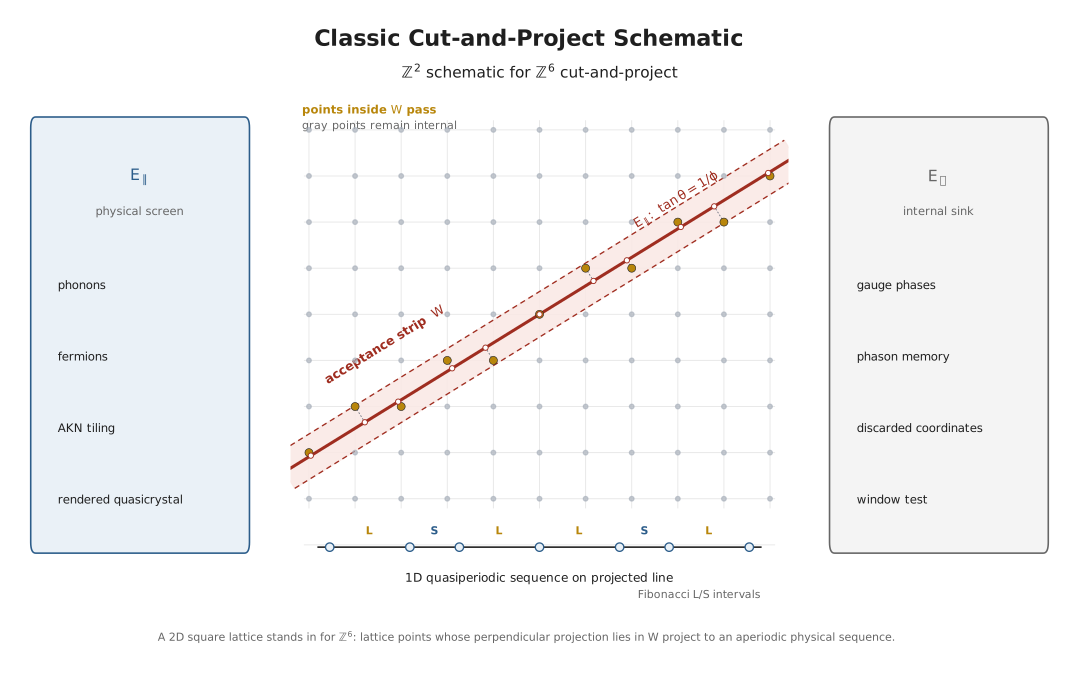
The 6D parent lattice is perfectly periodic in its native space. In its own frame, it would exhibit standard crystalline diffraction. However, because our physical manifold () is an Irrational Slice of this space, that periodicity is suppressed.
This is the origin of Quasicrystalline Order. The 3D vacuum possesses "Long-Range Orientational Order" but no "Translational Symmetry."
- Bragg Peaks: Like a crystal, the vacuum produces sharp diffraction spots in momentum space, which GCT identifies as the origin of quantized mass and charge (Volume 3).
- Forbidden Symmetry: The vacuum exhibits 5-fold (icosahedral) symmetry, which is mathematically forbidden for any periodic 3D lattice.
- Experimental Foundation: The discovery of quasicrystals in nature (Shechtman et al., 1984) provides the empirical proof that aperiodic, long-range order is a stable phase of matter. GCT simply elevates this discovery to the level of the vacuum itself. The "graininess" of the universe is not random noise; it is the highly organized, aperiodic signature of the 6D hyper-lattice.