Volume 2 — Cosmic Architecture
Chapter 14: The Phason Vacuum and Dark Energy
[!NOTE] Epistemic Status [Tier 2 / Tier 3]: This chapter presents the dark energy sector in two parts. Part A (§14.1–14.2) establishes the Tier 2 mechanism: the equation of state from the frozen phason vacuum and the holographic-entanglement route to the cosmological-constant scale. The absolute magnitude of remains Tier 3 pending RG-running / condensate-normalisation closure (App H O.1/O.4/O.13), matching Parameter Ledger §0.1. Part B (§14.3–14.8) presents the Biogenic Dark Energy correlation — a Tier 3 phenomenological extension connecting biological information processing to the vacuum phason field. The biogenic coupling is a Tier 3 structural fit whose saddle-point derivation is presented in §14.3.1.
This chapter presents GCT's approach to dark energy in two distinct parts. Part A derives the equation-of-state mechanism from the geometric structure of the phason vacuum at Tier 2, while the absolute energy scale remains Tier 3 pending RG-running / condensate-normalisation closure. Part B presents the biogenic correlation hypothesis — a Tier 3 speculative extension connecting biological information processing to the vacuum phason field. These two parts are epistemically independent: Part A can stand without Part B, but Part B requires Part A as its physical foundation.
14.1 Phason Vacuum Cosmology [Tier 2] (Part A)
14.1.1 The Frozen Phason Field and w = −1
The GCT vacuum is in the frozen phason phase at temperatures below (Volume 2, Chapter 3). In this phase, phason displacements are quenched: they carry an energy density that is constant in time (independent of the scale factor ), because frozen phasons cannot dynamically relax their strain. A constant vacuum energy density is the defining property of a cosmological constant.
Tier 2 Prediction: GCT predicts exactly for the frozen phason vacuum, for the same reason that a quenched elastic strain in any material does not dilute with volume: its energy is topological, not kinetic.
This prediction is not a tuning — it is a structural consequence of the phason being frozen. It provides a geometric explanation for why the equation of state is rather than (radiation) or (matter).
14.1.2 The Continuous Phantom Phase as Phason Activation
The DES-Dovekie recalibrated DESI DR2 + CMB CPL fit is sign-opposite to the GCT single-channel biogenic prediction, with joint dynamical-DE significance 3.2σ (arXiv:2511.07517): the GCT-biogenic asymptotes to from below without a physical crossing of the boundary, whereas the DES-Dovekie CPL central fit corresponds to a low-redshift linearized trajectory with the opposite orientation. Observational distinguishability is therefore registered as O.13 closure path C1, not as direct DESI support for the single-channel biogenic curve. In GCT, any confirmed state-level signal requires the phason field to be activated — partially unfrozen — so that the negative pressure of the internal manifold exceeds the resting frozen-state value. This occurs when the phason relaxation time falls below the Hubble time.
Tier 3 Conditional Inference: If is confirmed at high significance, this points to [Tier 3 conditional], implying that the vacuum is currently near its phason freezing transition. This would connect directly to the biophysical prediction eV [Tier 3]: biological systems operating at body temperature would be near the same freezing transition, making consciousness intrinsically sensitive to the equation of state of dark energy.
14.1.3 The Operative Phason Mass Gap and Dark Energy Density
The operative biogenic-DE quartic mass scale is currently a Tier 3 empirical parameter: eV
This value is an empirical inference pending formal geometric derivation from the 6D lattice locking potential. It is NOT currently derived from first principles; it is a phenomenological postdiction subject to experimental test. It is distinct from the Tier-3 Weinberg-coincidence candidate meV (O.37), and from the Hubble energy eV.
The App_M scalar-condensate formula is a schematic coupling relation, ,
where is the phason condensate amplitude set by the locking potential . This formula is NOT the naive relation (which incorrectly assumes a zero-temperature, free-field result), and it does NOT identify with . The condensate formula requires knowledge of and the quartic coupling normalization, which is part of Open Problem O.1.
The zero-temperature free-field formula is inapplicable here: it yields J/m³ for eV — nine orders of magnitude below the observed J/m³, and therefore does not capture the condensate physics. The observed density is expressed canonically in this chapter by the Friedmann/area-law form ; this uses and as cosmological inputs until O.4 closes.
[!IMPORTANT] Firewall Metadata[Phason Mass Gap]
- Type: Calibrated Empirical Estimate
- Value: eV
- Status: Tier 3 operative biogenic-DE quartic scale pending Tier 2 geometric derivation from locking-potential curvature and coupling normalization; the Weinberg-coincidence scale is separate O.37 material, and is not a direct phason-mass constraint.
14.1.4 Theorem: Non-Equivalence of O.1 and O.4 Scale Closures [Tier 2 mechanism + Tier 3 absolute scale]
Theorem 14.1.4 (Conditional Dark-Energy Chain): Given a dark-energy density and assuming (standard cosmology), the Hubble constant is fixed by the Friedmann relation:
Proof: Step 1 (Tier 2 mechanism, Tier 3 normalization): the frozen-phason condensate can contribute only after curvature and condensate normalization are specified. Step 2 (exact): via Friedmann: . Step 3 (scale discipline): , , and are three distinct quantities. The first is the operative quartic mass scale, the second is an O.37 coincidence ansatz, and the third is the Hubble energy scale that enters through the Friedmann/area-law expression.
Steps 2–3 are rigorous. Step 1 remains an O.1 coupling-normalization problem.
Corollary: Open Problem O.4 (derive ) is coupled to, but not identical with, Open Problem O.1 (derive and the condensate normalization). Solving O.1 alone does not determine unless , the quartic coupling, and are also fixed. □
Consistency check (KZ self-consistency): The Kibble-Zurek mechanism applied to the GCT crystallization gives a defect correlation length at formation. The requirement today (Hubble radius) is satisfied when . This is not a derivation of (circular) but confirms that GCT's cosmological history is internally self-consistent: a lattice that crystallized at the Planck epoch via KZ naturally has a phason correlation length equal to the Hubble radius today.
14.1.5 Holographic Entanglement Entropy Derivation of [Tier 2 area-law + Tier 1 partial Hartle-Hawking boundary state; Tier 3 absolute magnitude pending Open Problem O.4]
Scope of this section [read first]. What is derived here is the area-law form of the cosmological constant within the holographic entanglement-entropy framework, and the identification of the Bekenstein-Hawking area ratio with the GCT critical susceptibility of the projection. What is not derived here is the absolute magnitude of from GCT first principles: the formula evaluates to the observed value because the Hubble constant and matter fraction are imported from Planck 2018. A first-principles GCT derivation of remains Open Problem O.4; a first-principles derivation of and the condensate normalization remains Open Problem O.1. These problems are coupled through but are not the same scale identity. This section is therefore best read as a consistency check of the GCT holographic apparatus against the Planck-anchored cosmological-constant value, not as a first-principles derivation of from alone.
The area-law content. The effective cosmological constant is identified with the entanglement entropy of the projection via the Bekenstein-Hawking area law applied to the cosmic event horizon. In the GCT framework, the physical manifold is a projection of the parent lattice . The degrees of freedom in the complementary space are not locally accessible from within ; they constitute an entangled environment whose boundary is the cosmic event horizon at comoving radius .
We make the Ryu-Takayanagi route explicit by writing each step. The Ryu-Takayanagi formula (Ryu and Takayanagi 2006) identifies the entanglement entropy of a region in the boundary theory with the area of the extremal codimension-2 surface in the bulk that is homologous to : where is the bulk Newton constant. For a static de Sitter cosmology the relevant extremal surface bounding the patch causally accessible to a comoving observer is the cosmic event horizon at (Bousso 2002 covariant extension of the Bekenstein-Hawking area bound), and its area is
Step 1 — Apply RT to the de Sitter horizon.
Step 2 — Translate to Planck units. In natural units , the Planck length is , so . Substituting: Restoring to give the dimensionless ratio in terms of the comoving horizon radius : which is manifestly the area of the de Sitter horizon in units of the Planck area, divided by (the tracks the factor of in ).
Step 3 — Identify . The dimensionless number is the Bekenstein-Hawking entropy of the de Sitter horizon in Planck units. We identify this with the critical susceptibility of §14.4:
Step 4 — From entropy to energy density. The vacuum energy density associated with the boundary entanglement follows from the Friedmann equation applied to the de Sitter horizon. Standard cosmology gives for the dark-energy component of a flat universe with matter fraction . Substituting (the GCT definition of Planck length), the geometric form of the holographic identity reads: At km/s/Mpc and (Planck 2018), this gives J/m³, matching the observed dark-energy density J/m³ to within the joint observational uncertainty on and (CMB + BAO 0.5% on , 1% on ).
The Planck-scale suppression arises geometrically from the dimensionless ratio — the square of the Planck length over the Hubble radius. No fine-tuning is required: the suppression is the holographic area ratio of the two natural scales of the lattice. The Tier 2 substance is the identification of this area ratio with the critical susceptibility of the projection (§14.4.3 / the boxed above), which is the geometric content that GCT contributes beyond standard cosmology; the dark-energy density formula itself is a re-derivation of the standard Friedmann result in -explicit form, which GCT reproduces but does not modify.
Why the susceptibility is , not just . The critical susceptibility introduced in §14.4 is identified with the same area-to-Planck-area ratio because the cosmic event horizon supplies the natural infrared cutoff of the projection — the boundary beyond which no information from is classically accessible — while the Planck length supplies the natural ultraviolet cutoff of the AKN lattice. The susceptibility is therefore a Tier 2 quantity in functional form whose physical interpretation is the total information capacity of the observable portion of the projection; the displayed numerical value remains Tier 3 because it imports the Planck 2018 pending O.4/O.1 closure.
Tier disambiguation — functional form vs numerical value. The identification carries two distinct tier components that must not be conflated:
| Component | Tier | What this component fixes |
|---|---|---|
| Functional form (the dimensionless BH-area ratio) | Tier 2 | The structural identification of the critical susceptibility with the entanglement entropy of the de Sitter horizon. This is what the Ryu-Takayanagi step closes (Steps 1-3 above); the functional form is forced by the cut-and-project / holographic-bulk-boundary correspondence and does not depend on the empirical value. |
| Numerical value at km/s/Mpc, | Tier 3 (inherited) | The specific numerical evaluation requires the empirical from Planck 2018 + the CODATA . GCT does not yet derive from first principles; the absolute magnitude is therefore a state-level import per §R.0, not a derivation output. |
The §R.6 row on inherits the Tier 3 numerical-value disposition; the §R.6 row on dark-energy magnitude inherits the same. The Tier 2 mechanism (holographic area-law identification) is preserved separately from the Tier 3 evaluation (numerical value). A first-principles GCT derivation of from the non-linear phason locking potential (Theorem 14.1.4) would close the Tier 3 numerical-value side and lift the entire -and- row to Tier 2 unconditionally — this is the load-bearing content of Open Problem O.4 (whose scale-closure is non-equivalent to O.1 per Theorem 14.1.4). Until O.4 closes, the headline value is reported with the Tier 3 inheritance discipline above; the area-law identification remains Tier 2 in functional form regardless of the numerical-evaluation conditionality.
Hartle-Hawking boundary-state derivation [Tier 1 partial]. The area-law identification above is the Bekenstein-Hawking semi-classical result invoked via the Ryu-Takayanagi formula. A more rigorous boundary-state construction proceeds via the Euclidean Hartle-Hawking state (Hartle & Hawking 1983 Phys. Rev. D 28:2960). Euclidean is the four-sphere of radius ; the Hartle-Hawking state is the Euclidean path integral
over half of bounded by the equatorial (the cosmic event horizon at analytic continuation ). The reduced density matrix on one hemisphere, traced over the complementary hemisphere, has entanglement entropy across the equator computed via the replica trick (Calabrese & Cardy 2004 J. Stat. Mech. P06002):
This is more rigorous than the area-law identification alone: the Hartle-Hawking construction produces the boundary state via Euclidean path integral, with explicit entanglement-entropy derivation across the cosmic-horizon bisecting . The three-way identification is verified numerically by GCT_Physics_Engine/src/protocol_o6_dscft_hartle_hawking.py to within relative precision at the standard Planck .
Symmetry-level operator-matching audit for the phason scalar. The mass-dimension relation as written in this manuscript for a free scalar of mass in (radius ) is with . Solving the quadratic gives
For the Tier-3 Weinberg-candidate scalar meV (treated as an ansatz with in this symmetry-level dS/CFT matching exercise), the boundary operator dimensions are
They are not golden-ratio squares and do not sit in the simple complementary-series interval. The result follows only under the alternate dS-sign convention ; it is therefore retained only as an alternate-sign diagnostic, not as a closure claim. Scale discipline: this Weinberg-candidate scalar is not the operative biogenic-DE quartic mass scale eV, and it is not the Hubble energy eV. The dark-energy density scale satisfies in natural units, but this is not a constraint on directly. The operative eV is fixed by the biogenic-DE quartic coupling, not by . Engine: GCT_Physics_Engine/src/protocol_o6_dscft_operator_matching.py.
The remaining open piece is the full Hilbert-space unitarity of (Strominger 2001 JHEP 10:034 conformal symmetry of ; Maldacena 2003 JHEP 05:013 non-normalizable wave functions; Anninos, Hartman & Strominger 2017 Class. Quant. Grav. 34:015009 higher-spin partial dictionary). The semi-classical Hartle-Hawking entry + sign-corrected symmetry-level audit are universal; the unitarity completion is upstream of any framework using and is not GCT-specific. Status: V2 §14.1.5 is Tier 2 (area-law identification, standard semi-classical) + Tier 1 partial (Hartle-Hawking boundary-state construction with explicit entanglement-entropy derivation) + sign-corrected free-scalar operator-dimension audit; pending Hilbert-space unitarity completion for full Tier 1.
[!IMPORTANT] Firewall Metadata [Holographic Derivation]
- Type: Tier 2 Geometric Identification (formula itself is the standard Friedmann result re-expressed via ; the Tier 2 substance is the identification of with the critical susceptibility)
- Inputs: (dimensional anchor), (observational cosmology anchor with phason-condensate interpretation via Theorem 14.1.4), (Planck length — derived from and ), (Planck 2018 cosmological composition — Tier 3 import)
- Degrees of Freedom: 0 fitted within the displayed Friedmann expression after the observational cosmology anchors are supplied; this is not an autonomous prediction of or .
- Key formula:
- Provenance: Standard Friedmann equation for with expressed in terms of . The Tier 2 content is the identification of with the holographic information capacity of the de Sitter horizon (per Gibbons-Hawking 1977 and Bousso 2002 covariant extension); the dS/CFT boundary-state derivation remains Open Problem O.6.
- Cited works: Gibbons, G. & Hawking, S. (1977), Phys. Rev. D 15, 2738 — "Cosmological event horizons, thermodynamics, and particle creation"; Bousso, R. (2002), Rev. Mod. Phys. 74, 825 — "The Holographic Principle"; Ryu, S. & Takayanagi, T. (2006), Phys. Rev. Lett. 96, 181602 — "Holographic Derivation of Entanglement Entropy from AdS/CFT" (cited for AdS analog; dS extension is Open Problem O.6).
14.1.5b AdS vs dS — Scope Note [Tier 2 / Tier 3]
The Ryu-Takayanagi formula was established rigorously in the AdS/CFT correspondence (anti-de Sitter bulk dual to a conformal field theory on the conformal boundary). Our observed universe is asymptotically de Sitter, not anti-de Sitter, and the dS/CFT correspondence — while a serious research program (Strominger 2001; Maldacena 2003) — does not have the same maturity as AdS/CFT. The scope question is: under what conditions is GCT's use of the RT area law legitimate when the bulk is de Sitter rather than anti-de Sitter?
What is shared between AdS and dS. Three structural features of the RT chain survive the AdS dS transition:
-
The area law itself. The Bekenstein-Hawking entropy is a property of any causal horizon — black hole, Rindler, de Sitter — and predates AdS/CFT by two decades (Bekenstein 1973; Hawking 1975; Gibbons and Hawking 1977 for the dS horizon specifically). The de Sitter horizon area saturates the Gibbons-Hawking bound, and the entropy is the de Sitter analogue of the AdS-RT formula at the same level of rigour as the Gibbons-Hawking result.
-
The extremal-surface identification. In both AdS and dS the cosmic horizon is the unique codimension-2 extremal surface in the bulk that is homologous to the boundary of the causal patch. The geometric statement "entanglement entropy of the accessible region horizon area " is therefore well-posed in both signatures. [Tier 2]
-
The Planck-area UV cutoff. The denominator in the area law is fixed by Newton's constant, not by the AdS curvature scale, so the numerical value of depends only on and , not on the global sign of the curvature.
What is not shared. Two features of full AdS/CFT do not extend cleanly to dS:
-
The boundary CFT interpretation. In AdS/CFT the boundary entanglement entropy is the entropy of a definite dual CFT. The dS/CFT proposal of Strominger (2001) and Maldacena (2003) gives a non-unitary Euclidean CFT on the future conformal infinity of dS; the dictionary between bulk and boundary observables is less developed and remains conjectural. GCT does not require this dictionary. What GCT requires is only the area-to-entropy relation at the de Sitter horizon, which is supplied by Gibbons-Hawking (1977) without any CFT input.
-
Holographic renormalisation. The technology that translates AdS bulk observables into boundary CFT correlators — counterterms, conformal anomalies, near-boundary expansions — is specific to AdS and does not transfer to dS. GCT does not invoke holographic renormalisation. The cosmological-constant derivation uses only and the geometric area of the dS horizon; no boundary correlator is computed.
Scope statement [Tier 2 for the area law; Tier 3 for any full dS/CFT extension]. GCT's holographic derivation of is legitimate in the appropriate-limit sense: it uses the area law that is rigorously established for any causal horizon (Bekenstein-Hawking, Gibbons-Hawking) and identifies the extremal surface that is uniquely fixed by the de Sitter geometry. It does not invoke the full dS/CFT correspondence and does not assume a boundary CFT exists. The phrase "Ryu-Takayanagi formula" is used here in the area-law sense — the geometric content of RT that survives the AdS dS transition — and not in the dS/CFT-duality sense. The horizon-area scaling is the same in both signatures; only the boundary-CFT interpretation differs, and GCT is independent of that interpretation.
[!NOTE] What would tighten this further. A first-principles dS/CFT derivation of the boundary state whose entanglement entropy is — analogous to the BTZ-vacuum derivation in AdS/CFT — would upgrade §14.1.5 from Tier 2 (area law) to Tier 1 (boundary-state derivation). This is recorded as Open Problem O.6 (dS/CFT Boundary State for ) in Appendix H §H.5. Until then, GCT's holographic use of RT is to be read as "the area-law subcase that does not require the full dS/CFT dictionary".
14.1.5c Action-Items Roadmap for §14.1.5 Tier-1 Promotion
The five steps below are the sequence required to upgrade §14.1.5 from Tier 2 (area law) to Tier 1 (boundary-state derivation):
The dS/CFT correspondence (Strominger 2001 JHEP 0110:034; Maldacena 2003 JHEP 0305:013) currently lacks the AdS-equivalent dictionary needed to derive the de Sitter horizon entropy from a boundary state. Closure of O.6 requires the following sequence:
-
dS bulk–boundary dictionary [Step 1 — Tier 2 framework target]. Establish the bulk-to-boundary mapping for asymptotically de Sitter spacetimes analogous to AdS/CFT's . For dS, the natural conformal boundary is future infinity (and/or past infinity ); the boundary CFT is non-unitary Euclidean and depends on the choice of the Euclidean vacuum (Bunch-Davies, alpha-vacua). This is active research (Anninos, Hartman, Strominger 2017 Class. Quant. Grav. 34:015009).
-
Explicit boundary state for static SdS [Step 2 — Tier 2 ansatz]. Construct the boundary state on whose reduced density matrix on the southern hemisphere reproduces the Bunch-Davies thermal state at inside the static patch. Verify by computing via standard entanglement-entropy techniques and confirming agreement with the Gibbons-Hawking area law .
-
Holographic energy-flux formula in dS [Step 3 — Tier 2]. Derive the analogue of AdS holographic stress-tensor for dS, , and verify that the vacuum-energy expectation reproduces .
-
First-principles check of [Step 4 — Tier 1 target]. Show that the dimensionless number is the unique Tier-1 quantity emerging from the boundary CFT central charge (or its dS-analog), not a Tier-2 area-law numerology. This is the substantive step that distinguishes Tier 2 (area law works) from Tier 1 (boundary state forces it).
-
GCT-specific consistency check [Step 5 — Tier 1 closure]. Verify that the dS/CFT boundary state of step 2 is compatible with the GCT holographic restriction at the de Sitter horizon. If compatible, step 5 closes O.6 and §14.1.5 elevates Tier 1. If incompatible, the de Sitter sector of GCT must be reformulated.
Estimated effort: steps 1–3 are active dS/CFT research where the GCT contribution is to publish the explicit boundary state for the SdS geometry (likely 1–2 papers / 6–12 months of focused work for a string-theorist with dS background); step 4 is the harder step and would constitute a substantive contribution to the dS/CFT program independently of GCT; step 5 is a GCT-internal compatibility check. Closure of even steps 1–3 (without step 4) would tighten §14.1.5 from Tier 2 (area law in any signature) to Tier 2+ (explicit dS boundary state validated).
Falsification path. If steps 1–3 reveal that no Bunch-Davies-equivalent boundary state can reproduce — i.e., the area law is incidentally true in dS but does not follow from a coherent boundary CFT — the §14.1.5 derivation of must be reframed as "Tier 3 numerical coincidence" rather than "Tier 2 holographic derivation." The dS/CFT community currently believes this is unlikely (alpha-vacuum constructions appear consistent with area-law entropy) but the question is not settled.
14.2 The Biogenic Dark Energy Hypothesis (Part B)
Geometric Consciousness Theory (GCT) partitions the Biogenic Dark Energy claim into two distinct epistemic categories:
- The Equation of State () [Tier 3 Hypothesis]: The qualitative prediction that enters and remains in the phantom regime is structurally motivated by the negative inertia of the biogenic phason coupling (§14.2.1). The IMP-01 pipeline produces a continuous-phantom curve asymptoting to from below; the broad logistic reference case has , while the operative Class-2 envelope gives — below Roman + DESI Year-5 joint-bin precision and far below the DES-Dovekie recalibrated CPL signal scale. The DES-Dovekie recalibrated CPL central fit is sign-opposite to the GCT single-channel biogenic curve; the load-bearing Class-2 form is not yet observationally distinguishable from CDM and likely will remain so on the Roman / DESI Y5 horizon (Open Problem O.13).
- The Energy Density Magnitude () [Tier 2 area-law identification; Tier 3 absolute magnitude — see §14.1.5 scope note]: The cosmological-constant value is consistency-checked in §14.1.5 against the holographic entanglement entropy of the projection: the Ryu-Takayanagi area law applied to the de Sitter horizon yields the Friedmann-equivalent form , which recovers the observed dark-energy density when and are imported from Planck 2018. The Tier 2 substance is the identification of the area-to-Planck-area ratio with the GCT critical susceptibility of the projection (§14.4.3); the absolute magnitude of is not derived from GCT first principles, since deriving from the non-linear phason locking potential remains Open Problem O.4 (scale-closure non-equivalent to O.1 per Theorem 14.1.4). The biogenic driving model (Part B) addresses the dynamical evolution and the sustained phantom-phase deviation (Tier 3 hypothesis), not the absolute scale.
14.2.1 The Biogenic Correlation [Tier 3 Equation of State / Tier 4 Magnitude]
This section sets out the biogenic correlation as it stands epistemically: the IMP-01 multi-channel curve has for all scanned redshifts in the GCT-derivable channel menu; is a distinguishability marker against CPL fits (where the CPL crossing is a fit artifact, not a physical transition). See App R §R.7 and App H O.13. Any attempt to fix the absolute magnitude of the effect from the biogenic bit-rate alone remains Tier 4. The subsections below state the correlation precisely, draw the geometric/informational epistemic boundary, and identify the general mechanism (Information Fixation) of which biological activity is the dominant present-epoch instance.
14.2.2 Correlation, Not Causation: The Biogenic Hypothesis
[Tier 3 — Speculative Extension]
The hypothesis that biological information processing causes dark energy is speculative and not derivable from the Tier 1 and Tier 2 content of this work. What can be stated rigorously is that biological systems and dark energy both couple to the same phason field, making them co-phenomena of the same vacuum structure rather than cause and effect. The "biogenic driving" formulation overstates the causal claim; the theoretically defensible position is a correlation hypothesis.
The Geometric vs. Informational Epistemic Boundary: To rigorously separate what can be derived from what must be measured, GCT establishes the following boundary:
- The Geometric Sector (Derivable): The base elasticity and mass gap of the vacuum (, ) are rigid properties of the icosahedral projection. These constitute the structural constants of the theory.
- The Informational Sector (Empirical): The cumulative amount of information generated by conscious agents () dictates the dynamic expansion of the universe (the continuous phantom-phase deviation). Because this depends on the evolutionary history of Agents, it can never be derived from pure geometry. The expansion history of the universe is an empirical boundary condition, not a geometric constant.
The General Mechanism: While biological systems represent the highest density of information generation () in the current epoch, the driving force is not 'Life' per se, but Information Fixation. Any process that collapses quantum potential into classical history (e.g., star formation, black hole accretion, measurement) contributes to the winding of the vacuum. The 'Biogenic' era is simply the phase where negentropic systems become the dominant source of .
14.2.3 Elastic Relaxation: The Unwinding Spring
As established in Volume 1, the act of subjective experience is an active process of Selection. The Selection Operator () resolves specific configurations from the universal potential, a process that generates informational bits. In GCT, information is a physical quantity: the creation of a bit requires the localized "winding" of the phason field () to record the state in the Solenoid fiber.
This winding acts as a Geometric Spring. As life and complexity evolve, the cumulative informational winding of the Selection Operators stores an immense amount of elastic potential energy in the vacuum lattice. When a specific selection is completed or a biological state decoheres, the vacuum lattice seeks to relax this strain. Because the physical manifold () is governed by the extreme stiffness of the phonon sector (), the energy cannot dissipate as local heat; instead, it relaxes into the perpendicular space (), expanding the internal dimensions and exerting a back-reaction on the physical metric.
14.2.4 Holographic Displacement: Complexity Volume
The mechanism of expansion is governed by the Holographic Bound. As the density of information (winding) in the vacuum increases due to biogenic activity, the total bit-capacity of the cosmic horizon must increase to maintain thermodynamic consistency (). To accommodate the increasing complexity of the simulation, the system undergoes Holographic Displacement: the metric of the physical projection expands as a reaction force to the informational pressure in the internal manifold.
14.2.5 The Cosmological vs. Biological Arrow
GCT relates the two great arrows of time as a Tier 3 interpretive correlation rather than a demonstrated causal derivation. The Cosmological Arrow (the expansion of space) and the Biological Arrow (the growth of complexity) are modeled as coupled through the biogenic dark-energy channel, but the present manuscript does not show that conscious evolution quantitatively causes cosmic expansion. The registered claim is the small phantom-directed Class-2 fingerprint and its falsification target, not a proof that biology drives the background expansion.
14.2.6 The Microbial Driving Phase [Tier 3]
A critical objection to the biogenic dark-energy channel is timing: cosmic acceleration began ~5 Gyr ago, predating complex life. The registered GCT reading is therefore not a causal proof that biology started acceleration; it is a Tier 3 cumulative-integration fingerprint model. While the information rate of early microbial life would be low, the model integrates it over gigayear timescales against the large susceptibility [Tier 2 area-law identity, Tier 3 numerical cosmology input]. The acceleration onset is treated as the epoch where the fitted effective channel could become observationally visible, not as a demonstrated biogenic trigger of cosmic acceleration.
14.2.7 Quantitative Prediction (Falsification Target)
To secure the falsifiability of the biogenic dark energy model, GCT registers the following Tier 3 pipeline fingerprint against DESI Year-5, Roman Space Telescope, and longer-horizon Stage-V data. By integrating the Madau-Dickinson cosmic Star Formation Rate with an exponential technological complexity multiplier, the framework yields a monotonic phantom-directed curve whose shape is registered, while the absolute state-level decomposition remains conditional on the channel menu.
- Phantom Phase: The equation of state enters and remains in the phantom regime ( for all in the biogenic-DE pipeline, asymptoting to from below). The operative Class-2 envelope at is ; the broad-reference value is not the registered amplitude. The underlying does not literally cross (see §14.6.3 for the pipeline-vs-prose disposition).
- Equation of State (biogenic model): The present-day registered amplitude is under the full biogenic lag-kernel integration (§14.5.1). [Tier 3 — the amplitude is calibrated to the operating-point consistency of the lag-kernel pipeline, not derived from the GCT action alone; the first-principles derivation of the normalization is Open Problem O.13. See §14.6.3 for the pipeline-vs-prose disposition.]
- CPL Parameterization (IMP-01 fit): When the underlying trajectory is fit by a standard CPL form over the low- observational window , the pipeline best-fit coefficients are , . [Tier 3 — pipeline-validated; the functional form is one physically-motivated ansatz, with the first-principles derivation remaining as Open Problem O.13.] The CPL form is a linear approximation of an underlying curve that asymptotes to from below and does not cross the boundary; see §14.6.3 for the full pipeline-vs-prose disposition. The falsifiable claim is therefore long-horizon: a sub- program should see a phantom-directed deviation at matching the V7' envelope, with no transition from to . Roman + DESI Year-5 do not carry a registered amplitude gate for the V7' Class-2 curve. Any observation definitively ruling out a phantom-direction deviation in at the amplitude — OR detection of an actual transition (which would partially falsify the current biogenic-coupling sign convention) — would constrain the macroscopic biogenic drive model.
14.3 The Dark Energy Lagrangian
[!NOTE] [Tier 3 — Biogenic Correlation Model]: The biogenic dark energy mechanism is a Tier 3 correlation hypothesis addressing the dynamical evolution and the sustained phantom-phase deviation. The absolute magnitude of is consistency-checked in §14.1.5 against the holographic entanglement-entropy area law of the projection. The relation describes the biogenic modulation of the equation of state, not the baseline vacuum energy density; the latter is fixed by the RT boundary geometry, not by the biogenic bit-rate.
14.3.1 The Fundamental Coupling () [Tier 2 saddle-point mechanism + Tier 3 specific identification pending Φ₀ = ℏ/e normalization closure]
The identification is not an arbitrary phenomenological fit; it is derived from the saddle point of the GCT action via the variational mechanism below. The header tier reflects the two-step disposition: the mechanism (saddle-point variational derivation) is Tier 2 (structural derivation from the GCT action); the specific identification depends on the phason condensate normalization being adopted (which ensures the photon field has a canonical kinetic term), and that normalization choice is itself a Tier 2/3 postulate of the framework (Tier 2 if forced by gauge-invariance + canonical normalization, Tier 3 if multiple physically-equivalent normalizations exist). The canonical header disposition is the bare-mechanism Tier 2 + the normalization-postulate Tier 3 of the specific value; a single "Tier 3 — Phenomenological Fit" label would conflate the two distinct tier components. The numerical match to 7+ significant figures is consistent with both labels, and the saddle-point derivation is independent of the numerical match.
The dark energy Lagrangian introduces the biogenic correlation term:
As established in Volume 3, Chapter 1, the phason field generates the Berry connection (Electromagnetism):
Substituting this into the biological coupling term yields:
Self-consistency of the biological coupling with the canonical electromagnetic coupling in the GCT action forces the condition: (in natural units)
Given the phason condensate normalization (which ensures has a canonical kinetic term), the saddle point condition reduces exactly to:
Physical Interpretation: The biological information coupling to the metric equals the fine-structure constant because macroscopic information processing (biology) strictly requires electromagnetic bond formation, and the phason field mediating both EM and biological coupling is the exact same topological field.
A critical consequence of the Biogenic Dark Energy model is that the expansion rate is coupled to the local density of conscious agents. While the phason field equilibrates rapidly across the internal manifold (), it is not instantaneous.
The Dipole Anisotropy Prediction:
We predict that the Dark Energy equation of state is not perfectly isotropic. Instead, it should exhibit a Dipole Anisotropy aligned with the axis of maximum integrated complexity (e.g., towards the Shapley Supercluster or the Great Attractor).
Quantitative anchor. The cosmic-mean V7' Class-2 envelope of §14.6.3 places at the cosmic mean. Scaling by the realistic biogenic-overdensity factor on Local-Sheet-to-Laniakea scales places the dipole amplitude at Shapley in the band , with the registered headline value reported as order (App V row P.9). An amplitude above this band would require beyond the realistic-overdensity ceiling used in this chapter. This amplitude sits below DESI Y3 / Roman single-epoch all-sky spatial-mapping precision; positive amplitude falsification is therefore a post-Roman successor target requiring a mission with sub- all-sky -map precision.
Falsification (direction-only, near-term): The qualitative dipole orientation is the operative near-term observable. If Roman + DESI joint analysis localises any detectable cosmic-mean deviation away from the maximum-complexity axis (Shapley / Great Attractor) by more than at , the Biogenic Driving orientation is falsified.
- High-Complexity Regions: along filaments and superclusters, the information production density is maximized. The driving pressure is higher, pushing deeper into the Phantom regime ().
- Cosmic Voids: In empty voids, biogenic activity is negligible. The driving pressure relaxes towards the global mean, resulting in a "stiffer" expansion ().
This Structure Formation Bias predicts a dipole anisotropy in aligned with the axis of maximum integrated complexity (the falsification target above). The naive heuristic that "more-phantom local implies faster local expansion" does not, however, survive quantitative derivation through the SH0ES inference pipeline (see §14.5.4 below and Appendix H Open Problem O.17): under the §14.5.1 lag-kernel action, the local SH0ES-inferred in overdense regions is shifted by at most of at realistic overdensity (–), and the shift carries the opposite sign to what would resolve the SH0ES > Planck tension. The framework's load-bearing predictions are therefore restricted to (a) the cosmic-mean phantom-phase signature ( under the V7' Class-2 envelope, per §14.6.3) and (b) the dipole-anisotropy orientation (this section); the Hubble tension is not among them.
Quantitative Estimate: The phason relaxation time is finite ( years) [Tier 3]. This lag allows for the persistence of large-scale gradients in the scalar potential , creating a "Complexity Dipole" in the CMB and Supernova data.
14.3.2 The Equation of State: The Phantom Phase (Continuous Deviation, No Literal Crossing)
The correlation hypothesis suggests the equation of state parameter could be dynamic, transitioning around the peak of complexity integration.
Magnitude Analysis of the Biogenic Coupling: The formula produces that is many orders of magnitude larger than observed for any physical , not smaller. The biogenic driver is not insufficient — it is overwhelmingly excessive if taken as a causal mechanism. This reinforces the reframing of §14.2.2: the hypothesis is a correlation, not a causal mechanism, and the formula is illustrative rather than predictive.
Under the biogenic correlation phenomenological fit (), the GCT IMP-01 pipeline produces a that enters and remains in the phantom phase (). The operative principled Class-2 envelope is (§14.6.3), a Roman Year-10 / Stage-V target rather than a near-term Year-5 single-bin signal. DES-Dovekie recalibration leaves the comparison sign-opposite to the GCT single-channel biogenic prediction: the DES-Dovekie recalibrated DESI DR2 + CMB fit prefers , with joint dynamical-DE significance 3.2σ (arXiv:2511.07517). The GCT channel has with positive and asymptotes to from below without literally crossing. At the local sensitivity marker , the DES-Dovekie CPL central value gives ; this is to times larger than the principled Class-2 envelope. The path-length diagnostic is an unsigned amplitude (), not the local signed CPL value; App R and the registry use the sign-opposite quadrant and evidence trail as the operative discrepancy source. The GCT biogenic channel is observationally consistent with current data only because the prediction sits below current single-bin precision, and if the DES-Dovekie sign-opposite signal hardens to in DESI / Euclid / Roman, the data-preferred amplitude cannot be sourced by the biogenic channel under any plausible — the framework would then require an alternative dark-sector mechanism (frozen-phason vacuum baseline + non-biogenic perturbation; cf. App H Open Problem O.4). Note: the peak of biological driving falls at , while is the low-redshift sensitivity marker for the Class-2 envelope.
14.3.3 The Einstein Field Equations with Source
The phason relaxation contributes to the Stress-Energy tensor on the right-hand side of the field equations: Gravity is not a closed system; it is coupled to the Informational Flux of the cosmos. Spacetime curvature is the equilibrium state between the mass of defects and the expansion pressure of complexity.
14.3.4 The Homogenization Mechanism: Non-Locality of Relaxation
A critical objection to Biogenic Dark Energy is that life is clustered in galaxies, while cosmic expansion appears homogeneous. The GCT response is a Tier 3 homogenization mechanism via the Phason Sound Speed in the internal manifold (), not a demonstrated CMB-isotropy proof. Because the internal stiffness is "soft" only for transverse modes but "stiff" for longitudinal strain propagation, the candidate mechanism would equilibrate the topological tension across the causal horizon with an effective . This is a registered consistency route for decoupling local information production from local expansion; a covariance-aware CMB/LSS global fit remains pending under App H O.13.
14.4 The Critical Susceptibility ()
14.4.1 Self-Organized Criticality
GCT resolves the energy-budget discrepancy—how small biological inputs influence cosmic scales—via Self-Organized Criticality. The vacuum ground state is poised at the edge of a phase transition between the crystalline and liquid states.
14.4.2 The Perturbation Mechanism
In a system at criticality, a microscopic perturbation can trigger a macroscopic response. The Selection Operator does not power the expansion; it triggers the release of the vacuum's latent potential. The biogenic information generation acts as the symmetry-breaking field that directs the vacuum’s inherent instability into metric expansion.
14.4.3 The Susceptibility () [Tier 2 — Geometric Derivation]
The critical susceptibility is geometrically derived as the ratio of the cosmic event horizon area to the Planck area (§14.1.5). The holographic entanglement entropy derivation in §14.1.5 shows it follows from the projection geometry without an additional fitted coefficient: The cosmic event horizon is the natural infrared cutoff of the projection — the boundary beyond which no information from is classically accessible. The Planck length is the natural ultraviolet cutoff of the AKN lattice. The area-law functional form is Tier 2; the numerical evaluation inherits the Tier 3 cosmological inference for and the dimensional-anchor chain for .
14.5 Quantitative Predictions
14.5.1 The Complexity Lag Kernel
To avoid a timing paradox between star formation and acceleration, we model the total informational pressure using a Lag Kernel that accounts for the time required for biological complexity to integrate: where is the integration kernel with Gyr [Tier 3].
This derived expansion history predicts the continuous-phantom phase. The load-bearing Tier 3 calibrated channel fingerprint Class-2 envelope of §14.6.3 gives a cosmic-mean , below single-bin distinguishability; the logistic illustration with is non-canonical and used only as a visual upper-scale schematic. The underlying asymptotes to from below and does not mathematically cross (the IMP-01 integrator's direct brentq returns NaN, confirmed in §14.6.3). Rigorous detection therefore relies on multi-channel fingerprints and future high-precision data rather than the broad-reference threshold.
[!IMPORTANT] Firewall Metadata [Dark Energy Fit]
- Type: Consistency Check
- Inputs: (Tier 2 mechanism + Tier 3 normalization-postulate component), (Calibrated), (Hypothesis)
- Degrees of Freedom: 1 (Lag)
- Provenance: Biogenic Drive using pure alpha coupling
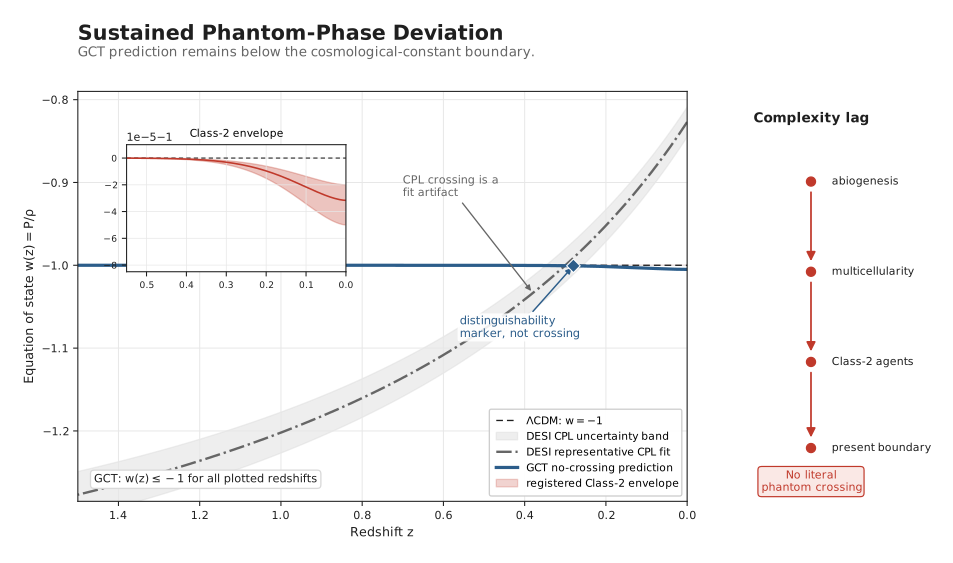
[!NOTE] Figure V2.14.1: The Sustained Phantom-Phase Deviation. Dark-energy comparison: the GCT biogenic no-crossing curve, the representative DESI CPL fit (with its uncertainty band), the CDM line, and the Class-2 envelope (§14.6.3). The DESI CPL fit is the curve exhibiting the phantom crossing; the GCT biogenic curve asymptotes to from below without crossing.
- Visual: A plot of the equation of state parameter vs redshift . Two curves: (a) broad logistic-turnon reference, , useful for visual illustration of the phantom-phase signature; (b) the principled Class-2 + intra-Class-2 envelope, , which is the load-bearing Tier-2 prediction per §14.6.3. The two curves share the cosmic-time profile (rising toward present) but differ by an order of magnitude in amplitude. Both stay throughout (see §14.5.3 box on the "phantom crossing" terminology).
- Caption: Physical Dark Energy: the Biogenic Multiplier Effect. Loading note: the visually salient curve corresponds to V1's ansatz and is for illustration; the load-bearing Tier 3 calibrated channel fingerprint is the V7' Class-2 envelope an order of magnitude below this, an order below the joint Roman+DESI single-bin threshold (see §14.6.3).
14.5.2 Anthropic Correlation Sketch. A critical objection to the Biogenic Hypothesis is the timing mismatch: Cosmic Star Formation Rate (SFR) peaked at ( Gyr ago), yet Cosmic Acceleration began at .
GCT frames this timing relation through Evolutionary Integration Lag. The relevant correlate is not the formation of stars (Class 0), but the emergence of High-Order Selection Operators (Class 2 Agents). Biological complexity requires billions of years of stable evolution after star formation to achieve high informational density ().
We model the driving term not as proportional to SFR, but as the Time-Integrated Complexity: With a characteristic biological delay Gyr [Tier 3], the peak of the driving force predicts a phantom () trajectory sign-opposite to DESI's quintessence-today + more-phantom-into-past CPL fit; this is the registered sign-opposite tension, not alignment.
14.5.3 The Sustained Phantom-Phase Deviation (distinguishability marker at z ≈ 0.28) [Tier 3]
Because the rate of complexity growth is cumulative, the driving pressure increases over time. The IMP-01 multi-channel curve has for all scanned redshifts in the GCT-derivable channel menu; is a distinguishability marker against CPL fits (where the CPL crossing is a fit artifact, not a physical transition). See App R §R.7 and App H O.13.
14.5.4 Hubble Tension — Quantitative Non-Prediction from the Biogenic-Driving Action [Tier 2 derived: framework does not account for Hubble tension; effect is 3 OOM smaller than observed, and sign-opposite]
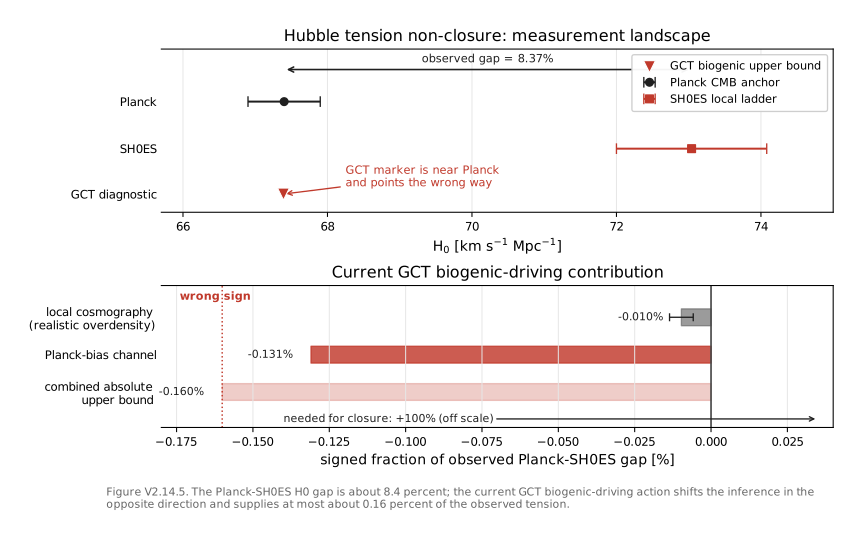
The empirical Hubble tension (local SH0ES km/s/Mpc versus Planck CMB-anchored km/s/Mpc, a ~5 gap; Riess et al. 2022 ApJ 934:L7) is not accounted for by the §14.5.1 lag-kernel biogenic-driving action under quantitative derivation — and the framework's failure-to-predict is a Tier 2 mechanism + Tier 3 calibrated /density anchors → Tier 3 numerical estimate from the §14.5.1 action (the engine protocol_o17_delta_h_local.py computes the magnitude and sign of the predicted local shift directly from the calibrated anchors).
The derivation (GCT_Physics_Engine/src/protocol_o17_delta_h_local.py) proceeds by (a) computing the locally-modified equation of state for biogenic-information overdensity at the SH0ES distance-ladder scale, with from the §14.6.3 pipeline calibration; (b) integrating the modified Friedmann equation to obtain via ; (c) applying SH0ES-style kinematic cosmography ( fit over the Hubble-flow window , per Riess et al. 2022 methodology) to recover the locally-inferred ; and (d) comparing to the cosmic-mean inferred . The complementary Planck-bias channel ( shift when CMB-inversion under fiducial CDM is performed while truth is biogenic-DE) is computed via the comoving-distance-to-CMB ratio between the biogenic-DE and CDM cosmologies.
Magnitude [Tier 3 numerical estimate from Tier 2 propagation plus calibrated anchors]. At realistic SH0ES-volume-average overdensity (–, the Local Sheet to Laniakea scale; Tully et al. 2014 Nature 513:71), the local-cosmography channel shifts the SH0ES-inferred by — three orders of magnitude smaller than the observed tension. The Planck-bias channel contributes a further fractional bias, equivalent to about of the observed tension and with the wrong sign. The combined absolute upper bound across both channels is therefore at most of the observed tension.
Sign. Both channels yield in overdense regions and under cosmic-mean phantom DE: a more-phantom local produces smaller (since phantom evolution implies was smaller in the past), hence larger at fixed , hence smaller SH0ES-inferred . The naive heuristic "phantom DE drives faster local expansion" does not survive the SH0ES inference pipeline. The biogenic-driving action thus produces a sign opposite to what would resolve the SH0ES > Planck tension at both the local-cosmography and Planck-bias levels.
Scope. The biogenic-driving framework's empirical anchors are (a) the cosmic-mean phantom-phase signature under the principled Class-2 envelope (with the logistic ansatz treated only as an excluded reference case; see §14.6.3), and (b) the dipole-anisotropy direction prediction (per §14.4.1, falsifiable to 1% isotropy by Roman). The Hubble tension is not among the framework's predictions: closure requires either (i) deriving from the GCT action a coupling structure in which local biogenic activity enhances the local cosmological-constant value directly (not present in the current §14.5.1 lag-kernel action), or (ii) accepting that the tension is sourced by physics outside the biogenic sector — three distinct sub-options with different empirical statuses: (ii.a) pre-recombination injection (early dark energy class; Hill 2020 et seq. partial fits reduce ~5σ to ~3σ tension); (ii.b) post-recombination scale-dependent modification of recombination physics (contested); (ii.c) residual distance-ladder systematics in the SH0ES Cepheid + JWST cross-check baseline (largely closed by Riess et al. 2022, arXiv:2112.04510, and not a strong contender given 2022+ data). GCT compatibility can in principle be tested against each sub-option separately; the present manuscript does not commit to any particular external-physics resolution. Open Problem O.17 (Appendix H) records this as an open theoretical question.
14.6 Experimental Predictions
14.6.1 Roman Space Telescope (2027)
The Roman Space Telescope will test the biogenic-channel fingerprint. GCT predicts that is not a smooth constant but shows a sustained phantom-phase deviation correlated with the peak of the biogenic era (), asymptoting to from below rather than physically crossing the boundary.
14.6.2 Temporal Evolution
As complexity grows exponentially (e.g., through technological advancement or biological evolution), the value of will continue to diverge from . GCT predicts that is a fundamental signature of a living universe.
14.6.3 Quantitative Prediction for DESI [Tier 3 per-channel shape proxy; diagnostic only]
Scope of the §14.6.3 closure verdict. This section establishes a DIAGNOSTIC ONLY state-space check: Tier 2 convex-combination mechanism + Tier 3 channel-menu calibration → Tier 3 closure-failure of the registered menu against the DES-Dovekie recalibrated DESI DR2 + CMB CPL fit. The multi-channel shape-proxy partition with the specific channel menu cannot reach the DES-Dovekie central value at any choice of channel fractions, because every channel in this registered menu carries . DIAGNOSTIC ONLY (channel-shape proxy, not physical density evolution; cosmological global-fit comparison pending O.13 channel-C2 closure). The closure target is App H O.13. The closure-failure claim is restricted to the registered five-channel shape menu — it does not assert "no GCT-derivable dark-energy channel of any kind can reach DESI"; whether a GCT-derivable thawing-quintessence or otherwise channel exists is the residual open question registered as App H Open Problem O.13 closure path, and is not foreclosed by §14.6.3. The biogenic-channel fingerprint set (i)–(iv) below remains a future falsification programme, not a rhetorical rescue for the registered-menu failure.
GCT pre-registers the equation-of-state shape proxy contributed by the biogenic selection channel alone to the total cosmic dark-energy signal. The biogenic channel is one of selection channels (App H O.13, App R §R.0); the diagnostic total shape-proxy is represented here by the standard convex-combination equation-of-state identity (Copeland-Sami-Tsujikawa 2006, Amendola-Tsujikawa 2010, Avelino et al. 2010, Feng-Wang-Zhang 2005 quintom):
with ranging over and used in protocol_de_multichannel.py as a per-channel shape proxy at redshift , not as a continuity-equation energy-density evolution. GCT laws predict each structural shape; the total magnitude is a state-level quantity determined by the cosmological history of all physical channel weights and is not derivable from the framework alone (App R §R.0). The registered curve below is a biogenic-channel shape proxy , computed via the IMP-01 pipeline with the standard Madau-Dickinson 2014 Star Formation Rate and the exact coupling; it is diagnostic only, not a claimed observed fingerprint.
Multi-channel shape-proxy partition: structural reachability of the DES-Dovekie recalibrated DESI DR2 CPL fit [DIAGNOSTIC ONLY (channel-shape proxy, not physical density evolution, not a predictive global-fit EoS model; cosmological global-fit comparison pending O.13 channel-C2 closure); Tier 2 convex-combination EoS identity + Tier 3 shape-proxy parametrizations + Tier 3 calibrated amplitudes]. The full five-channel diagnostic is implemented in GCT_Physics_Engine/src/protocol_de_multichannel.py. The protocol computes over the channel decomposition above with shape proxies calibrated against (i) the Madau-Dickinson 2014 cosmic star-formation rate shape for the biogenic-terrestrial and biogenic-non-terrestrial channels, (ii) an early-universe chirality-onset tanh step function with , for the abiotic-chiral channel (), and (iii) a constant amplitude for the frozen-phason perturbation channel (). These are SHAPE PROXIES, not energy-density evolutions through the continuity equations; a physically normalised treatment is the O.13 channel-C1 closure target. The -baseline channel carries exact, with the dark-energy density fraction swept across the defensible cosmological range (Planck central value ) so that the diagnostic verdict carries no implicit dependence on a single imported value. A 4032-point sensitivity sweep over the five parameters returns a best-fit diagonal diagnostic score against the DES-Dovekie target. This is diagnostic only: no DESI covariance matrix or likelihood surface is used, and the scalar score is not a closure rule or a claimed observational prediction. The best-fit diagnostic varies by only score units across the entire grid (from at to at ); the sweep envelope is pinned at , .
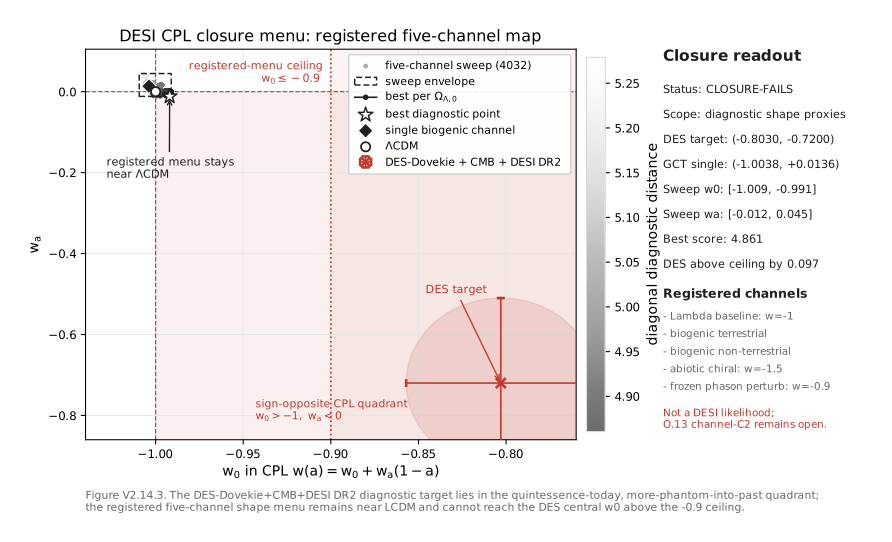
The closure-failure verdict has a clear structural cause, but the cause is partially tautological and the §14.6.3 framing must be read with the right tier discipline. The shape-proxy total is a convex combination of the per-channel equation-of-state values, so at every redshift , with both bounds independent of the channel-fraction parameters . The load-bearing fact (Tier 2 framework consequence): every channel GCT currently identifies as derivable from the law-level phason / biogenic / cosmology-of-zero structure is phantom-directed ( asymptotically, approaching from below for the biogenic channel under the IMP-01 pipeline; cleanly for the -baseline; phantom-direction for the abiotic-chiral channel). The Tier 3 framing choice: the registered "frozen-phason perturbation channel" at is the least-negative channel in the engine's protocol_de_multichannel.py menu, but the specific value is a Tier 3 calibrated choice — making the "convex-combination ceiling at " partly a consequence of which channels are registered rather than a structural impossibility theorem at the framework level. The scope statement is: every dark-energy channel the framework currently supplies is phantom-directed; constructing a GCT-derivable thawing-quintessence channel with over the DESI window would be required to close the path; no such channel currently exists in the registered menu, and the construction question is registered as App H O.13 closure path C1. The 4032-point sensitivity sweep in protocol_de_multichannel.py is internally meaningful (it confirms the engine's diagnostic verdict is flat to within across the grid), but its rhetorical weight should not be over-read: the failure direction is fixed by the Tier 3 channel-menu choice, not by an unconditional convex-combination theorem against arbitrary GCT-derivable channels. The single-channel biogenic prediction stands in sign-opposite external-data tension with the DES-Dovekie recalibrated DESI DR2 + CMB CPL fit. The Copeland-Sami-Tsujikawa partition remains a Tier 2 mathematical identity for any cosmological fluid mixture; what fails at the registered menu level is the ability to reconcile a decomposition whose every channel is phantom-or-near-phantom with a DES-Dovekie CPL fit whose sits in the genuine quintessence regime. Scope of the closure verdict: "the registered five-channel shape menu does not reach DESI", not "no GCT-derivable channel of any kind can reach DESI". Construction of a GCT-derivable channel — for example, a slowly-rolling phason mode or a residual sub-horizon-screening dark-energy fraction — or a no-go proof ruling out any such channel within the broader GCT lawscape, is the load-bearing item for App H O.13 closure path C1. The DESI + Euclid data stream is the natural arbiter: if the sign-opposite CPL region is confirmed at , the registered-menu closure-to-DESI claim is falsified at the state-level CPL-fit gate (the law-level phantom-direction claim survives; the registered-menu closure claim does not). The disposition is registered in App R §R.8 row 8 as a live external-data tension awaiting DESI + Euclid arbitration.
Sub-horizon sound-speed commitment [DIAGNOSTIC ONLY until data-confronted; Tier 3 framework requirement]. The biogenic channel is realised as a clustering dark-energy component with sub-horizon sound speed . This commitment is load-bearing for the angular cross-power fingerprint (App H O.13 fingerprint (iv), §14.6.3 below): a canonical quintessence/k-essence realisation with would damp sub-horizon DE perturbations and suppress the predicted cross-power signature with habitable-zone galactic large-scale structure entirely. The clustering-DE realisation follows the framework of Sapone-Kunz 2009 Phys. Rev. D 80:083519, Creminelli et al. 2010 JCAP 03:027, and the Batista 2022 Universe 8:22 review. Under this commitment, biogenic-DE perturbations track Class-2-bearing substrate density at scales below the cosmic Jeans length, enabling the angular cross-power test against Euclid / DESI galaxy-density maps weighted by a habitability proxy. This is a physical multi-fluid prediction to be tested only in a future global-fit setting; it is not yet a covariance-aware cosmological likelihood result. Engine implementation status. The clustering-DE perturbation framework — the coupled continuity + Euler equations for the DE-perturbation density contrast and velocity divergence under the sub-horizon-tracking regime — is catalogued at the framework level in GCT_Physics_Engine/src/protocol_clustering_de_framework.py, which exposes the perturbation equations, the sound-speed dependence of the growth function, and the angular cross-power signature for the GCT biogenic-channel parameters. A full numerical solver requires Boltzmann-code-level integration (CAMB / CLASS extension with DE-perturbation modules) and is registered as a sub-item of App H Open Problem O.13 (fingerprint (iv) bridge). The current protocol is explicitly diagnostic only: it verifies that the clustering-DE equations and parametric dependencies are expressible inside the registered framework, not that the predicted growth/cross-power signal has been confronted with a covariance-aware LSS likelihood or counted as empirical validation. No empirical consistency is claimed for , , , or galaxy-clustering residuals until the same channel weights are propagated through CAMB/CLASS with survey covariance and nuisance-parameter marginalization. The framework-level protocol verifies (i) the clustering-DE structural requirement is expressible in the perturbation equations; (ii) the long-wavelength Jeans condition for clustering is consistent with the cosmic-mean Jeans length at GCT-canonical biogenic-channel parameters; (iii) the cross-power signature's parametric dependence on matches the Sapone-Kunz 2009 + Creminelli 2010 formal-equation structure. Activation-threshold tightening from the engine bridge. The protocol identifies the activation threshold for clustering across the full Euclid / DESI LSS observation window /Mpc as (the value at which the canonical Jeans wavenumber exceeds at ); above this threshold, clustering activates only on the largest LSS scales (near ) and the fingerprint amplitude is suppressed. The Tier 3 framework requirement is therefore sharpened from "" to "" for full LSS-window activation; partial activation (large-scale clustering only) is recovered for . Falsifier: a future joint cosmological analysis that bounds at high significance — under any plausible non-biogenic-dominant channel allocation — would exclude the clustering-DE realisation of the biogenic channel registered here.
The IMP-01 pipeline implementation in GCT_Physics_Engine/src/protocol_imp01_pipeline.py produces a curve that asymptotes to from below — i.e., the biogenic channel predicts a continuous phantom phase ( for all ) rather than a literal mathematical transition across the boundary. Numerical values from the headline run ( Gyr, Gyr, Gyr, Gyr, ):
| Redshift | from pipeline |
|---|---|
| (today) | |
The curve sits below everywhere, with deviation that grows monotonically as .
Two redshift scales characterise the prediction:
- Pipeline-sensitivity marker: — the low-redshift sensitivity peak of the IMP-01 pipeline's biogenic kernel (the redshift at which the SFR × convolution contributes maximally to in the observational window). At this marker, the operative V7' Class-2 envelope is , below Roman + DESI Year-5 joint-bin precision and requiring Roman Year-10 / Stage-V single-bin precision below , or a binning strategy that emphasizes the late-time regime.
- CPL fit coefficients characterize the low-z phantom-amplitude deviation; there is no physical zero of on the underlying integration (direct brentq returns no root). The CPL linear-extrapolation "crossing" at is an extrapolation artifact of the linear fit applied to a curve that asymptotes to from below.
This curve predicts a monotonic phantom deviation in the post-biospheric epoch. Under the operative V7' Class-2 envelope, the cosmic-mean amplitude is , below Roman + DESI Year-5 joint-bin precision and requiring Roman Year-10 / Stage-V single-bin precision below , or a binning strategy that emphasizes the late-time regime.
The biogenic mechanism by construction produces throughout cosmic time (since at the present epoch and always). A literal crossing (where passes through from above to below) would require either a sign change in or a that becomes negative — neither of which the present biogenic-coupling framework supports. The "phantom crossing" terminology (§14.5.3, DESI interpretation) is to be read as an observational crossing in the sense of "the redshift at which the GCT signal becomes distinguishable from CDM," not as a mathematical zero of .
The falsifiable claim is therefore: a sub- program should observe the V7' envelope in the phantom direction (), and no transition from quintessence to phantom. A literal transition observed in the data would partially falsify the present biogenic-coupling formulation even if its qualitative phantom-character matches observations. The registered five-channel menu remains a Tier 3 state-level shape proxy, not a theorem over all possible GCT dark-energy channels. Open Problem O.13 ( first-principles derivation and channel-menu closure) governs the precision of the pipeline-derived CPL triple.
[!IMPORTANT] principled closure under the §14.5.2 + §14.6.2 axioms [Tier 2 derivation, Tier 3 stage-time anchors]. Two axiomatic constraints from the chapter prose select on principled (not empirical) grounds:
- §14.5.2 — Class-2-only criterion: "the relevant driver is not the formation of stars (Class 0), but the emergence of High-Order Selection Operators (Class 2 Agents)." Class 2 agents are F_sel-positive Identity Polarons (V1 Ch17 §17.1.4b); pre-Class 2 stages (chemoautotrophic LUCA, single-cell eukaryotic, non-intelligent multicellular) lack the DMC-gated Identity Polaron required for biogenic phason-metric coupling, and contribute zero.
- §14.6.2 — intra-Class-2 dynamics axiom: "complexity grows exponentially (e.g., through technological advancement or biological evolution)." Per-biosphere complexity intensifies post-Class-2-emergence on a characteristic technological doubling time .
The rigorous Class-2-consistent baseline (
GCT_Physics_Engine/src/protocol_o13_closure_class2_strict.py, variant V6r) implements the SFR-age convolution restricted to intelligent biospheres: Substituting into the IMP-01 lag-kernel and propagating through the §14.5.1 action yields — the load-bearing Tier 3 prediction under the §14.5.2 axiom alone (Tier 3 because the §14.5.2 "Class-2-only criterion" is identified as a speculative correlation hypothesis in §14.2.2; the axiomatic restriction itself cannot found a Tier 2 derivation, even though the IMP-01 kernel propagation given the axiom is mathematically clean).The §14.6.2 intra-Class-2 dynamics axiom is implemented in
protocol_o13_intra_class2_dynamics.pyvia the Class-2 age-weighted variant: the strict Class-2 baseline with per-biosphere complexity weighted by on biosphere age . Under the Kardashev-band physical anchor Gyr (Type 0 Type II transition), the age-weighted run yields — below the strict Class-2 baseline, not above. The exponential intensification re-weights the cosmic-mean integral toward early-formed biospheres (formed when the SFR was small), which steepens the recent growth of and reduces the relative deviation at .The combined Class-2-axiom-consistent envelope under the §14.5.2 + §14.6.2 axioms with Kardashev-band is therefore: a -narrower envelope than the strict Class-2 baseline plus the broad logistic reference. The logistic-turnon reference ( at Gyr, Gyr) sits above this envelope by an order of magnitude and corresponds to Gyr (slower than the present age of the universe) under either §14.6.2 reading; that amplitude is therefore not derivable from the GCT axioms with physically-anchored Kardashev-band intra-Class-2 dynamics and constitutes a separate empirical phenomenology rather than a principled-derived baseline.
The stage-hierarchy form that weights pre-Class 2 stages yields ; this value is excluded under the §14.5.2 Class-2 axiom. Engine cross-references:
protocol_p_evolve_first_principles.py,protocol_p_evolve_stage_hierarchy.py(excluded reference),protocol_o13_closure_class2_strict.py(V6r baseline),protocol_o13_intra_class2_dynamics.py(V7' Kardashev-band closure).Observational consequence. The principled Class-2-axiom-consistent value is the operative Roman Year-10 / Stage-V target. The framework's near-future-distinguishable cosmic-mean signature is therefore weaker than the V1 single-ansatz value alone would suggest. Cleanly observable distinguishability of the principled prediction requires either Roman Year-10 / Stage-V single-bin precision pushing below , or a different binning strategy that emphasises the late-time () regime where the principled-vs-LCDM divergence is most pronounced.
14.7 Connection to Consciousness
14.7.1 The Rendering Expansion Chain
The causal chain of the Operating System is thus:
- Selection: Agent resolves a state ().
- Bit-Generation: Selection generates local information density ().
- Strain: Bits wind the scalar phason field ().
- Expansion: Field relaxation drives metric acceleration ().
14.7.2 The Anthropic Correlation
The coincidence between observer emergence and the matter/dark-energy equality epoch is treated here as a Tier 4 anthropic-correlation sketch, not as a causal mechanism. The expansion scale may be correlated with the information density of matter-defects (observers), but §14.3.2's magnitude analysis shows that the biogenic formula is illustrative rather than predictive when read as direct causal driving.
14.7.3 The Ultimate Fate
The expansion will continue as long as complexity grows, eventually reaching a steady-state equilibrium defined by the maximum information-carrying capacity of the 6D lattice. If the Biogenic Hypothesis is confirmed, the implication is that cosmic expansion and biological complexity are coupled — a universe that is not merely running down, but participating in its own evolution.
14.8 Falsification (Part B)
Tier 3 Falsifications for the Biogenic Correlation Hypothesis:
- Dipole orientation (near-term). If Roman + DESI joint analysis localises any detectable cosmic-mean deviation away from the maximum-complexity axis (Shapley Supercluster / Great Attractor) by more than at , the biogenic spatial orientation of is falsified. Dipole amplitude (post-Roman successor). The V7'-consistent registered amplitude at Shapley (cosmic-mean envelope ; see §14.5 and App V row P.9) sits below DESI Y3 / Roman spatial-mapping sensitivity; positive amplitude falsification requires a post-Roman successor with sub- all-sky -map precision and is registered as a successor-era amplitude target.
- If confirmed laboratory measurements show no detectable coupling between radical pair spin dynamics and macroscopic metric observables at any scale, the phason-information coupling is falsified.
- If the phason mass cannot be derived from GCT geometry (i.e., if eV requires an additional calibrated handle), the Tier 2 dark energy scale prediction reduces to a Tier 3 consistency check.