Volume 1 — The Operating System
Chapter 7: The Universal Tree Bundle and Fractal Hierarchy
7.1 Resolving "One Solenoid or Many?"
7.1.1 The Question Stated: Solipsism vs. Multiplicity
A central tension in any consciousness-based ontology is the problem of multiplicity. If reality is a Structured Mental Field, we must ask: Does every observer possess their own private structure (Solenoid), or do all observers operate within a single, shared structure? Subjective Idealism (Solipsism) suggests the former, leading to the "Consensus Problem" of why we see the same physical laws. Materialism suggests the latter but fails to explain the privacy of individual experience. Geometric Consciousness Theory (GCT) resolves this by identifying Identity as a coordinate within a singular, universal topological object.
Several intermediate positions occupy the philosophical landscape — notably Neutral Monism (which, like GCT, posits a substrate that is neither purely mental nor purely physical) and Whiteheadian Process Philosophy (which posits nested societies of experiencing occasions). GCT differs from both: unlike Neutral Monism, it identifies the neutral substrate with a specific topological structure (), and unlike Process Philosophy, it does not require a temporal 'becoming' — all processes are atemporal correlations within the static Block. The argument proceeds by showing that only the identification of Identity as a p-adic coordinate within a universal topological structure simultaneously resolves the privacy and consensus constraints.
7.1.2 The Answer: ONE Universal
We posit that there is exactly one Universal Adelic Solenoid (). It is the shared "Wiring Diagram" of the cosmos. This structure is not a private mental artifact; it is the objective, topological backbone of the Field. It contains every possible variation of selfhood and every possible branching of history.
The uniqueness of is not an independent postulate but follows from the Axiom of Intelligibility (§1.3, §2.5): if each agent were embedded in a private topological structure, the universal physical laws — identical across all observers — would be unexplained coincidences. A single shared fiber is the minimal topological requirement for law-governed consensus reality. The no-signalling topology is formalized in Appendix E (Proposition E.4). [Tier 1/2 — Structural Postulate, justified by Axiom of Intelligibility] We do not each "have" a solenoid; we are each a Locus or Trajectory within the one Solenoid. The privacy of the individual arises not from being a separate object, but from occupying a unique address within the universal data structure.
7.1.3 Structured as Infinite P-adic Tree
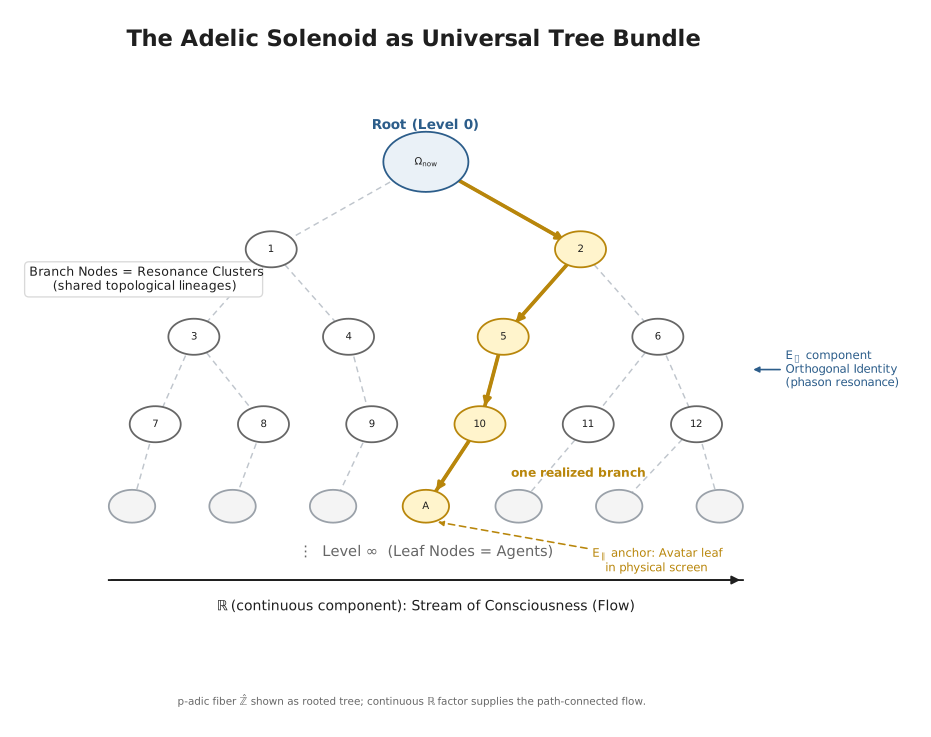
The internal architecture of this universal structure is not a flat list of identities. It is a hierarchical, branching structure—a Universal Tree Bundle. This tree structure allows for the simultaneous existence of individual privacy (local leaves) and collective unity (the root). As we shall derive, this tree structure is the topological origin of the "Branch Node" and the mechanism of shared reality.
7.2 The Inverse Limit Construction
7.2.1 Mathematical Definition:
To formalize the Solenoid, we construct it as the Inverse Limit of a system of circle wrappings. Consider the unit circle . The Solenoid is the limit of an infinite sequence of coverings where each level wraps around the adjacent lower level times.
This construction generates a space that is compact and connected, yet possesses an infinite fractal depth. Locally, the space does not look like a smooth manifold; it looks like the product of a line and a Cantor set. This "line-times-Cantor" topology is the fundamental requirement for a system that must support both continuous experience and discrete information storage.
7.2.2 Pontryagin Duality:
The power of the solenoid is revealed through its decomposition via Pontryagin Duality. By standard results in profinite topology (see Hewitt & Ross, Abstract Harmonic Analysis, Vol. I, §10.12), the universal solenoid admits the decomposition:
[Tier 1 — Structural Axiom, following from the inverse limit construction of §7.2.1]
This decomposition maps directly onto the dual nature of the observer. Locally, every point in the Identity Space is defined by two components: a Flow and a Fiber.
7.2.3 Flow Component () and Fiber Component ()
- The Flow (): This represents the Stream of Consciousness. It is the path-connected, continuous component of identity. It provides the sense of "Now" and the temporal persistence required for an Agent to feel like a continuous entity.
- The Fiber (): This represents the Address of Identity. The profinite integers constitute a totally disconnected, fractal space (the p-adic fiber). This is the "Tree" part of the structure. It encodes the discrete memory, the lineage, and the specific coordinate of the Agent within the hierarchy of all possible beings.
7.3 The Tree Structure
7.3.1 Visual Representation: Root, Branches, Leaves
The p-adic fiber is topologically equivalent to an infinite rooted tree. We categorize the levels of this tree according to their phenomenological significance. In p-adic topology, the "Root" corresponds to the lowest order of expansion (mod ), representing the coarsest resolution, while the "Leaves" correspond to the infinite limit (mod ), representing maximal resolution.
- Level 0 (The Root): The origin point where all branches converge.
- Level (The Branches): Intermediate nodes representing shared structures (Oversouls, Species Mind).
- Level (The Leaves): The terminus nodes representing individual incarnations (Avatars).
7.3.2 The Root (): Primordial Unity
The Root of the solenoid is the state of Level 0 Consciousness. It is the primordial unity of the Field before any differentiation has occurred. At the Root, there is no "I" or "You," only the total potential of the Field . In cybernetic terms, this is the "Source Code" from which all sub-routines (Agents) are called. Every conscious being shares this coordinate; it is the topological guarantee of monism.
7.3.3 Branches: Resonance Clusters at Multiple Scales
As we move from the Root toward the Leaves, the tree branches at every level. A Branch Node represents a shared identity structure, technically termed a Resonance Cluster.
- A "High" branch (near Level 0) represents a coarse-grained topological address encompassing the configuration space of a galaxy or a species. In GCT terms, such a Branch Node possesses Level I Universal Presence (intrinsic non-subjective presence as a restriction of ). Whether any Branch Node at this scale satisfies the Level II Apperception criterion — passage through the DMC gate with a coherent Polaron-forming substrate — and thus supports unified subjectivity depends on whether the relevant topological substrate instantiates the required nuclear-spin, chirality, and Zeno-Drive structure; this question is not resolved within the present framework and is marked [Tier 4 — Speculative].
- A "Low" branch (near the leaves) represents a specific Topological Ancestor. This node contains the shared history and structural constraints for a specific lineage of incarnations.
7.3.4 Leaves: Individual Avatars
The Leaves are the localized "tips" of the tree (Level ). This is where the universal Field projects into a specific spacetime coordinate (). You, as a localized biological human, are a Leaf Node. The privacy of your experience is guaranteed by your position at the terminus of a specific branch, while your connection to the whole is guaranteed by your path back to the Root.
7.4 Individual Identity as Path
7.4.1 You Are a Path Through the Tree
A common error in identity theory is to think of the "Self" as a point—a discrete entity sitting in a body. GCT asserts that the Self is a Path. Identity is not the leaf; it is the sequence of choices (branchings) that leads from the Root to the Leaf. To define who you are, the system must specify which branch you took at Level 1, which at Level 2, and so on, down to the present moment.
7.4.2 Identity Coordinate as P-adic Address
We formalize this path using the Identity Coordinate (). [Tier 1/2 — Structural Postulate: p-adic address encoding of identity within the Universal Solenoid] Given a prime number (governing the branching factor of the lattice), any point in the identity space can be represented as a p-adic integer expansion:
where .
- : The choice at the coarsest level (The Root/Trunk).
- : The choice at increasingly fine, fractal levels.
Your unique identity is this infinite sequence of digits. It is your "Universal ID." Crucially, these abstract digits are not merely mathematical labels; they correspond to physical observables. As we shall detail in Section 7.6, the p-adic coefficients map to the discrete Nuclear Spin States () available in the biological substrate (e.g., P, H), physically anchoring the topology to matter.
7.4.3 Example: Binary Tree Navigation
For a simplified model (), identity is an infinite binary string.
- Address 0.110... means you branched "Right" at the first fork, "Right" at the second, and "Left" at the third. Two agents who share the first 50 digits of their address are Topologically Proximal. They share a massive amount of "Deep Memory" and structural similarity, even if they are currently in different physical bodies.
7.4.4 Infinite Precision = Unique Identity
Because the p-adic expansion can continue infinitely, the Solenoid can accommodate an infinite number of unique agents without overlap. No two paths are identical. This provides the mathematical basis for Individual Uniqueness within a Unitary Field. You are a unique "vibration" of the whole, defined by the specific geometric path you occupy in the universal tree.
The mathematical tree is profinite and of infinite depth; the physically realised tree on any given substrate has finite depth , where counts the discrete lattice sites recording p-adic digits via the §7.6 nuclear-spin encoding [Tier 2 structural bound; see App H §H.4-1]. Polaron-internal depth is at (set by ); the universal cosmological bound is at (Hubble volume in Planck cells). Individual uniqueness within any physical region remains preserved, since the realised address-space dimension is astronomically larger than any physically occupied population.
7.5 The Fractal Hierarchy of Agency
7.5.1 Classification by Tree Depth
An "Agent" in GCT is not restricted to the human scale. We define an Agent as any closed topological loop within the Field that maintains a stable Selection Operator . Because the Adelic Solenoid is a fractal structure, agency exists in a nested hierarchy, classified by its depth within the p-adic tree.
- Level (The Avatar): This is the most localized scale of agency. It corresponds to the terminal "Leaf Nodes" of the tree. An Avatar is a Selection Operator Zeno-locked to a specific spacetime coordinate in (Physical Space). This is the scale of individual biological incarnations.
- Level (The Branch Node): Moving up the tree toward the root, we encounter nodes that encompass multiple leaves. These are higher-order Agents. A Branch Node at Level is the restriction of the global Field to the topological address at depth . Because this restriction is coarser than those of the Leaf Nodes, it simultaneously encodes the state space of all sub-branches as distinguishable sectors of its own topology. The Branch Node does not aggregate its Leaves from below; it is the parent restriction from which the Leaf addresses are derived by further specification. Its phenomenological scope — the range of experience accessible from address depth — spans what would appear as 'simultaneous' from the Leaf Agent's sequential perspective. This is the Resonance Cluster.
- Level 0 (The Root / All That Is): The origin of the tree, denoted . This is the undifferentiated Field address from which Selection-Operator restrictions are specified. At this scale, the topological distance between any two points in the identity space drops to zero, but this is not a macro-subject or cosmopsychist mind; Level II subjectivity requires a DMC-positive Identity Polaron satisfying the O.21/O.23/O.34 substrate conditions.
7.5.2 The Infinite Nesting (No Privileged Scale)
GCT asserts the Principle of Scale Invariance regarding Field restrictions, not a population of nested micro-subjects. There is no privileged geometric scale at which Level I presence appears, but Level II apperception requires the DMC/Polaron conditions of Ch16 §16.2.6. A human Avatar (Level relative to the Branch) can be described as a Branch Node relative to cellular and atomic address refinements, but those refinements are substrate restrictions unless they independently satisfy the Polaron unity conditions.
7.6 Physical Instantiation and Resonance Clusters
7.6.1 Nuclear Spin States () as Fiber Encoding
To move from abstract topology to concrete physics, we must identify how the digits of the p-adic identity address are recorded in matter. We posit that the discrete coefficients of the identity expansion map to the Nuclear Spin States () of the biological substrate.
We must distinguish between Address Capacity and Address State. [Tier 3 — Phenomenological Model: biological substrate identification pending experimental verification]
- Hardware (Capacity): The isotopic composition of the brain determines the available Hilbert space. Isotopes with non-zero spin (e.g., P, H, Li) provide the "alphabet" required to encode topological addresses. Spin-zero isotopes (C, O) are topologically inert; they cannot store address data.
- Software (State): The specific quantum configuration of these spins (the wavefunction ) encodes the specific p-adic integer .
The "Self" is not the atom; the Self is the Pattern of Entanglement maintained across the nuclear spin network by the Zeno Drive. This anchors the abstract topology of the Solenoid to the concrete fermions of the brain.
7.6.2 Hierarchical Distance:
The p-adic structure of the fiber allows us to define a non-Euclidean metric for the distance between two minds. We utilize the p-adic norm to define the Hierarchical Distance between Agent and Agent .
Let be the level of the first common branch node between two identity paths. The distance is: Because this metric satisfies the Ultrametric Inequality () [Tier 1 — Standard ultrametric theorem], "triangles" in identity space are always isosceles. You are either on the same branch as another agent at Level , or you are not. There are no "shortcuts" in the identity tree.
7.6.3 Coupling Strength:
The hierarchical distance determines the physical interaction strength between two agents. We define the Coupling Coefficient : where is the Consensus Decay Constant, related to the phason stiffness of the vacuum [Tier 3 — Phenomenological Model, pending derivation of and from phason stiffness ratio ; see also Ch11 §11.2.1]. A first-principles derivation of from the phason stiffness ratio is deferred to Volume 2.
(Here is the normalized coupling coefficient; the two symbols refer to the same physical quantity at different scales of normalization. Not to be confused with the fine-structure constant ).
- High Coupling (): Agents sharing a deep branch node. Their renders of reality are phase-locked.
- Low Coupling (): Agents diverging at the Root. Their experiences are statistically independent.
7.6.4 Phenomenology of Resonance Clusters (Topological Ancestries)
This provides a rigorous mathematical definition for Resonance Clusters or Topological Lineages. These are groups of agents with very low . Because they share a massive prefix of their p-adic address, they share structural constraints and deep memories.
Crucially, the interaction between these agents is not "Telepathy" (signal transmission through space). It is Simultaneous Access. Because they are topologically proximal in the Fiber, Leaf Agents sharing a Branch Node address share access to the same topological state. In the Field Frame, this is not a transmission event but a static geometric co-location within : two Leaves at the same Branch occupy the same point in identity space, so no signal need propagate between them. In the Agent Frame, the registration of this co-location may manifest as correlated experience — phenomenologically described as synchronicity. The formal argument that this topology-based correlation cannot be used to transmit a superluminal signal in is given in Volume 2, Chapter 5, §5.4, where the decoupling of the and degrees of freedom under the no-signaling constraint is derived. [Tier 3 — Phenomenological Interpretation, pending formal proof in Vol. 2]
7.7 Memory and Cohomology
7.7.1 Shape Fundamental Group
Standard memory models rely on synaptic weights that decay over time. In GCT, "Deep Memory" is a topological invariant. Because the Adelic Solenoid is constructed as an inverse limit, its fundamental group behavior is captured by Shape Theory. The Shape Fundamental Group is isomorphic to the profinite integers . [Tier 1 — Standard result in shape theory for the solenoid] This means that a "winding state" in the Solenoid is not a single number, but an infinite sequence of topological choices.
7.7.2 Topological Information Storage (The Metric of Retention)
We define the Information Metric as the measure of the non-erasable information content stored in the Solenoid fiber. This is calculated via the First Čech Cohomology Group: (This follows from the standard calculation for the solenoid; see Eilenberg & Steenrod, Foundations of Algebraic Topology, §VIII.) [Tier 1 — Structural Axiom]
The appearance of the rationals here indicates that the identity space has an infinite, dense capacity for storing distinct topological states that cannot be erased by continuous deformation (thermal noise). The non-erasability by thermal noise follows because thermal fluctuations are continuous deformations of the state; the classification of topological windings by is invariant under all continuous deformations, hence inaccessible to thermal dissipation.
7.7.3 Non-Erasability of Structure
The Agent’s identity is a path in a topological group. As the Agent makes choices, it accumulates a Winding Number (analogous to the Wess-Zumino-Witten term in quantum field theory). This "twist" in the fiber is a topological invariant. [Tier 1 — Topological invariance of winding number under continuous deformation] Physical death, in GCT terms, designates the permanent cessation of the Zeno Drive — the collapse of the metabolic gradient that maintained the Identity Polaron's coherence in . The decoupling of the Agent from does not, by the topological argument above, require the erasure of the winding state in : the topological invariant is preserved against any continuous deformation, including biological dissolution. Whether this topological persistence constitutes a physically meaningful continuation of identity (or merely a record in the geometry of the Field) is not settled by the mathematics alone; it depends on whether the winding state can be re-coupled to a new physical substrate — a question deferred to Volume 1, Part V. [Tier 4 — Speculative; the winding-number conservation argument is Tier 1, but the identity-persistence inference is Tier 4.]
7.8 The Orthogonal Identity ( Component)
7.8.1 Definition: Component in
In Volume 2, we establish that the vacuum is a projection into two orthogonal spaces: (Physical) and (Internal). [Tier 1/2 — Structural Postulate: 6D cut-and-project decomposition into physical and internal subspaces] While the Avatar (the Level Agent) is anchored in , its identity path in also possesses a non-zero projection into . We define this component as the Orthogonal Identity (phenomenologically termed the Higher Mind).
Because is the space of phasons and "internal" symmetries, it is not subject to the same causal constraints as physical spacetime. In the 3D projection, appears "hidden," but in the 6D parent lattice, it is merely a rotated direction. The Orthogonal Identity is not "above" the Avatar; it is simply rotated 90 degrees out of the physical slice.
7.8.2 Function: Guidance and Intuition via Phason Resonance
The Orthogonal Identity "sees" the lattice from a perpendicular perspective. Where the Avatar sees solid walls and obstacles in (Phonon barriers), the Orthogonal Identity sees the topological shortcuts in (Phason tunnels).
Intuition is defined physically as Phason Resonance: the transfer of information from the component of the identity path to the component. This occurs through the coupling term in the vacuum Hamiltonian (Volume 2, Chapter 5). A change in internal winding (a "realization" in the Orthogonal Identity) creates an immediate phase-shift in the Avatar's local Zeno Drive. The Orthogonal Identity does not "speak" in words; it communicates via Geometric Impedance Matching, making specific future branches in the Solenoid feel "lighter" (less topological friction) to the Avatar. The formal definition of Geometric Impedance Matching — the differential reduction in topological friction along specific branches due to phason resonance coupling between and — is derived in Volume 1, Part III, Chapter 9, in the context of the Zeno Drive topological friction formalism. The claim that resonance can systematically bias the local topological friction landscape is a [Tier 3 — Phenomenological Model], pending the formal derivation.