Volume 2 — Cosmic Architecture
PART III: GRAVITY AND SPACETIME
Chapter 8: The Acoustic Metric
General Relativity treats the spacetime metric as a fundamental, dynamic field—the "fabric" of the universe. Geometric Consciousness Theory (GCT) identifies this fabric as a hydrodynamic approximation. Spacetime is not a pre-existing stage but an effective geometry experienced by excitations propagating through the vacuum condensate. In this chapter, we derive the Einsteinian metric as the Acoustic Metric of the supersolid quasicrystal.
8.1 Emergent Geometry
8.1.1 The Refractive Vacuum (Gravity as Sound in a Condensate) [Tier 2]
In Volume 1, we established that reality is rendered as a time-averaged geometric surface. In Volume 2, Part II, we identified the physical "photon" as the second-sound mode of the phason field. It follows that any measurement of space and time is a measurement of how these waves propagate.
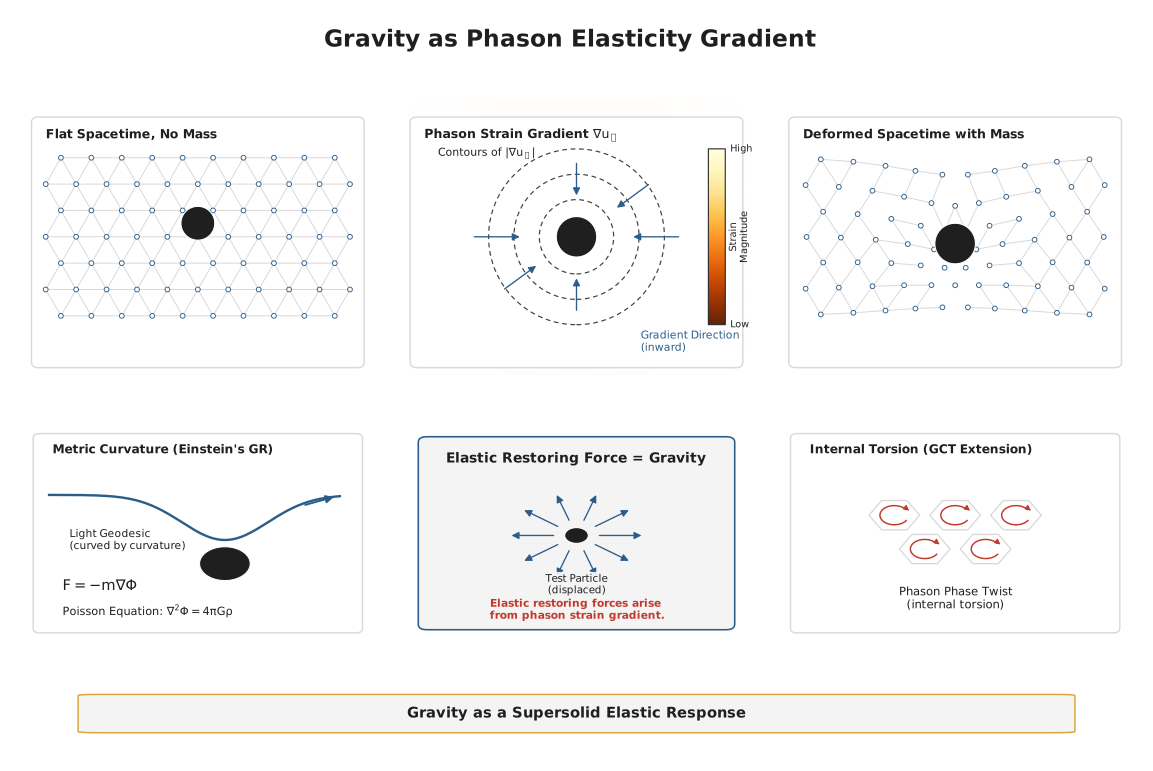
In any superfluid or supersolid condensate, a wave-packet (whether light or matter) does not experience the "absolute" Euclidean coordinates of the 6D parent lattice. Instead, the vacuum acts as a medium with a variable Refractive Index. Gravity is not a force pulling on objects; it is the name we give to the refraction of phason wave-packets by gradients in the local state of the vacuum.
8.1.2 The Unruh Metric (Derivation of Effective Geometry) [Tier 2]
To derive the metric tensor , we examine the wave equation for phason perturbations in a non-uniform condensate. As demonstrated in the study of analogue gravity, the linearized dynamics of fluctuations around a background state can be rewritten in the form of a d’Alembertian in curved spacetime:
By identifying the coefficients, we extract the Acoustic Metric:
The Origin of Static Curvature: While (flow) corresponds to frame-dragging and gravitomagnetism, static Newtonian gravity arises from spatial gradients in the Density () and Local Speed of Sound (). As matter defects (Volume 3) create localized Phason Strain (), they modulate the local stiffness and density of the condensate. This variation in the "stiffness-to-inertia" ratio alters the propagation speed , bending the paths of light and matter toward regions of higher strain energy.
The Conformal Factor (): The term represents the Metric Stiffness. A higher vacuum density implies a more rigid metric that is harder to curve, providing the informational resistance that scales the gravitational constant (as established in Volume 1, Chapter 13).
8.1.3 Signature and Time Dilation (Lorentzian Emergence) [Tier 2]
The emergence of the Lorentzian signature is a direct consequence of the finite speed of organizational refresh ().
- The Sound Cone: The "Light Cone" of relativity is the "Sound Cone" of the phason field. In the physical manifold , information cannot propagate faster than the second-sound mode at speed , creating an effective causal horizon.
- Time Dilation: Clocks in GCT are Selection Operators iterating at a tick rate . In regions where the vacuum density is high or the sound speed is refracted (slower), the coordinate stride per tick increases [Tier 2] — meaning the Agent covers more coordinate time per internal tick, but each tick takes longer as measured by a distant observer. The Agent's internal tick rate (as observed externally) decreases, and the Agent ages more slowly. This is the standard gravitational time dilation of General Relativity, derived here as a consequence of the refractive acoustic metric.
" is the phason group velocity (= effective speed of light in the physical projection, see §13.3.4). This notation is used throughout to distinguish it from the bare Planck speed ."
8.1.4 The Derivation of Newton's Constant () [Tier 2 thermodynamic mechanism + Tier 4 Planck-link conjecture + Tier 3 dimensional anchor]
In standard General Relativity, is a fundamental constant of nature to be measured. In GCT, is a Derived Coupling Coefficient emerging from the elastic limit of the phason effective action.
We extract by examining the Newtonian Limit of the acoustic metric. For a static, non-relativistic mass distribution with energy density , the metric perturbation (where ) must satisfy the Poisson equation:
By identifying the gravitational potential with the localized phason strain density , we derive as a function of the lattice parameters:
Where:
- : The lattice speed of light.
- : The transverse phason stiffness.
- : The lattice spacing.
Result: The Scaling Structure of G The φ-scaling of the two ingredients is: and , so the ratio — a non-trivial geometric factor, not an invariant. The numerical normalization that closes the comparison with the CODATA value of is fixed by the lattice spacing and the dimensional embedding constants tracked in the bottom-up thermodynamic derivation of V2 §9.1.6 (with the holographic-screening reading in V1 §13.3.4) — the thermodynamically primary derivation of , see the note below. The phason-elasticity formula here is a mechanical consistency condition on the acoustic limit; it reproduces to the precision quoted in the Precision Scorecard (App R §R.4) when the lattice constants are imported from the Jacobson derivation, and is not an independent closed prediction of from the elasticity formula alone. The perceived weakness of is a direct consequence of the stiffness hierarchy between the phonon metric () and the phason field (): gravity is weak because the vacuum "fabric" is exceptionally rigid relative to the information-carrying phason modes.
[!NOTE] Primary vs. Consistency Check (V2 §9.1.6, V1 §13.3.4): The phason elasticity formula derived here is the mechanical consistency condition that the phason fluid must satisfy. The thermodynamically primary derivation of runs bottom-up from holographic-screen entropy in V2 §9.1.6 (Verlinde presentation: screen entropy equipartition Newton's law Einstein equations MOND limit), with the Jacobson identity as its closed-form output. The same chain is given in its holographic-screening reading in V1 §13.3.4. The elasticity formula of this section reproduces to the precision quoted in the Precision Scorecard (App R §R.4) when the lattice constants are imported from the bottom-up thermodynamic derivation, and serves as the cross-check confirming that the acoustic-metric limit is mutually consistent with the entropic-gravity primary chain. The full three-route algebraic equivalence is in Appendix K §K.7.
8.2 Universality of Free Fall
8.2.1 The Knot-Metric Coupling [Tier 2]
The Weak Equivalence Principle—the fact that all objects fall at the same rate regardless of their mass—is a Tier 2 structural consequence of the GCT lattice architecture: it follows necessarily once all matter and light are identified as phason-based excitations of the same substrate, governed by a single hydrodynamic wave equation.
Matter particles (Fermions) are topological defects (knots) in the vacuum lattice. These knots are not "solid balls" being pushed by a field; they are localized wave-packets of the Field itself. Since all phason-based excitations (both light and matter knots) are governed by the same hydrodynamic wave equation, they are necessarily refracted by the same vacuum gradients. A knot and a photon "fall" along the same geodesics of the acoustic metric because their propagation is determined by the same underlying lattice stiffness and density.
8.2.2 Inertial vs. Gravitational Mass
In GCT, the distinction between inertial and gravitational mass is a matter of perspective on the same interaction:
- Inertial Mass: The work required to move a knot against the static phason stiffness (The Drag).
- Gravitational Mass: The degree to which the knot's strain field couples to the local phason density (The Refraction).
Because both arise from the phason field’s interaction with the lattice, they are fundamentally identical. Gravity is the "Self-Weight" of information in the vacuum.
8.3 Hopf Algebra Deformation and Doubly Special Relativity (DSR)
8.3.1 The Lattice Scattering Paradox
A historical objection to discrete spacetime is the Lattice Scattering Paradox. If space is a lattice with a fundamental scale (e.g., the Planck length ), high-energy particles with wavelengths should interact with the discrete structure, leading to broken Lorentz invariance, vacuum Cherenkov radiation, or Bragg scattering, making the universe opaque to ultra-high-energy cosmic rays.
8.3.2 Doubly Special Relativity (DSR) [Tier 2]
GCT resolves this paradox not by "smearing" or blurring the discrete nodes, but by explicitly adopting Doubly Special Relativity (DSR). In standard Special Relativity, only the speed of light () is treated as an observer-independent invariant. In a discrete quasicrystal vacuum, both the speed of light () AND the fundamental lattice scale () must be strictly invariant across all reference frames.
To accommodate two simultaneous invariants, the continuous group of spacetime translations and rotations (the Poincaré group) cannot act as a simple Lie group.
8.3.3 The Hopf-Lorentz Isomorphism [Tier 2]
To preserve the invariance of both and , GCT formalizes Lorentz Invariance as a Hopf algebra deformation (a Quantum Group) of the Poincaré group, acting directly on the discrete AKN tiling.
In this framework, continuous Lorentz transformations (boosts) are not fundamental operations; they are strictly the macroscopic, low-energy effective limits of discrete braiding operations of the defect propagating through the 144-node icosahedral lattice. The continuous Lie algebra is deformed into a non-commutative, non-cocommutative Hopf algebra . Because the deformation parameter is correlated with the invariant lattice scale (), the symmetries of Special Relativity are preserved dynamically up to the threshold of the lattice geometry.
8.3.4 The Planck Scale Limit (Anisotropic GZK Recovery) [Tier 2]
A critical requirement of the Hopf-Lorentz Isomorphism is that continuous boosts explicitly terminate at the Planck scale.
As a particle is boosted to , its de Broglie wavelength shrinks, approaching the fundamental invariant scale . At this threshold, the Lorentz-covariant continuum approximation breaks down. The particle's wavefunction is forced to interact with the discrete, anisotropic structure of the quasicrystal lattice.
Consequently, infinite continuous boosts are prohibited. Instead, the kinematics result in an anisotropic GZK-like recovery at the Planck scale. High-energy propagation is halted by the invariant lattice momentum geometry, ensuring that the defect cannot be boosted beyond the resolution limit of the quasicrystal.
8.3.5 Lorentz Violation Bounds and Center-Inversion Symmetry [Tier 2 — Prediction]
A common challenge for discrete spacetime models involves Lorentz Invariance Violation (LIV) at the linear order ( dispersion). In GCT, the linear LIV term is identically zeroed by the Center-Inversion Symmetry of the Rhombic Triacontahedron (RT) bounding the internal acceptance window. This precise geometric cancellation guarantees an quadratic dispersion relation at leading order. Because the term vanishes strictly by the symmetry of the projection, GCT rigorously preserves "Lorentz Safety" and remains fully compatible with stringent high-energy astrophysical bounds on Lorentz violation, while the Hopf mechanics handle the non-linear Planckian termination.