Volume 1 — The Operating System
Chapter 4: Discrete Geometry and the Quasicrystal
4.1 The Geometric Fork: Continuum vs. Discrete
4.1.1 Branch A: The Continuum
Having established that Reality is a Structured Mental Field (Chapter 3), we must now determine the geometric nature of this structure. We face a binary choice: Is the geometry of the field Continuous or Discrete?
Branch A (The Continuum) posits that space is infinitely divisible. Between any two points and , there exists a third point . The manifold is modeled by the Real Numbers , which possess the cardinality of the Continuum (). The promise of this model is mathematical elegance. Calculus, differential geometry, and gauge theory are naturally formulated on smooth manifolds.
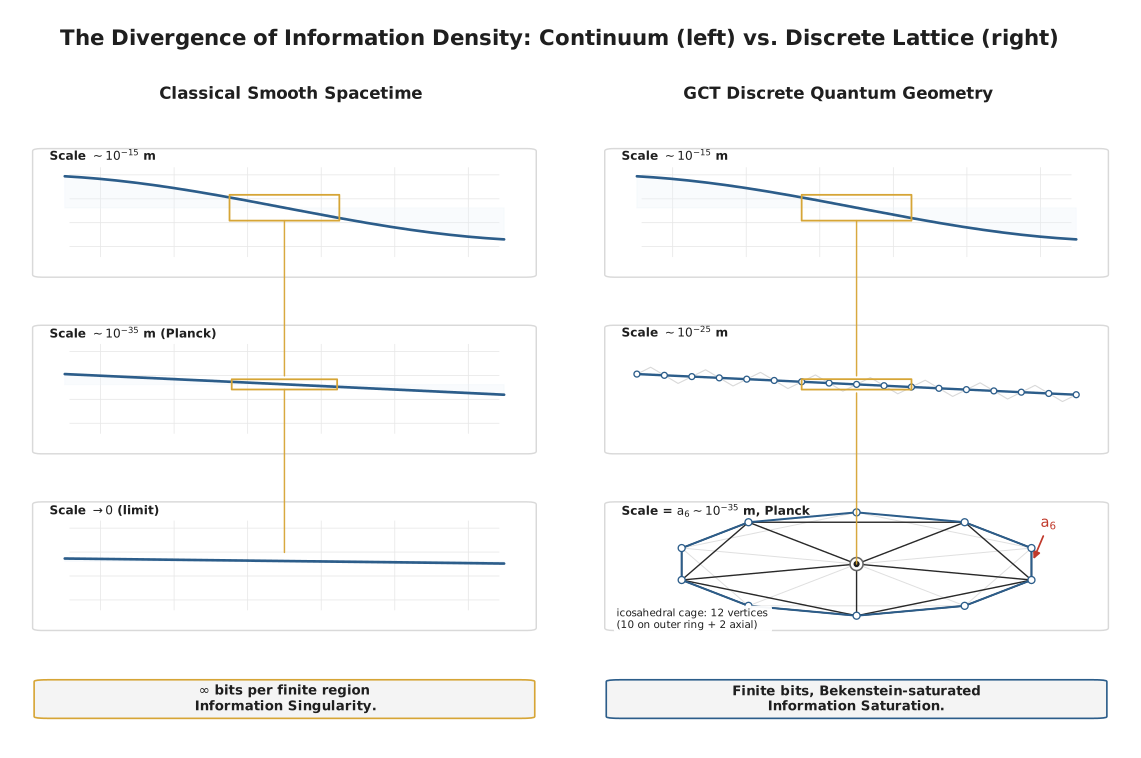
The Cost: Singularities and Infinities However, the Continuum Hypothesis carries a fatal flaw: it permits Information Singularities. [Tier 1 — Logical consequence of infinite divisibility] If a region of space has infinite resolution, it can store infinite information. This leads to the Ultraviolet Catastrophe in thermodynamics and the prediction of infinite energy density in Quantum Field Theory (requiring Renormalization to subtract the infinities). Most critically, it leads to the Black Hole Information Paradox. If space is continuous, a black hole can store an infinite amount of entropy in a finite volume, violating the Second Law of Thermodynamics upon evaporation. The Continuum predicts its own breakdown.
4.1.2 Branch B: The Discrete
Branch B (The Discrete) posits that space has a minimum resolution limit—a "pixel size." Below a certain scale , the concept of distance ceases to be meaningful. The manifold is modeled by a Lattice or Graph structure.
The Claim: Minimum Resolution GCT asserts that the universe is computable and finite. Therefore, it must be discrete. The fundamental unit of geometry is not the point (-dimensional), but the Cell (finite volume).
The Evidence: Bekenstein-Hawking Entropy The strongest evidence for discreteness comes from Black Hole Thermodynamics. Bekenstein and Hawking proved that the maximum entropy (information) observable in a region of space is proportional to its Surface Area, measured in fundamental units. where , half the 6D lattice constant, as formally identified in the NOTE below.
[!NOTE] Canonical Scale Identification [Tier 2 — Geometric Scale Identification] The 6D parent lattice constant is identified with twice the Planck length: In lattice units (), . This lattice–Planck relation (App. K §K.7; engine
protocol_absolute_scale.py) is fixed by the Bekenstein bound applied to the holographic horizon of the quasicrystal: one lattice plaquette of area carries exactly one bit (§13.3.3). Every subsequent formula in this work that uses implicitly employs .
This formula implies that the horizon is tiled by discrete plaquettes of area , each carrying exactly one bit of information: . If the boundary has finite information capacity, the bulk cannot have infinite degrees of freedom, or the holographic mapping would fail. Discreteness is a bulk necessity. (Note: Chapter 13 establishes the area-information thermodynamic mechanism behind Newton's ; its SI numerical value inherits the O.14 Planck-link and dimensional-anchor qualifications.)
4.1.3 The Bayesian Decision
We compare the complexity costs:
- Continuum: Requires bits to describe any state. Predicts singularities. Contradicts Thermodynamics.
- Discrete: Requires finite bits. Consistent with Quantum Mechanics. Matches Entropy bounds.
Decision: . [Tier 1/2 — Structural Postulate: discreteness selected by parsimony and Bekenstein bound; see §2.2.3] We proceed with the understanding that the universe is a Discrete Lattice.
4.2 The Quasicrystal Necessity
4.2.1 The Constraint of Isotropy
If the universe is a lattice, what is its shape? A simple periodic lattice (like a cubic grid ) has a fatal flaw: it breaks Rotational Symmetry (Isotropy).
- The Problem: In a cubic grid, the distance between nodes is along the axis, but along the diagonal. A particle moving diagonally would experience a different "speed of light" than one moving axially.
- Observation: Special Relativity and astronomical observations confirm that the speed of light is isotropic to 1 part in . [Tier 3 — Phenomenological bound from CMB and gamma-ray burst observations] The universe does not look like a grid; it looks smooth.
We face a trilemma. We need a structure that is:
- Discrete (to avoid singularities).
- Isotropic (to match observation).
- Ordered (to support physical laws).
Standard candidates fail:
- Periodic Crystal: Discrete + Ordered, but Anisotropic.
- Random Glass / Causal Set: Discrete + Isotropic (statistically), but Disordered.
4.2.2 The Unique Solution: Projected Quasicrystal
There is a third option, often overlooked: The Quasicrystal. A Quasicrystal is a structure that is ordered but not periodic. It lacks translational symmetry but possesses Long-Range Orientational Order. Crucially, quasicrystals can possess "forbidden" rotational symmetries, such as 5-fold (Pentagonal) or Icosahedral symmetry, which are impossible for periodic crystals. Isotropy by itself is not enough to select the icosahedral case: and also satisfy macroscopic finite-point isotropy. GCT therefore adds the maximal-finite-point-symmetry axiom: among finite three-dimensional point groups compatible with a discrete substrate, the icosahedral group is selected as the largest finite rotational order. This is an architectural postulate rather than a deduction from isotropy alone; it is the closest finite lattice symmetry can get to perfect spherical isotropy.
Rejecting Randomness (Causal Sets) Why not a Random Graph (Causal Set)? A random graph has Maximal Kolmogorov Complexity—it is incompressible noise. To specify the universe, one would need to specify every single link individually. A Quasicrystal has Minimal Kolmogorov Complexity. It is generated by a simple, deterministic projection algorithm. By the Principle of Parsimony (Chapter 2), the Quasicrystal is exponentially more probable than the Random Graph.
The Cut-and-Project Method How is such a structure generated? It is mathematically impossible to construct a 5-fold lattice in 3 dimensions using only 3D operations. However, it is possible to generate one by projecting a higher-dimensional lattice into 3D. The standard Penrose Tiling (2D) is a projection of a 5D hypercubic lattice. The Ammann-Kramer-Neri Tiling (3D) is a projection of a 6D hypercubic lattice.
GCT posits that the physical universe is a 3-dimensional slice through a 6-dimensional hyper-lattice. [Tier 1/2 — Structural Postulate: 6D parent lattice with cut-and-project]
4.2.3 The Geometric Engine
This projection mechanism is not just a mathematical trick; it is the engine of physics.
- The Connection: The 6D lattice has an index-2 sublattice (the checkerboard lattice of even-coordinate-sum points), which satisfies the color parity requirement (Volume 3). Both and embed naturally as coordinate projections of the Root Lattice via the Elser-Sloane map (Appendix U §U.7). The inclusion chain is .
- Emergence of Gauge Symmetries: The "hidden" dimensions of the lattice () do not disappear. They become the internal spaces of particle physics. The Tier 2 icosahedral-projection ansatz yields the registered gauge-product candidate, with the full physical Standard-Model spectral-triple identification conditional on App H O.32.
- Topological Necessity: We do not choose this geometry arbitrarily. We choose it because, once maximal finite point symmetry is added to discreteness, isotropy, spinoriality, and algorithmic simplicity, it is the classified residue of the binary polyhedral subgroup analysis. (See Appendix U.6 for the Uniqueness Theorem.) The constants of nature (, masses) are spectral and metric invariants of this specific projection.
4.3 Conclusion of the Epistemic Derivation
4.3.1 The Complete Logical Chain
This completes the descent from Logic to Physics. The chain runs:
- Axioms: Presence + Intelligibility.
- Ontology: Idealism (Mind is fundamental).
- Geometry: Discrete Space (Finite Information).
- Symmetry: Quasicrystal (Isotropy requires Projection).
- Hardware: The 6D Lattice (Geometry of the Vacuum).
4.3.2 From Pure Logic to Physical Structure
The framework arrives at a specific, falsifiable physical model without invoking arbitrary particles or fields. The universe must be a projected high-dimensional lattice. Chapter 5 derives the dynamical law that governs this lattice: the Wheeler-DeWitt equation. Before that, the "Cosmology of Zero" establishes why the lattice exists at all. This bridges the gap between Volume 1 (Logic) and Volume 2 (Architecture). The "Software" (Consciousness) requires "Hardware" (Geometry) to render itself. The Quasicrystal is that hardware.