Volume 3 — The Matter Spectrum
Chapter 2: The Rotation Sector (SU(2))
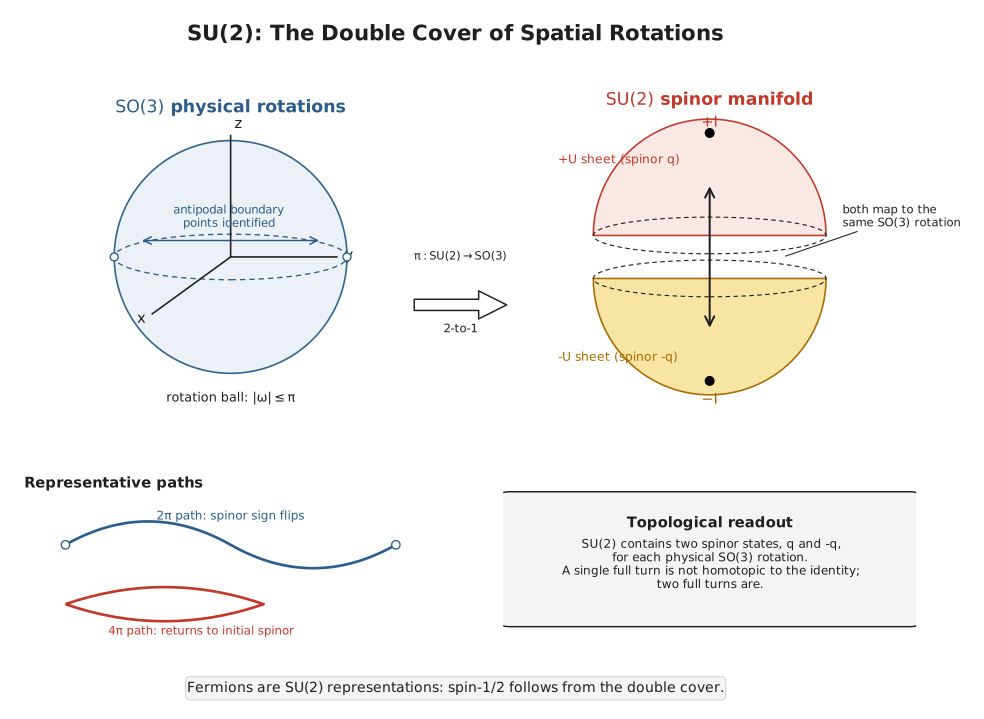
While the sector arises from the internal scalar phase of the vacuum condensate, the Weak Interaction is derived from the topological constraints of physical rotation. In standard Quantum Field Theory, the gauge group is typically postulated as a fundamental symmetry to account for isospin and parity violation. In Geometric Consciousness Theory (GCT), is revealed as the Simply Connected Universal Cover of the rotation group, necessitated by the requirement that tethered topological defects (Agents) maintain single-valued wavefunctions. This chapter gives the Tier 2 GCT derivation of the weak-force identification from the 3D manifold topology and the chiral separation of the 6D projection; the underlying double-cover topology remains a Tier 1 mathematical input.
2.1 The Two Bundles: Spin and Isospin
2.1.1 Isomorphism is not Identity
Standard physics distinguishes between Spin (transforming under spatial rotations) and Weak Isospin (transforming under internal gauge rotations), even though both obey the algebra. GCT derives both from a single source—the icosahedral quasicrystal—but assigns them to distinct fiber bundles.
- The Frame Bundle (): The 3D physical manifold requires a spinor double-cover to allow for tethered defects. This generates Space-Time Spin ().
- The Internal Bundle (): The 3D internal manifold possesses the same point-group symmetry. The double-cover of the internal rotations generates Weak Isospin ().
2.1.2 The Geometric Origin of
While Spin arises from the continuous rotation of the defect in space, Weak Isospin arises from the Discrete hopping of the defect's internal frame between the 120 vertices of the Binary Icosahedral Group (). Because the projection is chiral (-dependent), the internal bundle couples only to the Left-Handed projection of the defect, deriving the chiral nature of the Weak interaction.
2.2 The Double Cover Requirement
2.2.1 Theorem 2.1 [Tier 1 double-cover topology + Tier 2 GCT defect interpretation]: The Spinor Necessity Theorem
Theorem 2.1: Any self-referential topological defect (Agent) tethered to a fixed identity background in 3D space must transform under the fundamental representation of to maintain a single-valued state vector.
2.2.2 Proof: 360° rotation identity for ribbons
We model the Agent as a Framed Ribbon representing the Berry Phase Holonomy of the wavefunction phase. This "Identity Tether" links the 3D knot in physical space to the universal fiber.
- A rotation of () returns the knot to its original geometric position but introduces a phase factor of in the holonomy of the connection. Topologically, the ribbon accumulates a "twist" that cannot be removed by translation.
- A rotation of () introduces a double-twist (). In 3D, a double-twist is contractible; it can be "looped" over the object to restore the system to its original state.
Because the Agent’s state depends on its topological relationship to the background, the "Identity" of the Agent is only restored after . The symmetry group of the Agent is therefore the double cover of the rotation group.
2.2.3 Spinors and the need for ( symmetry)
The universal cover of is the Special Unitary group . Mathematically, is topologically equivalent to the 3-sphere (), which is simply connected. Under , the identity is reached only after a phase advance, matching the requirement of the tethered defect.
2.2.4 The Dirac Belt Trick and the Identity Tether
The "Dirac Belt Trick" is the physical proof of this Tier 1 derivation. It demonstrates that in a 3D manifold, "Orientation" is not just a local property, but a global property of the object’s relationship to the background. In GCT, matter behaves as spinors because matter consists of anchored defects whose phase must remain coherent with the universal Solenoid.
2.2.5 Proof of the Double Cover Map (Quaternions) [Tier 1]
Using the isomorphism between and the unit quaternions , a rotation by angle about axis is mapped to elements , where . The factor of ensures that yields , and yields . This covering map rigorously defines the Weak Isospin space as the Topological Frame of the vacuum.
2.3 The Binary Icosahedral Group
2.3.1 (120 Elements)
While the hydrodynamic limit utilizes the continuous group , the underlying hardware is a discrete lattice. The rotational symmetry of the 6D parent lattice projects to the Binary Icosahedral Group, denoted (or ). This is a discrete subgroup of containing 120 elements.
2.3.2 Lift of the Icosahedral Classes
The 60 rotational symmetries of the icosahedron (group ) are "doubled" in to account for the spinor phase. The 120 elements of correspond to the 120 vertices of the 600-Cell (a regular 4-polytope) embedded in the manifold of the gauge group.
2.3.3 Quaternion Representation (The 600-Cell) [Tier 1]
The elements of the weak sector are discrete:
- 8 units: and permutations.
- 16 vertices: .
- 96 vertices: even permutations of .
2.3.4 Discrete Hopping of Internal Frames
Because the lattice is discrete at the Planck scale, the internal frame of a particle cannot rotate continuously; it "hops" between these 120 allowed orientations. The "Weak Force" is the gauge field required to synchronize these discrete orientations between adjacent lattice cells.
2.4 Chirality from Projection
2.4.1 The Primary Chiral Asymmetry (Geometric CP-Violation)
Standard physics treats CP-violation (the preference for matter over antimatter) as a parameter in the CKM matrix. GCT identifies it as a Structural Property of the Projection.
2.4.2 Chirality Witness: Jackiw-Rebbi Domain Wall [Tier 2 mechanism + Tier 3 numerical-control witness]
Chirality is treated as a computationally verified witness under the current model. The cut-and-project boundary of the quasicrystal acts as a topological domain wall, structurally analogous to the Jackiw-Rebbi mechanism. Computations on the 1D Fibonacci Chain equivalent yielded exactly 13 midgap states manifesting a net chirality of (a left-handed surplus). This supports the Tier 2 chiral-domain-wall mechanism and supplies a Tier 3 numerical-control witness for parity violation; theorem-grade uniqueness over the full gauge/classification setting remains an open App H O.39 target.
2.4.3 The Selection Operator and Chiral Projection
An Agent is defined as a chiral loop in the lattice. To define a "Forward" direction of time (and thus an arrow involving causal choice), the Agent must project onto the manifold.
- Left-Handed States: Can couple to the geometric curvature of the Physical Manifold ().
- Right-Handed States: Are rotated into the Internal Manifold ().
Because the Operating System (Consciousness) resides in the projection mechanism, it can only "grip" the handles that extend into the physical frame. The universe is left-handed because Agency is Chiral. We select the path that aligns with the projection, discarding the sterile shadow.
The representation decomposes as:
- : A doublet under physical rotations () and a singlet under internal rotations.
- : A singlet under physical rotations and a doublet under internal rotations ().
2.4.4 Left-Handed Coupling to Weak Force
We identify the physical Weak Force with the gauge bosons of the group. Because left-handed fermions carry the index, their spinor orientation is aligned with the physical projection. They possess the "topological handles" required to couple to the and fields.
2.4.5 Right-Handed Sterile States and Neutrinos
Conversely, right-handed fermions carry the index. Their spinor orientation is rotated into the Internal Space (). Because the weak bosons are excitations of the physical metric, they cannot "grip" these states, which appear Sterile to the interaction. These sterile states correspond to the right-handed neutrino components; their isolation in provides the geometric basis for the second-order neutrino mass suppression derived in Chapter 9.
2.5 Physical Interpretation
2.5.1 Three Generators: (Before Mixing)
The algebra is generated by three operators. are the Step Operators that rotate the Agent's identity address (e.g., Electron Neutrino), while is the pre-mixing neutral current that later combines with the Hypercharge field (Chapter 4) to form the physical and .
2.5.2 Weak Isospin as Lattice Orientation
The quantum number corresponds to whether the Agent's identity-knot is "Up" or "Down" relative to the primary axis of the local vertex star.
2.5.3 Parity Violation as Geometric Feature
GCT concludes that the universe is not "left-handed" by accident. The 6D3D projection is a chiral operation. By choosing an irrational -slope to project the lattice, the Operating System selects a preferred orientation for spinor transport. Parity violation is the Geometric Signature of the Projection—it is the proof that our 3D world is an oriented slice of a higher-dimensional totality.