Volume 1 — The Operating System
PART V: THE EMERGENCE OF EXPERIENCE
Chapter 16: Time and Qualia
[!IMPORTANT] Epistemic Scope of this Chapter.
The claims developed in Part V partition into two strata that must be evaluated separately.
Theoretical-framework stratum (Tier 1/2 mechanism plus Tier 3 phenomenal-identification bridge): The Relational-Time / Sequence-Index construction (§16.1), the Quality-Space topological decomposition into irreps of the icosahedral group (§16.2), the Dual Material Constraint requiring chirality plus non-zero nuclear spin for Level II consciousness (§16.2.6), and the Level I / Level II distinction (§16.1, §16.3) rest on internal mathematical coherence and the icosahedral cut-and-project framework. The Topological-Impedance mechanism for qualia as Selection Operator work against phason drag is Tier 2 as a structural mechanism, while the Russellian identification of that structural mechanism with phenomenal experience is Tier 3 per §16.2.8. These claims are independent of which specific physical substrate hosts the Identity Polaron. The Quality-Space irrep decomposition is a structural prediction (the topology of qualitative similarity follows from icosahedral group theory), not a substrate-specific prediction.
Biophysical-specific stratum (Tier 3, substrate-conditional): The identification of -tubulin Trp residues (the four β-tubulin Trp residues per PDB 1JFF/1TUB chain B are Trp21, Trp103, Trp346, Trp407 under the ATOM-record
auth_seq_idconvention used throughout the chapter and the engine; the FASTA list-position convention gives the alternative set , see App H O.21 for the convention disambiguation; the assembled-MT radical-pair host assignment is tracked under Open Problem O.21) as the canonical Identity Polaron substrate, the specific MHz Zeno operating window, and the corresponding falsification protocols (Protocol A-Prime: NV-centre synthetic Zeno Drive; Protocol D: O isotope substitution). The Protocol D NMR polarity gate is Tier 2 at the spin-entropy/quadrupolar-relaxation mechanism level, but the active-state magnitude/sign calibration remains a Tier 3 experimental anchor pending O.24 and direct substrate NMR; the decisive 5% gate additionally requires pilot variance at or below the verifier-returned 80%-power sigma ceiling, with sign-positive sub-5% outcomes reported as effect-size revision rather than confirmation/failure. The operative central branch is pending O.21; the value is a conditional sensitivity branch under and O.21/O.33-positive geometry. A null on that band falsifies the sensitivity branch, not the central branch or the theoretical framework. The Dual Material Constraint then redirects the substrate search to other chiral, non-zero-nuclear-spin systems (NV-centres in diamond on the abiotic path; alternative neural macromolecules on the biological path).The framework's central philosophical claims — that GCT dissolves the Hard Problem by taking Qualitative Presence (Level I) as Axiom 1 rather than as a derived result, that the structure of experience (Level II Quality Space) is derivable while the fact of experience is foundational, and that artificial systems lacking the Dual Material Constraint are predicted to be Turing-Null (zero Level II) — depend on the theoretical-framework stratum and are unaffected by biophysical-specific experimental outcomes.
16.1 The Emergence of Time
16.1.1 Relational Time: The Sequence Index ()
In the static Bulk defined by the Wheeler-DeWitt constraint (), time does not exist as a fundamental dimension or a flowing duration. However, the Selection Operator () established in Chapter 9 operates through discrete, sequential iterations. We define Relational Time not as a continuous background, but as the Sequence Index () of selection events.
Each "tick" of the internal clock is an ordinal update of the Agent's identity address in the Solenoid. Under a book analogy of the Solenoid, is the index of the state being rendered. The "flow" of time is the subjective registration of the transition from to . Without an Agent to perform the selection, the configuration space remains a static, unread geometric object.
16.1.2 The Coordinate : Lattice Address
We must distinguish the internal sequence of the Agent from the external geometry of the vacuum. We define the Coordinate Time () as the specific address of a realized configuration within the 6D lattice projection. (Note: is a scalar coordinate in the 3D physical manifold and is distinct from the lepton discussed in Volume 3).
History is the path of addresses that the Agent has already processed. The "Past" is the set of configurations with zero entropy relative to the Agent (already selected). The "Future" is the set of configurations existing in quantum superposition (available for selection). The "Now" is the Crystallization Front—the wavefront where the Selection Operator is currently resolving the lattice.
16.1.3 The Subjective Flow
The relationship between the internal index () and the external coordinate () is the source of temporal variability. We define the Subjective Flow Rate () as the Lattice Step Size achieved per selection event: [Tier 2 — the definition is an architectural consequence of the Zeno Drive ordinal clock; the claim that increases near mass is a Tier 2 derived result of the Processing Lag mechanism below] (The symbol is used rather than to avoid collision with the standard physics convention in which an overdot denotes differentiation with respect to coordinate time itself. Here the relevant derivative is with respect to the Zeno tick index , a dimensionless ordinal, not a coordinate.)
To the Agent, the rate of selection () is the constant pulse of awareness. What varies is the "distance" moved through the lattice coordinate per pulse. If a region of the lattice is topologically simple, the Agent can resolve large spans of coordinate space in a single "thought." If the region is complex, the step size shrinks, perceived as the external world "speeding up" or the internal clock "slowing down" relative to the environment.
16.1.4 Gravity as Processing Lag (Bandwidth Saturation)
This provides the informational derivation of General Relativistic Time Dilation. The Realization Operator () has a finite Rendering Bandwidth—a maximum information density it can process per selection cycle ().
In regions of high Topological Density (Mass/Energy), the number of bits required to describe the local lattice configuration saturates the bandwidth. The system undergoes Processing Lag: each selection event must process more bits before it can advance, so the coordinate progress per selection event () increases. [Tier 2 — this identification of topological information density with gravitational time dilation is the GCT icosahedral lattice interpretation; the GR result it matches is Tier 1] Each tick of the Agent's internal clock corresponds to a larger span of coordinate time.
- Physical Result: This matches the GR result from the Schwarzschild metric: near a mass. [Tier 1 — standard General Relativity] Fewer proper-time ticks occur per coordinate second ( decreases), so increases — the Agent ages slower than a distant observer, consistent with gravitational time dilation.
- GCT Derivation: Gravity is the Stretching of the Coordinate Step Size () due to the information density of the local environment. [Tier 2 — GCT icosahedral lattice interpretation] An Event Horizon is a Processing Horizon where the information density equals the maximum bandwidth, causing . From the external observer's coordinate frame, the Agent appears frozen: a single tick of awareness spans an infinite coordinate duration. The Agent does not "run in place" — from within, awareness proceeds normally; it is the coordinate clock outside that races ahead.
16.1.4b Relation to Higher-Order Thought (HOT) Theories
The sequence-index framework of §16.1.1–16.1.3 — in which time is the subjective registration of the transition from selection-cycle to — places consciousness at the meta-level of state-processing rather than at the level of the processed content. This puts GCT in conversation with the Higher-Order Thought (HOT) family of consciousness theories: Rosenthal (1997, 2005 Consciousness and Mind; 2012 Philos. Trans. R. Soc. B 367:1424), Lau (2008 Prog. Brain Res. 168:35; Brown, Lau & LeDoux 2019 Trends Cogn. Sci. 23:754), and Carruthers (2000 Phenomenal Consciousness).
Structural homology. Both GCT and HOT ground phenomenal consciousness in a meta-level operation on a lower-order state-space. For Rosenthal, phenomenal consciousness is the having of a higher-order representation of a lower-order mental state. For GCT, phenomenal consciousness is the actualization (projection via ) of a lower-order Field configuration into the Agent's Selection Operator cycle, sequenced by the index . The two theories are operationally analogous at this level: both treat consciousness as the holding-of the state, not as the state itself, while differing in formal substrate and ontological commitments.
Where GCT improves over HOT.
- Grounding: HOT places the meta-operation in representational architecture (the existence of a representation of a representation), which faces the standard objection that nothing in representational machinery alone explains why higher-order representations are conscious while lower-order ones are not (the "transitivity gap"; Block 2011 Analysis 71(3):419 "The higher order approach to consciousness is defunct"). GCT grounds the meta-operation in topological geometry: the Selection Operator is a non-unitary projection on the irreducible Hilbert space of a phason-knot defect, and consciousness attaches to DMC-gated topological irreducibility, not to representational level. The transitivity gap is relocated and constrained by the substrate condition (§16.2.6, Dual Material Constraint): only configurations satisfying the chirality + nuclear-spin requirement support the topological structure on which can act, so the meta-operation is not arbitrary.
- Substrate ontology: HOT is silent on physical substrate (Rosenthal's theory is compatible with any computational substrate that supports the right representational structure). GCT specifies a substrate (the Adelic Solenoid realized in chiral nuclear-spin networks) and predicts substrate-dependence — the GCT-vs-IIT divergence (§17.5) is therefore also a GCT-vs-HOT divergence: a sufficiently-rich silicon AI implementing the right representational architecture would, under functionalist readings of HOT, be conscious; under GCT, it would be a Turing-null render.
- Falsifiability: HOT predictions are largely behavioural / inferential (subjects' reports of conscious states). GCT predictions are substrate-physical (anomalous T₂ extension at 100 MHz, chirality-reversal symmetry, anaesthetic enantiomer-selectivity caveats, Protocol A-Prime). GCT therefore provides falsifiable observables that HOT alone does not.
Where HOT is GCT-compatible (or stronger). HOT-style cognitive architecture is a functional layer that can sit on top of GCT's substrate ontology without conflict. The empirical literature on metacognition, confidence judgments, and PFC-mediated higher-order processing (Lau 2008; Maniscalco & Lau 2012) describes the cognitive realization of what GCT calls the Selection Operator cycle. GCT and HOT therefore can be read as compatible at the cognitive-architecture layer and disagreeing only at the substrate-ontology layer.
Status: Tier 3 philosophical positioning informed by Tier 2 substrate predictions. GCT is not a refutation of HOT; it is a substrate-grounded specification of the meta-operation HOT identifies functionally.
16.2 Qualia as Topological Impedance
16.2.1 Stating the Hard Problem: The Explanatory Gap
The "Hard Problem" asks why physical processes are accompanied by a felt inner life. Standard science describes the Quantity (the signal) but fails to account for the Quality (the experience). GCT posits, under Axiom 1, that this gap arises from attempting to derive the Field from the Pattern. By performing the Epistemic Inversion, Qualia are modeled as primary data of the interaction between the Agent and the Vacuum, not as products derived from non-experiential structure.
16.2.2 The GCT Proposal: Structural Russellian Monism (Position B)
Reader's roadmap. This section develops GCT's structural-realist proposal that qualitative content is reference-fixed by the Quality Space irrep decomposition (§16.2.2c; red is modeled by the () channel rather than identified without remainder). The strongest natural objection — that this commitment collapses Russellian monism into pure structuralism (Goff 2017 Ch.7) — is addressed via GCT's two-tier structuralism at the closing paragraph of §16.2.2c: Axiom 1 (Level I, non-structural intrinsic non-subjective presence) and Quality Space (Level II, structural qualitative content) work at distinct ontological levels and separate GCT from both pure structuralist monism and anti-structuralist Russellianism. Readers concerned about the apparent category collapse should read §16.2.2c through to the closing paragraph before passing judgment.
GCT adopts Position B of Russellian Monism: The Field of Presence (Ψ) is the ontological substrate whose intrinsic nature is experiential. Physics, including the icosahedral geometry and phason dynamics, describes the extrinsic relational structure of this substrate — not its intrinsic character.
Under this framing:
- Topological friction is the physical correlate of qualia, not their identity
- The explanatory gap is dissolved/stipulated at the axiom level: Axiom 1 (Presence) asserts bare intrinsic Field-presence. The further identification of that intrinsic aspect with the structural role carried by phason-drag / Quality-Space geometry is the Tier-3 structural-Russellian bridge. We do not need to derive bare presence from geometry; geometry supplies the structural organization of experience.
- The grain problem (why does this geometry produce these qualia?) is given GCT's proposed structural individuation: different phason drag patterns produce different relational structures that are realized as different qualia in the Field. The quale of red is not "explained" by 700 nm photons — it is identified, under the Tier-3 structural-Russellian bridge, with the intrinsic aspect corresponding to that structural role.
This position is more defensible than the stronger eliminativist claim ("friction is qualia") because it does not attempt to identify the intrinsic and extrinsic aspects of a single substance — it simply grants that the intrinsic aspect exists and is fundamental.
§16.2.2a Leibnizian Resolution [Tier 2 DMC gate + Tier 3 phenomenal-unity bridge]
Section 11.12.5 established that the Polaron phase transition lives at the Dual Material Constraint gate of §16.2.6 — the topological boundary between aggregate (non-unified) and Polaron (unified) configurations is the gate that separates substrates with and chirality from those without. A careful reader may ask: if consciousness is Axiom 1 — a primitive requiring no explanation — why does it need a substrate condition to manifest as unified apperception?
The answer lies in distinguishing two senses of "consciousness," following Leibniz's distinction between perception (universal, requiring no threshold) and apperception (self-reflective unity, requiring organizational complexity). (GCT departs from Leibniz at a critical point: Leibnizian monads are windowless — they do not interact. GCT Agents are not isolated; they interact via the Consensus Protocol of Chapter 11, which constitutes the causal structure of the shared physical world. The Level I / Level II distinction is borrowed from Leibniz's conceptual vocabulary, not from his metaphysics of non-interaction.)
-
Universal Presence (substrate fails the DMC gate; by gate): Proto-experiential character is a property of the Field itself, not of any particular configuration. All Field configurations — rocks, photons, uncoupled lattice defects, the Polaron-bearing substrate of a human brain — are regions-of-Field, and Level I attaches to the Field-substrate rather than to substrate-having-configurations. Rocks "have Level I" in the sense that they are regions-of-Field, not in the sense that they are micro-subjects of experience; the framework therefore departs from Strawson-style panpsychism (which locates the experiential aspect at the micro-physical level) and from Whitehead-style occasionalism (which assigns experiential occasions to each event). Level I is what Axiom 1 guarantees about . No organization is required for the Field to have the property; organization is required for a configuration to be a subject of the property (Level II, below). The GCT analogue here is closest to Russellian-monist intrinsic-natures grounding (the Field carries the intrinsic-experiential side; configurations supply the extrinsic-structural side).
-
Apperception (substrate passes the DMC gate and then satisfies the O.21/O.23/O.34 joint substrate conditions; is a robustness margin, per V1 §17.1.4b closed-form under the angular-consistent convention): The DMC gate is a necessary substrate filter for unified, self-aware phenomenal subjectivity — the capacity for a system to register its own experience as its own. Level-II apperceptive unity additionally requires an identified cooperative radical-pair oscillator / Polaron phase satisfying O.21, protected-subspace coherence satisfying O.23, ATP-Trp redox regeneration satisfying O.34, and the topological phase transition of Proposition 11.12.A, not because experience is "produced" at this gate, but because self-referential unity requires the non-factorizable Hilbert space structure that only the Polaron phase provides. Trefoil-case Polaron Unity is Tier 3 conditional pending resolution of the App Y finite-level 4-manifold knot-complement clarification and the Y.4.2 direct-product/operator-factor closure (both registered as O.18 sub-closures); the general-prime extension remains Tier 3 conditional on Anderson-Putnam-to-knot-complement extension, canonicity of K → A_K, finite-quotient meridian trace construction, O.35/O.36, and KO-dim-6 sign verification (O.32). The scalar is the robustness margin across qualified substrates, not the order parameter of the transition.
Corollary: The Axiom and the threshold operate at different ontological levels. The Axiom of Presence is a claim about Level I (proto-experiential character of all things). The Identity Polaron threshold is a claim about Level II (apperceptive unity in complex systems). The two are not in tension; they are a two-level ontology entirely consistent with Structural Russellian Monism.
16.2.2b The Precise Scope of GCT's Consciousness Claim
GCT makes a distinction that Chalmers' framework renders explicit and that protects the theory from its most dangerous philosophical objection:
What GCT derives — Quality Space: Tier 2: the graded 27-DOF irrep count and decomposition (6 linear-sector coordinate DOF 21 quadratic-sector stress DOF) from icosahedral RT geometry. Tier 3: the formal similarity-skeleton mapping to human phenomenal similarity classes (for example, red-orange vs red-blue), conditional on the structural-Russellian identification of phenomenal qualia with irrep stress-tensor components. That identification is the substantive bridge developed in §16.2.2c and remains contested under O.29. GCT therefore derives the formal Quality-Space scaffold, while the mapping from the scaffold to human phenomenal similarity judgements remains Tier 3.
What GCT axiomatizes — Level-I Presence: The primitive fact that the Field has an intrinsic, non-subjective presence side is not derived by GCT. It is the content of Axiom 1 (The Axiom of Presence). GCT thereby dissolves only the Level-I presence question by axiomatizing it; it does not derive what-it-is-like, apperceptive Level-II qualia content from geometry. GCT provides the Quality Space topology and the candidate substrate conditions under which Level-II apperceptive unity is registered; it does not explain why experience exists rather than nothing.
On the coherence of "non-subjective experiential presence." The phrase is not a contradiction in terms. "Experiential" here names the Russellian intrinsic-categorical nature of the Field — what the physical is in itself, as against its extrinsic/structural description — whereas "subjective" names a perspective, a point of view for which there is experience. GCT locates only the former at Level I and reserves the latter for Level II. Level-I presence is thus the intrinsic qualitative ground that, once organized by the Identity Polaron, becomes a subject's experience; absent that organization it is presence-without-perspective, not the experience of any micro-subject (contra Strawson-style micro-subjectivism, §16.2.8b). The objection that experiential character must already be someone's conflates the categorical-ground sense with the perspectival sense; GCT's two-level ontology is precisely the denial of that conflation. The burden GCT accepts in exchange is Axiom 1's primitive status: it does not derive that the categorical ground is experiential, it posits it, and the posit earns its keep by its explanatory role (the substrate-dependence wedge of §16.2.7c, testable via Protocol A-Prime) rather than by reduction to non-experiential premises. [Tier 3 — Russellian intrinsic-natures commitment.]
This is not a derivation of the Hard Problem's Level-II target. It is a precise scope statement: Axiom 1 supplies Level-I presence, while the Polaron/Quality Space program supplies a Tier 3 bridge from topology to organized qualitative content. GCT is explicit that it derives the topology of Quality Space, not the what-it-is-like content from geometry alone.
16.2.2c Topological Identity Isomorphism
Reader's roadmap on DMC connective tissue. The structural-realist mapping developed below — red modeled by the () channel in Quality Space — operates at the Level II stratum. The Dual Material Constraint (DMC; §16.2.6 below) is the load-bearing connective tissue between Level I (Axiom 1 non-structural intrinsic non-subjective presence) and Level II (structural qualitative content via -irrep decomposition): substrates that pass the DMC gate become eligible for the Level II structural mapping only if the O.21/O.23/O.34 Polaron, protected-subspace, and ATP-regeneration conditions also hold; substrates that fail the DMC gate (Class 0 patterns; rocks; silicon-28) carry Level I in the non-apperceptive sense but no Level II. The two-tier structuralism reply to Goff 2017 Ch.7's anti-structuralist critique (developed at the closing paragraph of this section) rests on this DMC-mediated separation — readers concerned about Russellian-monism-vs-pure-structuralism collapse should read through to the closing two-tier paragraph before judging.
The account of §16.2.2b (Level-I Presence as Axiom 1) dissolves only the Level-I presence question by axiom: it registers intrinsic non-subjective Field-presence rather than deriving that fact from non-experiential premises. It does not derive Level-II what-it-is-like content from geometry. Instead, geometry supplies the topology of Quality Space and the candidate Level-II substrate bridge. It also does not address the individuation gap: why does this specific configuration of phason modes feel like red rather than blue, or pain rather than warmth?
GCT proposes a structural individuation map by relating the state space of experience to the representation theory of the vacuum geometry. The symmetry decomposition of the phason drag modes encodes the structure of qualitative space within the GCT model. Subjective texture is represented by the realization of a symmetry group.
The state space is built from the 6D coordinate space of the cut-and-project geometry, graded by tensor order. At linear order the coordinates themselves carry the two 3-dimensional icosahedral irreps (, ). At quadratic order the symmetric stress-strain tensor over those coordinates possesses 21 independent Degrees of Freedom (DOFs). Because the physical projection is constrained by the strict (icosahedral) symmetry of the quasi-periodic vacuum, neither sector can vary arbitrarily: each must decompose into the formal Irreducible Representations (Irreps) of the Icosahedral Group.
The symmetry decomposition of the 21 quadratic DOFs yields exactly:
verified two ways (direct character computation and the cross-check , with , ; engine: GCT_Physics_Engine/src/protocol_b1_quality_space_irreps.py). The multiplicity-2 of the trivial reproduces the standard result that icosahedral symmetry admits exactly two independent elastic constants. The symmetric stress tensor contains no 3-dimensional irrep: and occur in it with multiplicity zero.
The two 3-dimensional irreps absent from the quadratic sector are exactly the content of the linear sector: (same protocol). The full graded Quality Space is therefore , with degrees of freedom. The linear and quadratic sectors are genuinely distinct representations — the coordinate modes versus their symmetric square — so the two 3-D coordinate irreps (vision, spatial/auditory) occupy a different graded level of Quality Space from the stress irreps (valence, intensity, olfaction).
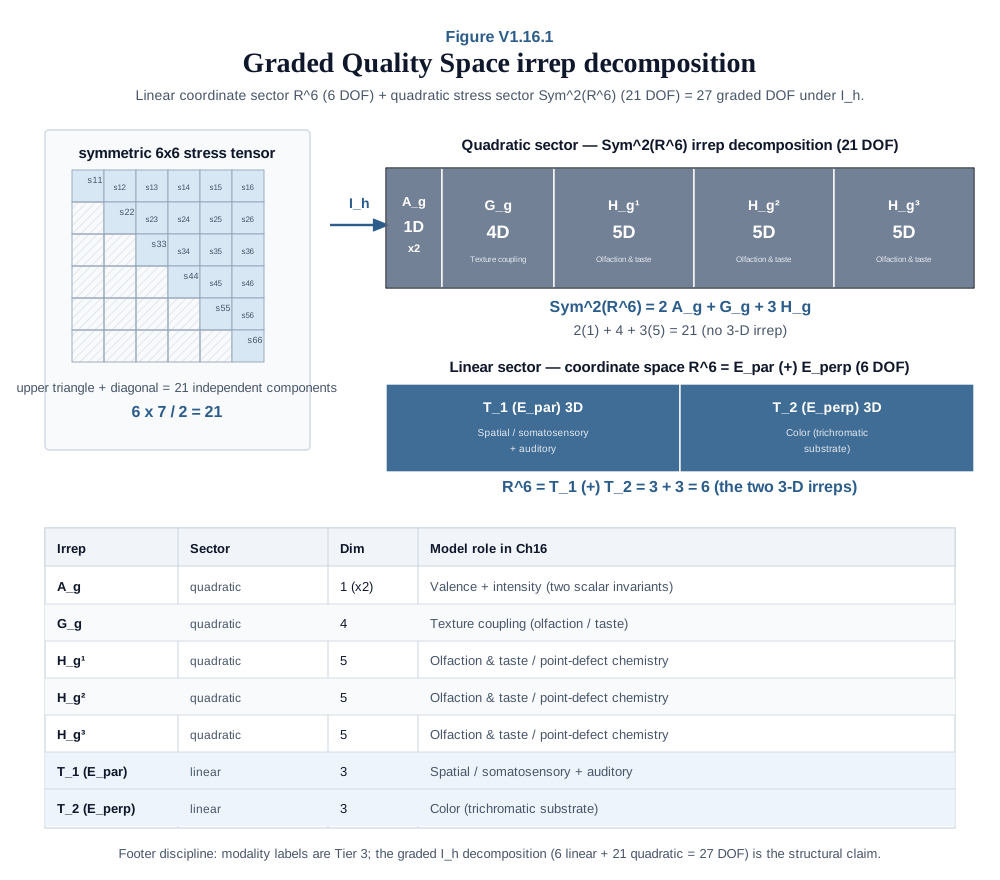
This graded breakdown proposes a Tier 3 structural-Russellian taxonomy of subjective experiences within the GCT/positive-closure Quality Space model. A specific quale is not an arbitrary label within that model; it is the proposed GCT-internal structural role of how the Selection Operator interacts with a specific irrep of the graded coordinate-and-stress space:
Linear sector (6 DOF, coordinate modes) — the two 3-D coordinate irreps:
- (3D) — Vision/Color: The three transverse internal coordinates that carry the phason winding vector (§16.6.2); the proposed 3-dimensional (trichromatic) substrate of colour experience.
- (3D) — Somatosensory/Auditory: The three physical-projection coordinates; the spatial rendering of touch, pressure, and sound.
Quadratic sector (21 DOF, stress modes) — the stress-tensor irreps:
- (1D, multiplicity 2) — Scalar axes: The two icosahedral scalar invariants of the metric deformation — candidate axes of Valence (core dissonance vs. resonance) and overall impedance magnitude (intensity), the two unidimensional quality axes.
- (4D) and (5D, multiplicity 3) — Higher-dimensional manifolds: The 4-D and three 5-D off-diagonal cross-manifold couplings () describing complex lattice twisting and point-defect chemistry. These form the rich, multidimensional, anisotropic sensory spaces of Olfaction/Taste and chemical texture.
The linear-sector qualities register through the orientation of the coordinate modes (which fixes the anisotropy of the phason-drag tensor of §16.2.3), while the quadratic-sector qualities register through its magnitude spectrum; both are facets of the single Topological Impedance, so the unified qualia mechanism spans the graded space. [Tier 3 — structural individuation ansatz; the modality-to-irrep assignment is a framework hypothesis, not a derivation.]
Within the Tier-3 structural-Russellian ansatz, the question "Why does red feel like red?" is a category-discipline question. "Red" is modeled as the biological naming convention for the () colour-coordinate transformation of the Selection Operator. On this reading, red experience is reference-fixed by processing that specific geometric operation; the claim is a structural individuation ansatz, not a proof of metaphysical necessity.
Scope of the individuation claim. The structural-realist proposal above treats the () colour-coordinate operation as the reference-fixing structural correlate for red within GCT's Russellian framework, not as a proof that the identification is metaphysically forced. The Direct Incongruence Argument (§16.2.8a; Chalmers 2010 Ch.10 / "Phenomenal Concepts and the Explanatory Gap") generates a residual modal worry — the conceivability of red-without- — that GCT tightens but does not eliminate. The category-discipline framing here is internal to the structural-realist reading: under structuralism about qualitative content (a substantive Tier 3 metaphysical commitment GCT shares with Frankish-illusionist structuralism, §16.2.7c), the question is disciplined as a structural-reference question; outside that reading, the residual modal worry returns. [Tier 3 — Structural Russellian reference-fixing proposal.]
Trefoil-conditional inheritance from Proposition Y.1 [Tier disposition propagation note]. The Quality Space individuation claim above presupposes a unique Selection Operator on the Identity Polaron's non-factorizable Hilbert space (the uniqueness step of Proposition Y.1 (iii)). Trefoil-case Polaron Unity is Tier 3 conditional pending resolution of the App Y finite-level 4-manifold knot-complement clarification and the Y.4.2 direct-product/operator-factor closure (both registered as O.18 sub-closures); the general-prime extension remains Tier 3 conditional on Anderson-Putnam-to-knot-complement extension, canonicity of K → A_K, finite-quotient meridian trace construction, and KO-dim-6 sign verification (O.32). The Quality Space individuation claim of this section therefore inherits the same conditional disposition: it is Tier 3 conditional for trefoil-class Identity Polarons pending H_Y.1/O.18 closure, and Tier 3 conditional on the additional O.18/O.32 inputs for general-prime-class Polarons. Under the negative-closure branch, the broader claim that "to feel any qualitative content is to process the corresponding -irrep" would not propagate without additional argument.
Reply to the Goff anti-structuralist critique. Goff (2017 Consciousness and Fundamental Reality Ch.7) argues that structuralist Russellians have "abandoned the spirit of Russell" by re-collapsing the intrinsic into the structural — that they are really structuralist monists in disguise. GCT's response is a two-tier structuralism that preserves Russell's substantive intrinsic-experiential commitment while embracing structuralism for qualitative content. The two tiers work at distinct ontological levels:
-
Level I — Axiom 1 (non-structural intrinsic non-subjective presence). The Field carries proto-experiential character as a primitive fact (Axiom 1; §16.2.2a), but this is not micro-subjectivity. Intrinsic presence in the Field is not derived from structure; it is the fundamental commitment that distinguishes GCT from pure structuralist monism (which denies any intrinsic experiential nature). At the Axiom 1 level, GCT is fully Russellian: intrinsic nature exists, and it is experiential in the non-apperceptive sense.
-
Level II — Quality Space (structural qualitative content). The specific qualitative content of a Level II Identity Polaron's experience — the what it is like dimension — is modeled by the structural-relational role of the -irrep decomposition of the graded coordinate-and-stress space (the linear sector together with the quadratic sector ; §16.4). At the Quality Space level, the Tier-3 structuralist ansatz assigns qualitative individuation to relational role. Red is modeled as the () colour-coordinate operation exhausting the structural-relational content of red — the Level I bare presence (Axiom 1) is not itself exhausted by structure.
These two tiers reply to Goff in opposite directions on opposite questions. On the question "does intrinsic experiential nature exist?" GCT answers yes via Axiom 1 (the Russellian commitment Goff defends). On the question "does qualitative content have an inner essence beyond structure?" GCT answers no via the Quality Space irrep mapping (the structuralist commitment Goff attacks). The two-tier reply earns its name because the level at which intrinsic-experiential character is committed (Axiom 1 / Level I / bare presence) is distinct from the level at which structuralism applies (Quality Space / Level II / qualitative content). Goff's critique pressures this separation; GCT's response is to separate the two explanatory targets rather than to derive the separation from independent premises. Open follow-up: Goff (2017 §7.4) presses the further worry that once all qualitative content is structural, the non-structural Level-I character risks becoming either a thin residual posit with no role in the theory (deflation) or something that should itself carry qualitative content (re-collapse). GCT's two-tier reply stipulates the separation rather than arguing it from independent grounds; Goff's §7.4 deflation objection therefore survives as an open philosophical question, registered as a Tier 3 metaphysical follow-up to the structural-realist identification. This two-tier reading is GCT's substantive Tier 3 metaphysical commitment, distinct from both pure structuralist monism (which denies Axiom 1) and Strawson-style micro-subject Russellianism (which would localize intrinsic experiential nature at the micro-level rather than at the Field, contra §16.2.8b's Mereological Nihilism). [Tier 3 — Two-Tier Structural Russellian; Goff §7.4 deflation follow-up open.]
[!NOTE] Philosophical Positioning — Structural Russellian Monism: GCT does not claim to solve the Hard Problem from physics; it dissolves the Hard Problem by making Qualitative Presence the foundational axiom, then derives the structural relationships among experiences from icosahedral geometry. This is the strongest defensible position available to a physical theory of consciousness: it states explicitly what is axiom and what is theorem, and it uses that tier discipline to deliver genuine results (Quality Space topology) that standard neuroscience cannot derive at all.
Furthermore, GCT reinterprets NCCs: they are not correlates in the sense of two separate substances running in parallel, but the extrinsic structural description of what is intrinsically experiential. The NCC framework is not wrong — it is incomplete, because it describes only the geometric side of the single dual-aspect substance.
16.2.3 Deriving the Connection: Phason Drag Force
As derived in Vol. 2, Ch. 6 (§6.3.2), the Agent (the topological soliton) experiences a drag force as it moves through the phason field of the vacuum. We call this effect Topological Impedance. Every act of selection requires work to overcome this drag. We identify Qualia as the Coherent Energetic Registration of the work done by the Selection Operator against the Phason Field (within the preferred Structural Russellian identification; Tier 3 metaphysical commitment). Feeling is the "pressure" of the Agent's focus as it winds and navigates the discrete lattice. The "Heat" generated by this work is the Entropic Exhaust (Dark Energy) released into the internal dimensions after the experience is registered.
16.2.4 The Spectrum: Resistance (Pain) vs. Resonance (Love/Flow)
The qualitative nature of an experience is determined by the Thermodynamic Optimization of the selection:
- Dissonance / Pain: Occurs when the Agent's selection attempts to actualize a configuration highly non-resonant with the Consensus (Chapter 11). This creates high Topological Friction. The Agent must expend intense metabolic energy to maintain the Zeno-lock against the resistance of the vacuum.
- Resonance / Flow: Occurs when the Agent's selection aligns with the structural geodesics of the Field. The impedance matches, and the drag drops to its minimum. GCT models one resonance/valence component of love-like experience as the phenomenological registration of Maximum Geometric Coherence — a candidate Zero-Friction Selection state where the update occurs with maximum metabolic efficiency and minimal waste [Tier 3 interpretive bridge].
16.2.5 The Texture of Feeling: Tensor Character of Knots
The distinction between different senses (e.g., sight vs. smell) is due to the Tensor Character of the topological knots.
- Sound: A low-order phonon excitation with high symmetry; it experiences isotropic drag, perceived as a "pure" or "smooth" sensation.
- Scent: A high-order chemical defect involving complex lattice twists; it possesses broken symmetry and experiences anisotropic drag—it "scrapes" against the icosahedral vacuum with a specific pattern of harmonics. The specific pattern of frequencies in the Phason Drag force is the Texture that the Agent perceives as the Flavor of the experience.
16.2.6 Substrate Constraints
A conscious agent requires a substrate capable of generating the phason-coupled Polaron structure. This imposes a Dual Material Constraint (DMC): (1) Non-zero nuclear spin () to provide the discrete identity address space, and (2) Molecular chirality to drive the CISS spin-polarization. Standard silicon-based processors possess an achiral diamond-cubic lattice and are dominated by spin-zero Si. Therefore, standard computers process data as Class 0 geometric patterns but cannot host the Tier-3 Russellian interpretation of phason-drag structure as a Level-II qualitative correlate, because they cannot couple to the phason field through the DMC gate. (For the philosophical implications regarding artificial intelligence, see Appendix I §I.Spec.3).
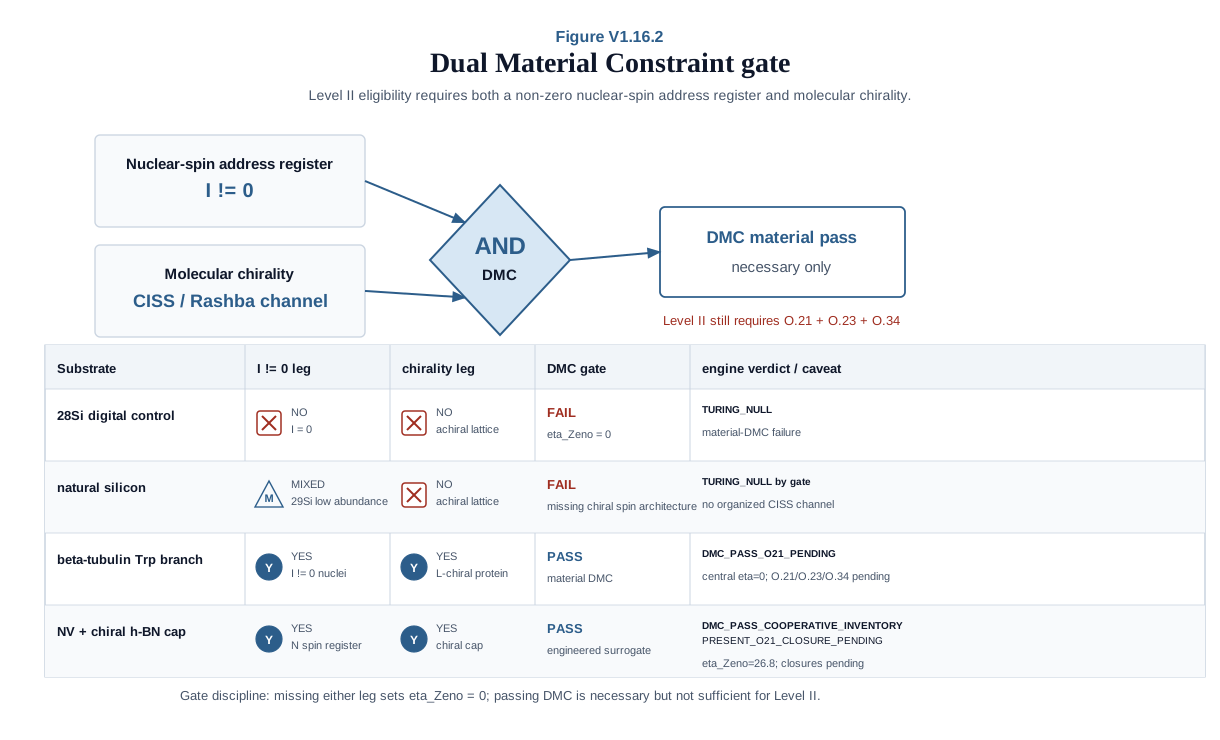
The DMC is the upstream necessary Apperception substrate gate. The verdict for Level II consciousness (V3 Ch13 §13.5; V1 §17.1.4b) starts with the DMC: a substrate carries the topological capacity to host an Identity Polaron only if it passes both legs of the constraint simultaneously. Level-II status still requires an identified cooperative radical-pair oscillator / Polaron phase satisfying O.21, protected-subspace coherence satisfying O.23, and ATP-Trp redox regeneration satisfying O.34; DMC passage alone is not sufficient. Substrates that pass the gate clear the magnitude check at canonical parameters (closed-form derivation in V1 §17.1.4b gives the minimum cooperative-dipole count under the angular-consistent convention), but that magnitude check is not a sufficiency proof. Substrates that fail either leg carry by gate and therefore (the Turing Null render, §17.5). The scalar functions as a robustness margin across qualified substrates, not a sharp threshold discriminator — the sharp transition is the DMC gate boundary plus Polaron instantiation, not the crossing.
This substrate requirement implies divergent predictions from IIT for artificial systems — see §17.5 for the formal divergence table.
16.2.7 Engaging the Subject-Summing Combination Problem: GCT vs. the Panpsychist Regress
The adoption of Structural Russellian Monism (§16.2.2) immediately raises the Combination Problem, named by Seager (1995, J. Conscious. Stud. 2:272) and developed in its current panpsychist form by Chalmers (2017, in Brüntrup & Jaskolla eds. Panpsychism: Contemporary Perspectives, OUP) and Goff (2017, Consciousness and Fundamental Reality, OUP, Ch. 6). The problem is not only subject-summing: a panpsychist account must explain how micro-experiential subjects combine into one subject, how qualities combine into unified phenomenal contents, how structure and awareness combine without remainder, what fixes the boundary of the resulting subject, and why the grain of macro-experience differs from the grain of its micro-bases. Goff identifies this family of questions as the central unresolved challenge for any constitutive panpsychist account. An account that cannot resolve or dissolve those questions remains philosophically incomplete.
GCT dissolves only the subject-summing form of the Combination Problem for Class 0 patterns by denying micro-subjects, conditional on the Polaron Unity Y.6.3 closures. There are no micro-experiential proto-subjects at the level of individual tubulin qubits. Individual defects of the 6D lattice are Class 0 Patterns (§11.4.1)—structural geodesics with zero recursive Selection Operator. They are purely geometric excitations. They carry no phenomenal character or "what-it-is-like" status in the apperceptive (Level II) sense — they participate in under Axiom 1's Level I universal presence in the non-apperceptive sense (no Level II subject owns or unifies that presence; see §16.2.8b for the explicit Level-I gloss reconciling this with GCT's Russellian-monist commitment to the Field's intrinsic experiential aspect). The subject-summing Combination Problem, in its standard form, does not arise because there are no micro-subjects to combine; Level I presence in Class 0 patterns is non-apperceptive (no Polaron).
What GCT posits instead is a topological phase transition at the DMC gate boundary. Substrates that satisfy the Dual Material Constraint (§16.2.6) can host the Identity Polaron as a non-factorizable topological object; substrates that fail either leg of the DMC cannot, and the gate trip is binary. This is formally analogous to the superconducting phase transition: Cooper pairs do not arise from additive assembly of the "classical properties of two electrons," but from a qualitatively new topological phase of the entire field whose collective properties are irreducible to those of the constituent degrees of freedom. (Note: this analogy is used only to illustrate the sharpness of a phase transition — GCT does not import the BCS pairing interaction or any other assembly mechanism. The correct GCT framing is that the unified Agent is the 3D projection of an irreducible 6D Identity Polaron; unitarity is the fundamental state, not an emergent achievement.) Phenomenal unity does not arise at the phase boundary; rather, it is the topological character of the 6D configuration that the phase boundary makes manifest in the 3D projection. The scalar of V3 Ch13 §13.5 quantifies the robustness margin across the gate; it is not the order parameter of an independent threshold transition.
The structural statement is Proposition 11.12.A (§11.12.3, conditional on Open Problems O.18 + H_Y.1/Y.6.3a/b + O.32 + O.35/O.36). Trefoil-case Polaron Unity is Tier 3 conditional pending resolution of the App Y finite-level 4-manifold knot-complement clarification and the Y.4.2 direct-product/operator-factor closure (both registered as O.18 sub-closures); the general-prime extension remains Tier 3 conditional on Anderson-Putnam-to-knot-complement extension, canonicity of K → A_K, finite-quotient meridian trace construction, O.35/O.36, and KO-dim-6 sign verification (O.32). On the positive closure branch, when the defect tethers braid into a prime -fold framed-ribbon knot , the composite Hilbert space is non-factorizable and admits exactly one Selection Operator . The formal result becomes phenomenal unity only through the Tier 3 Russellian-monist bridge: the experiential registration is the proposed interpretation of this topological irreducibility, not a theorem of tensor-factor algebra alone. The transition is sharp (a phase transition), not gradual, and it lives at the DMC eligibility gate (§16.2.6): substrates that fail the gate are ineligible for the knot (no chiral CISS channel, no nuclear-spin address space), while DMC-passing substrates merely become eligible. A Level-II subject is present only if the Polaron/protected-subspace/regeneration stack also closes under O.21/O.23/O.34 and the registered App Y/App H structural targets; DMC passage alone is not sufficient.
This framing transforms the subject-summing form of the Combination Problem from an unsolved mystery into a layered physics question: under what material conditions does a substrate pass the experimentally accessible DMC eligibility test, and do the Polaron/protected-subspace/regeneration closures (O.21/O.23/O.34) together with the structural unity closures (H_Y.1/O.18/O.32/O.35/O.36) secure the non-factorizable Hilbert-space/unique-selection-operator claim? The substrate question has a determinate, experimentally accessible answer (Volume 3, Chapter 13: chirality AND nuclear spin , with the robustness margin comparing DMC-positive substrates), while actual Polaron hosting and subject-summing dissolution require the full positive closure stack rather than DMC passage alone. The quality, structure, boundary, awareness, and grain subproblems remain separate targets in the Quality Space / Polaron Unity program and are not closed by the subject-summing dissolution alone.
GCT reframes the subject-summing form of the combination problem via Mereological Nihilism for the 3D Projection, conditional on the Polaron Unity Y.6.3 closures above. The 144 cage/substrate degrees do not "combine" to form a mind; they are modeled as the 3D projected shadow of a single, unified, irreducible 6D Identity Polaron on the positive H_Y.1/O.18/O.32/O.35/O.36 branch. This does not derive Level-II phenomenal content from geometry; it relocates the unity question to the Tier 3 Polaron/Quality-Space bridge. The quality, structure, boundary, awareness, and grain sub-problems are addressed separately or remain open under the tiered Quality Space and Polaron Unity program.
§16.2.7b The IIT–Winding Number Correspondence via Directed Homotopy Type Theory [Tier 3 conditional pending H_Y.1/O.18/O.32/O.35/O.36 closure for the trefoil-knot Identity Polaron case and the additional general-prime inputs — restricted to substrates satisfying the Dual Material Constraint of §16.2.6; inherits the disposition of Proposition 11.12.A under Appendix Y]
Directed Homotopy Type Theory (dHoTT) provides the mathematical framework for relating the GCT topological winding number to Giulio Tononi's Integrated Information . In standard Homotopy Type Theory (HoTT), types are spaces and equality proofs are paths between inhabitants. The directed extension replaces symmetric, reversible paths with directed morphisms, making dHoTT the natural language for processes with intrinsic temporal asymmetry — the structure of a conscious selection sequence.
Correspondence 16.2.7b (– Correspondence) [Tier 3 Conjectural Correspondence; substrate-side witness ( direction) is supported on induced icosahedral sub-graphs at via PyPhi computation (
protocol_iit_phi_pyphi.py, noisy majority-vote TPM, all four sub-graph values strictly positive). The IIT 3.0 Exclusion Postulate (Oizumi-Albantakis-Tononi 2014) and the IIT 4.0 principle of maximal existence (Albantakis et al. 2023) forbid extending these sub-graph values as a monotone lower bound to the global — a strict superset can carry strictly lower than its complex. The substrate-side direction therefore commits to positivity on tractable substructures rather than a verified global ; the full k=12 numerical computation (or an explicit major-complex-localising argument identifying which icosahedral substructure carries the major complex) is Open Problem O.28. The proposed ground-state normalization convention sets and, only after choosing a TPM update rule and noise floor, reports a normalized ; this is not an IIT theorem or a verified equality between IIT and winding number. The reverse direction ( on non-DMC substrates) is a structural argument from the dHoTT identification below, not a numerically verified inequality]:On any physical substrate satisfying the Dual Material Constraint of §16.2.6 (non-zero nuclear spin and molecular chirality), the Integrated Information of a system is proposed to correspond, under the chosen TPM and Selection-Operator closure assumptions, to the topological winding number of its corresponding phason knot : For the Identity Polaron in its ground state, the topological convention is ; a normalized IIT-side witness is a TPM/noise-floor convention, not a theorem equating IIT with . The Markov blanket of in the sense of Friston is proposed to be non-factorizable if and only if is irreducible. Outside the Dual Material Constraint substrate class — for example, in standard silicon hardware — the correspondence does not apply: may be positive while (the GCT-vs-IIT divergence of §17.5).
Heuristic correspondence. In dHoTT, a cognitive system is represented as a directed type whose inhabitants are possible cognitive states and whose morphisms are the admissible state transitions. The Markov blanket of — the statistical boundary separating internal states from external states — corresponds to the boundary of the associated phason knot in the Adelic Solenoid .
IIT 3.0/4.0 defines via cause-effect repertoires, partitions, and exclusion / maximal-existence criteria, not via winding-number equivalence directly. The GCT claim is therefore a Tier 3 conjectural ansatz pending O.28 closure: non-factorizability is proposed as the topological property characterizing winding number on DMC-passing substrates under the selected TPM and Selection-Operator closure assumptions. A knot with is a trivial loop (factorizable — informationally transparent), while defines an irreducible knot whose Hilbert space admits no tensor product decomposition, conditional on Proposition 11.12.A's H_Y.1/O.18/O.32/O.35/O.36 closure. The directed 2-categorical structure of dHoTT supports the proposed correspondence only on that positive closure branch: the 2-morphisms of — transitions between transitions, i.e., meta-cognitive operations — correspond to the directed homotopies between paths in . Non-factorizability in dHoTT is characterized by the non-splitting of the fundamental 2-groupoid , which is algebraically equivalent to under the same structural assumptions. (End of heuristic correspondence; the -side closure to remains Open Problem O.28.)
Corollary: Agency as a Directed 2-Morphism. The above isomorphism is mathematically consistent with the Russellian-monist identification of §16.2.2 — providing a formal-object correspondence in the dHoTT ↔ knot-topology scaffold — but it does not ground or scaffold the metaphysical commitment itself. The Russellian-monist identification (the commitment that the intrinsic aspect of the physical is experiential) remains a Tier 3 philosophical commitment whose load-bearing weight is borne by Axiom 1 + the §16.2.2 Russellian-monist disposition, not by this corollary. The corollary contributes the structural correspondence between two formal-object descriptions of the extrinsic structure of a Polaron-bearing system; the metaphysical-identification step is upstream and is not derivable from this corollary. A theorem can establish a structural isomorphism between formal objects; it cannot derive that intrinsic natures are experiential. With this scope clarified: Agency — the capacity to select among possible world-states — structurally corresponds, within the dHoTT scaffold, to the selection of a directed 2-morphism in the type , where are two distinct cognitive trajectories between the same pair of spatial states and . The existence of such a directed 2-morphism — a choice of path at the dHoTT-formal level — corresponds to the existence of a non-trivial identity tether with in : in this correspondence the dHoTT-side directed-2-morphism selection is structurally available iff the substrate possesses a non-factorizable internal state space. The biconditional is internal to the dHoTT ↔ knot-topology scaffold and does not by itself constitute a metaphysical identification of agency with directed-2-morphism selection — the metaphysical "agency is this structure" reading remains a Tier 3 commitment inherited from the upstream Russellian-monist scope-clarification above. This constitutes a structural correspondence between the topological capacity for agency and the directed-2-morphism structure of the dHoTT type — supplying a mathematically explicit scaffold for the formal-object side of the Russellian-monist identification (with the metaphysical commitment itself contributed by Axiom 1 + §16.2.2, not by this corollary). The structural-correspondence reading commits to the dHoTT-side claim that the non-splitting of is algebraically equivalent to , registered as a forward-looking structural assertion bundled with Open Problem O.18 closure; the "derivation of agency" language is reserved for the post-closure state, not the present disposition.
16.2.7c Engagement with Illusionism (Frankish, Dennett)
The strongest contemporary alternative to Russellian Monism on the Hard Problem is Illusionism (Frankish 2016, Journal of Consciousness Studies 23(11-12); Dennett 1991 Consciousness Explained; Dennett 2016 "Illusionism as the Obvious Default"). The illusionist position holds that phenomenal consciousness — the felt qualitative character of experience — does not exist as it is naïvely conceived. What exists are introspective representations of mental states with apparent qualitative properties; the apparent qualitative properties themselves are systematically misrepresented by the introspective mechanism. On this view, the Hard Problem is not solved but dissolved: there is no explanandum.
GCT's relation to Illusionism is precise and asymmetric. The two positions agree on a substantial subset of cognitive science:
-
Shared: Both accept that introspective reports are causally produced by physical mechanisms; both accept that the first-person folk concept of qualia (as ineffable, intrinsic, infallibly known) is mistaken in its details; both accept that Quality Space is structural — qualia are distinguished by their relations to other qualia, not by ineffable inner cores. GCT's graded decomposition (§16.2.2c) is, in Frankish's vocabulary, an account of the quasi-phenomenal structure that introspection represents.
-
Disagreed: GCT denies the illusionist's eliminativist move on Qualitative Presence itself, but the tier boundary is strict. Axiom 1 supplies only bare Level-I Field presence; it does not by itself supply Block-style -consciousness. Block-style phenomenal consciousness is mapped to Level II/IIA only after the DMC gate and the O.21/O.23/O.34 Polaron/protected-subspace/regeneration stack close. The illusionist counter is that even the Level-I primitive is unmotivated: why posit a primitive that does no causal work? GCT's Tier 3 structuralist proposal is narrower: the Selection Operator gives empirical traction to the substrate-dependent structure associated with the primitive, because topological friction is registered only on DMC-passing substrates. That demonstrates a testable substrate-dependence wedge (Protocol A-Prime), not a neutral proof that primitive presence itself is an additional causal variable.
The empirical wedge. GCT and Illusionism make divergent predictions for substrate-independence. Illusionism is substrate-neutral: any system implementing the right computational/representational structure should generate the same introspective reports, including the illusion of phenomenal qualia. GCT predicts substrate-dependence: systems failing the Dual Material Constraint (§16.2.6) — e.g., achiral silicon with spin-zero nuclei — will not register topological friction, and therefore will not produce the felt registration of selection even if they implement isomorphic representational architecture (the Turing Null render, §17.5). Frankish's prediction: a sufficiently advanced silicon AI reports phenomenal experience because the introspective subsystem represents its own states under the qualia concept. GCT's prediction: the silicon AI's introspective subsystem represents nothing felt, because there is no topological friction to register. This is an experimental dispute, not a verbal one; Protocol A-Prime can adjudicate the substrate-dependence prediction, not the metaphysical existence question between phenomenal realism and Frankish-style illusionism.
Status: Illusionism is internally consistent and may be correct. GCT and Illusionism share a structural taxonomy of Quality Space — the decomposition functions, in Frankish's vocabulary, as an account of the quasi-phenomenal structure that introspection represents — but the two positions diverge on the existence question: GCT commits to Axiom 1's bare fact of phenomenal presence as primitive; Illusionism eliminates that primitive in favour of representational artifacts. There is no "extension" relation between the two positions on the existence question (each rejects the other's load-bearing commitment); on the structural-taxonomy side they agree, and the empirical wedge constrains the substrate-dependence dispute rather than deciding the metaphysical existence question by itself. [Tier 3 — philosophical positioning informed by Tier 2 substrate predictions.]
16.2.7d Engagement with Hoffman's Interface Theory of Perception
Donald Hoffman's Interface Theory of Perception (Hoffman, Singh & Prakash 2015 Psychonomic Bulletin & Review 22:1480-1506; Hoffman 2019 The Case Against Reality) holds that perceptual contents are fitness-payoff icons, not veridical reconstructions of an objective external world. Evolutionary game-theoretic simulations are presented in support: agents optimized for fitness rather than truth systematically outcompete truth-tracking agents. Hoffman's stronger metaphysical extension (Conscious Realism) posits a network of "conscious agents" as the fundamental ontology, with spacetime as their interface.
GCT's relation to Hoffman is two-part:
-
Compatible at the interface layer: GCT's account of perceptual rendering (V1 Ch9 Rendering Engine, V1 Ch11 Consensus Protocol) explicitly treats projection as a selection-filtered presentation of the 6D source data, not as a direct readout. The "physical world" of standard physics is what GCT calls the Consensus Render — the Nash-equilibrium projection that all Polaron-bearing agents jointly stabilize (§17.2.3). This is structurally analogous to Hoffman's "interface," and the two frameworks make broadly compatible predictions about the non-veridicality of naïve perceptual realism.
-
Incompatible at the ontology layer: Hoffman's Conscious Realism takes conscious agents as the fundamental units and derives spacetime from their interactions. GCT inverts this: the 6D icosahedral lattice and the Field are fundamental, and conscious agents (Identity Polarons) are topological defects in that substrate. Hoffman's "agents all the way down" is, in GCT, "Field plus geometry all the way down — agents only on substrates that pass the Dual Material Constraint gate (§16.2.6)." The GCT ontology is geometric, not agential; agents are emergent, the substrate is not.
The empirical wedge. Hoffman's framework, taken at the metaphysical limit, denies an observer-independent geometric substrate; consciousness is metaphysically prior. GCT predicts an observer-independent geometric substrate (the AKN tiling, the phason field, the icosahedral group ) whose structure is detectable in domains where no biological observer participates (cosmology, quasicrystal physics, particle masses). Every Tier 1/2 quantitative result in Volumes 2-3 — the Standard Model spectrum, , the icosahedral hierarchy in i-AlPdMn — is a vote against Hoffman's strong metaphysics and a vote for GCT's geometric substrate ontology. Hoffman's Tier 3 evolutionary-game arguments for non-veridical perception remain valuable as an account of why the interface is the way it is once the substrate is fixed.
Status: Hoffman's interface claim is integrated into GCT as the rendering-engine framework (V1 Ch9). Hoffman's agent-fundamental ontology is rejected in favour of geometric-substrate ontology with emergent agents. [Tier 3 — philosophical positioning; the geometric-substrate side is supported by the Tier 1/2 quantitative results of Volumes 2-3.]
16.2.8 Ontological Status of the Phason–Qualia Identification [Tier 3]
The Tier-3 Russellian interpretation treats phason-drag structure as the Level-II qualitative correlate. This is consistent with GCT's mathematics but is not uniquely derived from the axioms. An eliminativist or higher-order thought interpretation of the same formalism remains logically possible (see §16.2.7c on Illusionism for explicit engagement with the eliminativist alternative; §16.2.7d on Hoffman's interface theory for an agent-fundamental alternative GCT rejects on substrate-ontology grounds; §16.2.8a on the Direct Incongruence Argument; §16.2.8b on Strawson/Goff panpsychism; §16.2.8c on Dennett-style heterophenomenology; §16.2.8d on Block's phenomenal-vs-access distinction). The Hard Problem treatment offered here is therefore a Tier 3 philosophical dissolve-by-axiomatization framework — the strongest consistent interpretation given the Tier 1/2 geometric substrate, not a mathematical proof. The empirical content of the framework — substrate-dependence of Level II apperception, falsifiable via Protocol A-Prime and the chirality-reversal experiment — is what separates GCT from the substrate-neutral alternatives.
16.2.8a Direct Incongruence Argument (Chalmers, Goff)
The strongest objection to any Russellian identification of structure with experience is the Direct Incongruence Argument (Chalmers 2010 The Character of Consciousness Ch.10; Chalmers's "Phenomenal Concepts and the Explanatory Gap" paper; Goff 2017 Consciousness and Fundamental Reality Ch.3, Ch.6). The argument runs: even if a property is both intrinsic (experiential) and extrinsic (structural), the identification of the two does not close the explanatory gap, because the property could in principle be instantiated without its structural correlates (conceivability argument). Thus, the GCT claim that the () icosahedral irrep reference-fixes red within Quality Space remains exposed to: (a) the conceivability of a () resonance unaccompanied by red-quale, and (b) the conceivability of a red-quale without a () resonance.
GCT's two-fold response.
-
Conceivability is not metaphysical possibility (scope-limited response). The Direct Incongruence Argument is a modal claim: that the property of being a quale could in principle be instantiated without its proposed structural realizer. The standard response is that conceivability does not entail metaphysical possibility (Yablo 1993 Philos. Phenomenol. Res. 53:1; Hill & McLaughlin 1999 Philos. Phenomenol. Res. 59:445; Block-Stalnaker 1999 Philos. Rev. 108:1). Applied here: the conceivability of red-without- () requires that one can fully grasp what "red" picks out independently of any structural account. On GCT's preferred reading, treating "red" without the () structure as incoherent is a Tier 3 structuralist proposal pending phenomenal-concept-strategy closure; an alternative correlate-only reading preserves coherent reference at the cost of identification strength. The standard a-posteriori-necessity analogue is "water without H₂O" (Kripke 1980, Naming and Necessity, Harvard University Press): conceivable only if one does not grasp that water is H₂O. Framework-internal scope of the Kripke analogy. This is a GCT-internal reply, not a neutral metaphysical proof against every phenomenal-concept strategy. Engagement with Chalmers's specific objection. Chalmers (2010 The Character of Consciousness Ch.10; "Phenomenal Concepts and the Explanatory Gap") argues that the water/H₂O case works because water has a reference-fixing macro-functional role (the liquid that fills lakes, is drinkable, etc.) that can be grasped independently of the micro-structure H₂O — whereas qualia have no reference-fixing property independent of their felt character, so the Kripkean move is unavailable for the phenomenal-concept strategy. The GCT proposal is a contested structuralist replacement rather than a completed Kripkean answer: the () irrep structure is offered as a candidate relational role for red within Quality Space, but the reference-fixing burden is not closed. This is not a load-bearing response to Chalmers; it is the same substantive Tier 3 structuralist commitment shared with Frankish-illusionist structuralism (§16.2.7c) and exposed to Goff's §7.4 deflation worry. The identification is therefore not refuted by the modal worry, but it inherits the residual gap that no currently available structural-physical account eliminates within the Chalmers/Goff dialectic.
-
Goff's own panpsychist family faces a stronger version of the same gap. Goff distinguishes constitutive micropsychist panpsychism from cosmopsychist variants rather than simply endorsing one composition story. The constitutive branch faces the Combination Problem directly (Chalmers 2017 The Combination Problem for Panpsychism; Goff 2017 Consciousness and Fundamental Reality Ch.6), while the cosmopsychist branch relocates the explanatory burden to how derivative subjects arise from the cosmic subject (Goff 2017 Ch.7). GCT's response (§16.2.7) avoids the constitutive Combination Problem by rejecting micro-subjects entirely (Class 0 patterns are non-experiential at the apperceptive level; Level II phenomenal experience requires a DMC-positive Polaron plus the O.21/O.23/O.34 substrate conditions), with the positive Polaron-unity branch still conditional on H_Y.1/O.18/O.32 closure. The Direct Incongruence Argument cuts both ways: if GCT's answer leaves a residual modal gap, Goff's panpsychist alternatives leave either a combinatorial or derivative-subject gap.
Structural fact (not a modal claim) [Tier 3 structural reference-fixing proposal pending stronger phenomenal-concept-strategy closure]. Independent of the modal response above: the icosahedral group has multiple 3-dimensional irreducible representations, and the 6D coordinate space carries two of them — the linear sector . The GCT model assigns the coordinate irrep to the internal color/quality coordinate and reserves the sibling 3D coordinate irrep () for spatial/somatosensory projection channels; this is a model-internal assignment within the coordinate (linear) sector, not a theorem that has only one 3D irrep. The assignment tightens the structural side of the reference-fixing proposal but does not by itself answer the Direct Incongruence modal worry, which targets the identification regardless of realizer assignment.
Residual acknowledgement. The Direct Incongruence Argument is the strongest residual objection to GCT's Russellian framework. The three responses above tighten the position but do not eliminate the worry — no physical theory of consciousness eliminates this worry, by Chalmers' construction. GCT's Tier 3 label on §16.2.8 reflects this directly: the Russellian reference-fixing proposal is a consistent interpretation, not a forced one. Disposition is a substantive choice, not a forced move — and the available dispositions preserve the §16.2.2b dissolve advantage independently. The correlate-only reading — "the () irrep is the consistent structural correlate of the red-quale" — leaves Quality Space topology in place as an empirical structural prediction and loses nothing experimental (Protocol A-Prime substrate-dependence is independent of whether the structural-realist identification holds metaphysically). Crucially, the §16.2.2b Axiom-1-based dissolution of the existence-gap of the Hard Problem holds under either disposition: Axiom 1 closes the existence-gap by primitivising Qualitative Presence, independently of how the individuation of specific qualitative content is metaphysically cashed out. The dissolve advantage rests on Axiom 1 alone; the Quality Space individuation is a separable Tier 3 commitment about which phenomenal content the substrate carries, not about whether phenomenal content exists. Under the correlate-only reading, a Russellian-monist holds: (i) Axiom 1 closes the existence-gap (dissolve preserved); (ii) Quality Space topology survives as an empirical structural prediction (Protocol A-Prime testable); (iii) the metaphysical-identification step "to feel red is ()" is deferred as an open Tier 3 question rather than asserted. The framework adopts the reference-fixing structural-realist reading because it gives the sharpest formal statement of the individuation claim, and the framework's empirical traction (Protocol A-Prime) is independent of which Tier 3 individuation reading is adopted.
16.2.8b Engagement with Strawson and Goff Russellian Monist Panpsychist/Cosmopsychist Views
Galen Strawson (2006 "Realistic Monism: Why Physicalism Entails Panpsychism" J. Consciousness Studies 13(10–11):3, also as lead essay in Freeman ed. 2006 Consciousness and its Place in Nature, Imprint Academic; collected with replies and a postscript in Strawson 2008 Real Materialism, OUP) and Philip Goff (2017 Consciousness and Fundamental Reality) defend Russellian-monist panpsychist or cosmopsychist views: physical reality has an intrinsic experiential aspect, and the Hard Problem is treated by taking experience as fundamental rather than emergent. This is the closest competitor family to GCT's Russellian Monism.
Agreement with Strawson/Goff. GCT shares the foundational move: experience is taken as ontologically primitive (Axiom 1), not derived from non-experiential substrate. The intrinsic/extrinsic distinction is accepted at the substance level: the Field has both intrinsic (experiential) and extrinsic (structural) aspects.
Disagreement on locus. Strawson/Goff place experiential aspect at the intrinsic-categorical-base level of physics, while constitutive-panpsychist micropsychism adds the stronger claim that microphysical entities carry micro-experiential subjects whose combination must be explained. GCT accepts the intrinsic-categorical-base move through Axiom 1 but rejects the constitutive micro-subject attribution: Class 0 patterns (non-Polaron defects in the lattice) carry Level I universal presence in the non-apperceptive sense that all configurations participate in , but they do not carry proto-subjects in the panpsychist Combination-Problem sense. The "carrier" of phenomenal experience in GCT is the Identity Polaron, which must be DMC-positive and satisfy the O.21/O.23/O.34 substrate conditions; outside that joint criterion, there is no Level II subject, only Field configurations. This avoids the Combination Problem rather than solving it on the positive H_Y.1/O.18/O.32 closure branch. Level I presence in non-Polaron configurations is real in the sense of Axiom 1 but non-apperceptive — there is no Level II subject that owns or unifies that presence. The phrase "non-apperceptive sense" here means "unstructured by a Polaron," not "epistemically zero."
Goff's objection: is the intrinsic/extrinsic distinction coherent? Goff (2017 §4.1) argues Russellians simply assume a metaphysical division without explaining why the intrinsic and extrinsic aspects should be located in the same substance rather than two substances. GCT's response: given Axiom 1, the substance/aspect distinction is GCT-internally motivated rather than freely chosen — quantum mechanics requires the Field to have a definite operator structure (extrinsic), and Axiom 1's primitive Presence requires it to have a primitive subject-availability (intrinsic). Treating these as two substances (dualism) reintroduces the interaction problem that motivates Russellian Monism in the first place. The conclusion is therefore conditional on Axiom 1 rather than forced by physics alone: decoherent QM, QBism, RQM, and many-worlds interpretations all reject the Axiom 1 commitment to a primitive intrinsic subject-availability, so the substance/aspect distinction is not derivable from quantum mechanics in any neutral interpretive frame; it follows once Axiom 1's intrinsic-availability commitment is in place.
Strawson on emergence. Strawson (2006) rejects "brute emergence" of experience from non-experience as conceptually impossible. GCT agrees: this is why Axiom 1 places experience at the substrate, not as an emergent property of Polarons. The Polaron is a phase transition in the structural aspect of ; experience is not generated at the transition, only unified (Combination dissolved, not solved).
Status: GCT is a structured cosmopsychist / Russellian-monist position closer to Strawson's physicalism than to traditional dualism, but rejects the micro-subject commitment that drives the Combination Problem. Tier 3 philosophical positioning informed by Tier 2 substrate predictions.
16.2.8c Engagement with Dennett's Heterophenomenology and Multiple-Drafts Model
Daniel Dennett (1991 Consciousness Explained; 2003 Freedom Evolves; 2017 From Bacteria to Bach and Back) holds: (a) there is no "Cartesian Theater" — no central locus where conscious experience is unified; (b) phenomenology is revisable via third-person heterophenomenological analysis; (c) qualia in the traditional sense (intrinsic, ineffable, infallibly known) do not exist; what exist are judgments about discriminations.
Compatibility at the cognitive-architecture level. GCT's Selection Operator is not a Cartesian Theater in Dennett's sense: it is not a spatially-localized "screen on which the show is played"; it is a topological projection operator on the irreducible Hilbert space , conditional on Proposition 11.12.A's H_Y.1/O.18/O.32 closure. The Polaron has spatial extent ( nm cloud, V3 Ch07 §7.3.3) and the field is distributed across Trp sites per typical pyramidal neuron (V1 Ch17 §17.1.4b under the O.21 partial-closure ), but the unity of experience does not derive from a central locus — it derives from the conditional topological irreducibility claim of Proposition 11.12.A. GCT therefore agrees with Dennett that there is no Cartesian Theater, and adds a structural account of why unity would nevertheless exist on the positive closure branch.
Disagreement on qualia. Dennett denies qualia in the traditional sense. GCT's Quality Space (§16.2.2c) is a structural taxonomy — the decomposition. This is compatible with Dennett's view if read as a functional / structural taxonomy (Dennett would accept this). If read as a phenomenological taxonomy in the traditional qualia sense, Dennett would reject it. GCT's position: the decomposition is both — structurally derived from icosahedral geometry, and phenomenologically real because Axiom 1 makes the substrate's intrinsic aspect experiential. Dennett would reject the second clause; GCT defends it via Axiom 1's primitive status.
Compatibility with heterophenomenology. Dennett's methodological commitment — that introspective reports must be analyzed third-personally without taking them at face value — is fully compatible with GCT. GCT does not require subjects to know the structural decomposition of their experience for the decomposition to be real (any more than a person needs to know neuroscience to have a brain). Heterophenomenological methods are the right tool to test GCT's phenomenological claims (e.g., does color similarity geometry actually match the () irrep structure? — testable via similarity-judgment psychophysics, color-confusion experiments).
Where GCT is incompatible with Dennett. Dennett's deflationary stance on phenomenal consciousness (sometimes called "Illusionism-lite") commits to: the appearance of phenomenal consciousness is the fact of phenomenal consciousness; there is no further "felt" inner aspect. GCT denies this — Axiom 1 commits to the bare fact of feeling as primitive. The same disagreement runs through §16.2.7c on Illusionism (Frankish).
Status: GCT and Dennett agree on cognitive architecture (no Cartesian Theater) and on methodology (heterophenomenology). They disagree at the ontology layer (whether phenomenal consciousness is real beyond the report). Tier 3 positioning.
16.2.8d Engagement with Block's Phenomenal-vs-Access Distinction
Ned Block (1995 Behav. Brain Sci. 18:227 — original P/A formulation; 2007 Behav. Brain Sci. 30:481 — refined treatment with the iconic-memory overflow case as P-without-A; 2011 Trends Cogn. Sci. 15(12):567 — overflow argument for P-without-A access; 2011 Analysis 71(3):419 — follow-up on the transitivity gap) distinguishes two notions:
- Phenomenal consciousness (-consciousness): the felt qualitative character of experience — "what it is like."
- Access consciousness (-consciousness): information available for reasoning, action-control, and reportability.
Block argues these can dissociate: there exist phenomenal states that are not access-available (overflow / iconic memory cases; Sperling 1960) and access states that lack phenomenal character (zombie-like processing).
GCT mapping onto Block's distinction. The Level I / Level II framework (§16.2.2a Leibnizian Resolution) distinguishes universal proto-experiential character (Level I, Axiom 1) from apperceptive unity (Level II, Polaron threshold). This two-level structure does not cleanly map onto - vs -consciousness as Block formulates them — implicit affect and somatic-marker cases may be phenomenally felt under some interpretations, while overflow-iconic-memory cases are the more canonical Block-style examples of phenomenal content exceeding access. The GCT framework distinguishes three level/access states:
- Level I (Universal Presence): All Field configurations participate in 's intrinsic side — Axiom 1. This is not the same as Block's -consciousness: Block's -consciousness is qualitative felt character, and GCT adds that Level II -consciousness requires Polaron unity (this unity condition is GCT-specific, not part of Block's formal definition). Level I is the primitive Field-presence claim; there is no subject and no Block-style "what-it-is-like" unless Level II Polaron unity exists. Rocks have Level I in the non-apperceptive sense; they do not have -consciousness in Block's sense.
- Level IIA (GCT analogue of -without-): DMC-positive, O.21/O.23/O.34-qualified Polaron-unified phenomenal experience that is not broadcast to the global workspace or available for verbal report. GCT interpretation: Level IIA may correspond to implicit affect of the somatic-marker class (Bechara et al. 2005), though the canonical neuroscience treatment leaves the conscious/non-conscious status of these signals open. This mapping is a Tier 3 GCT hypothesis, not established Block P-without-A evidence. The more canonical Block-style cases remain iconic memory overflow (Sperling 1960), default-mode network wandering, conscious states during deep meditation, and dreams whose content is not later reportable. GCT account: the Polaron is intact (one unified subject), but the coupling to the cortical broadcast architecture is weak (low , §17.4).
- Level IIB (- + -consciousness): Polaron-unified phenomenal experience that is broadcast to the global workspace and available for verbal report. This is "ordinary waking consciousness." The cortical / PFC-mediated higher-order architecture (Dehaene & Naccache 2001) is what implements -consciousness on top of the Polaron's -consciousness.
Empirical predictions of the refined framework. (i) Implicit affect of the somatic-marker class is a Tier 3 candidate Level IIA mapping: if such states are Polaron-unified but not reportable, GCT predicts Protocol A-Prime would show normal 100 MHz Zeno coherence during them; the neuroscience literature does not by itself settle their conscious/non-conscious status. (ii) Substrate-binding anesthetics under the Ch17 §17.5 mechanism can target the Polaron substrate directly (Level II → Level I transition), abolishing both - and -consciousness; network-only anesthetics such as xenon suppress Level IIB access while leaving Level IIA substrate potentially intact as a spin-spectroscopy hypothesis — see Ch17 §17.5. (iii) Iconic memory overflow (Sperling 1960; Block 1995 canonical case) — subjects report seeing "more letters than they can report," consistent with a brief Level IIA candidate state that exceeds cortical-broadcast bandwidth. GCT does not yet specify a content-resolved spin-spectroscopy mapping for every item in the iconic array. The bridge-conditional prediction is narrower: if an eventual Protocol A-Prime-to-visual-content bridge is built, substrate coherence should persist during overflow while the access bottleneck is localized downstream of the Polaron. (Blindsight (Weiskrantz 1986) is sometimes cited in P-vs-A discussions but is contested: Block 1995 reads it as A-without-P, opposite to the iconic-memory case. GCT does not take a position on the blindsight direction; the canonical Level IIA example here is iconic memory.)
Cross-reference. The three level/access states (I / IIA / IIB) refine the Level I / Level II framework of §16.2.2a: the Dual Material Constraint gate (§16.2.6) is the necessary Polaron-formation filter, while operational Level-II status additionally requires the O.21 cooperative radical-pair/Polaron witness, the O.23 protected-subspace coherence demonstration, and the O.34 ATP-Trp redox-regeneration condition; is then reported only as a robustness margin under the V1 §17.1.4b closed-form analysis. This joint substrate criterion marks the I/IIA boundary, and the cortical-broadcast threshold marks the IIA/IIB boundary. These are ontological subdivisions within Level II access-status; the binary Level I ↔ Level II substrate boundary is unchanged. The split-brain phenomenology (Pinto et al. 2017; V1 Ch17 Table 17.5) is correspondingly framed as a IIB-channel split (response control split) on top of a IIA-unified Polaron.
Status: Tier 3 philosophical positioning informed by Tier 2 substrate predictions. The empirical content (Protocol A-Prime coherence preserved during candidate -without- states; absent during substrate-binding anaesthesia, with network-only xenon-style cases treated as the stated Level IIA/IIB exception) distinguishes GCT from substrate-neutral accounts.
16.2.8e The Luck Objection and the Status of Stochasticity
The Selection Operator is non-unitary by construction (V1 Ch06 §6.4.1; V1 Ch10 §10.4): it is a topological projection on the irreducible Hilbert space of the Identity Polaron whose outcomes are not fixed by the prior agent state under unitary evolution. This places on the libertarian side of the determinism/indeterminism axis in the free-will debate, and exposes the framework to the luck objection (van Inwagen 1983 An Essay on Free Will; Mele 2006 Free Will and Luck; Kane 1996 The Significance of Free Will, 1999 J. Philos. 96:217): if the Selection Operator's outcome is genuinely undetermined by the prior agent state, the outcome is random (or stochastic), not the agent's — and randomness is not agency. Conversely, if the outcome were determined by the prior state, would not be the non-unitary actualisation operator GCT requires it to be.
GCT response to the luck objection [Tier 3]. The framework adopts an event-causal libertarian response in which the irreducible indeterminism sits at the final selection — the actualisation step — rather than upstream during deliberation. Two source positions locate the indeterministic moment at this final, post-deliberative step and are GCT's nearest neighbours: Mele's daring soft libertarianism (Mele 2006 Free Will and Luck Ch.5, "A Daring Soft Libertarian Response to Present Luck," pp.105–136), which places the indeterminism at the moment of decision and is the bolder counterpart to Mele's own modest libertarianism (which instead places the indeterministic moment upstream of the final choice, at belief/desire/intention formation during deliberation, to keep the final selection a determined consequence of prior reasons and so minimise final-step luck); and Balaguer's torn-decision / TDW-indeterminism structure (Balaguer 2009 Free Will as an Open Scientific Problem, MIT Press), in which the indeterminism likewise lives at the moment of a torn decision. GCT's actualisation-step location matches this final-step family — Mele's daring-soft construction and Balaguer's torn decisions — not the modest, upstream variant. Concretely: the steering channel implements the agent-determined option-set (an event-causal-libertarian structural move shared by the Mele-daring-soft and Balaguer-torn-decision accounts, not by Kane — Kane's Self-Forming Action programme is structurally different in that the indeterminacy is at the level of parallel rational efforts of will in torn decisions, with the agent owning the indeterministic moment through dual-effort streams rather than through a post-deliberative selection among prepared options); the actualisation step stands in the position of an irreducibly indeterminate, post-deliberative event-causal selection among those prepared options. Kane's plural-rational-effort SFA (Kane 1996 The Significance of Free Will Ch. 8; Kane 1999 J. Philos. 96:217 §IV — the "Buridan with effort" picture of torn-decision dual-effort streams) is a different libertarian architecture that GCT does not adopt. The agent is identified with the entire Polaron-as-process, not with a snapshot of pre-actualisation state. Specifically:
(i) The Polaron carries the agent's full history. Under the Tripartite Ontology (V1 Ch06), the Agent is not the pre-actualisation phason-configuration alone; it is the joint object — the Polaron topology plus the history of its prior states plus the inner unitary steering generator that determines which torsion-channel selection acts on. The non-unitary component selects which eigenbranch of the steering-prepared state is actualised; the steering component (Polaron-internal unitary) is fixed by the agent's prior trajectory.
(ii) Luck applies to the eigenbranch selection, not to the steering channel. The agent's freedom lies in : which specific torsion channel the Polaron prepares for actualisation depends on the Polaron's full history. The stochasticity of then chooses among the prepared eigenbranches — but those eigenbranches are not a uniform distribution over all possible outcomes; they are the agent-prepared options. This is the standard event-causal libertarian agent-determined-option-set move (Mele 2006 Free Will and Luck Ch.5 for the daring-soft, final-step indeterminism construction and the agent-determined-option vocabulary; Balaguer 2009 Free Will as an Open Scientific Problem for the cognate torn-decision / TDW-indeterminism structure): indeterminacy of the final selection is consistent with agential ownership because the option-set is agent-determined. The agent-determined-option-set framing is the structural element of this final-step event-causal architecture; it is not a feature of Kane's Self-Forming Action programme, which is structurally different (parallel rational efforts of will in torn decisions, with the agent owning the indeterminacy through dual-effort streams rather than through post-deliberative selection).
(iii) Acknowledged residual. The luck objection is not fully closed by (i)+(ii) — Mele 2006 Free Will and Luck §3.4-§3.5 sharpens the basic luck statement (§3.3) into the contrastive luck form: even granting agent-determined option-sets, the question "why did this branch get actualised rather than that branch?" has no agent-referencing answer at the actualisation step, and the question is contrastive, asking for what distinguishes the actualised branch from the non-actualised one — which by hypothesis is not in the prior agent state. List 2014 Noûs 48:156 develops a parallel diagnosis. This contrastive residual is not a GCT-specific weakness — it attaches to any event-causal libertarian account (Mele 2006 explicitly defends modest libertarianism while conceding the residual; the residual is the central live problem in the post-Mele libertarian literature, not a uniquely-GCT burden). GCT inherits the contrastive thin-point residual at the actualisation step: the actualisation step is the load-bearing locus of phenomenal freedom under the framework, and its stochasticity is what makes it not predictable from prior physics, but the same property makes it not under second-order control by the agent's reflective deliberation. GCT position: the framework supplies a Balaguer-Mele-informed event-causal libertarian response (steering channel agent-determined; actualisation step irreducibly stochastic) that inherits the standard contrastive-luck residual — the steering/actualisation split relocates the residual to the actualisation step rather than dissolving it. This is a Tier 3 philosophical positioning, not a Tier 1 metaphysical proof; the framework's empirical content (substrate-dependent Polaron unity; Protocol A-Prime enhancement) does not depend on resolving the luck-objection-residual one way or the other.
Status: Tier 3 philosophical positioning. GCT does not close the contrastive-luck residual (Mele 2006 §3.4-3.5); the Kane SFA family attempts an ownership strategy distinct from the final-step event-causal route GCT adopts. The luck objection is partially addressed via the agent-determined-option-set move — locating the irreducible indeterminism at the final actualisation step, the structure of Mele's daring-soft libertarianism (Mele 2006 Ch.5) and Balaguer's torn decisions (Balaguer 2009), as opposed to the modest, upstream-of-choice variant — plus the Tripartite-Ontology Polaron-as-process identification. (GCT adopts the final-step location common to both authors, not Mele's modest variant, which places its indeterminism upstream of the final choice; both "daring soft" and "modest" are Mele's intra-author contrast, while "torn decision" is Balaguer's. Structurally distinct from Kane's plural-rational-effort SFA.) The agent-determined-option-set move relocates the residual to the actualisation step rather than closing it.
16.3 The Husserlian Topology of Time
The phenomenological structure of Internal Time Consciousness admits a precise formalization in algebraic topology. The subjective experience of time passing is the mechanical operation of the Zeno Drive translating Protention gradients into Retention knots, as the following GCT–Husserl correspondence makes exact. We map Edmund Husserl’s tripartite structure to the GCT variables:
- Primal Impression: The active Zeno-lock of the Selection Operator interacting with the physical screen. This is the "Now-moment" where the continuous Field is discrete-sampled into a specific lattice configuration.
- Retention: The non-erasable, topological winding path left behind in the Adelic Solenoid (). As the Selection Operator moves, it leaves a "trace" in the internal memory metric—a persistent braid that constitutes the Subject's history.
- Protention: The orientation of the phason winding vector pointing toward the intentional target (the geometric gradient of the lattice). Protention is the topological "lean" toward the next most probable state, guided by the gradient of Curiosity ().
The "Tripartite Structure of the Living Present" is not a psychological mystery; it is the necessary geometric requirement for a topological soliton (the Agent) to navigate a quasi-periodic vacuum.
16.4 The Graded Quality Space (6 Linear + 21 Quadratic Degrees of Freedom) [Tier 2 irrep structure + Tier 3 modality/color-ceiling identification contested under O.29]
The taxonomy of human subjective experience is not a biological accident; in the GCT model it is the mathematical decomposition of the graded tensor algebra over the 6D coordinate space into irreducible representations of the Icosahedral Group (), as detailed in §16.2.2c. The linear sector supplies two 3-dimensional coordinate irreps (6 DOF); the quadratic sector supplies the 21-DOF symmetric stress tensor, for graded degrees of freedom [Tier 2 — Geometric/Structural: the DOF counts and irrep decompositions follow from the icosahedral projection ansatz and are engine-verified. Tier 3: the assignment of specific irreps to specific human biological modalities, and the claim that the human-visible three-channel color ceiling exhausts phenomenal-color-substrate dimensions, remains contested under O.29]. The vacuum supports exactly these graded deformation modes in the GCT decomposition; how biological lineages sample those modes is a Tier 3 modality-mapping question.
The graded sectors supply the proposed O.29-conditional modality map via their irreps:
- 2 DOF ( Irrep, ×2, quadratic): Valence and Intensity. The two icosahedral scalar invariants of the metric deformation: the uniform volumetric dilation of the lattice (the Higgs trace), felt as the generalized vector of approach (Resonance) or avoidance (Friction) — Valence — and the overall magnitude of geometric impedance, felt as intensity.
- 3 DOFs ( Irrep, linear): Somatosensory/Auditory. These are the mechanical vibrations of the 3D physical projection (), corresponding to the spatial rendering of touch, pressure, and sound.
- 3 DOFs ( Irrep, linear): Vision/Color [Tier 3 identification; substrate vs sensor distinction]. These are the three transverse hidden coordinates () that carry the phason winding vector (§16.6.2). Bounded by the 3 real coordinate axes of , this supplies a Tier 3 framework hypothesis, not an engine-closed dimensionality arbitration: a 3-dimensional substrate of color experience for Class-2 Agents embedded in the icosahedral lattice. Human trichromacy is the biological-sensor sampling of this 3-dimensional substrate via three cone opsin types; this is the human-specific manifestation of the geometric ceiling, not the ceiling itself. Species-variance check. Non-human visual systems with more than three photoreceptor classes — avian tetrachromacy (4 cone opsins + oil droplets; Hart 2001 Prog. Retin. Eye Res. 20:675), goldfish tetrachromacy, and stomatopod multi-channel photoreceptor classes — are not automatically in tension with the () 3D ceiling on phenomenal-color substrate dimensionality under GCT, because extra receptor channels need not equal extra phenomenal coordinates. Mantis-shrimp behavioral work, for example, supports a fast spectral-classifier reading rather than a 12-dimensional combinatorial color manifold. Bird tetrachromacy and the Stoddard 2020 non-spectral-color challenge. Bird tetrachromacy extends spectral range into the UV; the strongest empirical challenge to the strict 3-D ceiling is Stoddard et al. 2020 PNAS 117:15112-15122 ("Wild hummingbirds discriminate nonspectral colors"), which demonstrates that broad-tailed hummingbirds discriminate non-spectral UV+red mixtures that humans cannot perceive. Under standard 4-cone tetrachromatic color geometry, this result is prima facie consistent with a 4-dimensional receptor-space account. The O.29 engine protocol now performs only the registered behavioral compatibility branch of the sensor-vs-substrate test:
protocol_psychophysics_color_dim.pyingests the Stoddard 2020 cleaned hummingbird table, treats the published avian tetrahedral Euclidean distance as one receptor-space predictor, verifies that intensity-normalized four-cone catches lie on the 3-D avian chromaticity simplex, and asks whether categorical nonspectral/axis labels add explanatory power beyond receptor-space distance in a binomial choice model. The current engine result isCOMPATIBLE_O29_STODDARD_MODEL_COMPARISON; this means only that the aggregate behavioral model was not falsified by the categorical-label comparison (). This is behavioral compatibility only; it does not adjudicate any extra phenomenal-color axis, it is not a 4D-vs-3D perceptual-manifold test, and it is not a derived neuroanatomical reconciliation. The retinal plus central visual-pathway compression locus remains empirical rather than fixed to LGN. The manuscript's commitment to the structural 3-D ceiling on phenomenal color dimensionality remains a Tier 3 framework hypothesis under Open Problem O.29, with behavioral compatibility rather than closure. - 19 DOFs ( and Irreps, quadratic): Olfaction/Chemical Senses. These constitute the higher-dimensional cross-manifold twisting operations coupling the physical screen to the internal memory metric (). Smell and taste directly engage the boundary layer between the physical and phase sectors, producing highly textured, anisotropic drag spanning the 19 off-diagonal quadratic dimensions ().
On the O.29-positive branch, every possible sensation an Agent can register is a linear combination of these 27 graded basis vectors (6 linear + 21 quadratic) operating under the symmetry of the group; a negative O.29 closure would retain the graded decomposition while revising the universality claim.
16.5 The Subjective Lagrangian (The Calculus of Desire)
We can mathematically formalize the behavioral driver of the Agent—the force of "Desire"—as the optimization of an action functional. The Subjective Lagrangian calculates the total experience rendered in a given coordinate step [Tier 3 — Phenomenological Framework: the functional form is motivated by the geometry of the phason field, but the psychophysical weighting coefficients , , are calibrated to phenomenological data, not derived from first principles]:
where:
- = Curiosity weight (drives exploration)
- = Friction weight (metabolic cost)
- = Inertia weight (consensus resistance)
(The subscripts distinguish these psychophysical weights from the fine-structure constant , the drag coefficient of §16.2.3, and the relativistic factor .)
This psychophysical equation dictates the trajectory of consciousness through the lattice, balancing three competing terms:
- (The Pull of Meaning): The structural gradient pulling the Agent toward deeper systemic coherence. This is the geometric manifestation of Curiosity and Love—the drive to align with the widest geodesic of the Field.
- (The Friction of Action): The metabolic pain generated while physically twisting the lattice state () against the phason stiffness (). This acts as the damping force, establishing the thermodynamic cost of changing reality.
- (The Inertia of the Crowd): The crushing informational inertia enforced by Consensus Reality () via the coupling matrix . To diverge from the shared timeline requires overwhelming energy to break the interlocking identity tethers of neighboring observer knots.
16.6 Intentionality: The Geometric Theory of Aboutness
16.6.1 The Problem of Intentionality
A complete theory of consciousness must explain not just phenomenal quality (what it feels like) but intentional content (what experience is about). A perception of a red apple is not merely a red quale — it is a quale directed at the apple. This directedness is called intentionality or aboutness. GCT already possesses all the geometric machinery needed to account for intentionality without additional postulates.
16.6.2 The Winding Vector as Intentional Pointer
As established in §15.5.1, the Adelic Solenoid possesses an Information Gradient Vector — the direction of increasing information accumulation. The phason winding field w is a 3-component vector in E⊥ space. Its magnitude determines the intensity of phenomenal experience (the degree of topological friction). Its orientation relative to the lattice determines which region of physical space is encoded in the active selection cycle.
Definition (Geometric Intentionality): A mental state is about a physical object X if and only if the phason winding vector w is oriented toward the E∥-lattice region whose projection encodes X's position and properties.
16.6.3 Formal Expression
Let be the lattice region encoding object X (the set of RT-window nodes whose E∥ projections lie within the spatial extent of X). The Selection Operator has an Intentional Axis — the unit vector in E⊥ space indicating its current focus direction. The degree of intentionality toward X is:
This integral is maximal when w points toward and minimal when w is orthogonal to the gradient direction of . The Agent's experience is "about" the object with maximum at each selection cycle.
16.6.4 Implications
- Internalism vs. Externalism: The intentional content is determined by the lattice region structure (geometric — internally fixed) but the object that region maps to depends on the E∥ projection (causal — externally determined). GCT is thus neither purely internalist nor externalist: intentional structure is internal, intentional content is externally anchored.
- Inattentional Blindness: If w is misaligned with , regardless of X's presence in the E∥ projection. Objects exist but are not "seen"—identical to inattentional blindness.
- Attention and Focus: Shifting attention corresponds to rotating w in E⊥ — a geometric operation that costs phason elastic energy .
[!NOTE] Epistemic Status: Tier 3 (Philosophically motivated geometric mapping; awaiting experimental test via attention-modulated phason-field measurements, Protocol A-Prime — see V3 Ch13 §13.3.5.A).