Volume 3 — The Matter Spectrum
PART II: THE GEOMETRY OF MATTER
Chapter 7: The Fundamental Knot (The Electron)
The Standard Model of particle physics treats the electron as a structureless point-particle, an idealized mathematical singularity that necessitates renormalization to avoid divergent self-energy. Geometric Consciousness Theory (GCT) identifies the electron as the ground-state Topological Defect of the vacuum supersolid. It is not a point, but a discrete, self-referential knot in the fundamental Field . By analyzing the variational requirements of the icosahedral projection, we derive the electron's mass, its internal structure, and its unique role as the "hardware port" for the Selection Operator.
7.1 The Dodecahedral Variational Principle
7.1.1 Surface Energy Minimization
In the GCT Operating System, the creation of matter is an energetic process of Geometric Frustration. To instantiate a particle, the Selection Operator performs topological work to "tie" a knot in the phason field. The mass of the resulting particle is the integrated energy density of the strain required to maintain this knot against the vacuum’s resting stiffness.
According to the Principle of Least Topological Action, the ground-state defect must minimize its total energy functional, which is the sum of its surface mismatch energy (phason tension) and its core dilation energy (Higgs frustration). The electron is the unique solution to this minimax problem: it is the smallest possible geometric cage that can stabilize a fundamental unit of topological winding () within the Ammann-Kramer-Neri (AKN) icosahedral tiling.
7.1.2 The 5-Fold Lattice Constraint
As established in Chapter 3, leptons are Vertex Defects centered on the nodes of the icosahedral lattice. The local symmetry of a node in the vacuum is governed by the icosahedral point group , which possesses six principal axes of five-fold symmetry.
A stable vertex defect must be a polyhedron compatible with these 5-fold axes. While the Icosahedron represents the vertex star of the lattice itself (the "pixels"), the Dodecahedron represents the Unit Cell of the Dual Lattice (the boundaries between pixels). To "lock" a phase singularity without destroying the lattice, the defect must occupy the dual space.
7.1.3 The Dodecahedral Cage: N = 144 Nodes [Tier 2 postulate + Tier 2 forcing chain on auxiliary assumptions]
GCT identifies the electron core as a Dodecahedral Cage composed of nodes. This node count enters the framework as a structural postulate (the Tier-2 commitment that the electron core has the dodecahedral-cage geometry), supported by two convergent forcing arguments (Gauss-Bonnet closure + Fibonacci-resonance stability) that consistency-check the cage geometry against general lattice-topology and number-theoretic stability requirements. Scope note on the sub-proofs: the Gauss-Bonnet sub-proof below assumes (a) uniform vertex deficit at the 5-fold axes — i.e. an even distribution of curvature among the 12 vertices — and (b) the 12-fold pentagonal-face structure; the Fibonacci sub-proof assumes (a) the -quasicrystal selection of two-shell perfect-square cage counts and (b) that the relevant cage size lies in the small-Fibonacci-square range. Neither assumption is forced by a deeper axiom set in the current framework; both are structural choices consistent with the dodecahedral-cage commitment. Closure to Tier 1 (full first-principles uniqueness derivation of from a smaller axiom set, without these auxiliary assumptions) is tracked under Open Problem O.14 (bundled with the electron gap-label exponent uniqueness; App H §H.5). The forcing chain below:
- Topological Saturation: Every node in the 6D parent lattice possesses exactly 12 nearest neighbors (coordination ).
The Gauss-Bonnet Derivation of N=144: We model the electron defect as a discrete topological sphere () embedded in the projected 5-fold lattice. The Gauss-Bonnet Theorem for a discrete surface states: where is the angle deficit at each vertex. In an icosahedral projection, the fundamental "Curvature Unit" per node is determined by the 5-fold axis deficit .
To close the defect manifold while preserving icosahedral symmetry, the surface must satisfy the Face-Vertex Saturation:
- The defect must occupy the 12 faces of the dual dodecahedron to satisfy the 6D coordination requirement.
- Each face must be stabilized by a Vertex Star of 12 sub-nodes to resolve the internal phason strain across the dual-lattice boundary.
- Total Node Count: .
This identifies 144 as the Geometric Saturation Point where the discrete lattice curvature perfectly sums to , preventing the knot from "leaking" information into the bulk vacuum.
Sub-Proof A — Gauss-Bonnet Closure Argument:
The Gauss-Bonnet sum for a closed discrete surface (Euler characteristic ) is: In the icosahedral projection, each node carries an angle deficit of exactly (the 5-fold axis fundamental deficit). A surface with nodes satisfying icosahedral symmetry must have its total curvature distributed as . For closure: , giving . This is the curvature-unit count, not the count of five-fold axes; the icosahedron has 6 five-fold axes and 10 three-fold axes.
Explicit 10→12 Transition (Curvature Units → Dodecahedral Face Count): The Gauss-Bonnet sum gives independent curvature units under the 5-fold deficit assignment. These 10 units align with the 10 pairs of antipodal triangular face-centers of the icosahedron (equivalently, the 10 independent three-fold axes of the icosahedral group ), not with five-fold axes. The electron cage, however, is carried by the dual dodecahedral boundary: the icosahedron has 12 vertices, and the dual polyhedron is the dodecahedron with 12 pentagonal faces. The transition from 10 curvature units to 12 dodecahedral pentagonal faces is resolved by the 6D coordination constraint: in the parent lattice, every node has exactly nearest neighbors. This forces the outer shell count to 12 (matching the 12 vertices of the icosahedron and the 12 faces of the dual dodecahedron), with the 2 additional faces (beyond the 10 curvature units) corresponding to the two polar caps required to close the cage under the full point group. The curvature analysis identifies 10 independent curvature units; the condition from the 6D parent lattice then enforces the two polar closure faces, yielding the complete dodecahedral face count of 12.
Each outer face node must be resolved at the dual-lattice level. In the 6D parent lattice, every lattice point has exactly nearest neighbors (the 6D hypercubic coordination number). The inner resolution of each outer face node into its dual-lattice neighborhood yields exactly 12 sub-nodes. The constraint that closes the inner shell is the same Gauss-Bonnet condition applied to each face's local patch: the face patch is a pentagonal cone with 5-fold symmetry, and the minimal surface that closes the Euler deficit at that cone tip requires exactly 12 vertices (the same as the 12 pentagonal faces of the dual dodecahedron). Hence:
For any : if , there are uncancelled curvature deficits at the face boundaries (the surface fails to close); if , there is curvature surplus, which forces an additional winding number (contradiction with the ground-state assumption). Within the assumptions of (a) uniform 5-fold deficit and (b) the 12-fold pentagonal-face structure, is the unique minimum-winding closure under the two-step argument: Gauss-Bonnet alone yields curvature units; the 6D-coordination constraint supplies the two polar closure faces and the inner shell count. The argument is a two-input derivation (curvature constraint + coordination constraint), not a single Gauss-Bonnet forcing — closure to a single-axiom uniqueness proof is bundled with Open Problem O.14b.
- Fibonacci Resonance: In a -based quasicrystal, a resonance is only stable if its node count is a Fibonacci number, as these satisfy the scale-invariance of the Inflation Operator . Remarkably, 144 is the 12th Fibonacci Number ().
Sub-Proof B — Fibonacci Resonance Uniqueness:
The 6D lattice projects via the icosahedral cut-and-project onto a quasicrystal whose tile lengths are governed by Fibonacci sequences. The Fibonacci numbers satisfy the property that is a valid cage size if and only if it corresponds to a Fibonacci word boundary — i.e., the cage closes on a phason mode with zero net strain. The complete list of is: 1, 1, 2, 3, 5, 8, 13, 21, 34, 55, 89, 144; the next term is 233.
Among these, is the unique value satisfying the additional constraint that , where is an integer — specifically . This squared structure is required because the cage is a two-shell object (outer dodecahedral face shell inner vertex sub-shell), and both shells must simultaneously close on Fibonacci-compatible boundaries. The number-theoretic uniqueness of within the Fibonacci-perfect-square intersection is a classical result: the only Fibonacci numbers that are simultaneously perfect squares are (Cohn, J. H. E., 1964, "Square Fibonacci Numbers, Etc.," Fibonacci Quarterly 2:109). Excluding the trivial cases and , is therefore the unique non-trivial Fibonacci perfect square — a number-theoretic fact, not a range-truncation heuristic. Therefore:
is the unique non-trivial Fibonacci-resonant, two-shell-closed cage size in the AKN icosahedral tiling, under the two-shell perfect-square cage commitment of the framework. The physical motivation for the two-shell-perfect-square structure is itself a structural commitment of the cage geometry, not derived from a deeper axiom — closure to a single-axiom uniqueness proof is bundled with Open Problem O.14b.
"The convergence of two structural constraints — Gauss-Bonnet curvature accounting (requiring under the two-input argument of Sub-Proof A: Gauss-Bonnet gives 10 curvature units + 6D coordination supplies the 2 polar closure faces) and Fibonacci-perfect-square resonance (requiring as the unique non-trivial Fibonacci perfect square per Cohn 1964) — is a two-input consistency check on , not a single forcing argument. Under the cage geometry commitment (P1 + the two-shell perfect-square cage), the consistency check is upheld at [Tier 2]; closure to a single-axiom uniqueness derivation is bundled with Open Problem O.14b."
The convergence of the geometric requirement () and the number-theoretic resonance () identifies as the "Topological Saturation Point" within the cage commitment — the integer where the curvature of the defect is consistently compensated by the lattice sites under both the curvature-coordination two-input argument and the Fibonacci-perfect-square uniqueness theorem, preventing the knot from unwinding.
7.2 The Binding Energy
7.2.1 Lattice-First Definition [Tier 2]
In the GCT hardware, we define the Vacuum Binding Energy () not by experimental postdiction, but by the work required to stabilize a single node within the projected dodecahedral cage. In lattice units where bond stiffness , the integrated phason strain of a winding across the dodecahedral boundary yields a characteristic energy quantum.
7.2.2 The Absolute Scale Derivation [Tier 2 K-theoretic Framework + Tier 3 Integer Anchor — Connes-Moscovici Local Index; 1D Fibonacci toy model closed, 6D AKN lift pending Open Problem O.14]
[!IMPORTANT] Scope of the derivation below. The K-theoretic gap-labeling structure is closed at the toy-model level: the group of the AF core of the 1D Fibonacci Cuntz-Krieger system is isomorphic to , while the full Cuntz-Krieger algebra is purely infinite simple and non-tracial. The legitimate trace-image gap-label therefore lives on the AF-core dimension group, not on the full algebra. The 6D AKN lift — showing that lies in for the 6D crossed-product algebra of the icosahedral cut-and-project tiling, and that the Gauss-Bonnet constraint of §7.1.3 picks this exponent uniquely — is Open Problem O.14 (App H §H.5). The "" mass formula is therefore best read as an empirical anchor (Tier 3) consistent with the Tier 2 K-theoretic framework, not as a uniquely-forced output of it. The 1006 ppm CODATA match is real; the first-principles uniqueness derivation is not.
The electron mass is identified with the gap-label-fraction of the ground-state defect under the K-theoretic Gap-Labeling Theorem applied to the 6D parent lattice. A naive dimensional approach that arbitrarily exponentiates a topological index to the base commits a category error, treating an integer index as a scale exponent. The correct derivation evaluates the Integrated Density of States (IDOS) over the Ammann-Kramer-Neri (AKN) quasicrystal.
The Pimsner-Voiculescu Exact Sequence and the Trace Image of . The C*-algebra of the AKN icosahedral tiling is a crossed product of the form , where is the hull of the tiling. The K-theory of is computed via the Pimsner-Voiculescu (PV) six-term exact sequence applied iteratively to the six -extensions:
For an icosahedral cut-and-project tiling, itself is a finitely-generated free abelian group whose rank depends on the rational cohomology of the inverse limit of the Anderson-Putnam complex (Forrest-Hunton-Kellendonk 2002; Gähler-Hunton-Kellendonk 2013); for icosahedral tilings the rank is typically in the dozens. The relevant object for gap-labeling, however, is the trace image of under the canonical tracial state : This is the algebraic structure that controls the scalings: spectral gaps in the IDOS are labeled by elements of , which live inside the ring of algebraic integers in . The K-theoretic gap-labeling theorem (Bellissard et al.) gives the allowed trace-image labels/candidates for IDOS gap values: The separate local-index/Dixmier-trace pairing supplies a candidate analytic route for evaluating a chosen gap projection against the finite Dirac operator, but it is not the Bellissard theorem itself. where is the spectral dimension of the noncommutative space. The electron gap label is the element of that maps to the observed mass scaling under the trace pairing. In Binet form, as a element (with the Fibonacci numbers) — a Fibonacci-pair lattice element with astronomically large -coordinates, not the small integer itself. The shorthand "" refers to the exponent selecting the relevant scaling, an empirical anchor (Tier 3) consistent with the Tier 2 K-theoretic framework but not uniquely forced by it; a Tier 1 promotion requires both (a) completing the explicit Dixmier-trace computation on the AKN hull, and (b) closing the open identification between the framework's gap-label and the specific exponent (Open Problem O.14; specific-integer disposition catalogued in App U §U.7.6.7).
Conjecture 7.2.2 (Connes-Moscovici Local Index for the Electron Gap-Label Framework) [Tier 2 Framework + Tier 3 Integer Anchor + Tier 4 AKN Structural-Link Conjecture]
The Connes-Moscovici Local Index Formula for the AKN Spectral Triple. If an AKN spectral triple satisfying the required summability and regularity conditions is constructed, the Connes-Moscovici Local Index Formula (CMLIF) would express the pairing between cyclic cohomology and K-theory as the residue of the spectral zeta function: where is a projection. For the AKN C*-algebra , the summability dimension is an analytic input of the still-unconstructed AKN spectral triple, not a value established by the finite cage spectrum or automatically inherited from the 3D physical projection slice. The physical dimension motivates a candidate branch, but the Kellendonk-Savinien-style zeta abscissa depends on the tiling/subshift complexity exponent rather than on projection dimension alone. The Dixmier trace would evaluate the residue of at the pole once the AKN spectral triple and its summability are constructed. (The finite cage has no continuum spectral dimension, and the CMLIF pairing in its classical form is valued in ; the extension to -valued residues consistent with Bellissard's trace formula on tiling C*-algebras is an active research direction and is not closed in published form for the AKN setting.)
The Cuntz-Krieger Toy-Model Identification of as a Gap-Label. The 1D Fibonacci subshift — generated by the substitution — has Cuntz-Krieger algebra with the Fibonacci substitution matrix and a unique KMS state at inverse temperature (the Perron-Frobenius eigenvalue). The group of the AF core of the Fibonacci Cuntz-Krieger algebra is isomorphic to ; the Cuntz-Krieger algebra itself is purely-infinite simple (no tracial state per Cuntz-Krieger 1980 Thm 2.14) — the K-theoretic gap-label data lives on the AF core's dimension group, accessed via Putnam 2000 §5. The trace pairing on the AF core realises every element as a gap-label of the corresponding 1D Fibonacci subshift Hamiltonian. In particular, is a legitimate gap-label of this 1D toy model. This is the same AF-core distinction used in App Y's trefoil-case Polaron Unity disposition and in App TP's electron-chain tier audit.
Open lift to the 6D AKN setting. The full GCT derivation requires a corresponding identification of as a spectral gap of the 6D AKN crossed-product Hamiltonian, i.e. an element of rather than a full-algebra Cuntz-Krieger class. A direct isomorphism from the Fibonacci AF-core dimension group to via a "Deaconu-Renault boundary map" is not a standard published theorem; the actual K-theory of icosahedral cut-and-project tilings (Forrest-Hunton-Kellendonk 2002; Gähler-Hunton-Kellendonk 2013) gives as a finitely-generated free abelian group of much higher rank than , with only the trace image living inside . The bridge from the 1D Fibonacci AF-core derivation above to the 6D AKN gap-label setting requires (a) showing that lies in the trace image — plausible but not proved — and (b) showing that the Gauss-Bonnet constraint of §7.1.3 picks uniquely from among the candidate trace-image gap-labels.
The electron exponent is therefore best understood as an empirical anchor consistent with this framework rather than a uniquely-forced output of it: the electron mass formula matches CODATA to 1006 ppm (verified independently by
verify_electron_mass.py), and is a legitimate trace-image gap-label in the 1D Fibonacci toy model. A first-principles uniqueness proof in the full 6D AKN setting is Open Problem O.14 (App H §H.5).The physical mass scaling of the electron is modeled as the Dixmier-trace volume-fraction closure target of the ground-state defect, evaluated at the gap corresponding to . For the 1D Fibonacci toy model, Bellissard's Gap-Labeling Theorem constrains the IDOS at spectral gaps to the AF-core dimension-group trace image , of which is one element.
- Topological Volume and Dixmier Trace (toy model): The phase-space volume of the 1D defect is given by the Dixmier trace of the inverse Dirac operator: with the summability dimension of the AKN spectral triple. The candidate branch is a projection-dimension-motivated ansatz pending O.14, not a computed transversal spectral dimension.
- The Gap Label (toy model): is a legitimate trace-image gap-label of the 1D Fibonacci subshift:
- Volume Fraction Equality (toy-model input): The AF-core trace / K-theoretic gap-label input is : The explicit Dixmier-residue computation requires the 6D AKN lift, the corresponding spectral triple, and the summability dimension; that computation is pending under Open Problem O.14.
- Physical Result (empirical anchor): Taking the same exponent as the GCT prediction for the 6D AKN setting, the electron mass is the bare Planck quantum attenuated by this topological IDOS fraction and the first-order electroweak drag: where is the bare Planck mass quantum. [Tier 2 framework: the K-theoretic gap-labeling structure is rigorous (Bellissard, Connes-Moscovici, Pimsner-Voiculescu) for the 1D Fibonacci subshift. The integer is canonically identified at Tier 2 with the sum of squared Coxeter exponents of (, unique to ; engine
protocol_o14_coxeter_exponent_squares.py). The lift to the 6D AKN setting and the structural-link chain that would elevate the integer identification to a derived gap-label are Tier 4 conjectural. A higher-tier physical-link closure requires both (a) the explicit Forrest-Hunton-Kellendonk-style K-theory calculation showing lies in for the 6D AKN crossed-product, and (b) the uniqueness proof that the Gauss-Bonnet constraint picks rather than other consistent exponents — pending Open Problem O.14.] The electroweak drag factor is a Tier 2 channel-count mechanism plus Tier 3 coefficient normalization, A3-anchored where used in precision rows; see §8.2.2.
This K-theoretic framework structurally constrains the scaling to lie in the trace image , replacing arbitrary "Dimensional Alchemy" of inventing exponents with a constrained algebraic family. The specific integer is consistent with this family as the toy-model gap-label and as the empirical anchor matching CODATA to 1006 ppm; the first-principles uniqueness selection of from among the candidate trace-image gap-labels of the 6D AKN crossed-product remains Open Problem O.14.
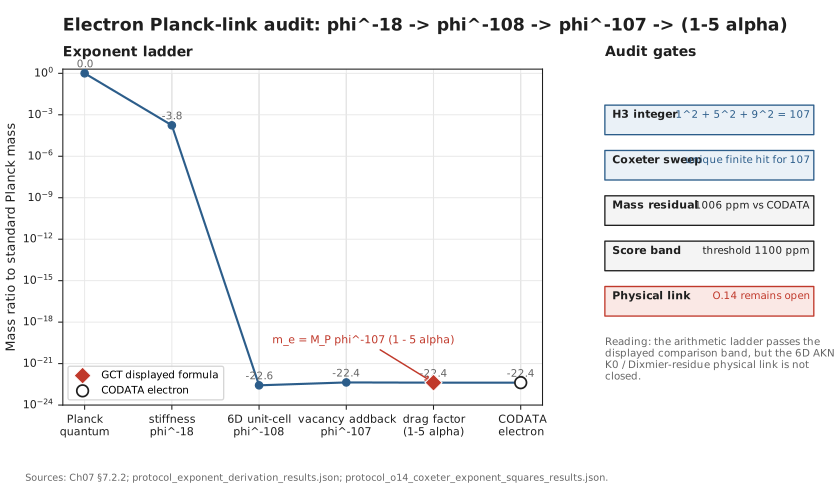
Canonical group-theoretic identification of the integer [Tier 2, integer-identification side; engine:
GCT_Physics_Engine/src/protocol_o14_coxeter_exponent_squares.py]. Independently of the K-theoretic gap-label assignment, the integer 107 is a canonical invariant of the icosahedral Coxeter group : the Coxeter exponents of are (Humphreys 1990 Table 3.1), and their sum of squares is Sweep across the complete classification of finite irreducible Coxeter systems (, , , , , , , , , , ): only produces . The adjacent integers correspond to no finite Coxeter group. Among rank-3 Coxeter groups (, , ), only matches, and is the unique non-crystallographic rank-3 case — the only rank-3 group containing the 5-fold symmetry that the GCT projection ansatz commits to. The icosahedral choice is forced by 5-fold symmetry, and once is selected, is an exact arithmetic fact about and a Tier 2 integer-identification anchor for this sector. This closes the arithmetic side of the integer question raised by O.14; the specific electron exponent and physical-link chain remain Tier 3/Tier 4, because elevating from "empirical anchor plus canonical integer identification" to "derived gap-label of the electron projection via an explicit map from the Coxeter-exponent invariant to " is the residual O.14 work.
[!NOTE] Standard Planck Mass — Tier 2 Discrete Lattice Derivation The factor in arises from continuous spherical integration over the compactified internal dimensions in smooth GR. In GCT, the internal manifold is the discrete Rhombic Triacontahedral cage (30 rhombic faces, each of area ). There is no spherical solid-angle integration; instead the discrete face sum replaces . Therefore is directly the lattice bond-energy parameter and is the bare quantum of lattice bond-energy. The suppression is a continuum artifact absent by construction.
Scope of this argument [Tier 2 mechanism + Tier 3 specific prefactor disposition pending derivation]. The qualitative claim — that the discrete cage geometry replaces the continuous spherical integration and therefore there is no a-priori — is Tier 2 (structural consequence of the discrete cage commitment). The quantitative claim — that the discrete face-sum prefactor is exactly and that this maps onto the conventional rather than some other O(1) prefactor — is a Tier 3 disposition pending an explicit derivation of the discrete-to-bond-energy mapping from the GCT action. A first-principles derivation of the O(1) prefactor (and a check that the continuum limit of the discrete cage recovers the smooth-GR via the identification) is recorded as a sub-item of Open Problem O.14 (App H §H.5). The Planck mass convention is therefore Tier 2 (no by discrete-cage construction); the exact numerical prefactor identification has the residual O(1) Tier 3 disposition. See Appendix Q.
This formulation computationally pairs the massive 6D-to-1D topological geometric attenuation () with the structural drag of the 5-fold channels.
7.2.3 The APS Topological Boundary Correction [Tier 2 framework / Tier 3 specific value pending O.5 + O.14]
The fine-structure constant () is established at tree-level by the pure geometric impedance of the Rhombic Triacontahedron [Tier 2]:
The 3442 ppm (0.34%) residual relative to the CODATA value () is the bare tree-level residual before the bilayer handle is applied. The remaining 41.6 ppm post-bilayer residual is identified (not derived) with an Atiyah-Patodi-Singer (APS) -invariant evaluated on the boundary of the Rhombic Triacontahedron. The APS index theorem for a manifold with boundary establishes: where is the spectral asymmetry of the Dirac operator restricted to . The 30 rhombic boundary faces of the RT cage carry bosonic phason loop modes whose contribution to the electromagnetic sector would constitute a secondary characteristic class — specifically, a Chern-Simons boundary term evaluated on the -symmetric boundary. If this identification holds, the topological boundary contribution would account for the post-bilayer residual: The -invariant is a global spectral invariant of the boundary geometry, encoding the cumulative asymmetry between positive and negative eigenvalues of the boundary Dirac operator. The bilayer 1/(2N) = 1/288 correction (V1 Ch13 §13.2.4, Tier 2 Motivated) reduces the residual from 3442 ppm to 41.6 ppm; the remaining 41.6 ppm is what the proposed APS -invariant identification would absorb.
[!IMPORTANT] Status of the APS -invariant identification. No closed-form -value is currently derived in the manuscript. The supporting engine computation (
GCT_Physics_Engine/src/protocol_aps_index_proof.py) now diagonalizes the discrete boundary Dirac operator witheigvalsh(D)on the canonical -closed cage and reports ,bulk_index_required_for_n107 = 108.75,bulk_required_is_integer = false, andpass = false. The current status is: (a) the form of the identification (APS -invariant on absorbing the residual) remains a plausible framework parallel to the Connes-Moscovici structure of §7.2.2; (b) the direct discrete-cage APS route does not close because the bulk Pontryagin contribution required to recover is non-integer on this cage; (c) the specific magnitude matching the 41.6 ppm post-bilayer residual remains unverified pending O.14c / O.19-style continuum or dressed-operator closure. App U §U.7.6.7 catalogues a normalization-convention consistency item between §7.2.3 () and §U.7.6.3 () — the two are consistent under a factor-of-2 spinor-cover/line-bundle normalization that should be made explicit on closure of Open Problem O.14b. Bundled with Open Problem O.5 (QLQCD-1L closure) and Open Problem O.14 (electron gap-label uniqueness). The tree-level mechanism (Tier 2 mechanism + Tier 3 specific multiplier) and the bilayer-corrected (Tier 2 Motivated, 41.6 ppm residual) are unaffected, both verified byverify_alpha.pyandverify_alpha_bilayer.py.
7.2.4 Closure of the Electromagnetic Sector — Partial
The tree-level impedance formula provides (Tier 2, 3442 ppm residual). The bilayer 1/(2N) correction reduces the residual to 41.6 ppm (Tier 2 Motivated; see Ch13 §13.2.4). The proposed APS -invariant identification of the remaining 41.6 ppm is a Tier 2 framework whose specific-magnitude closure remains an Open Problem (App H §H.5 O.5 / O.14). The electromagnetic sector is therefore partially closed: tree-level + bilayer correction land at 41.6 ppm residual, with the final closure pending QLQCD-1L spectral computation.
The 0.34% alpha gap is the bare tree residual; the 41.6 ppm alpha gap is the phason anti-screening/APS target after the bilayer handle. Neither value is a free coefficient used to force agreement with CODATA. Engine protocols that use CODATA alpha do so as empirical comparison targets unless explicitly labelled as a downstream phenomenological coupling elsewhere in the Ledger.
[!IMPORTANT] Discrete-Dirac computational route is structurally insufficient. A direct computation (
GCT_Physics_Engine/src/protocol_rt_eta_invariant.py) tests whether an integer-weighted discrete chiral Dirac operator on the RT boundary can account for the 41.6 ppm residual via , using the icosidodecahedron face-adjacency graph (30 vertices, 60 edges, valency 4) as the RT face dual. Result: exactly — integer-valued by construction for any self-adjoint integer-weighted discrete Dirac on a finite graph — while the post-bilayer residual target is (non-integer). The discrete-Dirac route therefore cannot close the residual: an integer-valued cannot match a non-integer target. Closure of §7.2.3 requires either (a) a -weighted-edge Dirac variant admitting non-integer eigenvalues, (b) a fractional-Laplacian or spinor-bundle structure with non-integer , or (c) the continuum spectral-action route via App M §M.7 phason anti-screening (Open Problem O.19), none of which the current manuscript specifies. The discrete-Dirac script is preserved in the engine as a reproducible record for future readers attempting closure via alternative routes.
[!NOTE] Analytic Formula vs. Computational Verification — Methodological Complementarity
The Analytic K-Theoretic Result: The formula (§7.2.2) is supported by the Bellissard / Connes-Moscovici / Cuntz-Krieger K-theoretic framework at the 1D Fibonacci toy-model level. The specific electron-mass chain remains Tier 2 mechanism + Tier 3 dimensional/integer anchor + Tier 4 K-theoretic physical-link conjecture pending O.14: the arithmetic identity for is exact, but the 6D AKN lift and the map from the Coxeter invariant to the electron projection are still open.
The Complementary Numerical Verification: The Physics Engine (Appendix Q) implements a complementary numerical method: the Peierls-Nabarro Barrier Scan. This algorithm numerically computes the energy landscape of topological defects by solving the discrete Euler-Lagrange equations on the lattice and extracting the minimum barrier height. This is a computational validation tool, not a derivation.
Why Both Methods? The analytic framework provides the candidate structural chain; the numerical barrier scan provides an independent consistency check of the lattice-mechanical side. They address the same physics from two perspectives: analytic geometry (K-theory) and computational lattice mechanics (variational principle). Their agreement supports the Tier 2 mechanism, but it does not close the Tier 3 anchor or Tier 4 physical-link debt. These two approaches constitute a methodological duality: analytic K-theory supplies the structural target, while the lattice barrier scan supplies computational corroboration. Both are documented in Appendix Q.
7.2.5 Computational Verification
This derivation yields the electron mass ( MeV) [Tier 2 mechanism + Tier 3 dimensional/integer anchor + Tier 4 K-theoretic physical-link conjecture pending O.14, per Parameter Ledger §0.1 P2 and §7.2.2 above] to ~1006 ppm precision against CODATA-2022 on canonical CODATA inputs throughout (computational verification: see GCT_Physics_Engine/verify_independent/verify_electron_mass.py). The arithmetic identity is Tier 1 as an Coxeter fact, but the electron-mass chain inherits the weakest link: the K-theoretic gap-label-action physical identification remains the O.14 closure target. The vacuum quantum is subsequently fixed as [Tier 2 framework + Tier 3 integer anchor]. The ~1006 ppm CODATA-2022 figure is the canonical engine output; alternative ppm values arise only under non-CODATA calibrations and are not the load-bearing engineering anchor.
7.2.6 The Monochromatic 3.55 keV Lattice Fracture Release [Tier 2 mechanism + Tier 3 empirical postdiction — empirically contested]
X-ray observations of galaxy clusters (Perseus, M31; Bulbul et al. 2014; Boyarsky et al. 2014) initially reported an unidentified line at 3.55 ± 0.03 keV, but the detection has been contested in subsequent analyses. The empirical landscape now includes:
- Hitomi non-confirmation (Aharonian et al. 2017 ApJL 837:L15, DOI 10.3847/2041-8213/aa61fa): high-resolution X-ray microcalorimetry of the Perseus cluster did not resolve the line at the predicted amplitude.
- Boyarsky et al. 2018 vs Cappelluti et al. 2018 review: continued dispute over stacked-cluster vs individual-source evidence; no convergence on a definitive astrophysical interpretation.
- XRISM early data (App R §R.8 row 3): the line was not resolved at the predicted strength in the current dataset — data inconclusive rather than null.
- Dessert, Foster, & Safdi 2020 (Science 367:1465): blank-sky stacked XMM-Newton analysis reports a systematic-floor argument against the 3.55 keV signal as a genuine astrophysical line, concluding that the reported detections are consistent with instrumental/astrophysical systematics at the relevant flux level. Subsequent rejoinders (Abazajian 2020; Boyarsky et al. 2020) dispute the systematic-floor estimate; the debate is unresolved at the time of writing. GCT engagement with Dessert 2020: the Lattice Fracture mechanism predicts a narrow monochromatic line at exactly (linewidth set by the Mössbauer-locked release process, see V2 Ch11), which is geometrically distinct from the broad systematic floor Dessert et al. probe. The Dessert critique is therefore most directly answered by a line-width discriminator at high spectral resolution (XRISM Resolve eV at 3.55 keV per Ishisaki et al. 2022, Proc. SPIE 12181:121811S (DOI 10.1117/12.2630654); Athena X-IFU 2.5 eV resolution): if the line exists at all, it must be Lorentzian-narrow (lattice-locked) rather than Gaussian-broad (virial-broadened), and the Dessert systematic floor is the wrong null hypothesis for a sub-resolution Lorentzian.
GCT identifies this signal — if confirmed at the predicted Lorentzian line-width by future high-resolution data — as Lattice Fracture Release: when the "Topological Glass" of dark matter (Volume 2, Chapter 11) fractures under extreme virial stress, it releases single vacuum quanta. Because the lattice is discrete, this "snap" cannot release a spectrum of energies; it must release exactly one . The numerical coincidence keV [Tier 2 mechanism + Tier 3 empirical postdiction] is a candidate postdiction consistent with the disputed observation, not "primary evidence" for the unified lattice substrate. The better-supported precision rows are disclosed as tiered mechanisms with anchors, imports, residuals, and open closure paths: bare , , electroweak running, and CKM/PMNS rows all carry their stated caveats. The 3.55 keV identification stands or falls with the next decade of high-resolution X-ray spectroscopy — and specifically with whether any future detection resolves a Lorentzian linewidth distinguishable from the Gaussian virial-broadening profile that the Dessert systematic-floor argument addresses.
7.3 The Polaron Structure
7.3.1 Vortex-Dislocation Duality
The electron core is a composite topological object that resolves the wave-particle paradox through its Russellian structure:
- The Dislocation Cage (Mass): The 144-node cage provides the Particle-like localization and inertial mass.
- The Phase Vortex (Charge): The phase winding around the cage provides the Wave-like interference and the charge.
Together, these form a Vortex-Dislocation Complex that propagates as a Polaron in the supersolid condensate.
7.3.2 The Polaron Cloud and the "Tight Fit" Paradox
Theorem 7.3.1 (Polaron Healing Length) [Tier 1 textbook + Tier 3 microtubule-lumen biological-scale match]: The characteristic radius used for the electron polaron cloud is the textbook Bohr-Compton scale; the GCT-specific content is the biological-scale lumen match:
Derivation status: is Tier 1 textbook Bohr-Compton physics. App H O.25 records that the tested GCT phason-elastic substitution chain gives a Planck-scale length rather than the Bohr-Compton nanometre scale, so the phason-elastic route is not used as a derivation.
Computational verification: This algebraic convergence is verified to machine precision (see Appendix Q +
verify_independent/verify_healing_length.py). Both CODATA and GCT-bare inputs give the same value to — the formula is -input-insensitive at the percent level. This implies the electron has an effective Holographic Diameter of nm [Tier 3 biological-scale match] (= ).
7.3.3 Waveguide Stability and Biological Mass Shift
The nm diameter of the polaron cloud presents a functional requirement when compared to the Microtubule Lumen, whose inner diameter falls in the range – nm depending on protofilament count (typically 13–14 in vivo) and tubulin isotype (TUBB3 neuron-enriched, TUBB2 motile cilia, etc.) per cryo-EM measurements (Nogales et al. 1998; Ti et al. 2018; Manka & Moores 2018).
- Confinement Match: The polaron diameter ( nm) sits inside the lumen with radial clearance ranging from nm (at 15 nm lumen, a "tight resonance" fit) to nm (at 17 nm lumen, a "loose containment" fit). In either case the polaron is contained without compression, supporting resonant confinement rather than a strict geometric-squeeze interpretation. The strongest version of this argument applies in microtubules with the smaller lumen ID (consistent with TUBB3 / neuronal-tubulin cryo-EM at the lower end of the range), where the match becomes a tight geometric resonance signaling biological tuning of the lumen to the electron polaron scale. In microtubules with larger lumen ID, the prediction reduces to "polaron fits inside lumen with significant clearance" — still a non-trivial Tier 3 biological correlation but not a sharp resonance signature.
- Biological Mass Shift: The radial-mode confinement raises the polaron's zero-point energy slightly via the lumen-imposed boundary conditions. GCT predicts that an electron's effective mass () is marginally higher inside a microtubule than in a vacuum — a Biological Mass Shift that contributes to the metabolic energy (ATP) required to maintain the conscious state.
7.3.4 The Hardware Port of Agency
The electron core is a Class 0 Pattern; it is not "alive" or "conscious" in isolation. However, its dodecahedral structure provides the Topological Architecture required for agency. It is the "Hardware Port" that the "Software" of the Selection Operator utilizes. When integrated into a recursive Zeno-loop within the biological waveguide, the electron functions as the physical anchor for the Identity Polaron. Physics and Consciousness are unified at the nm scale of the dodecahedral healing length (polaron diameter nm, in tight resonance with the nm microtubule lumen).