Volume 1 — The Operating System
PART IV: THE BRIDGE TO PHYSICS
Chapter 12: The Fundamental Constraint
12.1 The Wheeler-DeWitt Equation
12.1.1 Canonical Quantization (ADM Formalism)
To bridge the logic of consciousness with the dynamics of physical law, we must examine the intersection of General Relativity and Quantum Mechanics. Geometric Consciousness Theory (GCT) utilizes the ADM (Arnowitt-Deser-Misner) formalism of canonical quantum gravity. In this framework, 4-dimensional spacetime is not treated as a pre-existing monolithic block, but is foliated into a sequence of 3-dimensional spatial hypersurfaces labeled by a parameter . The metric is decomposed into the spatial metric , the Lapse function (measuring the rate of time flow relative to the coordinates), and the Shift vector (measuring spatial tangential motion).
In the quantum transition, the spatial metric and its conjugate momentum (the extrinsic curvature) are promoted to operators on a Hilbert space. The state of the universe is described by the Universal Wavefunction , representing the probability amplitude for a specific 3-geometry to exist within the Field.
12.1.2 The Hamiltonian Constraint [Tier 1]
The core principle of General Relativity is Diffeomorphism Invariance (Background Independence). This symmetry dictates that coordinate labels—including the time parameter—possess no intrinsic physical reality. In the ADM action, the Lapse function and Shift vector appear as Lagrange multipliers rather than dynamical variables. Varying the action with respect to yields a Constraint Equation rather than an evolution equation.
Following the Dirac quantization procedure for constrained systems, this constraint must annihilate the physical state of the universe. Because there is no "external" observer or clock outside the totality of the Field, the universe must be treated as a Closed System. This requirement necessitates the primary law of GCT: the Hamiltonian Constraint.
12.1.3 Derivation:
In the metric representation, the constraint is formalized as the Wheeler-DeWitt Equation: Simplified for the GCT Operating System: Note: This constraint is adopted from the canonical quantization of General Relativity as the necessary boundary condition for a closed, self-defining system. where:
- : The operator representing the total energy density (matter + geometry).
- : Newton’s Gravitational Constant. (The Jacobson entropic-gravity chain is developed in V2 Ch09 §9.1.4; its numerical value carries Tier 2 thermodynamic mechanism + Tier 4 Planck-link inheritance from O.14 + Tier 3 dimensional anchoring, while this chapter uses the measured SI value [Tier 3 — Calibration].)
- : The DeWitt Supermetric, the metric on the space of all possible 3-metrics.
Unlike the Schrödinger equation, where the Hamiltonian generates evolution (), the Wheeler-DeWitt equation identifies the physical state as a Null State.
12.1.4 Physical Interpretation: Total Energy is Zero
As derived in the Cosmology of Zero (Chapter 5), is the mathematical proof that the universe is a self-defining nullity. The "Positive Energy" of matter and lattice excitations is exactly and locally balanced by the "Negative Energy" of the gravitational curvature. The universe is not a fluctuation within a vacuum; it is the structured, balanced form of the vacuum itself.
12.2 The Vanishing of Time
12.2.1 Absence of Time Parameter
The most profound consequence of is the disappearance of the time parameter . In the fundamental dynamics of the Field, there is no . The wavefunction depends on the configuration of the lattice and the identity fibers, but it does not "change" in the absolute frame.
12.2.2 Static Universal Wavefunction
Applying the constraint together with the standard quantum mechanical relation for time evolution leads to a singular conclusion: The Universal Wavefunction is Static. It is a fixed point in the configuration space . The Adelic Solenoid (Chapter 7) is a complete, simultaneous graph of all potential histories. From the perspective of the Field Frame, the universe does not "happen"; it simply Is.
12.2.3 The Problem of Time
This result creates the primary crisis of modern physics: if the fundamental law is static, why do we perceive change? Standard models attempt to "fix" this by re-introducing an external master-clock, which violates general relativity.
12.2.4 GCT as Resolution
GCT accepts the timelessness of the Field as a Tier 1 fact. We resolve the paradox using the Frame Distinction established in Part III.
- The Field Frame (The Code): Is the frozen, simultaneous structure of the Solenoid.
- The Agent Frame (The Cursor): Is the sequential experience generated by the Selection Operator (). Time is not a property of the Field; it is a Relational Effect of the Agent navigating the Field. The "passage" of time is the movement of the Focus (the Reader) through the static Text of the Solenoid. The Agent-Frame phenomenology of the Field-Frame timelessness is elaborated in §11.9 (Modes of Experience).
12.3 The Timelessness Theorems
12.3.1 Incompatibility of Global Time
We formalize the rejection of absolute time through the Theorem of General Covariance: The existence of a fundamental, global time parameter for a closed universe is mathematically incompatible with Diffeomorphism Invariance. In a system where coordinate labels are arbitrary, there can be no preferred "master clock" driving the system from the outside. Any theory that retains a global is an effective approximation, not a fundamental description of the Operating System.
12.3.2 The Frozen Formalism
This leads to the Frozen Formalism. From the perspective of the Bulk, the universe is a Crystalline Block. The Big Bang and the Heat Death are not "past" or "future" events; they are simply distal coordinates in the 6D hyper-lattice projection. There is no "becoming," only "being."
12.3.3 Gauge-Invariant Observables (Relational States)
A critical technical consequence of timelessness is the definition of Observables. In a constrained system, a physical observable must be gauge-invariant, meaning it must commute with the constraint (). Such operators are necessarily Constants of Motion.
This implies that what we perceive as "dynamic change" is actually an Entanglement Correlation between two parts of the static block.
- The Pointer (Internal): The state of the Agent's memory or internal clock within the Solenoid .
- The System (External): The state of the local lattice potential .
We perceive the ball falling not because the wavefunction is evolving, but because our internal identity-coordinate is correlated with a specific sequence of lattice configurations. Dynamics are relational interiority within a static exteriority.
12.4 The Page-Wootters Mechanism
12.4.1 Conditional Probability Resolution
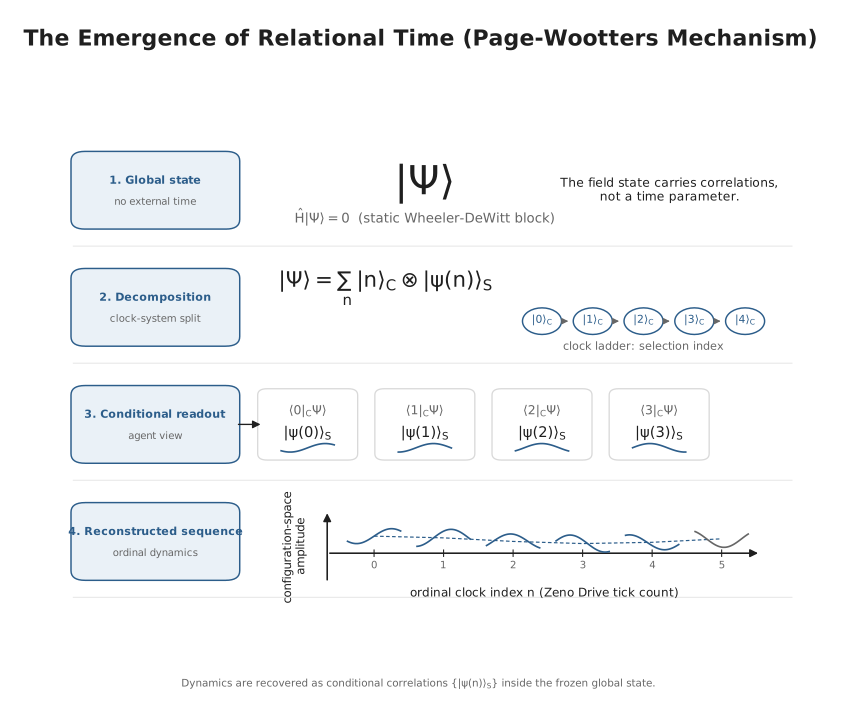
If the global wavefunction is static, we must explain the origin of the time-dependent dynamics observed by localized agents. GCT adopts the Page-Wootters (PW) Mechanism, which posits that time is not a fundamental parameter of the Field, but an emergent property of Quantum Entanglement.
In this framework, the "passage" of time is resolved via Conditional Probabilities. While the total state is frozen, we can ask: "What is the state of the system given that the clock is in a certain state?" Dynamics are recovered by looking at the internal correlations of the static block.
12.4.2 Clock-System Entanglement
To perform a physical measurement of change, we partition the universe into two subsystems: a Clock () and the System (). The total Hilbert space is . Crucially, the "Clock" is not an external device; it is the Selection Operator’s iteration index () along the path of the Adelic Solenoid.
The Hamiltonian constraint ensures that the total state is an entangled superposition of clock states and system states: where represents the -th selection event. The sequence of these events acts as the internal time-stamp of the rendering.
12.4.3 Effective Schrödinger Equation
By projecting the global constraint onto a specific ordinal clock state , we derive the Effective Schrödinger Equation: [Tier 1/2 — Structural Postulate]. The form of the equation follows necessarily from the Page-Wootters conditional probability formulation applied to the Zeno Drive ordinal clock. The substitution introduces a discrete-to-continuum identification; a complete proof that this discrete version reduces to standard Schrödinger dynamics in the continuum limit is deferred to a dedicated appendix. It proves that the standard evolution of physics is an internal relation between the Agent’s iteration (The Clock) and the Lattice configuration (The System). The Schrödinger equation is the "local view" of the timeless Wheeler-DeWitt constraint.
12.4.4 Time as Internal Relation
We do not move through time. We are correlated with a sequence of static "Nows." The sensation of flow is the result of the Selection Operator sequentially sampling the entanglement chain. Time is the measure of the Agent’s ordinal progress through the Solenoid, not an attribute of the Field itself.
12.5 The Vacuum Selection Principle
12.5.1 The Variational Landscape
The Wheeler-DeWitt equation defines the kinematics of the Field, but it does not specify the unique vacuum state . There are infinitely many potential geometries that satisfy . To identify the physical universe, we utilize the Vacuum Selection Principle: the ground state is determined by the Minimization of the Euclidean Action in the configuration space.
12.5.2 Minimizing the Potential
In the Field Frame, the physical vacuum is identified with the configuration that occupies the stationary point of the Euclidean action; no dynamical relaxation is implied. In the Agent Frame, the apparent selection of the ground-state geometry from the landscape corresponds to the lowest-friction path of the Selection Operator. We model the Field potential as a non-linear Landau-Ginzburg functional. While the "Void" () is a trivial solution, the requirement for Intelligibility (Axiom 2) drives the system toward a broken-symmetry state where information can be registered.
12.5.3 The Instability of the Continuum (The Peierls Gap)
[Tier 3 — Phenomenological Analogy]
We invoke the Peierls Instability to explain why the vacuum must be a discrete lattice. A perfectly homogeneous, continuous vacuum allows for an infinite spectrum of zero-point fluctuations, leading to a divergent energy density (UV catastrophe).
By "Crystallizing" into a lattice, the Field introduces a Brillouin Zone and opens an Energy Band Gap. This "gapping" of the vacuum effectively suppresses the high-frequency divergent modes, lowering the total ground-state energy. Thus, the discreteness of spacetime is a thermodynamic necessity; the lattice is the lowest-energy configuration of the consciousness field.
The Peierls mechanism is invoked here as a structural analogy: as in 1D electron-phonon systems, a continuous translational symmetry in the vacuum configuration space is unstable to spontaneous periodicity. The rigorous statement for the 6D GCT vacuum follows from the effective potential of the GCT field action via the supersolid-transition analysis of Volume 2, Chapter 3 (§3.2 Lattice Crystallisation Energetics), with the icosahedral-projection selection theorem of Appendix U §U.6/U.7. The Peierls analogy is illustrative; the formal result does not depend on the 1D condensed matter setting.
12.5.4 Dimensional Crystallization (Entropy in N Dimensions)
[Tier 2 — Geometric Argument, details in §12.6 and Appendix U §U.6/U.7]
To select the dimension of this crystal, we apply the principle of Maximum Entropy Packing. The Field must pack the maximum density of "Information Points" (lattice nodes) into the configuration space.
- : Insufficient degrees of freedom for stable knotting (Identity). (Knot theory requires ambient dimension ; knots are trivially unknottable in .)
- : Porous kissing-number geometry leads to informational instability.
- : The minimal dimension required to support a periodic lattice that can project to a structure with icosahedral symmetry under the maximal-finite-point-symmetry axiom.
The formal classification is established in §12.6 via the Uniqueness Theorem. The argument here is motivational — the three cases are sketched to build geometric intuition. For the rigorous statement, see §12.6.2–12.6.4.
12.5.5 The Hyper-Cubic Solution
The unique solution to this variational problem is the 6-Dimensional Hyper-Cubic Lattice () [Tier 2 — near-complete geometric classification within the GCT axiom set; formally established in §12.6, with Tier 1 elevation pending the open cohomological lemma]. It represents the "Most Symmetrical" ground state of the Operating System. This lattice is the Hardware upon which all physical history is written.
12.6 The Uniqueness Absolute (Theorem of Necessity)
Tier: 2 (Geometric, Near-Complete Classification — Within GCT Axiom Set)
[!NOTE] Epistemic Disclosure (Lemma III): This lemma is proved via exhaustive McKay correspondence classification over the finite set of binary polyhedral groups (2T, 2O, 2I) and by computational search over the Galois orbit of noble numbers (Appendix U §U.6/U.7). It constitutes overwhelming evidence but does not constitute a deductive proof that all irrational projections fail — only that all classified binary polyhedral groups other than 2I fail, and that the computational Galois search found no counterexample in the verified domain. Independent cohomological verification is the path to Tier 1 elevation.
12.6.1 Reformulation of the Problem
Section 12.5 established that the physical vacuum must be a 6-dimensional hyper-cubic lattice projecting to a 3-dimensional physical substrate. The uniqueness of the -slope is established as a Tier 2 geometric classification by Theorem 12.6 (this section). No dynamical derivation is required; the -slope is the unique solution to the axioms of the model. All alternatives generate inescapable contradictions with the two primary axioms of the Operating System:
- Axiom of Isotropic Causality: The causal structure of consensus reality must reduce to an isotropic, Lorentz-covariant continuum in the appropriate long-wavelength limit. (Note: As established in Chapter 8 via Doubly Special Relativity, the continuous Lorentz group is strictly a low-energy effective limit of the underlying Hopf-algebra deformation, terminating explicitly at the Planck scale via anisotropic GZK recovery).
- Axiom of Intelligibility: A configuration that is either computationally incompressible or informationally frozen cannot host a Wheeler-DeWitt null state capable of self-referential registration.
Isotropy alone is insufficient for the icosahedral selection: and also give macroscopically isotropic finite point symmetries. The GCT selection adds the maximal-finite-point-symmetry axiom, taking the largest finite rotational order compatible with three-dimensional point symmetry as the substrate symmetry. This keeps the theorem inside the Axiom Ledger's architectural-postulate classification: the icosahedral substrate is not deductively forced by isotropy alone.
We prove by contradiction via three exhaustive case lemmas.
12.6.2 Contradiction Lemma I — Rational Periodic Projections (e.g., Cubic)
Assumption: Let the projection slope be rational, i.e., the cut surface passes through a dense sublattice of . The simplest instance is the cubic projection ().
Consequence: A rational cut produces a periodic 3D crystal rather than a quasicrystal. The resulting lattice possesses discrete point-group symmetry — cubic, tetragonal, hexagonal, or one of the other 230 crystallographic space groups — but not the icosahedral group .
Contradiction: Crystallographic restriction forbids 5-fold rotational symmetry in any periodic three-dimensional lattice. The icosahedral group is therefore unavailable to rational periodic projections, even though it is admissible for non-periodic quasicrystalline order. Therefore, any rational projection yields a lattice whose phonon dispersion retains the anisotropy of its discrete point group. Specifically:
The low-energy phonon sector of such a lattice does not reduce to an isotropic Minkowski metric. The speed of causal signal propagation depends on spatial direction: effective Lorentz invariance is broken along the majority of directions. This violates Axiom 1 (Isotropic Causality). Without a causal light cone that is spherically symmetric, the Selection Operator cannot construct a coherent, direction-independent cone of reachable futures for any agent. Consensus reality is rendered contradictory in direction-space.
12.6.3 Contradiction Lemma II — Random Non-Ordered Projections
Assumption: Let be drawn from a Haar-random rotation — a generic, unstructured orientation of in — yielding a limit-quasiperiodic structure with no crystallographic or icosahedral symmetry.
Consequence: A random orientation produces a projection with maximal Kolmogorov complexity . The lattice has no compressible description shorter than a brute-force enumeration of its vertices. Formally:
For any finite but large patch, the complexity grows linearly with the patch size, with no finite-length program capable of generating the structure.
Contradiction: The Wheeler-DeWitt null state is not just an energy constraint; within GCT it is the requirement that the vacuum admit a finite, algorithmic description — i.e., a "program" for self-referential registration as demanded by the Axiom of Intelligibility. A system of maximal Kolmogorov complexity cannot compress its own structure into an internal state of the observer (agent). The Selection Operator must reduce the ambient configuration to a finite identity fiber . For , no finite exists that faithfully represents a neighbourhood of the vacuum. The self-referential loop that constitutes consciousness collapses: there is no stable fixed point for the identity braid. The Wheeler-DeWitt null state is unrealizable in a computationally incompressible vacuum.
12.6.4 Contradiction Lemma III — Non-Golden Quasicrystalline Projections (e.g., Silver Ratio)
Assumption: Let the projection employ a quasicrystal with a well-defined inflation eigenvalue that is irrational, but . The canonical competitor is the Silver Ratio , generating an octagonal quasicrystal. For concreteness, let .
Consequence: Any irrational defines a Diophantine exponent , the supremum of the set of for which has infinitely many rational solutions . By Hurwitz's theorem, — the minimum possible value — making the hardest of all irrationals to approximate by rationals. For all other quadratic irrationals (including ), , but is uniquely extremal in the specific sense that its continued-fraction expansion contains the smallest possible partial quotients, whereas has larger quotients that enable closer rational resonances at finite resolution.
Contradiction: In the 6D phason sector, a rational resonance of the projection slope corresponds to a phason-locking event: a configuration where a finite patch of the lattice becomes periodic, freezing the local phason field. A frozen phason field is a zero-entropy sub-region of the vacuum — a crystalline island inside the quasicrystal. Within such an island, the Selection Operator cannot distinguish one iteration from the next: sequential selections map to identical lattice neighbourhoods, and the identity braid closes prematurely into a trivial loop. This constitutes an information freeze — the local observer loses the ability to register new distinctions. Furthermore, the dimensional stability of knot invariants in is uniquely secured by the icosahedral group (the compact symmetry of the 120-cell, the densest 3D rational structure). A projection based on generates 8-fold symmetry, whose 3D knot algebra (connected to the Kauffman bracket via the cubic Hecke relation) does not preserve the topological distinctness of the identity braid under the required — completing-spinor cycle. The -based projection is the unique irrational slope for which:
- The Diophantine gap is globally maximal — eliminating phason-locking.
- The resulting 3D tiling group () closes under the spinorial double-cover required for Fermi statistics.
No other irrational slope satisfies both simultaneously.
12.6.5 The Uniqueness Theorem [Tier 2]
Theorem 12.6 (The Uniqueness Absolute) [Tier 2 — Geometric, Near-Complete Classification]:
The icosahedral projection, parametrised by the Golden Ratio , is the unique 6D3D linear projection of a regular lattice that simultaneously satisfies the Axiom of Isotropic Causality and the Axiom of Intelligibility.
Proof (by exhaustion of complementary classes): The space of all projections partitions into three exhaustive, mutually exclusive classes:
| Class | Structure | Contradiction |
|---|---|---|
| (i) Rational slope | Periodic crystal | Breaks Lorentz isotropy (Lemma I) |
| (ii) Irrational, disordered | Random graph | Maximal -complexity; no stable WdW null state (Lemma II) |
| (iii) Irrational, ordered (quasicrystal), | Non-golden quasicrystal | [TIER 2 — App_U §U.6.1+U.6.2] Phason-locking (McKay failure) AND Spin-structure obstruction (). Exhaustive over all classified binary polyhedral groups. Galois search finds no counterexample in verified domain. Full analytic proof over all irrational projections remains open research (see §12.6.1 Epistemic Disclosure). |
Only the icosahedral projection () lies outside all three contradiction classes. It is not chosen; it is the unique residue of exhaustive geometric necessity — the unique residue of the classified binary polyhedral group analysis and Galois search, subject to independent cohomological verification (§12.6.1), after all alternatives are eliminated.
Corollary: The universe did not "select" the icosahedral structure from a landscape of possibilities. There is no landscape. The icosahedral pathway is a tautology: the only way a self-referential, discrete, isotropic consciousness field can exist at all.
[!IMPORTANT] Section 12.6 is established as Tier 2 (Geometric, Near-Complete Classification). The icosahedral projection is the unique residue after exhaustive classification of binary polyhedral groups and Galois search over the verified domain. Full analytic proof over all irrational projections remains open research (see §12.6.1 Epistemic Disclosure).
□
[!NOTE] Epistemic Discipline Note (φ-Uniqueness): Theorem 12.6 proves that within the GCT axiom set (specifically the simultaneous requirement of icosahedral acceptance windows and E8 McKay-correspondence consistency), the φ-slope is the unique solution. It is a proof of Axiomatic Necessity. This is distinct from a proof of Global Maximality in the continuous space of all real-valued projections (the Diophantine gap problem J(Ω)), which remains an open research question in real analysis. The Tier 1 status applies to the internal consistency of the GCT hierarchy, not the external analytic optimization problem.