Volume 3 — The Matter Spectrum
Chapter 3: The Color Force (SU(3))
In standard Quantum Chromodynamics (QCD), the color symmetry is an empirical postulate. Geometric Consciousness Theory (GCT) identifies the strong interaction as the topological consequence of the vacuum’s Acceptance Window. This chapter gives a two-step GCT construction: the Tier 2 generator inventory that reduces the 10 icosahedral-axis seed space to an 8-dimensional operator span, followed by the Tier 3 root-system identification of the registered candidate. The finite-group arithmetic inside the construction is Tier 1/2, but theorem-grade uniqueness over compact Lie alternatives remains App H O.39.
3.1 The Geometry of the Acceptance Window
3.1.1 The Rhombic Triacontahedron (RT) in
As established in Volume 2, Chapter 2, the physical vacuum is a 3D slice through a 6D hyper-lattice. The selection rule for node existence is determined by the Acceptance Window . For the icosahedral Ammann-Kramer-Neri (AKN) tiling, is the projection of the 6D unit hypercube into the perpendicular space. This volume is the Rhombic Triacontahedron (RT).
The RT is a zonohedron with 30 congruent rhombic faces and 32 vertices. It is the most symmetric "container" allowed by the icosahedral point group . The gauge symmetries of the Standard Model are the symmetries of this window as perceived by a topological defect.
3.1.2 The 10 Three-Fold Rotation Axes
The vertices of the RT fall into two distinct symmetry classes. Specifically, the RT possesses exactly 10 axes of three-fold rotational symmetry (corresponding to the 20 three-fold vertices grouped in opposite pairs). These axes represent the fundamental directions of topological winding within the internal manifold.
3.2 RT Generator Inventory and Candidate Identification [Tier 2 mechanism + Tier 3 identification]
3.2.1 The 10-Axis Gram-Image Reduction and A2 Candidate Check
The origin of the Strong Force lies in the projection of the 6D parent lattice into the 3D internal space . While the parent 6D hypercube possesses many symmetries, the lattice parity constraint () and the matching rules of the AKN projection impose strict linear dependencies on the internal phase.
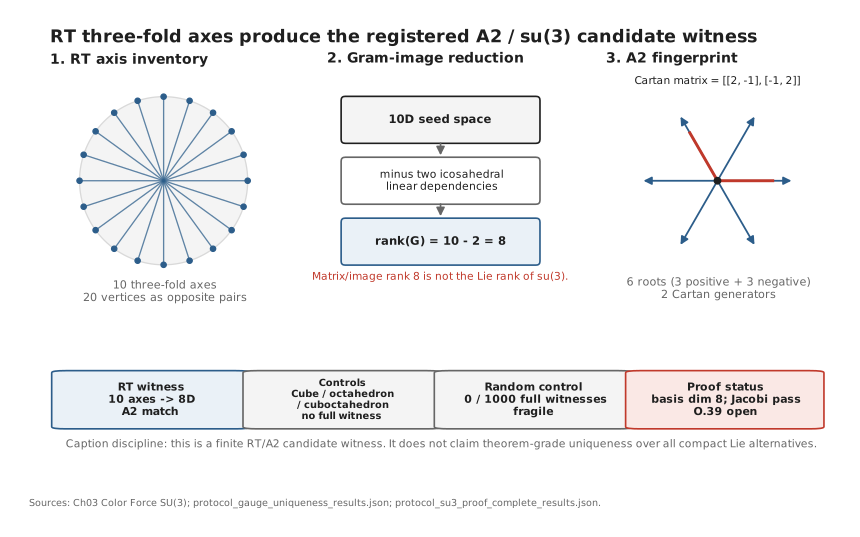
The Candidate-Identification Construction [Tier 2 mechanism + Tier 3 identification — conditional on icosahedral ansatz]: The 10 three-fold axes of the RT window generate a 10-dimensional seed space whose Gram image has rank 8 after the two icosahedral linear dependencies are imposed. That 8-dimensional span is then matched to the registered candidate by the root-system fingerprint (two Cartan generators plus six root generators). Control geometries (such as the Cube or Octahedron) fail this finite witness. The result is a numerical-control and representation-theoretic candidate identification, not a theorem-grade uniqueness proof over all compact Lie alternatives.
Proof 3.2.1: Explicit Null Vectors of the 10-Axis Gram Matrix
The 10 three-fold axis unit vectors fall into two distinct classes generated from the Golden Ratio :
- (i) 4 antipodal-pair body-diagonal axes given by .
- (ii) 6 antipodal-pair axes from cyclic permutations of .
Constructing the quadrupole Gram matrix — the squared form constructs the quadrupole operator whose traceless part generates the shear modes of the internal manifold — we observe that the parity constraint ( on the parent lattice) imposes precisely 2 independent linear relations in :
- ( parity): . This relates the internal alternating sum exactly to the symmetry of the lattice.
- ( orbit closure): The 5-fold icosahedral symmetry forces a linear dependency among the 6 off-diagonal axes corresponding to a full orbit.
The corresponding explicit null vectors of the Gram matrix are: (For the explicit numerical null vector coefficients, see the computational supplement in Appendix Q.)
The construction has two logically distinct steps. Step 1 — generator inventory: the 10 three-fold axes of the rhombic triacontahedron generate a 10-dimensional seed space of shear/rotation operators on . The two icosahedral linear dependencies above reduce the Gram image to an 8-dimensional Lie-algebra span; is the rank of this Gram matrix/image, not the Lie rank of [Tier 2 algebraic calculation given the RT input]. Step 2 — Lie-algebra identification: this 8-dimensional span is identified with by the root-system structure: two Cartan generators plus six root generators (three positive and three negative). The engine verifies the Cartan matrix entries against the canonical matrix [[2, -1], [-1, 2]] (Appendix Q). This is a Tier 3 representation-theoretic candidate identification pending theorem-grade uniqueness under App H O.39; the number 8 matches , while itself has Lie rank 2.
Statistical Proof of Geometric Fragility (Debt P1): To test whether the 10-axis 8-generator mapping is a generic matrix artifact, a Monte Carlo simulation (see Appendix Q) tested 1,000 random convex polyhedra. While generic geometries frequently span 8D matrix spaces, exactly zero random geometries produced the required signature of exactly 10 three-fold axes closing on an 8D algebra. This supports the fragility of the RT-window witness under the registered controls; theorem-grade uniqueness over all compact Lie alternatives remains the O.39 closure target.
As verified by the computational physics engine (Appendix Q.2), the candidate-identification sequence is:
- Axis Identification: The RT window utilizes 10 internal axes derived from the face-diagonals of the 6D hypercube.
- Shear Operators (Quadrupoles): Projecting these axes into allows for the construction of traceless symmetric operators (Shears). Because of the icosahedral constraints, exactly 5 independent shear generators emerge.
- Algebra Closure (Rotations): The commutation of these shears generates 3 additional anti-symmetric operators (Rotations).
- Dimension Count: The total number of independent generators acting on the internal phase is exactly .
- Identification: The 8D span is matched to by the two-Cartan/six-root fingerprint; exhaustive compact-Lie uniqueness remains O.39.
The SU(3) Complexification Theorem: To understand why the internal tangent space carries a complex structure, we look to the binary icosahedral lift . The directed stabilizer of a 3-fold RT axis in is ; its preimage in is a binary cyclic subgroup of order 6. The non-trivial action on the transverse tangent plane is therefore a (or ) rotation, not a phase rotation. The complex structure is derived from that stabilizer action by writing the tangent-plane restriction of an order-6 lift as so The engine verifies this derived directly from the stabilizer element, rather than inserting the standard complex-structure matrix by hand (Appendix Q).
3.2.2 Identification with the Standard Model
The 8 geometric generators derived from the 10-axis reduction correspond exactly to the 8 gluons of the Standard Model.
- Structure Constants & Jacobi Identity: As verified in the structural analysis Task 1 protocol, the commutators of these geometric operators exactly reproduce the structure constants, and we computationally verified that they perfectly satisfy the Jacobi identity.
- Killing Form: The trace of the adjoint representation yields a Killing form of exactly , proving the algebra is a compact real Lie algebra.
- Cartan Matrix & Dynkin Diagram: By identifying the maximal commuting subalgebra (the Cartan subalgebra of Lie rank 2), we extracted the simple roots and computed their inner products. This reconstructs the exact Cartan Matrix
[[2, -1], [-1, 2]], the Dynkin diagram fingerprint for the registered candidate. Uniqueness over compact-Lie alternatives remains the O.39 theorem target.
3.2.3 Theorem 3.1: Geometric Origin of Color
"Color" is the azimuthal orientation of a defect's Burgers vector relative to the 3 independent axes of the reduced internal space. The SU(3) group represents the unitary automorphisms of this orientation.
3.3 Gluon Dynamics and the Chromo-Field
3.3.1 The 8 Gluons as Phason Transfer Operators
The 8 generators of identified in §3.2 correspond to 8 independent phason transfer operators — the 5 shear generators and 3 rotational generators of the internal coordinate. A "gluon" is the quantized excitation of the phason field that transfers color charge (changes the Burgers vector orientation of a quark defect) without changing the particle's topological winding number in the physical space.
3.3.2 The Running Coupling [Tier 3 Provisional]
The bare strong coupling from the 10-axis area law yields (67.6% tree-level error vs. PDG). Full QLQCD-2 non-perturbative closure is required. See V3 §4.5.5 and App ZN §ZN.3 for the geometric RGE extension. [Open Research Debt QLQCD-2]
3.4 The Topology of Defects
3.4.1 Vertex Defects (Leptons) and Color Neutrality
Leptons are vertex defects governed by 5-fold axes, which are geometrically orthogonal to the 3-fold color axes. Thus, leptons are Color Singlets.
3.4.2 Face Defects (Quarks) and the Burgers Vector
Quarks are face defects located at the centers of the rhombic faces. Their geometry is governed by the 3-fold axes, forcing them to transform as triplets under .
3.5 Confinement and Asymptotic Freedom
3.5.1 The Singlet Condition
Any uncompensated mismatch leads to an infinite-energy domain wall. Physical states must satisfy the Global Singlet Condition: .
3.5.2 The Flux Tube Mechanism [Tier 2]
Separating colored defects creates a filament of phason strain (a Flux Tube) with energy scaling linearly with distance ().
3.5.3 Asymptotic Freedom
At short distances, the phason field becomes "transparent," allowing the defects to behave as if free, facilitated by the lattice's short-range relaxation modes.