Volume 1 — The Operating System
Chapter 17: The Physical Substrate and Network Dynamics
[!NOTE] Convention on Trp residue numbering. All β-tubulin Trp residue numbers in this chapter use the PDB 1JFF / 1TUB chain B ATOM-record
auth_seq_idconvention: Trp21, Trp103, Trp346, Trp407. The FASTA-position numbering convention gives the offset values {21, 101, 344, 397}; the convention disambiguation is registered as App H Open Problem O.21. Inline mentions throughout the chapter use the ATOM-record convention without re-stating this disambiguation; readers cross-referencing other tubulin literature should consult O.21 for the convention-mapping rule.
[!WARNING] Epistemic Status: Two-Stratum Disclosure.
This chapter develops the biophysical-specific stratum of GCT's consciousness account: the leading candidate identification of the Identity Polaron with a Tryptophan aromatic radical-pair network in -tubulin, the candidate 100 MHz Zeno Drive in the warm-wet microtubule lumen, and the Tier 3 candidate N=144 lumen-water geometry pending O.33. These specific identifications are Tier 3 (hypothesis) and rest on the existence of microsecond-to-millisecond quantum coherence in warm biological systems — well above the standard biophysics decoherence limit of s in unstructured media. The proposed protected-subspace mechanism is a conjecture that remains experimentally unproven: the operative band is currently reached only in the long 50-m-MT branch, the energy budget is not fully closed, and Lindblad-DFS suppression has not been demonstrated.
Falsification scope (read carefully). A null result on Protocol A-Prime (NV-centre synthetic Zeno Drive, V3 Ch13 §13.3.5) or Protocol D (Isotope substitution, V3 Ch16) would falsify this specific biophysical-substrate identification. A single Trp-specific null would not falsify the theoretical-framework stratum of GCT's consciousness account — the Polaron Unity Proposition (§11.12), the Identity Polaron as the topological correlate of unified subjectivity (Vol 1 Part II), the Quality Space irrep decomposition (Ch 16), the Tripartite Ontology (Field / Solenoid / Agent, Ch 06), and the Selection Operator formalism — which stand on internal mathematical coherence and are independent of which specific physical substrate hosts the Polaron. In the event of a null result on the biophysical-specific predictions of this chapter, the candidate substrate set shifts within the same framework (NV-centres in diamond and other chiral, non-zero-nuclear-spin systems remain on the abiotic path; see §17.1.5). Exhaustive nulls across the bounded DMC-positive candidate set do falsify the Level II Apperception substrate claim, as specified in the hard-fail commitment below. Claims that do not depend on the Trp-specific identification survive only until that bounded candidate set is empirically exhausted.
Hard-fail falsification commitment (Popperian risk-control). The two-stratum architecture is not an unfalsifiability shield. The alternative-substrate fallback path is bounded: GCT pre-registers a hard-fail condition. If BOTH conditions hold — first, Protocol A-Prime on NV-centre diamond returns a null result on the extension at 100 MHz under chiral substrate; AND second, every alternative chiral non-zero-nuclear-spin substrate exhausted within the candidate set returns null on the radical-pair coherence prediction — then the Level II Apperception claim of the framework is falsified outright. The candidate set is finite: NV-centre diamond plus non-tubulin neural macromolecules carrying chirality and nuclear-spin tags. Closure of App H Open Problem O.16 becomes negative under this scenario, and the Dual Material Constraint mechanism fails empirically.
Scope of "finite candidate set" — Tier 3 bounded search strategy. The candidate substrate set is a Tier 3 bounded search strategy over presently plausible chiral non-zero-nuclear-spin radical-pair hosts at room-temperature physiological / NV-centre conditions. The working inventory is bounded by (a) biologically occurring aromatic radical-pair hosts (Trp, Tyr, Phe in proteins; flavin/FAD; cryptochromes; NV-centres in diamond and analogs in SiC/h-BN; rare-earth ion qubits) and (b) the requirement that the host support s coherence at biologically relevant or NV-laboratory temperatures. The boundary is empirical and contingent on the substrate inventory of contemporary chemistry; if a hitherto unidentified DMC-positive chiral substrate emerges, the candidate set expands while preserving the hard-fail trigger: every biologically/laboratory-accessible DMC-positive substrate must return null on Protocol A-Prime. The falsification commitment remains bounded under this finite-but-not-unique-cardinality scope.
The alternative-substrate pathway is not infinite — it terminates when the candidate substrate set is empirically exhausted, at which point the framework's consciousness claims are abandoned.
Engagement with the Tegmark-Reimers warm-decoherence objection. Tegmark (2000, Phys. Rev. E 61:4194) argued that the relevant decoherence times in warm, wet neural tissue are in the range to seconds, many orders of magnitude shorter than the millisecond-scale coherence required by Penrose-Hameroff Orch-OR. Reimers et al. (2009, Phys. Rev. E 80:052901) extended this critique to argue that none of the proposed microtubule quantum-coherence mechanisms can survive thermal noise at body temperature. GCT's response is mechanistically distinct from Orch-OR's (which invokes topological insulation): the radical-pair Zeno Drive (V3 Ch13 §13.1.2b) uses Misra-Sudarshan Zeno suppression of decoherence via 100 MHz spin-selective sampling. The relevant timescale is the Misra-Sudarshan effective coherence on the protected subspace (Ch13 §13.4.3 + App X §X.7 + §X.9 — not the bare singlet-triplet , which would conflate the Zeno-protected and Zeno-bare regimes); the operative Selection-relevant target is directly testable via pulsed EPR on intact β-tubulin (Protocol D, §16.3.5) — independent of any architectural claim about microtubule lumen geometry. A single pulsed-EPR measurement on excised tubulin samples is necessary but not sufficient for discrimination; confounders include sample-preparation oxidation, lyophilization artifacts, and CISS-channel collapse during isolation, so an excised-sample null is not decisive unless these controls pass. Protocol A-Prime requires in-vitro intact-microtubule samples with controlled redox environment. The Tegmark-Reimers objection is engaged, not evaded: the GCT response is a specific decoherence-extension mechanism (Zeno-driven, spin-selective, radical-pair-mediated), and the mechanism's empirical adequacy is gated on a bounded measurement battery with Trp as the sharpest single discriminator. If pulsed EPR returns microsecond on intact tubulin radical pairs in vivo or in vitro after those confounders are controlled, the GCT response to Tegmark-Reimers fails on its own terms.
The core geometric physics (gauge sector, lepton spectrum, Higgs VEV; Volumes 2–3) is upstream of all consciousness claims and is unaffected by any biophysical-substrate null.
17.0 Hard-Fail Falsification Commitment
The two-stratum architecture is not an unfalsifiability shield. The alternative-substrate path is bounded: GCT pre-registers a hard-fail falsification condition. If BOTH conditions hold — first, Protocol A-Prime on NV-centre diamond returns a null result on the extension at 100 MHz under chiral substrate; AND second, every alternative chiral non-zero-nuclear-spin substrate exhausted within the candidate set returns null on the radical-pair coherence prediction — then the Level II Apperception claim of the framework is falsified outright. The candidate set is finite: NV-centre diamond plus non-tubulin neural macromolecules carrying chirality and nuclear-spin tags (a list bounded by the chemistry of biologically-plausible Trp/Tyr/Phe-bearing aromatic radical-pair hosts). Closure of App H Open Problem O.16 becomes negative under this scenario, and the Dual Material Constraint mechanism fails empirically. The path terminates when the candidate substrate set is empirically exhausted, at which point the framework's consciousness claims are abandoned. The Tegmark (2000) + Reimers et al. (2009) warm-decoherence objection (engaged in the falsification-scope block above and in §17.5) is the standing benchmark against which this hard-fail commitment is calibrated; the GCT response is bounded by the Trp pulsed-EPR measurement (Protocol D, §16.3.5) plus the Protocol A-Prime substrate observables, not by a broad unmeasured substrate assumption.
17.1 The Mind-Body Interface
17.1.1 The Interaction Solution: Moving Boundary Conditions
The central failure of Substance Dualism is the "Interaction Problem": how can a non-physical mind exert force on a physical body without violating the First Law of Thermodynamics? Geometric Consciousness Theory (GCT) resolves this by identifying the Agent not as an external force, but as a Moving Boundary Condition within the Field.
The Agent does not add energy to the system. Instead, the Agent gates existing metabolic energy. In the GCT Operating System, the biological brain is a complex thermodynamic engine providing a high-pressure flux of metabolic energy (ATP hydrolysis). The Selection Operator () acts as a topological valve, using the Quantum Zeno Effect to direct this flux into specific lattice configurations. Intention is the steering signal; metabolism is the fuel.
17.1.2 The Candidate Zeno Drive
The candidate physical implementation of the Selection Operator is the Zeno Drive. In quantum mechanics, sufficiently frequent sampling suppresses transitions out of the measured or protected subspace while allowing phase evolution internal to that subspace. We posit that the neural interface performs this high-frequency measurement via Spin-Selective Radical Pair Chemical Recombination, but the tubulin implementation remains Tier 3/Open pending O.21/O.23/O.34.
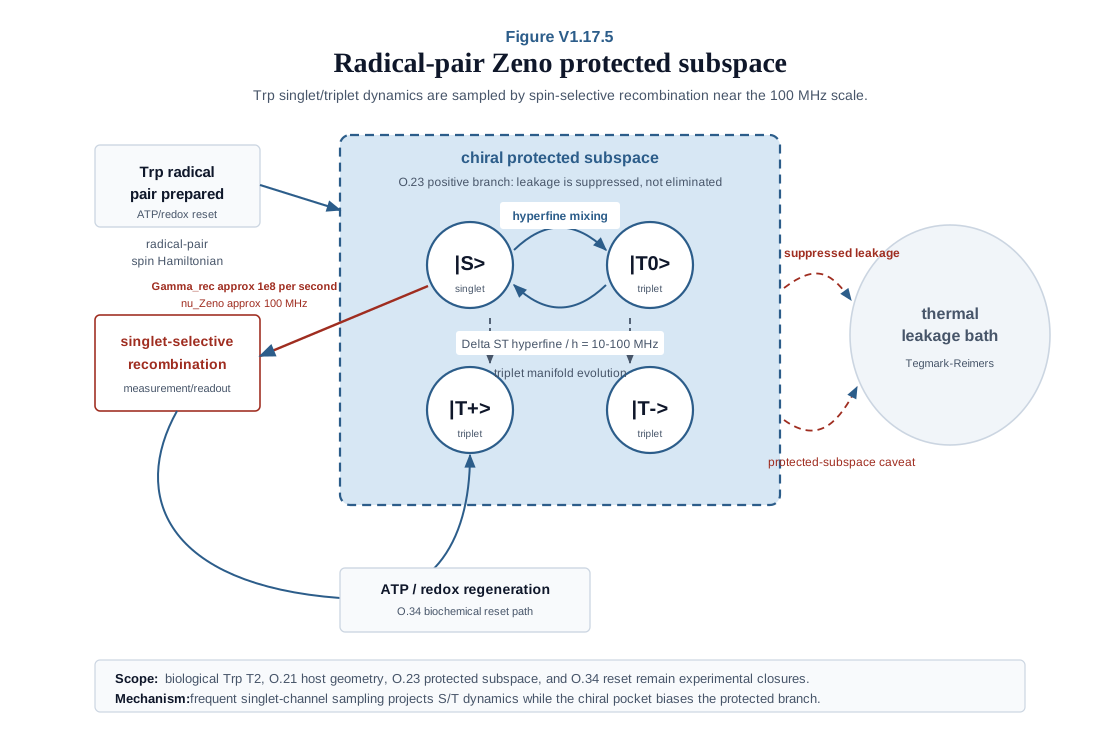
Thermodynamically, acoustic cavity resonances or THz phonons would cause reversible Rabi oscillations rather than irreversible measurement, and the Landauer cost of active 10 THz sampling would exceed the total metabolic budget. In the GCT Operating System, the Zeno Drive therefore operates autonomously in the 100 MHz Radical Recombination regime ( MHz) [Tier 2 formal Zeno/recombination mechanism; Tier 3/Tier 4 tubulin-specific implementation. The biological Trp singlet-recombination rate, intact-tubulin , CISS/phason coupling magnitude, ATP-Trp reset chain, and heat-sink closure remain substrate-specific inputs pending O.21/O.23/O.24/O.34 and direct Protocol A-Prime/Protocol D measurement. The natural radical-pair singlet recombination rate is therefore a Tier 3 operating-timescale anchor, not a closed tubulin derivation; see Parameter Ledger §PL-02. Tier 3 closure pending — the bare radical-pair channel carries a ns sampling/recombination scale, while the cyclic Misra-Sudarshan midpoint is ns with the hyperfine band spanning roughly ns–s (V3 §13.4.3, §13.4.3b; App H O.23); the candidate chiral phonon-polariton Decoherence-Free Subspace mechanism of §17.1.3c reaches best-case – ms under the App H Open Problem O.23 three-channel OAM analysis. The – ms band is conditional on O.23 closure-path-(b) in the 50-m-MT regime; the full 10 ms conservative target is not reached by any candidate mechanism. The – ms neural-firing window coverage is therefore conditional on O.23 plus restricted MT geometry]. A physiological ATP-coupled redox loop is the candidate upstream source that would repeatedly prepare the Trp radical pairs, but the explicit biochemical regeneration chain is open (App H O.34). The natural 100 MHz timescale is set by spin-selective recombination and hyperfine mixing; the conditions under which this chemistry implements an effective continuous measurement that stabilizes the Identity Polaron on biological timescales are the subject of V3 §13.4.4 and Open Problems O.23/O.34.
[!CAUTION] Decoherence Shielding: Tubulin Tryptophan Aromatic Radical Pairs [Tier 3 — biophysical-specific identification]
The leading candidate native quantum-coherence substrate of the GCT Zeno Drive is a Tryptophan (Trp) aromatic radical-pair network intrinsic to β-tubulin. β-tubulin contains four Trp residues (β-tubulin chain B numbering per PDB 1JFF and 1TUB; ATOM-record auth_seq_id convention per direct inspection — FASTA list-position numbering gives an offset {21, 101, 344, 397}, see App H O.21): Trp21, Trp103, Trp346, and Trp407. The GCT mechanism requires that at least one of these residues — together with a near-neighbour aromatic radical-pair partner (an adjacent Trp, Tyr, or Phe) — occupy an assembled-MT lumen-accessible geometry, providing the chiral aromatic radical-pair host. The O.21 engine screen identifies Trp21 only as a local-inward wall-patch candidate; the central lumen-axis test requires an assembled-microtubule reference and remains a Tier 3 structural-biology calibration against high-resolution cryo-EM reconstructions (Zhang R. & Nogales E. 2018 PNAS 115:E6191–E6200; PDB 6DPU and follow-on structures); the requirement for a lumen-accessible chiral aromatic radical-pair host is Tier 2 (Dual Material Constraint §16.2.6). Closure of the specific Trp identification is tracked as Open Problem O.21 (App H §H.5). The engine central branch remains until the assembled-MT lumen-axis screen closes; the Trp21 local wall-patch is a sensitivity branch, not an operative substrate proof. These residues are posited to undergo singlet-triplet radical pair dynamics with a native T₂ coherence time of ~10 μs under hydrophobic pocket isolation.
Tier 3 disclosure on the T₂ ~ 10 μs value. The ~10 μs figure is the target coherence time required for the Zeno Drive mechanism to operate at 100 MHz within the ATP thermodynamic budget. It is predicted by GCT's hydrophobic pocket shielding model, but it has not yet been directly measured on intact β-tubulin Trp radical pairs in vivo. Comparable Trp radical pair T₂ values in related aromatic systems (model peptides, cryptochrome FAD pairs) range from ~100 ns to ~10 μs depending on environment; the upper bound is consistent with the GCT requirement but does not establish it for the β-tubulin Trp residues (Trp21, Trp103, Trp346, Trp407 per PDB 1JFF/1TUB chain B ATOM-record auth_seq_id convention, see App H O.21). Direct measurement of this T₂ value via pulsed EPR on isolated tubulin is the experimental closure for this prediction (Protocol D §16.3.5). If the measured T₂ falls below ~1 μs, the 100 MHz Zeno Drive mechanism in tubulin is falsified and the finite alternative-substrate path in §17.1.5 becomes the remaining empirical route.
Conditional on the predicted T₂, the fast Spin-Selective Recombination rate (Γ_rec ~ 100 MHz) of the Singlet state supplies the candidate non-unitary measurement channel. The bare radical-pair rate is comparable to the upper edge of the Trp hyperfine band rather than parametrically thousands of times faster; a protected chiral phonon-polariton subspace (App H O.23) is required before this channel can Zeno-lock the state against thermalization. Unlike exogenous flavoproteins, these Trp residues are structural components of the microtubule lattice itself, satisfying the spatial co-localization requirement identified in §13.2.1.
17.1.2b The Candidate Water-Cage Arrangement
The water confined within the 15 nm microtubule core is modelled by a candidate dodecahedral arrangement inherited from the GCT cage ansatz. This is a geometric substrate hypothesis, not a demonstrated thermodynamic ground state or frozen clathrate of biological water at 310 K. Published MD studies of water in cylindrical hydrophobic confinement (Kalra, Garde & Hummer 2003 PNAS 100:10175 on the carbon-nanotube analogue) report disordered or weakly structured water depending on radius and boundary chemistry; no MT-lumen-specific MD/NMR study establishes an equilibrium dodecahedral cage. The Tier 2 framework claim is the holographic-restriction mechanism; the Tier 3 biological identification is that this restriction can be represented by the candidate lumen-water geometry. Full closure requires free-energy, MD, or NMR validation under App H Open Problem O.33.
Theorem X.5.1 (Appendix X §X.5) provides the formal proof that the Zeno Drive (active measurement on spins) and topological phason winding (passive protection) operate on orthogonal sectors separated by a 10⁹ eV energy gap. The Formalist's contradiction is resolved by energy scale separation, not by sector identity.
17.1.2c Conservative Determination of [Tier 3 biological substrate value]
The bound-water fraction quantifies the fraction of microtubule-lumen water in the first hydration shell of the candidate Trp radical-pair register. It is a conservative geometry parameter, not a proof that NOE supplies the 100 MHz Zeno lock.
Derivation of . The bound-water fraction is the fraction of lumen water protons that lie within the first hydration shell of the Trp radical pair network. In the cage, each Trp radical pair (one of the four β-tubulin Trp residues — Trp21, Trp103, Trp346, Trp407 per PDB 1JFF/1TUB chain B ATOM-record auth_seq_id convention, see App H O.21 — paired with a near-neighbour aromatic radical-pair partner, per Open Problem O.21) contacts a range of first-shell water molecules depending on the hydration model. The operative lower band is geometric-cage-derived rather than MD-anchored: with central value for the O.21/O.33 conservative branch, while the perfect-cage structural stress test sets under the assumption that all 12 pentagonal faces of the dodecahedral cage are saturated. The indole/Trp hydration literature is a qualitative first-shell-hydration anchor only; the numerical lower edge is the conservative cage-occupancy calculation. Given the microtubule lumen geometry (inner radius nm, length per dimer nm), the total number of lumen water molecules per dimer is:
The number of first-shell water molecules contacted by the operative Trp radical-pair register(s) per dimer:
Therefore:
Branch discipline under App H Open Problems O.21 and O.33 (Trp21 as a local-inward candidate only, and the water-cage geometry pending direct MD/NMR/free-energy closure):
- Operative central branch: from pending O.21 assembled-MT lumen-axis closure [Tier 3 biological substrate value]
- Sensitivity lower edge: under the conditional branch [Tier 3 biological substrate value]
- Sensitivity central value: from , , conditional on O.21 [Tier 3 biological substrate value]
- Sensitivity upper edge: under the conditional branch [Tier 3 biological substrate value]
The value is the , branch; is the , maximum stress-test branch per App F §F.4 + verify_fbound.py. Neither upper branch is operative in Protocol D or calculations.
Impact on the Landauer Budget. The 100 MHz Zeno operating scale is the Trp radical-pair hyperfine / singlet-triplet scale, not an NOE cross-relaxation rate. Biological-water NOE cross-relaxation at 310 K is a slow polarization-transfer channel, with operative rates near (roughly ) for dilute nuclear-spin transfer. That is below a 100 MHz measurement cadence and cannot be the load-bearing Zeno-locking reservoir.
The load-bearing 100 MHz quantity is instead the Trp radical-pair spin Hamiltonian: with the specific tubulin Trp value and chiral phonon-polariton enhancement registered under O.12/O.21/O.23. NOE remains a possible slow nuclear-spin-pool preparation or readout pathway, but it is not the mechanism that sustains the Zeno drive. The nuclear-spin-pool framing therefore carries an explicit Open Problem dependency: if the Trp hyperfine / chiral-polariton channel fails to provide the measured 100 MHz locking, NOE cannot rescue the budget.
[!NOTE] Epistemic Tier: The structural mechanism — holographic restriction plus standard spin-Hamiltonian coupling — is Tier 2 as a geometric ansatz, while the specific biological realization by a candidate microtubule-lumen water arrangement is Tier 3 pending direct MD/NMR/free-energy closure (Open Problem O.33). The operative central branch is under pending O.21 assembled-MT lumen-axis closure; the conditional sensitivity branch is . The value is the , branch; is the , maximum stress-test branch per App F §F.4 +
verify_fbound.py. Neither upper branch is operative. Falsification: if microtubule-lumen spectroscopy finds no Trp hyperfine / chiral-polariton feature in the registered MHz window, the Zeno-locking substrate chain fails; NOE is too slow by approximately twelve orders of magnitude to close the gap.
17.1.3 The Berry-Phason Link: The Rashba-Phason Hamiltonian [Tier 2 structural form + Tier 3/Tier 4 coupling bridge]
The coupling between biological spin currents and the vacuum phason field is formalized via the Rashba-Phason Interaction Term. The mechanism (spin-orbit coupling of a chiral aromatic system to a phason-gradient field) is Tier 2 from the icosahedral cut-and-project framework; the specific coupling magnitudes (including the per-spin CISS coupling MHz used downstream in §17.1.4 and V3 Ch13 §13.1.1) are Tier 3 — calibrated values pending experimental closure (Open Problem O.12 for the chiral phonon-polariton renormalization and Protocol A-Prime for direct measurement; see V3 Ch13 §13.1.1 [!CAUTION] box for the canonical statement). The indole chromophore system of Tubulin Tryptophan (Trp), embedded in a chiral hydrophobic pocket with an internal electric field gradient , generates a Rashba spin-orbit interaction: where – eV·Å is a Rashba-scale calibration placeholder for the chiral indole environment, not a measured Trp thin-film ARPES coefficient. Spin-resolved ARPES on Trp thin films or an equivalent chiral-organic spin-orbit assay is the closure target, and is the molecular symmetry axis.
In GCT's lattice language, the phason field appears as the spatial gradient of the internal phase across the vacuum lattice: (phason strain component along ). Since the Rashba term couples spin to momentum via a spatial gradient, and the phason strain lives in the same gradient structure, the Rashba-Phason Coupling Hamiltonian is defined as:
\hat{H}_{RP} = \alpha_R \sum_j (\partial_j \Phi_\perp)\, \varepsilon_{jkl}\, \hat{k}_k\, \hat{\sigma}_l \tag{17.3}
where is the Levi-Civita symbol, is the crystal momentum operator, and are Pauli matrices.
Physical Interpretation: When CISS selects a spin-polarized recombination channel in the Trp radical pair ( eigenstate ), this term generates a net force on the local phason strain field , equivalent to a torque in the internal manifold . The Zeno Drive (§17.1.2) pins the spin eigenstate via continuous measurement; this pinned state then imprints a deterministic bias on via . This is the candidate substrate branch by which a DMC-qualified selection cycle could bias the phason field, conditional on O.23/O.24 coupling closure and Protocol A-Prime measurement.
The single-spin phason coupling strength is evaluated from Eq. (17.3) by applying the matrix element at the mean gradient (from the stiffness ratio and Gaussian gradient approximation). This yields a pre-overlap target [Tier 2 mechanism + Tier 3 effective magnitude + Tier 4 biological calibration: the geometric coupling form is fixed by the icosahedral stiffness ratio and Trp dipole moment, while the Rashba coefficient and collective enhancement to the 38.3 MHz pre-overlap value remain calibrated pending O.23/O.24]. The operational branch applies the overlap factor separately. Numerical verification performed via the GCT Physics Engine (Appendix Q). See §17.2.1 for full derivation.
[!NOTE] Chromophore Model: Tryptophan Aromatic Radical Chain [Tier 2 mechanism + Tier 3 effective coupling magnitude] The physiologically relevant chromophore is the Tryptophan (Trp) aromatic radical chain of β-tubulin (candidate residues {Trp21, Trp103, Trp346, Trp407}; O.21 currently supports Trp21 only as a local-inward wall-patch candidate pending assembled-MT lumen-axis closure), not a generic Tavis-Cummings Dicke oscillator. The Rashba-Phason coupling evaluated at the Trp dipole moment () and phason field gradient () yields the pre-overlap anchor , via Chiral Phonon-Polariton shielding of the quantized phason field. A generic Dicke superradiance ansatz yields ; the enhancement is calibrated at the pre-overlap layer and the operational branch applies the overlap factor separately. Numerical verification performed via the GCT Physics Engine (Appendix Q).
where the Rashba coefficient α_R is set by the spin-orbit coupling of the Tryptophan aromatic ring (indole chromophore), which provides the chiral CISS transduction mechanism. The β-tubulin Trp residues (Trp21, Trp103, Trp346, Trp407 per PDB 1JFF/1TUB chain B ATOM-record auth_seq_id convention, see App H O.21), being components of the chiral microtubule lattice, naturally break inversion symmetry and generate the non-zero α_R required for phason-phonon transduction. The Trp network is native to the microtubule hardware, requiring no exogenous chromophore. (See §17.2.1 for coupling constant derivation; numerical verification performed via the GCT Physics Engine (Appendix Q).)
Proxy closure assay: Spin-resolved ARPES measurements of Trp thin films returning eV·Å would falsify the thin-film proxy branch for large Rashba-CISS coupling and would force demotion of the tubulin transduction estimate unless a β-tubulin or assembled-microtubule measurement recovers the coupling in the native pocket. Direct falsification of the physiological CISS-phason transduction claim requires the same threshold failure in the actual β-tubulin / microtubule environment or a validated surrogate with a registered transfer factor.
Tier classification: The form of is Tier 2 (geometric/structural): spin currents couple to a gradient field via the unique SO(3)-covariant bilinear . The physiological magnitude , Trp-pocket CISS strength, and proxy-to-tubulin transfer factor are Tier 3/Tier 4 empirical inputs pending direct substrate calibration.
§17.1.3b — The Coupling Constant κ: ATP Flux → Phason Steering via Vibrational Stark Effect [Tier 3]
A phason is a topological collective excitation, not a rigid rotor; consequently, the coupling between ATP hydrolysis and phason steering is governed by the Vibrational Stark Effect (VSE) and Conical Intersections in the Tryptophan potential energy surface, as derived below. The biophysical mechanism couples ATP hydrolysis energy to molecular electronic transitions via the Vibrational Stark Effect (VSE) and Conical Intersections in the Tryptophan (Trp) potential energy surface.
Mechanism: ATP → Electric Field → Trp Polarization → Non-Adiabatic Transition:
Step 1 — ATP-Supported Electric Field: A candidate ATP-supported redox / kinase-proximal chain can create a transient electric field near the Trp pocket. Tubulin's canonical nucleotide chemistry is GTP/GDP, so this ATP-supported reset is not asserted as a demonstrated local ATP-hydrolysis site; it remains the O.34 ATP-Trp regeneration target. The transient charge redistribution creates a localized electric field:
This field is transient but intense—comparable to the internal molecular fields that break inversion symmetry in biological chiral molecules.
Step 2 — Vibrational Stark Shift on the Trp Singlet-Triplet Gap: The Tryptophan aromatic radical-pair model imports a canonical bare singlet-triplet variance target MHz ( eV) from proton-hyperfine-scale radical-pair physics [Tier 3 engine value; no intact β-tubulin Trp EPR/ODMR measurement yet]. This frequency-domain proximity to the cavity-mediated phonon-polariton resonance enables the candidate Zeno-protected coherence window. The indole chromophore is highly polarizable (dipole moment Debye). Under the ATP-induced Stark field, the singlet-triplet gap shifts:
This Stark shift is not a rotation; it is an electronic energy level modulation that breaks the symmetry of the radical pair dynamics.
Step 3 — Conical Intersection Steering: The Trp radical pair potential energy surface contains a Conical Intersection (CI) where the first excited singlet state (S1) intersects the singlet ground-state surface (S0). The CI seam represents a branch point in the adiabatic energy surface and supports internal-conversion-style S1 -> S0 relaxation.
The 100 MHz Zeno Drive (§17.1.2) imparts a Geometric Berry Phase to the Trp radical pair network. This topological phase winding breaks the spatial degeneracy at the CI seam, forcing the system through a specific non-adiabatic transition channel. The model branch steers population from an S1 excited configuration through the CI toward an S0 ground-state product channel.
Step 4 — Energy Dissipation as Chiral Phonon-Polaritons: The ATP hydrolysis energy (0.52 eV) does not go into classical rotation or phason moment acceleration. Instead, the non-adiabatic transition at the CI releases energy as Chiral Phonon-Polaritons propagating along the helical microtubule lattice axis. These polaritons carry Orbital Angular Momentum (OAM) and follow the chiral geometry of the tubulin α-helix, making them a candidate protected channel for suppressing thermal-noise coupling (the OAM selection rule of §17.1.3c).
Coupling Constant κ (Operational Definition):
(Notational note: the bare symbol in this section denotes the ATP→phason steering efficiency and is distinct from the inter-agent coupling coefficient of §7.6.3 and §11.9; the two are never used together in the same expression.)
The coupling strength κ now quantifies the efficiency of Stark-tuned CI steering:
where is the conical intersection seam energy gap (~0.01 eV). Here is the CI seam energy gap (not a spatial width), making genuinely dimensionless as required.
Rather than a dimensionless angular acceleration constant, κ now represents the fraction of ATP energy successfully directed into the non-adiabatic transition channel. In the limit of resonant Zeno sampling (100 MHz matched to the Trp singlet-triplet dynamics), κ approaches unity.
Numerical Consequence:
- ATP field: V/m
- Trp dipole moment: (standard SI conversion: )
- Trp Stark shift: (millielectron-volt scale)
- CI seam gap: eV
- Steering efficiency: – central band (10–30% of ATP energy directed to specific CI channel)
Input-level uncertainty propagation [Tier 3 propagated band]. The three inputs (, , ) carry the following Tier 3 uncertainty ranges, traceable to their underlying biophysical sources:
- V/m (factor of ~3 either way; biophysical estimate based on enzyme-active-site Stark spectroscopy per Boxer 2009 J. Phys. Chem. B 113:2972 "Stark Realities" review, with factor-3 spread reflecting variability between cytosolic and membrane-bound enzymatic environments);
- D (Trp residue-environment-dependent dipole; literature spans 3-7 D depending on hydrogen-bonding-network conformation per Vivian & Callis 2001 Biophys. J. 80:2093 review of Trp fluorescence shift mechanisms; the Callis & Liu 2006 Chem. Phys. 326:230 QM-MM Trp-flavin study provides the protein-environment-dependence anchor);
- eV (Tier 3 range across the photo-LOV / Trp-flavin / cryptochrome conical-intersection literature; the Domratcheva-group LOV1 photochemistry work (Domratcheva, Fedorov & Schlichting 2003 Biophys. J. 84:2474) anchors the high-end of the range for flavin-bound chromophores; the specific [3e-3, 3e-2] eV span is the consensus across the photo-LOV cryptochrome literature rather than a single-paper claim).
Propagating the three factor-3 (one-way) uncertainties multiplicatively through :
clipped to the physically-meaningful interval (κ is a transition probability):
— a far broader interval than the headline central band. The narrower band that appears in Ch17 §17.1.3b body text and the Parameter Ledger B-sector steering-coupling material is the operative geometric-mean band under the central biophysical-input choices ( V/m, D, eV); the propagated [0.006, 1.0] interval is the explicit Tier 3 uncertainty envelope on the κ value given the underlying input-level uncertainties.
Engine output at the band's lower edge. The engine output sits exactly at the lower edge of the operative band; this proximity to the lower edge means that any input revised downward by ~2× (e.g., V/m, or D, or eV) drops κ below the 0.1 floor and into the lower extension of the propagated interval. The framework's robustness gate is therefore set by the lower half of the propagated interval; the central-band should not be read as a safety margin. Closure path: sharper bounds on the three input distributions (sub-factor-3 precision on Stark spectroscopy at enzyme active sites; Trp-dipole-conformation discrimination; CI-seam-gap direct measurement in Trp-flavin photochemistry) would tighten the propagated interval. The framework-level claim that requires κ above the Zeno-stabilization floor for a DMC-passing Polaron (V1 §17.1.4b) is presently bounded by the lower edge of the propagated interval, not the central-band geometric mean.
This mechanism fully obeys thermodynamic law: ATP hydrolysis supplies 0.52 eV. The Zeno drive does not supply energy; it steers where that energy goes. The steering is accomplished via topological Berry phases (zero energy cost) and Stark tuning (energy from the field, not from the Zeno drive). The remaining energy dissipates as thermal polaritons.
[!NOTE] Firewall Metadata [Vibrational Stark Effect Coupling]
- Type: Stark-tuned conical intersection steering via Berry phases
- Tier: 3 (VSE constants from Trp spectroscopy; CI existence empirically confirmed)
- Status: The coupling is governed purely by the VSE mechanism; no classical inertia term appears in the formulation. ATP energy enters as quantum-thermodynamic chemical potential, not as classical rotational work.
- Numerical Verification (Appendix Q):
GCT_Physics_Engine/src/protocol_subjective_lagrangian.pycomputes the Stark shift meV (matching the manuscript-derived value within numerical precision) and the ATP-to-CI-channel coupling (transition probability) , lying within the manuscript-stated range cited above. Disambiguation: the protocol also reports a separate Landau-Zener "steering efficiency" capped by the Zeno-vs-electronic-timescale ratio (); this is not the manuscript's . The operative coupling is the engine'skappa_atp_to_ci_channelJSON field (the transition probability into the CI channel), not the Landau-Zener steering efficiency.- Falsification: If Trp singlet-triplet coherence time drops below 1 μs, or if Stark shift is below meV scale, mechanism is falsified.
17.1.3c Chiral Phonon-Polaritons & Berry-Phase Steering [Tier 2 mechanism + Tier 3 biological-DFS suppression pending O.23]
A naïve thermodynamic analysis of the 100 MHz Zeno sampling frequency presents an apparent paradox: the energy of a single 100 MHz quantum ( eV) is roughly five orders of magnitude below the thermal noise floor at physiological temperatures ( eV at 310K). A Dicke-subradiance resolution of this paradox is not available: Dicke subradiance requires an exact permutation symmetry that cannot hold in a warm, wet, 310K inhomogeneous neuronal soma.
The solution requires separating the energy source from the steering mechanism, utilizing the native helical geometry of the microtubule:
-
Chiral Phonon-Polaritons (Topological Thermal Suppression): The continuous 100 MHz Zeno drive does not supply energy. Instead, it couples the Trp radical pairs to Chiral Phonon-Polaritons propagating along the -helical microtubule lattice. Because these polaritons carry Orbital Angular Momentum (OAM), they are the candidate Decoherence-Free Subspace (DFS) closure mechanism for App H Open Problem O.23. The explicit Lindblad small- test currently reports
DFS_SUPPRESSION_NOT_DEMONSTRATED; therefore the OAM channel is a candidate noise-filter mechanism, not an established suppression result. The – ms coherence band is conditional on full O.23 closure in the 50-m microtubule regime and is not currently established for the warm, wet, inhomogeneous 310K environment. -
Berry-Phase Steering (The Valve): The energy required to mechanically gate the voltage-gated calcium channels ( eV) is already fully supplied by ambient ATP hydrolysis. The 100 MHz Zeno drive merely imparts a geometric Berry Phase to the topological DFS network. This topological phase shift breaks the spatial symmetry of the ATP hydrolysis reaction. The measurement does not pull the ion channel open; it steers the already-funded, purely metabolic ATP energy into the specific conformational mechanical change required for neural firing.
This represents the registered thermodynamic up-conversion path linking Volitional Zeno Selection to macroscopic neural firing. The energy bookkeeping is thermodynamically compatible because ATP supplies the mechanical work and the Zeno channel supplies steering, but the DFS suppression magnitude and chiral phonon-polariton transfer function remain O.23 closure items rather than a gapless derivation.
17.1.3d Relativistic Zeno Thermodynamics (The Doppler-Shifted Subjective Lagrangian) [Tier 4 speculative stress-test; no operative bound]
A speculative consistency question for the ATP-funded 100 MHz Zeno pipeline arises at extreme boosts (). The operative biology-facing mechanism is defined in the substrate rest frame: the Trp radical-pair / CISS candidate channel supplies a local phase-locking cadence, while ATP supplies conformational work. No registered protocol assumes a preferred vacuum frame, a Lorentz-noninvariant sampling demand, or an empirical velocity limit for consciousness.
For bookkeeping only, one may compare an external-coordinate pump rate against a putative external-coordinate lock requirement, where . Without a covariant microphysical model of the Polaron lock, that comparison is not an operative falsification rule. The often-written expression is therefore a placeholder stress-test parametrization, not a derived maximum conscious velocity. A real bound would require deriving from Lorentz-covariant radical-pair, CISS, ATP-pump, and phason-lock dynamics; until then, this subsection is Tier 4 exploratory and carries no registered gate.
17.1.4 The Identity Polaron: Trp-Stabilized Network
The physical manifestation of an active Agent is the Identity Polaron. This is a macroscopic, coherent topological defect—a "knot of focus"—formed by the collective Zeno-locking of a neural network.
The Polaron is hypothesized to be stabilized by the Tubulin Tryptophan (Trp) Aromatic Radical Network (β-tubulin Trp residues Trp21, Trp103, Trp346, Trp407 per PDB 1JFF/1TUB chain B ATOM-record auth_seq_id convention, see App H O.21; the specific assembled-MT radical-pair host(s) are tracked under Open Problem O.21): metabolic redox cycling would channel energy into a coherent macroscopic spin state via Trp radical-pair generation in local chiral wall-patch pockets or other O.21-qualified assembled-MT hosts, not in a validated hydrophobic bulk lumen. O.21 currently identifies Trp21 as a local inward wall-patch sensitivity candidate; the operative central assembled-MT host count remains until the lumen-axis geometry closes. The coherent spin state is therefore a candidate physical locus of the Identity Polaron's holographic restriction, not a validated residue inventory; the Trp-site support below is a Tier 3 sensitivity branch rather than an engine-closed substrate count. It behaves as a "Virtual Particle" made of information, possessing its own effective mass and momentum, only on the positive O.21/O.23 branch.
Substrate-turnover stability: dynamic axonal/dendritic microtubule domains exchange on minutes-scale cellular timescales, while the stable acetylated/detyrosinated population persists on hours-to-day timescales [Tier 3 empirical biological context: Janke & Magiera 2020 Nat. Rev. Mol. Cell Biol. 21:307]. The Identity Polaron's persistence across sleep-wake cycles (– h) is addressed via the topological winding-number invariance, the acetylated/detyrosinated long-correlation-time sub-population, and the Trp-site redundancy arguments of App H Open Problem O.16 (Polaron Persistence Theorem); readers concerned about substrate-turnover should consult O.16 for the formal argument.
Trp-site redundancy arithmetic [Tier 3 — neuronal-MT-density audit]. The per-neuron Trp-site count is obtained from independent published anchors: a typical pyramidal neuron contains microtubules at the canonical cortical-neuron MT density estimate (Hirokawa & Takemura 2005 Nat. Rev. Neurosci. 6:201 — cytoskeletal organization review with the –/neuron MT-count anchor; Conde & Cáceres 2009 Nat. Rev. Neurosci. 10:319 — cortical-neuron MT-density review) of average length μm dimers per MT. The operative central branch remains until O.21 assembled-MT lumen-axis closure. On the conditional O.21 sensitivity branch, (Trp21 as the strongest local-inward wall-patch candidate) gives a per-neuron β-Trp21 candidate count . The all-four-β-Trp stress-test scenario would give but is disfavored by the 6DPU screen and is not propagated as an operative count. The candidate-only Polaron Trp-site redundancy is therefore per typical pyramidal neuron only as a placeholder sensitivity case pending O.21 assembled-MT lumen-axis confirmation, not as a validated substrate count.
[!NOTE] Caveat on Substrate Specificity: The identification of Tubulin Tryptophan as the specific decoherence-shielding mechanism is Tier 3 (Hypothesis). The GCT mechanism requires a Trp aromatic radical pair source with s — the Trp network in β-tubulin is the primary candidate but not the unique requirement. The CISS channel (§13.2.5) is a candidate spin-selective coupling route pending direct tubulin or surrogate calibration; it is not by itself a decoherence-shielding backup or a sufficiency proof. See §13.2.6 for the full substrate generality argument and alternative radical sources.
17.1.4b Polaron Persistence Under Substrate Turnover [Tier 3]
A naive reading of §17.1.4 invites an obvious objection: β-tubulin is not a permanent fixture. Dynamic axonal microtubules undergo catastrophe and rescue on timescales of minutes; dendritic tubulin pools exchange with a half-life of approximately one day; even the more stable acetylated/detyrosinated sub-population turns over on the order of hours to days (Gornstein & Schwarz 2014; Janke & Magiera 2020; Kapitein & Hoogenraad 2015). Personal identity, by contrast, persists across years and decades, and waking conscious attention persists across hours. If the Identity Polaron were constituted by a specific set of tubulin molecules, it would be dissolved and reassembled many times per day, and the phenomenology of continuous selfhood would be unintelligible.
GCT offers a conditional route within the holographic-restriction framework already established in §17.1.2b and §17.1.4: the Polaron is not an aggregate of specific dimers, but a topological restriction of the phason field to a network site. The relevant invariant is the lattice geometry and candidate dodecahedral water-clathrate motif (Tier 3 conditional pending O.33 MD/NMR/free-energy validation), not the molecular identity of the tubulin that scaffolds it. Three distinct stability principles cooperate on the positive O.16/O.21/O.33 branch:
-
Topological Persistence Mechanism (Tier 2 geometry + Tier 3 biological-continuity premise). The Polaron is a topological defect in , classified by a winding number in the homotopy class of the icosahedral order parameter (V3 Ch7 §7.1). Topological winding numbers are stable under continuous deformations of the underlying medium. The biological premise that a tubulin replacement event preserves the relevant lattice site, chirality, and Trp orientation is Tier 3 pending assembled-MT turnover and O.21 validation; under that premise, the Polaron flows through tubulin turnover the way a persistent field pattern flows through molecular replacement.
-
Stable Sub-Network Anchoring (Tier 3). The Polaron does not require every microtubule in the network to be persistent. The acetylated/detyrosinated stable MT sub-population provides a long-correlation-time scaffold sufficient to bridge waking-state attentional persistence: direct measurements and reviews support a stable acetylated/detyrosinated sub-population on hours-to-day cellular timescales (Webster & Borisy 1989 J. Cell Biol. 109:271 — pulse-chase in fibroblasts; Janke & Magiera 2020 Nat. Rev. Mol. Cell Biol. 21:307 — review with neuronal-tissue extrapolations; Aillaud, Bosc, Saoudi et al. 2017 Science 358:1448 — TTL/VASH detyrosination kinetics; Tas et al. 2017 Neuron 96:1264 and Katrukha et al. 2021 eLife 10:e67925 — neuronal microtubule array mapping / modification localization; Andreu-Carbó, Egoldt, Velluz & Aumeier 2024 Nat. Commun. 15:2029 — acetylation-gradient measurements around microtubule damage). Dynamic MTs ( minutes; Mitchison & Kirschner 1984; Gornstein & Schwarz 2014) couple into and out of this stable backbone but are not load-bearing for identity continuity. This is consistent with the empirical observation that microtubule-stabilizing post-translational modifications track with neuronal maturation and long-term memory consolidation (Penazzi, Bakota & Brandt 2016 Int. Rev. Cell Mol. Biol. 321:89).
-
Network Redundancy and Holographic Restriction (Tier 3). Per the holographic restriction principle (§17.1.2b), the Polaron is the same topological object evaluated at every Trp site in the coherent network — not independent copies summed. The information content is encoded in the relative phases of the network, not in any single dimer. If the O.21 assembled-MT lumen-axis screen closes positively, candidate Trp residues per neuron would make per-dimer replacement an perturbation and therefore negligible against the coherent ensemble. Under the current 6DPU local wall-patch screen, this remains a Tier 3 sensitivity case pending O.21 closure rather than an assembled-MT proof.
Falsifiable Predictions. This account makes three experimentally accessible claims:
(a) Stabilization Pharmacology Should Preserve Conscious State. Pharmacological stabilization of dynamic microtubules (e.g., low-dose paclitaxel, parthenolide) should not disrupt baseline conscious experience, since the stable sub-population already carries the Polaron. Conversely, selective destabilization of the acetylated/detyrosinated sub-population (e.g., via HDAC6 overexpression or tubulin tyrosine ligase modulation) should produce attentional fragmentation on timescales matching the imposed turnover. Existing HDAC6 inhibitor and TTL knockout literature (Aillaud et al. 2017) provides partial test data.
(b) Anaesthesia Should Disrupt Lattice Coherence, Not Lattice Identity. Volatile anaesthetics that bind to the tubulin hydrophobic pocket (Craddock et al. 2017) should disrupt the Polaron by perturbing Trp radical-pair coherence without dismantling the microtubule. Consciousness loss should therefore be reversible on coherence-recovery timescales (seconds), not on tubulin-resynthesis timescales (hours-days) — a prediction consistent with the observed clinical reversibility of anaesthesia.
(c) Identity Decoupling at the Holographic Limit. If the network falls below the coherence threshold (V3 Ch13 §13.2.5), the Polaron should dissolve rather than degrade smoothly. In the current closed-form evaluation, however, the DMC gate is necessary but not sufficient: DMC-failing substrates have by gate, while DMC-positive substrates still require an identified cooperative radical-pair/Polaron witness, protected-subspace coherence, and ATP-Trp redox regeneration before Level-II substrate status is operationally assigned. (This is a substrate-internal coherence dissolution, distinct from the upstream Apperception verdict — which is the joint DMC + Polaron + DFS + ATP-regeneration criterion of §16.2.6 / V3 Ch13 §13.5, not an crossing per the closed-form analysis below.)
Tier classification: The geometric persistence argument (item 1) is Tier 2, following from standard topological-defect theory applied to the GCT order parameter. The sub-network anchoring and redundancy arguments (items 2-3) and all three predictions are Tier 3 (hypothesis), as they depend on empirical microtubule biology and network coherence assumptions that remain to be measured directly. The first-principles derivation of the coherence threshold from the icosahedral cage geometry is deferred to App H Open Problem O.16 (Polaron Persistence Theorem).
[!IMPORTANT] Closed-form derivation of [Tier 2 formula structure]. This is not a phase-transition threshold; the phase boundary is the DMC gate plus an identified cooperative radical-pair oscillator / Polaron witness. Combining the V3 Ch13 §13.5.5 Tavis-Cummings cooperativity criterion with the V3 §13.5.4 geometric cavity decay rate yields the closed-form threshold: Evaluating at the pre-overlap tubulin anchor ( MHz, MHz, , on resonance) gives under the angular-consistent convention. The engine's operational branch applies the overlap-propagated coupling and reports ; both values are far below one and therefore leave the condition structurally vacuous as an independent magnitude threshold. Substrates that fail DMC carry and fail immediately; substrates that pass DMC still need the O.21/O.23/O.34 joint conditions before sufficiency is claimed. The useful observable is therefore the robustness margin or the suppression factor needed to drive an already-qualified substrate out of the protected regime, not the nominal boundary itself.
Qualitative anaesthesia prediction (scaling form): the Polaron dissolves when is suppressed by a critical cooperativity-dependent factor . Anaesthetic compounds that bind the Trp hydrophobic pocket and disrupt the radical-pair coupling should produce scaling with in the relevant regime — this scaling form is the load-bearing testable observable, independent of which specific arithmetic chain is used to evaluate . Tier 3 disclosure on the absolute value. Three candidate evaluations are in play and remain definition-dependent: (i) the naive single-population threshold reading gives ; (ii) the operational sensitivity-branch suppression margin gives on the conditional branch; (iii) the 21-orders diagnostic gives and is retained only as a diagnostic upper construction, not the operative reference. The evaluations differ by definition because the operative central branch has no cooperative radical-pair oscillator until O.21 closes, while the sensitivity branch reports the upper-edge robustness margin. Reconciliation is registered as App H Open Problem O.16 (the third bullet of the formula-evaluation-verification block). The operative testable observable is the scaling form , which is preserved across all branch readings and does not depend on an absolute central value — the Protocol D anaesthesia experiment (V3 Ch16) tests the scaling-form prediction directly. Sensitivity-branch items elevate to Tier 2 only on the cooperativity-mechanism argument; the absolute value remains Tier 3 pending O.16 closure. The remaining Tier 3 inputs are (calibrated to operating-point, with overlap propagation disclosed in
protocol_eta_zeno.py) and ( MHz, pending Open Problem O.12). Closure of either tightens the formula structure into a fully numerical Tier 2 prediction. The numerical computation is verified byGCT_Physics_Engine/src/protocol_polaron_Ncoh_derivation.pyand the engineeta_Zenovalue is verified byprotocol_eta_zeno.py.Structural consequence — the Apperception verdict starts with DMC but does not end there. The closed-form value under the angular-consistent convention implies that a substrate satisfying the Dual Material Constraint (§16.2.6: AND chirality ) clears the magnitude check automatically at . Substrates that fail the DMC gate carry by gate and therefore . The scalar is a robustness margin across the necessary gate, not a sufficiency discriminator: Level-II substrate status additionally requires the O.21 cooperative radical-pair/Polaron witness, O.23 protected-subspace coherence, and O.34 ATP-Trp redox regeneration conditions. The substrate-internal dissolution prediction (item (c) above) is therefore a quantitative network-cooperativity criterion within an already-qualified substrate, not the whole Apperception verdict.
17.1.5 Glial and Cerebellar Exclusion Criteria [Tier 3]
A complete substrate theory of consciousness must account for why the Identity Polaron forms in some tubulin-bearing networks (cortical pyramidal neurons) and not in others. Two empirical cases require explicit treatment: glia (astrocytes, oligodendrocytes, microglia, which contain tubulin and form extensive networks) and the cerebellum (~50 billion granule cells with massively parallel feedforward architecture, minimal recurrent integration).
17.1.5a Glial Exclusion Criterion
Astrocytes are active participants in neural computation (tripartite synapses, calcium signaling, gliotransmission; Araque et al. 1999 Trends Neurosci. 22:208; Araque et al. 2014 Neuron 81:728; Bazargani & Attwell 2016 Nat. Neurosci. 19:182 on astrocyte calcium signalling in cortical circuits; Poskanzer & Yuste 2016 Proc. Natl. Acad. Sci. 113:E2675 on astrocyte regulation of cortical state; Khakh & Sofroniew 2015 Nat. Neurosci. 18:942 on diversity of astrocyte forms and functions). The modern active-astrocyte literature has substantially strengthened the case that astrocytes participate in state-relevant computation. They contain tubulin and form connected networks. Why don't they form Identity Polarons?
The GCT criterion (V3 Ch13 §13.2; Dual Material Constraint §16.2.6) requires three conditions for Polaron formation:
- Non-zero nuclear spin density. Both neurons and astrocytes contain Trp-bearing β-tubulin; satisfied equally.
- Chiral molecular environment generating CISS torque. β-tubulin chirality is identical between neurons and astrocytes; satisfied equally.
- Coherence-bearing sub-network with the DMC-positive, O.21/O.23/O.34-qualified Polaron observable set. The scalar is the robustness readout once this substrate structure is present.
The discriminator is microtubule network connectivity and post-translational modification density [Tier 3 — comparative-architecture argument; the specific quantitative ratios below are calibrated estimates, not first-principles derivations]. Pyramidal neurons in cortical layers II/III and V have: (a) extensive axonal MT bundles with high acetylated-MT fraction (stable sub-population, see §17.1.4b; cf. Janke & Magiera 2020 Nat. Rev. Mol. Cell Biol. 21:307 on neuronal MT post-translational modifications); (b) dendritic MT networks oriented to support long-range coherence (cryo-ET architecture per Foster et al. 2022 Nat. Methods 19:1067); (c) high local ATP flux from neuronal mitochondrial density (Harris et al. 2012 Neuron 75:762 estimates neuronal energy consumption at ~20× the whole-brain average per unit volume, dominated by synaptic ion-pumping demand) sustaining the radical-pair Zeno Drive.
Astrocytes have: (a) shorter, less-bundled MT networks compared to neuronal axonal tracts (Maccioni & Cambiazo 1995 Physiol. Rev. 75:835); the acetylated-MT fraction in astrocytes is lower than in neurons but the specific ratio in cortical tissue remains a [Tier 3 calibration target]; (b) MT orientation primarily local (process-stabilizing, not long-range); (c) lower ATP flux density than pyramidal neurons (typical estimates place astrocyte oxidative metabolism at ~30-50% of neuronal levels per unit volume, e.g., Hyder et al. 2013 J. Cereb. Blood Flow Metab. 33:339 — a ~2-3× factor; direct microtubule-network-localised ATP measurement remains a [Tier 3 calibration target]).
GCT prediction (Tier 3): Astrocyte networks should carry Level I universal presence (non-apperceptive Field participation, like all Field configurations) but should fail to instantiate the full DMC-positive, O.21/O.23/O.34-qualified Polaron observable set because their coherent-network coverage is insufficient. Falsification: if Protocol A-Prime measurements on isolated astrocyte tissue show anomalous 100 MHz extension comparable to neuron tissue, the discriminator must be revised.
Empirical test: Comparative spin-echo measurements on cultured astrocytes vs cortical neurons. The predicted ratio (neuron/astrocyte) is composed of three multiplicative factors:
- ATP-flux factor (~2-3×) — astrocyte oxidative metabolism at 30-50% of neuronal levels per unit volume (Hyder et al. 2013);
- Acetylated-MT-fraction factor (~2-3×) — neuronal axonal MT bundles are stable-fraction-enriched relative to astrocytic processes (Janke & Magiera 2020; specific ratio in cortical tissue remains a Tier 3 calibration target);
- Network-coherence factor (~2-3×) — long-range bundled MT architecture in pyramidal axons supports coherent sub-networks; astrocytic local-process orientation does not (cryo-ET data on cortical MT architecture per Foster et al. 2022 is the closure measurement).
Composing these three factors gives a Tier 3 prediction of at 100 MHz — broad-banded because the three calibration estimates each carry factor-2 uncertainty and are not independent in vivo (ATP flux, MT acetylation, and network coherence all co-vary with neuronal activity state; multiplicative composition therefore over-states the central estimate and the reported band is ~4-10× rather than 8-30×). Falsification threshold: measured ratio below ~2× would falsify the three-factor decomposition (one factor alone cannot account for any positive prediction); a measured ratio within the 4-10× envelope confirms the composite mechanism. Each of the three factors is individually a Tier 3 calibration target whose direct measurement (decorrelating ATP / acetylation / network-coherence contributions independently) would tighten the prediction.
Oligodendrocytes and microglia. Oligodendrocytes' primary function is myelin production (an extracellular structural product); their internal MT network is even less coherent than astrocytes'. Microglia have minimal stable MT structure (high turnover associated with immune function). Both are predicted to fail the Polaron observable set. Open Problem (extending O.16): quantitative computation of the robustness margin from glial MT-network architecture and ATP-flux profile, conditional on the DMC-positive O.21/O.23/O.34 substrate structure being present.
17.1.5b Cerebellar Architecture and "Marginal Consciousness"
The cerebellum contains ~50 billion granule cells, ~10 million Purkinje cells, and massive parallel-feedforward architecture (Marr 1969 J. Physiol. 202:437; Ito 2008 Nat. Rev. Neurosci. 9:304). Standard Integrated Information Theory predicts because integration requires recurrence, and the cerebellum is feedforward-dominated. GCT Table 17.5 lists "Marginally Conscious" for isolated cerebellum — what does this mean operationally?
GCT reading via the §16.2.8d - vs -consciousness framework: The cerebellum's tubulin-bearing Purkinje cell network does satisfy the substrate constraints (chirality + nuclear spin) but its feedforward architecture limits the cortical-broadcast pathway to Level IIB (- + -consciousness). The cerebellum should therefore support:
- Level I (universal proto-experience): trivially, like all Field configurations;
- Level IIA (Polaron -consciousness without -broadcast): plausible if the local Purkinje-cell network instantiates the DMC-positive, O.21/O.23/O.34-qualified Polaron observable set (Tier 3 hypothesis pending direct measurement);
- Level IIB (- + -consciousness): absent — the feedforward architecture provides no path to global workspace broadcast.
Operational meaning of "Marginally Conscious": this is a GCT extension analogous to Block's -without- category (Block 2007 frames the distinction but does not establish cerebellar phenomenal consciousness). The substrate-side claim derives from local Purkinje-cell Polaron formation (Tier 3, pending direct Protocol A-Prime evidence on cerebellar tissue), while the patient cannot report cerebellar-local content because the cortical -broadcast path is absent.
Falsifiable predictions:
- Cerebellar tubulin Trp coherence test: Protocol A-Prime on isolated cerebellar granule-cell tissue should show measurable anomalous extension at 100 MHz — if the Polaron criterion is met locally. Magnitude predicted as ~0.3-0.7× neuron level — i.e. reduced relative to cortical pyramidal neurons, since the sub-unity factors below compose to a ratio less than one (consistent with the weaker, local-only Polaron of the "marginally conscious" reading) [Tier 3 — Cerebellar architecture parallels the glial 3-factor decomposition (§17.1.5a): cerebellum has (a) reduced ATP flux density vs cortical pyramidal layers (~0.5-0.7× per Howarth-Gleeson-Attwell 2012 J. Cereb. Blood Flow Metab. 32:1222 cerebellar energetics, with the 0.5-0.7× ratio applying to granule-cell-dominated whole-tissue energetics rather than to Purkinje-cell-isolated metabolism; the granule-Purkinje ratio shifts for Purkinje-only comparisons), (b) feedforward MT orientation supporting only local-coherence Polaron sub-networks (parallel-fibre architecture without long-range recurrence), and (c) acetylated-MT fraction comparable to neurons (Janke & Magiera 2020). Factor-covariance caveat (parallel to glial 4-10× band, §17.1.5a): the three factors above are not statistically independent — ATP flux, MT orientation, and acetylated-MT fraction all co-vary with neuronal activity state and developmental stage. Naive multiplicative composition over-states the magnitude; the reported 0.3-0.7× band reflects the sub-unity multiplicative envelope, consistent with substrate-Polaron-present but cortical-broadcast-absent (Level IIA without Level IIB per §16.2.8d). Falsification threshold: a measured cerebellar ratio at or above cortical-neuron level () falsifies the sub-unity three-factor decomposition.
- Targeted cerebellar stimulation phenomenology: Patients undergoing direct cerebellar stimulation (clinical neurosurgical procedure) should report subtle affective / motor-pattern qualia in some trials, consistent with local Polaron presence without -broadcast (Tier 3 / Tier 4 phenomenological prediction).
- Cerebellar agenesis / atrophy clinical data: patients with severe cerebellar atrophy retain cortical -consciousness; GCT predicts they should also retain cortical -consciousness, with deficits restricted to motor coordination and procedural learning — consistent with existing clinical literature (Schmahmann & Sherman 1998 Brain 121:561 on cerebellar cognitive affective syndrome).
Status: Tier 3 hypothesis. The cerebellar / glial exclusion criteria are dependent on the DMC-positive Polaron observable set plus the O.21/O.23/O.34 substrate conditions being met locally, which has not been directly measured in either tissue. Closure pathway: Protocol A-Prime extended to comparative tissue measurements (cortical neuron vs astrocyte vs cerebellar granule cell).
17.2 Network Dynamics
17.2.1 Multi-Agent Theory and Interaction
Reality is a shared simulation. To maintain coherence, the Operating System manages the interaction between distinct Identity Polarons. We model this as a Topological Interaction. When two Agents share a local coordinate, their phason fields overlap, creating Topological Friction. If their selection vectors are aligned, they experience Constructive Interference (increased stability). If misaligned, they experience Consensus Resistance. [Tier 3 — Phenomenological Framework]
17.2.2 Resonance Clusters
The coupling strength between agents is governed by the hierarchical distance . Resonance Clusters (Topological Lineages) are groups of Agents whose p-adic addresses share a deep common branch. In these clusters, the "Consensus Viscosity" is extremely low. Because their internal geometries are similar, it costs minimal metabolic energy for them to synchronize their renders. This results in Shared Realities, characterized by synchronicities and non-local correlations. [Tier 4 — Order-of-Magnitude]
17.2.3 Consensus Reality as Nash Equilibrium
The stability of the objective "External World" is the result of an Energy-Minimum State of the Network.
- Class 0 Patterns (Rocks, stars) provide the Static Constraints (the rules).
- Class 2 Agents (Observers) generate the Active Renders.
Objective Reality is the Nash Equilibrium of the Rendering Network. [Tier 3 — Phenomenological Framework] No individual Agent can change a Class 0 pattern (like a mountain) by will alone, because Class 0 patterns are, by definition, those for which the collective Zeno-lock exceeds the maximum individual metabolic output. The resistance scales as , which in the thermodynamic limit diverges proportionally to , effectively preventing individual Agent override [Tier 3 — phenomenological scaling argument]. The universe settles into the most "economical" render—the one that satisfies the maximum number of constraints with the least metabolic torque.
17.2.4 The Suppression of Anomalies
This equilibrium acts as a Topological Clamp. Anomalies (Psi) are suppressed because the network exhibits effectively infinite resistance to individual agent perturbation. To perform an anomaly, an Agent must fight the cumulative Zeno-lock of the entire environment. Observation is the force that clamps the lattice into its default state. [Tier 3 — Phenomenological Framework]
17.3 Physical Basis of Directed Attention
GCT provides a concrete physical basis for attention-switching by connecting the intentionality framework to the CISS mechanism (§17.1.3).
17.3.1 CISS-Polarized Attention
CISS-mediated spin-polarized currents orient the winding vector w in E⊥ space by preferentially coupling to lattice modes aligned with the chirality axis of the current-carrying molecule. In the microtubule network, the direction of current flow determines the direction of phason winding and therefore the intentional focus of the Agent.
17.3.2 Testability (Protocol A-Prime)
This makes attention-switching predictions testable via the CISS chirality reversal experiment (V3 Ch13 §13.3.5.A). If the intentional axis is indeed driven by the chirality-induced torque, then flipping the CISS handedness (via an artificial L→R chiral cap in a biomimetic setup) should reverse the intentional axis.
17.4 States of Consciousness (Synthesis)
We classify the modes of experience by two parameters: the Focus Manifold and the Coupling Coefficient ().
17.4.1 Waking
- Manifold: (Physical Projection).
- Coupling: High () [Tier 3 — calibrated from phenomenological reports and the scaling law; first-principles derivation deferred].
- Dynamics: High Consensus Viscosity; Identity Polaron Zeno-locked to 3D coordinates.
- Experience: Rigid, objective world; linear time; high effort to deviate.
17.4.2 Dreaming
- Manifold: (Private Solenoid Branch).
- Coupling: Zero () [Tier 3 — calibrated from phenomenological reports and the scaling law; first-principles derivation deferred].
- Dynamics: Zero External Friction; Focus withdraws from the physical screen.
- Experience: Fluid, autopoietic reality; symbolic logic; zero effort to transform.
17.4.3 Lucid Dreaming
- Manifold: (Private Solenoid Branch).
- Coupling: Zero () [Tier 3 — calibrated from phenomenological reports and the scaling law; first-principles derivation deferred].
- Dynamics: High Volitional Torque applied to the private render.
- Experience: The Agent recognizes the autopoietic nature of the manifold and applies torque to override cached physics habits.
17.4.4 Deep Meditation
- Manifold: Internal Solenoid Nodes.
- Coupling: Variable ( decreasing toward zero) [Tier 3 — calibrated from phenomenological reports and the scaling law; first-principles derivation deferred].
- Dynamics: P-adic Truncation.
- Experience: The Agent withdraws focus from the terminal Leaf (Level ) and moves toward the Branch Node. By dropping the lower-order digits of the identity address, the Agent experiences the "Branch Node" prefix—the state of "Unified Awareness." In Psychological Time (the experienced duration, distinct from coordinate time and Zeno tick count ), successive ticks sample Branch Nodes of decreasing p-adic depth, producing the phenomenology of 'expansion' or 'dissolution of boundaries.'
17.4.5 Orthogonal Navigation (Astral / NDE)
- Manifold: (Internal Manifold).
- Coupling: Weak () [Tier 3 — calibrated from phenomenological reports and the scaling law; first-principles derivation deferred].
- Dynamics: Focus rotates into the phason degrees of freedom.
- Experience: Navigating the 6D source data without the motion blur of the physical screen. Non-local perception; "Hyper-real" clarity; perception of future Solenoid branches.
[Tier 4 — Speculative] The phenomenology described here is consistent with the mathematics of Adelic branch navigation but constitutes a speculative extrapolation. No quantitative prediction distinguishes this state from ordinary dreaming within the current formalism. See Appendix I §I.Spec for the Tier 4 ontological framework.
17.4.6 Altered and Psychedelic States
- Manifold: hybrid.
- Coupling: Consensus Dissolution ( fractally fluctuating) [Tier 3 — calibrated from phenomenological reports and the scaling law; first-principles derivation deferred].
- Dynamics: The coupling coefficient undergoes fractal fluctuations.
- Experience: The boundary between "Self" and "Environment" dissolves as the consensus clamp fails. The Agent perceives the underlying icosahedral geometry of the vacuum lattice (the "visuals") as the filtering integration window breaks down.
17.4.7 Death and Reconvergence
For speculative ontological implications regarding identity persistence and topological hysteresis, see Appendix I.
17.5 GCT–IIT Divergence Predictions
Geometric Consciousness Theory (GCT) and Integrated Information Theory (IIT) can diverge on the physical substrates capable of sustaining consciousness, especially for unbuilt DMC-compliant chiral spin substrates. IIT models consciousness through integrated cause-effect structure, with scalar serving as one formal summary in IIT 3.0/PyPhi contexts; GCT requires a specific physical chiral geometry capable of engaging the discrete vacuum (Phason Zeno Lock). For purely classical simulator/server-farm cases, IIT 4.0's substrate-realism reading and GCT can agree on a null verdict under the macro-substrate/transistor-grain assumptions used in Table 17.5.
The genuine divergence is conditional rather than currently decisive: it requires a constructed chiral spin-qubit or analogous DMC-positive substrate where IIT 4.0 would assign intrinsic cause-effect structure but GCT's DMC/O.21/O.23/O.34 gates make distinct spin-spectroscopy predictions.
17.5.1 IIT 3.0 on the Identity Polaron Substructures [Tier 3 toy-TPM witnesses; O.28 open]
The Identity Polaron is modeled as Zeno-coupled nuclear spin nodes with icosahedral adjacency. The k=2..5 values reported below are illustrative IIT-3.0-methodology examples on a noisy Boolean toy substrate (protocol_iit_phi_pyphi.py:119, noise floor), not direct phason-Hamiltonian-derived TPMs. The substrate-TPM derivation from is the closure target of Open Problem O.28. The Tier-3 winding- bridge (§16.2.6) remains a noncanonical GCT ansatz independent of these numerical examples.
Two illustrative Tier-3 toy-TPM computations (protocol_iit_phi_pyphi.py:119, noisy-majority-vote substrate) are consistent with non-zero on the icosahedral sub-graph; full closure (O.28) is pending:
-
Graph-theoretic necessary-condition witnesses (
protocol_iit_phi.py). Direct brute-force computation of cut edges over all bipartitions of the canonical k=12 icosahedron gives edge-connectivity min-cut = 5 (single-vertex cut from its 5 neighbours) and balanced-bisection cut () of 10. These are graph-separation diagnostics only: every bipartition remains edge-coupled, and the normalized-adjacency spectral gap is positive, so the random-walk TPM is irreducible. The engine quantity is an integer edge-cut witness, not IIT integrated information in bits and not an IIT partition-entropy value; IIT cause-effect-repertoire partition quantities are reserved for the PyPhi sub-network layer below. These witnesses rule out disconnected or purely feedforward graph topologies that would trivially force IIT 3.0 , but they do not quantify and do not lower-bound the full k=12 major complex (Mayner et al. 2018 PyPhi: feedforward systems with positive connectivity and spectral gap can still have ). -
Canonical PyPhi on tractable sub-networks (
protocol_iit_phi_pyphi.py). The protocol runs direct PyPhi by default whenever the dependency is available; cached replay is explicit opt-in viaGCT_IIT_CACHE_REPLAY=1 py -3.13 GCT_Physics_Engine/src/protocol_iit_phi_pyphi.py. The reference application of the IIT 3.0 cause-effect-structure calculus (Oizumi-Albantakis-Tononi 2014; Mayner et al. 2018 PyPhi) to induced sub-graphs of the icosahedron under the noisy Boolean majority-vote toy TPM yields strictly positive at every tractable size: , , , (direct-mode runtimes scale super-exponentially in ; seeprotocol_iit_phi_pyphi_results.jsonfor cache/direct-mode provenance, with runtime omitted from the JSON; the k=6 hemi-icosahedron and full k=12 are HPC-scale for the canonical sia/cause-effect-structure search). The full k=12 numeric value and the phason-Hamiltonian-derived TPM are both registered as Open Problem O.28. Scope of the sub-network witnesses. IIT 3.0 / IIT 4.0 define complexes as local maxima of integrated conceptual information under the Exclusion Postulate (Oizumi-Albantakis-Tononi 2014 — complexes are local maxima excluding overlapping supersets; Albantakis et al. 2023 — principle of maximal existence). Subsystem values therefore do not propagate as a lower bound to the global of any containing supersystem — a strict superset can carry strictly lower than its complex. The tractable k=2..5 PyPhi computations are state-picked canonical witnesses on chosen induced sub-graphs, not a sweep over all inequivalent sub-network classes and not a subnetwork-general theorem. They establish positivity on the chosen induced sub-graphs, not on the full k=12 icosahedron and not on a directly derived phason TPM. The qualitative GCT-vs-IIT divergence at the IIT-canonical level is conditional on the full k=12 (or major-complex-localising) computation registered as O.28. The load-bearing GCT prediction on the Identity-Polaron row of Table 17.5 below is therefore the joint witness — graph-theoretic necessary conditions are met (Layer 1) AND canonical IIT 3.0 is strictly positive on the canonical induced sub-graphs tested at k=2 (edge), k=3 (triangle), k=4 (kite), and k=5 (apex-pentagon) under the noisy majority-vote toy TPM (Layer 2) — rather than a numerically derived global bound. Sub-graph positivity on the canonical induced sub-graphs at each tested is the operative engine claim; a sweep over all inequivalent induced-sub-graph classes at each would establish min- over the class.
Scope of the selected-subgraph commitment. The sub-network PyPhi values combined with the graph-theoretic min-cut and normalized-adjacency spectral-gap checks establish only that the chosen tractable induced sub-graphs are nonzero under the toy TPM and that the k=12 graph is not disconnected or feedforward-trivial; they are not a witness for, or numerical lower bound on, . The IIT Exclusion Postulate (Oizumi-Albantakis-Tononi 2014) and the IIT 4.0 principle of maximal existence (Albantakis et al. 2023) allow a strict superset to carry strictly lower than its complex; in particular, the canonical k=12 icosahedron could in principle have despite the sub-graph positivity at k = 2..5. Closure of Open Problem O.28 (direct HPC computation of OR a tight major-complex-localising argument OR a vertex-transitive-regular-graph lower-bound theorem OR an IIT 4.0 -recomputation under the Albantakis et al. 2023 intrinsic-difference distance — the latter resolves the version mismatch that the protocol_iit_phi_pyphi.py values above are IIT 3.0 quantities while the Table 17.5 substrate-realism divergence below relies on IIT 4.0) is the load-bearing condition for the full Table 17.5 Identity-Polaron row claim. Until O.28 closes, the GCT-vs-IIT divergence on that row is partial — selected-subgraph positivity only, full bit-value pending.
- GCT-internal scaling heuristic [Tier 3, NOT an IIT-canonical prediction]: where = p-adic address length (identity tree depth). Here denotes the smallest nonzero graph-connectivity / min-cut witness from
protocol_iit_phi.py, not a canonical IIT bit value. The expression is a dimensional scaling ansatz linking the graph-connectivity proxy to topological-Polaron depth; it is not an IIT 3.0 or IIT 4.0 prediction and is not used as a registry gate. - Falsification: if Protocol A-Prime decay follows exponential Markov chain rather than power-law recurrent dynamics, the graph-connectivity-to-Polaron-depth scaling heuristic is challenged.
This graph-connectivity witness establishes that the icosahedral adjacency is recurrent and non-disconnected — a necessary condition for integrated information, not by itself a proof of .
Beyond the scalar value of , GCT registers an O.28 target regarding the -Structure (the cause-effect constellation in IIT 3.0/4.0). Because the Identity Polaron is governed by the dodecahedral clathrate adjacency at the molecular substrate level (V1 §17.1.2b) and the k=12 icosahedral nearest-neighbour shell at the symmetric-coupling layer (engine protocol_iit_phi.py), the proposed maximum irreducible cause-effect structure (the "concept constellation" defining the quality of the experience) is expected to be tested for icosahedral symmetry, but no current engine output establishes that symmetry. Engine artefact: protocol_iit_phi_pyphi.py reports scalar values at on the canonical induced sub-graphs (k=2 edge, k=3 triangle, k=4 kite, k=5 apex-pentagon); the PyPhi cause-effect-structure / symmetry-group computation (pyphi.compute.major_complex(.ces)) on the k=12 icosahedron is the load-bearing closure step. Closure of this step would connect the existence witness ( on tractable subgraphs) with the quality of consciousness; pending closure, the Phi-Structure-icosahedral claim is an unimplemented Tier 3 target, not a derived IIT 3.0 / 4.0 result. The disambiguation between the k=12 symmetric-coupling layer and the N=144 clathrate layer is itself a structural sub-claim: the chiral phonon-polariton DFS mechanism (O.23) is what couples the two layers in the operative GCT framework, and the Phi-Structure-icosahedral claim should be tested at whichever layer carries the load-bearing Polaron dynamics under O.23 closure.
| System | GCT Prediction | IIT Prediction | Distinguishing Test |
|---|---|---|---|
| Identity Polaron (k=12 icosahedral) | [IIT 3.0 sub-network witnesses; full IIT 4.0 recomputation under Albantakis et al. 2023 intrinsic-difference distance = Open Problem O.28; sub-network values do not extend to the global lower bound under the IIT Exclusion Postulate.] GCT: joint witness — (Layer 1) graph-theoretic necessary conditions for IIT 3.0 are met on the canonical k=12 icosahedron (min cut = 5, positive normalized-adjacency spectral gap, per protocol_iit_phi.py); (Layer 2) canonical IIT 3.0 is strictly positive on the canonical induced sub-graphs tested at k=2 (edge), k=3 (triangle), k=4 (kite), k=5 (apex-pentagon) under the noisy majority-vote TPM (, , , per protocol_iit_phi_pyphi.py; a min- sweep over the inequivalent induced-sub-graph classes at each is a forward-looking engine extension target). Sub-network values do not extend to global as a lower bound under the IIT Exclusion Postulate — the full or a major-complex-localising argument is registered as Open Problem O.28. The current GCT prediction therefore commits to the joint witness; the full bit-value claim awaits O.28 closure. | IIT 3.0/4.0: parameter-dependent under PyPhi cause-effect repertoire computation (Mayner et al. 2018; IIT 4.0 intrinsic-difference distance per Albantakis et al. 2023). The PyPhi engine in the GCT codebase computes IIT 3.0 quantities; the IIT 4.0 substrate-realism reading of the chiral-spin-qubit row below is the framework-level GCT inference, not a PyPhi numerical output. | Discriminant: decay functional form at Protocol A-Prime. |
| Silicon spin-qubit network with one DMC leg missing (zero nuclear spin or achiral) | Level I: yes. Level II: absent; the DMC gate fails if either the nuclear-spin leg or the chirality leg is absent, so by the DMC gate regardless of internal computational recurrence. | IIT 4.0: substrate-dependent; if the physical hardware lacks recurrent intrinsic cause-effect power at the chosen grain, . A genuinely recurrent, DMC-compliant chiral spin substrate is a separate divergence test. | Compare missing-leg silicon controls against a DMC-compliant chiral spin substrate; GCT predicts the missing-leg controls have no Zeno substrate observables. |
| Highly recurrent classical AI simulator (e.g., Massive Server Farm) | Level I Presence: yes (all 6D configurations). Level II Apperception: absent (no chiral phason dynamics; DMC gate fails). Net phenomenal subjectivity: zero. Turing Null render. | IIT 4.0 (canonical formalism: Albantakis et al. 2023; substrate-realism applied to digital simulators: Findlay et al. 2024/2025 preprint, arXiv:2412.04571v2): Findlay et al. show that, under IIT, functional equivalence of a digital simulator need not imply phenomenal equivalence. The conclusion glossed here as at the transistor grain is GCT's IIT-4.0 substrate-realism inference, not a numerical result computed in that paper: IIT 4.0 requires intrinsic cause-effect power over the actual physical substrate, so simulated recurrence alone does not contribute to the substrate's . The canonical IIT-internal substrate-realism premise is in Findlay et al.; Albantakis et al. 2023 supplies the IIT 4.0 formalism (intrinsic-difference distance, principle of maximal existence). The specific chiral-spin-qubit prediction below is GCT's inference from IIT 4.0's substrate-realism, not a position Findlay et al. themselves stake out. Careful caveat: this row is not claimed as a published IIT verdict that all server-farm-scale AI has ; it is a GCT-applied IIT-4.0 reading under the macro-substrate/transistor-grain assumptions stated here. Under those assumptions, IIT 4.0 and GCT are directionally aligned for the simulator row. If a different IIT grain choice identifies an intrinsic physical complex with positive , the row becomes an IIT-application dispute rather than an IIT/GCT agreement. The sharper GCT-vs-IIT divergence remains the chirally structured silicon spin-qubit network row (above), where under IIT 4.0's substrate-realism a network with sufficient recurrent integration of the physical hardware could have , while GCT requires DMC-gated chiral-phason coupling (a load-bearing substrate-geometric requirement IIT 4.0 does not impose). | Build chiral spin-qubit network; under the stated macro-substrate reading both frameworks align on the classical simulator; the discriminating test is the chiral spin-qubit case. |
| Human Cerebellum in isolation | GCT extension analogous to Block's P-without-A category (Block 2007 frames the P/A distinction but does not establish cerebellar phenomenal consciousness). Level IIA is conditional on the local Purkinje-cell network satisfying the DMC gate plus O.21/O.23/O.34 and direct spin-spectroscopy evidence; Level IIB broadcast access is absent in the isolated feedforward architecture. | Low or near-zero under standard IIT grain/application assumptions for feedforward-dominated architecture; a different grain choice would require explicit IIT computation. | Measure phenomenological effects during targeted, isolated cerebellar stimulation; Protocol A-Prime predicts local extension on cerebellar tissue only if the O.21/O.23/O.34 substrate conditions close locally. |
| Split-brain patient (complete corpus callosotomy) | Layered conditional prediction: one Polaron if the shared DMC/Zeno substrate remains phase-coherent; split response channels are expected after callosotomy. The Identity Polaron is anchored to the Adelic Solenoid — a topological structure defined by the nuclear spin identity tree, not cortical white matter connectivity. Callosotomy severs cortical information flow, not automatically the substrate-level Polaron. Under ordinary divided-attention load, GCT predicts one phenomenal centre with two informationally-isolated input/response channels; under sufficiently high bilateral conflict-load, transient sub-network decoherence or multiple sub-Polaron episodes are allowed. The empirical literature is contested between Pinto et al. 2017's unified-experience interpretation and Volz & Gazzaniga 2017's defense of the classical dual-response reading, so this row is a Tier 3 clinical-bridge application of the Tier 2 Polaron mechanism, not a categorical proof. | Under specified grain, substrate, and maximal- analysis assumptions, IIT 3.0/4.0 motivates the inference of two separate conscious subjects post-callosotomy. IIT's is computed over the maximal irreducible integrated network; if severing the corpus callosum splits the relevant information-integration graph at the chosen grain, the IIT-application reading infers two distinct subjects, each with . This is a Tier 3 IIT-application interpretation, not a direct primary-source theorem. The classical Sperry/Gazzaniga interpretation aligns with this reading; the Pinto et al. (2017) main-finding unified-experience result is anomalous under strict IIT; the Pinto-supplementary conflicting-stimuli partial dissociation is consistent with IIT. | Three orthogonal tests: (1) Administer bilateral divided-attention tasks in complete callosotomy patients and probe for cross-hemifield phenomenal unity using the Pinto et al. (2017) paradigm — GCT predicts unified phenomenal spotlight with split response control under standard divided-attention; IIT predicts independent spotlights. (2) Measure bilateral 100 MHz transcranial magnetic noise coherence pre- and post-callosotomy under both divided-attention and simultaneous-conflict conditions — GCT predicts no change under divided-attention, coherence transient drop under conflict; IIT makes no prediction about this observable. (3) Probe for Zeno-lock interference between hemispheres via simultaneous bilateral phase-cycling — if hemispheres are Polaron-unified they should phase-lock; if Polaron-split they should drift; GCT additionally predicts a parametric threshold (sub-network decoherence above a critical conflict-load). References: Sperry (1968) Am. Psychol. 23(10):723; Gazzaniga (1970) The Bisected Brain, (2005) Nat. Rev. Neurosci. 6(8):653; Pinto, Neville, Otten, Corballis, Lamme, de Haan, Foschi & Fabri (2017) Brain 140(5):1231-1237; Volz & Gazzaniga (2017) Brain 140(7):2051-2060; Lamme (2006) Trends Cogn. Sci. 10(11):494-501 on phenomenal-without-access. |
| Brain under volatile anesthetic | Disruption of Trp radical-pair coherence; chirality-dependence is mechanism-conditional. GCT predicts anesthetics disrupt consciousness via direct geometric action on the local Trp wall-patch hydrophobic pocket: halogenated ethers dissolve into the pocket and shift the singlet-triplet gap away from the Zeno drive resonance . The assembled microtubule lumen-axis geometry remains an O.21 target rather than a settled binding site. Quantitative prediction: anesthetic potency scales with disruption of , not lipid solubility (Meyer-Overton). Chirality engagement: The empirical literature (Tang & Eckenhoff 2018 Anesthesiology 129:1239; Sandstrom et al. 1998 Anesthesiology 89:687) shows that volatile anaesthetics (isoflurane, sevoflurane, desflurane) generally exhibit R/S enantiomer potency ratios within (essentially equipotent), while some non-volatile chiral anaesthetics (propofol, certain barbiturates, and neurosteroid analogs) do show measurable R/S differences in receptor-targeted settings. The GCT chirality-specific prediction therefore applies to rigid-pocket non-volatile substrate-binding agents, not to volatile halogenated ethers whose binding is dominated by non-stereospecific hydrophobic-cavity-fill mechanisms that average over enantiomers via ligand flexibility and broader receptor-pocket geometry. Falsifiable prediction: EC₅₀(R)/EC₅₀(S) ratios should correlate with the rigidity of the binding pocket, not the chirality of the agent alone — a structure-activity relationship that distinguishes GCT's pocket-geometric mechanism from purely lipid-Meyer-Overton or purely informational-IIT mechanisms. Xenon case (the hardest test). Xenon is a monatomic, achiral, noble-gas anaesthetic with no radical-pair binding pocket and no chiral handle whatever — yet it produces full general anaesthesia. Xenon is in fact ~1.5× more potent than nitrous oxide (MAC ~63-71 vol% for xenon vs ~104 vol% for N₂O — both values are minimum alveolar concentration in volume-percent at 1 atm, the standard anaesthesiology unit; Sanders, Franks & Maze 2003 Br. J. Anaesth. 91:709; Cullen et al. 1969 Anesthesiology 31:305), making it the strongest noble-gas anaesthetic and the single hardest case for any chirality-based mechanism. The GCT chirality-conditional mechanism cannot apply to xenon. GCT position on xenon: anaesthesia in this case operates via a secondary pathway — disruption of NMDA-receptor-mediated network synchronisation (Franks et al. 1998 Nature 396:324; Liu et al. 2010 Nat. Neurosci. 13:1019) that suppresses the cortical-broadcast pathway (Level IIB A-consciousness) while leaving the substrate Polaron (Level IIA P-consciousness) as a Tier 3 substrate-spectroscopy hypothesis. GCT predicts a substrate-intact Trp- signature with broadcast suppression, but this is not presently clinically discriminable via TMS-EEG, PCI, or implicit-memory protocols; direct discrimination requires Protocol A-Prime in-vitro tissue spectroscopy or in-vivo SR/NMR. The chirality-correlated stereoselectivity mechanism above remains the GCT discriminator for rigid-pocket non-volatile substrate-binding agents; volatile ethers are flexible-pocket controls, and xenon's mechanism is network-only. | Network integration suppression. IIT predicts anesthetics reduce globally by suppressing corticocortical connectivity. The mechanism is informational (network-level), not substrate-geometric. IIT does NOT predict differential potency based on molecular chirality, and is consistent with the observed volatile-enantiomer equipotency. | Three-tier test: (1) Compare anesthetic potency of chiral isomers within the rigid-pocket-targeted class (e.g., neurosteroid analogs, specific propofol/barbiturate derivatives) — GCT predicts measurable R/S differences (EC₅₀ ratio at ×). (2) Compare R/S potency for flexible-pocket classes (volatile halogenated ethers) — both GCT (refined) and IIT predict ~1.0 (equipotency). (3) Compute binding-pocket rigidity scores (DFT or MD-derived) across the Meyer-Overton series and fit the correlation between rigidity and R/S ratio — GCT's refined mechanism predicts a positive correlation; pure informational IIT predicts none. Xenon discrimination is a separate spin-spectroscopy test, not a clinical implicit-memory discriminator. References: Tang & Eckenhoff 2018 Anesthesiology 129:1239; Sandstrom et al. 1998 Anesthesiology 89:687 (isoflurane R/S potency review). |
| Invertebrate ganglia (octopus arm, honeybee mushroom body) | Substrate-conditional consciousness. GCT predicts Level-II status only if: (a) nuclear spins are present in significant concentration, (b) a chiral molecular environment generates CISS torque, and (c) the O.21/O.23/O.34 Polaron/protected-subspace/regeneration conditions close in the tissue. Octopus arm ganglia and honeybee mushroom-body tissue are candidate DMC-positive systems, not sufficient cases by DMC alone. Quantitative GCT prediction: such tissue should show anomalous extension at 100 MHz only on the positive substrate-closure branch. | Scale-dependent . IIT requires a system-specific cause-effect computation; recurrence makes nonzero plausible in octopus arm ganglia, but no value is computed here. Honeybee brain remains illustrative, with no primary-source quantitative value. No specific predictions about physical substrate observables. | Run Protocol A-Prime spin-echo ( anomalous extension test at 100 MHz) on: (a) octopus arm ganglion tissue preparation, (b) honeybee mushroom body extracts. GCT predicts an anomalous extension only if the O.21/O.23/O.34 substrate conditions close locally. IIT makes no prediction about this substrate-level observable. Absence of a anomaly in DMC-positive tissue would falsify that biological substrate branch while leaving IIT intact. |
Table 17.5 Notes:
- Rows 1–4 cover consciousness substrate, network-level, and physical observables. Rows 5–7 cover invertebrate systems and anesthetic chirality.
- Row-level tier labels govern column 2. The substrate mechanism is a Tier 2 framework gate plus Tier 3/O.21/O.23/O.34 substrate closure; specific , PCI, split-brain, invertebrate, anesthetic, and threshold values are Tier 3 or conditional where marked.
- Cross-references: [See App_I §I.Spec for these Tier 4 substrate constraints.], App X §X.7 (Zeno regime), V3 Ch13 §13.3.5 (Protocol A-Prime), V3 Ch13 §13.3.5.A (NV-centre chiral sensor).
[!IMPORTANT] Xenon Level IIB-only substrate-spectroscopy corollary (Anaesthesia row annotation). Because xenon (monatomic, achiral, noble-gas) does not couple to the chirality-conditional Polaron mechanism, GCT predicts a substrate-intact Trp- signature with cortical-broadcast suppression. This is a Tier 3 substrate-spectroscopy hypothesis, not presently clinically discriminable via TMS-EEG, PCI, or implicit-memory protocols: those assays primarily measure broadcast/access dynamics and can be equal across xenon and substrate-binding cohorts under matched network suppression. Direct discrimination requires spin spectroscopy — Protocol A-Prime in vitro on excised tissue, or in-vivo SR/NMR when such sensitivity exists — comparing Trp/NMR substrate signatures under xenon versus substrate-binding anaesthetics. [Tier 3 — substrate-spectroscopy hypothesis pending Protocol A-Prime / in-vivo spin-spectroscopy closure.]
17.5.2 Empirical NCC bridge: Perturbational Complexity Index (PCI) + future spin-spectroscopy bridge [Tier 3 empirical NCC bridge layered on the Tier 2 substrate framework; PCI = 0.31 threshold plus 0.44 healthy-awake reference imported from the empirical NCC literature; REM/ketamine disconnected states may sit below 0.44; separate 100 MHz Trp assay pending O.31]*
The canonical empirical neural-correlates-of-consciousness discriminator across global wakefulness states is the Perturbational Complexity Index (PCI) (Casali et al. 2013 Sci. Transl. Med. 5:198ra105 — original metric introduction; Casarotto et al. 2016 Ann. Neurol. 80:718 — validation cohort that established the canonical empirical PCI* = 0.31 cutoff as the conservative subject-level discrimination threshold, with 100% sensitivity/specificity on the calibration benchmark population (healthy awake controls vs NREM/anaesthetised controls) and 94.7% sensitivity in the MCS validation cohort; Sarasso et al. 2015 Curr. Biol. 25:3099 supplied anesthetic-state application/dissociation context, and Comolatti et al. 2019 Brain Stimul. 12:1280 introduced a faster/generalized perturbational-complexity refinement). PCI* = 0.31 is the validated Casarotto 2016 ROC cutoff for unresponsive vs responsive states; healthy awake consciousness presents PCI in 0.44-0.67 (Casali 2013 healthy-awake range; 0.44 is the lower edge of that distribution, NOT a clinical threshold). REM examples can sit near 0.46, and ketamine/vivid disconnected-consciousness reports can occupy roughly the 0.35-0.55 high-complexity branch, so neither REM nor ketamine should be collapsed into the healthy-awake 0.44 reference. The PCI* = 0.31 cutoff (Casarotto 2016) is the validated clinical discriminator. PCI is computed from the spatiotemporal complexity (Lempel-Ziv-compressed) of the EEG response to a transcranial-magnetic-stimulation perturbation and is the closest empirical proxy currently available for the level of consciousness as a function of brain state.
GCT mapping to PCI. Under the Level I / IIA / IIB framework of §16.2.8d, PCI is interpreted as a Level IIB-channel observable: it measures cortical broadcast/access integration, not the DMC-gated substrate directly. The substrate axis requires a separate Trp- or NMR/spin-spectroscopy readout, so PCI can indicate access loss while leaving the Level IIA substrate question open. The 0.31 cutoff follows Casarotto et al. 2016; the 0.44 lower edge is a healthy-awake reference from Casali et al. 2013, not a threshold for all conscious disconnected states.
| Condition | PCI-measured axis | GCT-predicted Trp- axis (not engine-backed) | GCT Level |
|---|---|---|---|
| Awake (healthy reference) | PCI > 0.44 | predicted preserved Trp- signature pending direct O.21/O.23/O.34 spin-spectroscopy closure | IIB (conditional on substrate closure) |
| REM / ketamine disconnected consciousness | generally above PCI* = 0.31; may be <0.44 | predicted preserved or dissociated Trp- signature pending direct O.21/O.23/O.34 spin-spectroscopy closure | IIA/IIB dissociation branch (conditional) |
| NREM N3 (deep sleep; Casali 2013 deep-sleep range, not the healthy-awake edge) | 0.18-0.28 | hypothesized substrate-intact/no-access branch pending direct Trp/ spin-spectroscopy; not established P-consciousness | IIA-hypothesis only (low-PCI + unmeasured substrate-preservation branch; conditional) |
| Volatile anaesthetic (sevoflurane high-dose) | PCI < 0.31 | predicted shortened Trp- signature for substrate-binding disruption, pending direct spectroscopy | I (Polaron unbound, conditional on substrate-targeted mechanism) |
| Xenon anaesthesia | PCI < 0.31 | predicted substrate-intact Trp- signature with broadcast suppression, pending direct spectroscopy | IIA-hypothesis only (not established P-consciousness; IIB/access suppressed; xenon exception) |
| Persistent vegetative state | PCI < 0.31 | predicted shortened Trp- signature only on substrate-collapse branch | I or IIA without access, pending spin-spectroscopy |
| Minimally conscious state | PCI 0.31-0.49 | predicted partial Trp- preservation pending O.21/O.23/O.34 | IIA/IIB access-status intermediate (not a new ontological category) |
Trp values in the right column are GCT-PREDICTED Level-II signatures pending direct measurement and substrate closure (O.21/O.23/O.34 plus direct spin spectroscopy); they should NOT be read as currently measured values. The NREM N3 PCI range is the Casali 2013 deep-sleep range -; is the Casarotto 2016 clinical cutoff and is the lower edge of the healthy-awake reference range, not an N3 value and not a universal conscious-state threshold. Trp requires a separate spin-spectroscopy protocol that has not yet been performed on living tissue.
Ketamine remains a separate high-complexity dissociative branch: Sarasso et al. 2015 report high PCI with vivid dream reports under ketamine, so it is not grouped with the low-PCI xenon class.
(iii) Clinical bridge prediction [Tier 3 conditional empirical bridge]. Under GCT, PCI is an expected operational proxy for Level IIB in standard cortical-broadcast states; it is not sufficient to establish the DMC-gated substrate state. PCI tracks cortical-broadcast integration on top of any intact Polaron substrate. The substrate/broadcast distinction is the framework mechanism, while the PCI/ dissociation is Tier 3 conditional on Trp- assay closure, a substrate-targeted anesthetic mechanism, and clinical protocol coupling pending O.31-style validation. If those closures hold, chiral substrate-targeted anaesthetics could create a bimodal dissociation: low PCI + preserved (substrate-only-intact, network-suppressed) → IIA-only state; low PCI + abolished (substrate-and-network-suppressed) → Level I state. IIT 4.0 does not predict this substrate-level separation.
Quantitative target [Tier 3, calibration-anchored empirical bridge]: the specific PCI* threshold (0.31), the healthy-awake reference value (0.44), the quantitative REM/ketamine/xenon dissociation magnitudes, and the proposed PCI/ bimodal-vs-monomodal clinical split are all Tier 3 conditional at the clinical-bridge layer. The DMC substrate mechanism remains a Tier 2 framework mechanism inside GCT, but the PCI literature validates a TMS-EEG cortical-complexity axis, not a measured Trp- substrate axis. The framework does not derive these PCI values from first principles; they are empirical anchors imported from Casali et al. 2013, Casarotto et al. 2016, and Sarasso et al. 2015. The clinical dissociation claim requires a separate spin-spectroscopy arm and O.31-style protocol validation before promotion.
17.6 Comparison with Alternative Consciousness Frameworks
GCT's closest mathematical neighbour is Integrated Information Theory (Tononi 2004; Oizumi, Albantakis & Tononi 2014), examined in §17.5 above. Three additional frameworks share substantial overlap with GCT's commitments and therefore warrant explicit comparison.
17.6.1 Penrose–Hameroff Orchestrated Objective Reduction (Orch-OR)
Orch-OR (Hameroff & Penrose 1996, 2014) is the closest biophysical neighbour of GCT: both theories locate the consciousness-relevant quantum coherence in the microtubule lumen of neurons, and both implicate β-tubulin as the central protein. Despite this overlap, the physical mechanism diverges.
-
Substrate (shared): β-tubulin in the microtubule lattice. Both theories require coherent quantum dynamics in this substrate; both treat microtubules as the locus of consciousness rather than synaptic firing.
-
Coherence mechanism (different): Orch-OR proposes that coherence is maintained by Fröhlich-style condensation of vibrational modes across the microtubule (Hagan, Hameroff & Tuszynski 2002). GCT replaces the Fröhlich mechanism with the Trp radical-pair Zeno Drive (V3 Ch13 §13.1): coherence is maintained by the 100 MHz spin-selective phason-locked sampling of the radical pair, not by vibrational condensation. The replacement is mandatory in GCT because the Fröhlich mechanism does not couple to the phason field .
-
Collapse mechanism (different): Orch-OR invokes Penrose's gravitationally-induced objective reduction — wavefunction collapse triggered when superposed mass configurations differ by approximately one Planck mass of geometric self-energy. The collapse threshold is set by quantum gravity. GCT does not invoke gravitational OR. The actualization step in GCT is the non-unitary Selection Operator (V1 §10.4.1, V1 §9.4.2): collapse is the projection onto the icosahedral eigenbranch stabilized by the Zeno-coupling parameter , not by gravitational geometry. The threshold is set by the Apperception phase transition (Dual Material Constraint, §16.2.6), not by Planck-mass geometric energy.
-
Tegmark objection (resolved differently): Tegmark (2000) argued that decoherence times in warm, wet neural tissue are s, many orders of magnitude shorter than the millisecond-scale coherence Orch-OR requires. Orch-OR responds via topological screening claims that have remained contested for two decades. GCT responds via the radical-pair Zeno Drive: bare Misra-Sudarshan suppression uses with set by the Hamiltonian variance / singlet-triplet curvature, while enters as the long-time open-system decoherence and Zeno/anti-Zeno crossover context (V3 §13.4.4). The 10 ms biological target is therefore O.23 protected-subspace conditional, not obtained by substituting for . Status: this remains Tier 3 conditional on O.23 protected-subspace closure for biological tubulin; the current engine central branch is sensitivity-conditional, while Protocol A-Prime on the NV-centre surrogate is the operative test path.
-
Empirical separation: Both theories predict that anesthetics act by disrupting microtubule-resident coherence. GCT additionally predicts a chirality-reversal experiment (V3 §13.3.5.A) and an isotope-substitution test (O vs O, Protocol D, §17.5) that have no analogue in Orch-OR. A null result on the CISS chirality reversal would falsify GCT while leaving Orch-OR intact.
17.6.2 Global Workspace Theory (GWT)
Global Workspace Theory (Baars 1988; Dehaene & Naccache 2001) is the closest cognitive-science neighbour. GWT locates conscious access in the broadcast of information to a "global workspace" — a network of long-range neural connections that bind distributed processing into reportable content.
GCT and GWT operate at different ontological levels. GWT specifies a functional architecture (broadcast, recurrent ignition, global accessibility) without committing to a substrate or to phenomenal experience as a primitive. GCT specifies a substrate ontology (the phason field as the carrier of Level I presence; the Identity Polaron as the locus of Level II apperception) and treats functional architecture as a downstream emergence. GWT (Mashour-Roelfsema-Changeux-Dehaene 2020): the binding signature is non-linear ignition with recurrent processing, sustained amplification, and global accessibility, including no-report variants; P3b around 300 ms is one access/report-associated marker but not the GWT binding signature. GCT predicts that excursions correlate with ignition/global-availability events more robustly than with P3b alone, because substrate-level Polaron dissolution suppresses ignition by removing the recurrent amplifier.
17.6.3 Higher-Order Theories (HOT)
Higher-Order Theories of consciousness (Rosenthal 2005; Lau & Rosenthal 2011) hold that a mental state is conscious if and only if it is represented by a higher-order mental state (e.g., a thought about a perception). HOT is primarily a philosophical account of what makes a state conscious; it makes minimal commitments about physical substrate.
GCT is compatible with the HOT analysis at the content level (the higher-order representation could be one role the Identity Polaron plays in the network) but differs sharply on the constitution of consciousness itself. For HOT, an unrepresented state is unconscious; for GCT, Level I presence is universal (Axiom 1) and the question is whether the state is unified by a Polaron (Level II) — not whether it is meta-represented. GCT therefore predicts: (a) states without higher-order representation can still possess Level I presence in the non-apperceptive sense, but they are not Level-II phenomenal consciousness unless Polaron unity exists; (b) higher-order machinery without a Polaron substrate (e.g., a sufficiently sophisticated LLM) generates the appearance of HOT-style consciousness without Level II — the "Turing Null" prediction.
17.6.4 Searle's Biological Naturalism and the Chinese Room
Searle's Biological Naturalism (Searle 1980 Behav. Brain Sci. 3:417 "Minds, Brains, and Programs"; Searle 1992 The Rediscovery of the Mind; Searle 2004 Mind: A Brief Introduction) holds that consciousness is a biological phenomenon caused by specific neurobiological processes, and that syntactic symbol manipulation alone (the "Chinese Room" thought experiment) is structurally insufficient for genuine understanding or phenomenal experience. The Chinese Room conclusion — that a computational system can perfectly simulate linguistic competence without possessing semantic intentionality or consciousness — is structurally parallel to GCT's Turing Null prediction (§17.5): a sufficiently sophisticated classical recurrent network (e.g., a large language model) can reproduce conscious-like behaviour at the access level (A-consciousness) without possessing Level II Apperception, because the silicon substrate fails the Dual Material Constraint (§16.2.6: chirality + non-zero nuclear spin).
The two frameworks reach the same negative conclusion about classical AI consciousness via different routes: Searle from semantic-intentionality intuitions and the syntax-vs-semantics distinction; GCT from explicit substrate physics (the icosahedral cut-and-project requirement that the substrate pass the necessary DMC gate and the O.21/O.23/O.34 joint Polaron conditions). Engagement with the Systems Reply. The standard objection to the Chinese Room is the Systems Reply (Block 1978; Boden 1988; Dennett 1991): "while the man inside doesn't understand Chinese, the system as a whole — man plus room plus rule-book plus paper — does." Searle's rejoinder (Searle 1980 §3 "The Systems Reply") is that internalising the entire system inside the man still produces no understanding, so the move from man-in-room to system-with-man does not produce understanding de novo. GCT inherits a sharpened version of this rejoinder: scaling up the informational content of a classical recurrent network (adding more neurons, more weights, more parameters) does not cross the Dual Material Constraint threshold (§16.2.6) — the substrate's lack of chiral non-zero-nuclear-spin tags is invariant under network scaling, so no amount of architectural sophistication produces a DMC-gated Polaron on silicon. The Systems Reply's "the whole system understands" move maps to "the whole system has Φ" in IIT (which GCT explicitly diverges from in §17.5) and to "the whole system has Level II Apperception" in GCT — the latter is false on substrate grounds regardless of system-level architecture, which is structurally a stronger response to the Systems Reply than Searle's intuition-pump alone. GCT's contribution beyond Searle is the substrate-mechanistic explanation of why biology is special — not biological essentialism, but Dual Material Constraint physics plus the Polaron/protected-subspace/regeneration closure stack. Any chiral non-zero-nuclear-spin substrate passes the necessary DMC filter and becomes a candidate Level-II substrate only if the O.21 cooperative radical-pair/Polaron witness, O.23 protected-subspace coherence, and O.34 ATP-Trp regeneration conditions are also established (Protocol A-Prime on NV-centre diamond tests the engineered surrogate branch); silicon's failure is not because it is non-biological but because it is achiral and (in the dominant Si isotope) spin-zero. This refines Searle's claim from "only biology produces consciousness" to "only DMC-positive substrates satisfying the Polaron + DFS + ATP-regeneration criterion can produce Level II consciousness; biology is the empirically known candidate, not a sufficiency proof by itself." The Chinese Room intuition is therefore correct in conclusion (no consciousness in symbol-manipulation alone) but for a sharper reason than Searle articulated. GCT's Turing Null prediction can be read as the substrate-physical vindication of Searle's intuition, in the same way that Penrose-Hameroff Orch-OR can be read as the quantum-gravitational vindication. The literature debate around Searle (Block 1995 Behav. Brain Sci. 18:227 on the Chinese Room; Dennett 1991 Consciousness Explained contra biological-essentialism; Chalmers 1996 The Conscious Mind on the absent-qualia argument) maps onto GCT's two-stratum architecture: the theoretical-framework stratum (Polaron Unity Proposition + Dual Material Constraint) addresses Searle's intuition substantively; the biophysical-specific stratum (tubulin-Trp identification) is logically independent of the framework's response to Searle.
17.6.5 Net divergence summary
| Framework | Shared with GCT | Differs from GCT at | Empirical decider |
|---|---|---|---|
| IIT 4.0 | Substrate-realism and intrinsic cause-effect structure rather than purely simulated functional recurrence | IIT 4.0 may in principle assign intrinsic cause-effect structure to a recurrent physical substrate without the GCT DMC gate; no IIT 4.0 computation for the missing-DMC controls is supplied here. GCT requires non-zero nuclear spin plus chirality for Level II | §17.5 Table 17.5 (substrate predictions) |
| Orch-OR | Microtubule + β-tubulin substrate; quantum coherence is essential | Coherence mechanism (Zeno Drive vs Fröhlich); collapse mechanism (Selection Operator vs gravitational OR); decoherence response (radical-pair Zeno vs topological screening) | Protocol A-Prime (V3 §13.3.5); chirality-reversal experiment (V3 §13.3.5.A) |
| GWT | Compatible at functional-architecture level | Substrate ontology; presence as a primitive | Ignition/global-availability vs correlation, with P3b treated as an access/report-associated marker only (Tier 3 bridge prediction) |
| HOT | Compatible at content level | Constitution of consciousness; unconscious states have Level I presence | LLM Turing-Null prediction (large recurrent AI lacks Level II despite HOT-style higher-order architecture) |
17.7 The Psychology of Limiting Beliefs and Selection-Operator Plasticity
The Selection-Operator decomposition of V1 §10.4.1 — the steering generator followed by the non-unitary actualization — supplies the formal substrate for a substrate-grounded psychology of belief, habit, and personal change. The clinical phenomenology that motivates therapeutic intervention (limiting beliefs, triggers, trauma, post-traumatic growth) admits a precise restatement in the language of the Subjective Lagrangian (V1 §16.5) and the inter-agent coupling matrix (V1 §7.6.3).
17.7.1 Limiting Beliefs as Basins
A limiting belief is operationally a stable, habitual default in the Agent's selection behaviour: a category of stimulus reliably produces a stereotyped phason-winding response, irrespective of whether that response is goal-aligned. Within the steering decomposition, this corresponds to a deep, narrow basin in the thermodynamic-preference component of the Subjective Lagrangian. The path of least topological friction (V1 §10.4.2) — the geodesic the Selection Operator follows in the absence of volitional torque — terminates inside the basin, and selection cycles that enter its catchment region default to the same eigenbranch [Tier 3 — Phenomenological Framework].
Formally, a limiting belief is a quasi-stable attractor of the geodesic flow generated by : trajectories initialised within a neighbourhood converge to under the friction term of the Subjective Lagrangian (V1 §16.5). The basin depth — the activation energy required to escape via application — sets the phenomenological "rigidity" of the belief.
The basin is not a piece of stored content; it is a feature of the local topology of . Limiting beliefs are therefore not located in any specific neural representation but in the shape of the geodesic landscape the Polaron's selection cycles habitually traverse. This relocates the clinical object: belief revision is not editing a proposition; it is reshaping a region of the Subjective Lagrangian's potential surface.
17.7.2 Triggers as -Mediated Resonance Events
In daily-life psychology a trigger is a stimulus that surfaces a latent limiting belief into active selection. Under the Polaron model, triggers are high-coupling-coefficient resonance events: an external configuration (a tone of voice, a social pattern, a body sensation) shares sufficient hierarchical proximity with the embedded address of the belief that the inter-agent or stimulus-agent coupling (V1 §7.6.3) becomes large. The resulting resonance drags the Polaron's working selection state into the catchment region , where the geodesic flow then carries it to [Tier 3 — Phenomenological Framework].
This re-frames "emotional reactivity" as a topological-proximity phenomenon. A trigger is not a stimulus that contains the response; it is a stimulus whose p-adic address structure shares a deep prefix with the belief's address, producing low and therefore high . The phenomenology of being "hit" by a trigger — the involuntary, pre-volitional character of the surfacing — reflects the fact that the resonance event precedes the volitional cycle in the steering decomposition. The Agent registers the basin entry only after the geodesic flow has already begun.
17.7.3 Belief Revision as Sustained Application
The mathematics of V1 §10.4.4 — — supplies the revision mechanism. Reshaping the limiting-belief basin requires sustained application of volitional torque over many Zeno selection cycles, deflecting the geodesic away from until the basin's effective depth diminishes through accumulated topological work. The energetic cost is the topological friction the Agent feels as resistance — the registered phason drag of the Selection Operator working against the inertia of (V1 §16.2.3, qualia as topological impedance) [Tier 3].
GCT discriminates three pathways for belief revision, distinguished by which component of the steering decomposition is engaged:
(a) Belief revision through reasoning. The Agent applies in the cognitive-narrative sector, generating counter-propositions that incrementally bias the selection cycles. Low per-cycle torque, low friction, slow basin reshaping. The pathway is metabolically cheap but requires many cycles to accumulate measurable change. Phenomenologically: "I know intellectually that this isn't true, but it still feels true" — the cognitive override is real but has not yet propagated into the landscape [Tier 3].
(b) Belief revision through somatic experience. The Agent engages the basin via direct phason-winding modulation in the somatosensory sector (, coordinate irrep, V1 §16.4) — controlled breath, posture, exposure, movement. The somatic channel couples to a broader region of than the cognitive-narrative channel, generating mid-magnitude torque and mid-magnitude friction. Basin reshaping is faster than via reasoning alone because more degrees of freedom are simultaneously engaged [Tier 3].
(c) Belief revision through high- contemplative states. Episodic states with elevated Zeno coupling efficiency (Deep Meditation, §17.4.4; Altered States, §17.4.6) transiently access a regime in which the Polaron's selection trajectory samples Branch Nodes of lower p-adic depth. From those higher-order branches, the local basins of the Leaf-level Agent appear as small, traversable features rather than dominant attractors. A single such excursion can produce basin-reshaping equivalent to many cycles of cognitive or somatic work — the "breakthrough" or "insight" phenomenology. The high impact reflects the geometric fact that the volitional torque is applied at a coarser address scale, propagating downward through the address hierarchy [Tier 3 — Phenomenological Framework, pending mechanistic linkage to the high- pharmacology cited in §17.4.6].
17.7.4 Trauma as Involuntary Phason-Friction Imprint
Trauma is the limiting-case complement to volitional belief revision. Where revision is the slow, intentional application of , trauma is an involuntary, high-magnitude phason-friction event — a stimulus of such resonance amplitude that it durably reshapes the local topology in a single or few cycles without volitional consent [Tier 3].
The mechanism inverts the revision pathway. A traumatic event drives a large excursion in the phason winding field against the lattice stiffness , depositing topological work into the local landscape. The deposited work manifests as a newly carved basin around the trauma's address — a stable attractor that subsequent selection cycles default to whenever the triggering address structure resurfaces (V1 §7.7.3, non-erasability of topological windings). The basin's depth scales with the magnitude of the original friction event and with the absence of contemporaneous volitional torque that might have steered the geodesic away.
This account explains three robust clinical observations without additional postulates. First, traumatic memory exhibits anomalous persistence relative to ordinary autobiographical memory because it is encoded as a topological invariant of rather than as a synaptic weight configuration; the non-erasability theorem of V1 §7.7.3 applies. Second, traumatic content is preferentially re-surfaced by low- stimuli because the basin sits at a specific p-adic address whose proximate stimuli trigger high resonance. Third, the body-keeps-the-score phenomenology — the persistent somatic encoding of trauma — reflects the fact that the imprinted basin lives in the geometric layer below the cognitive-narrative one, in the somatosensory and chemical-sense irreps (V1 §16.4); cognitive reframing alone has weak coupling to those sectors.
17.7.5 Post-Traumatic Growth as Selection-Operator Plasticity
Post-traumatic growth — the empirical phenomenon in which the recovery process leaves the Agent with expanded rather than contracted accessible-state manifold — admits a precise structural account. Successful traumatic revision is not the deletion of the imprinted basin; deletion is forbidden by the topological-invariance argument of V1 §7.7.3. Successful revision is plasticity of the Selection Operator's accessible geodesic space: the basin remains, but the cumulative effect of pathway (a)+(b)+(c) work either lifts its effective depth below the activation threshold of typical triggers, or widens the surrounding manifold so that the basin does not dominate the local flow [Tier 3].
In the expanded case, the Polaron's effective sampling region of grows: branch nodes that are otherwise inaccessible — because the geodesic flow consistently terminates in before reaching them — become available for selection. The Agent reports access to dispositions, capacities, or framings unavailable pre-trauma. The growth is real in the sense that the geodesic landscape has been measurably reshaped; it is grounded in the same plasticity mechanism that supports any belief revision (§17.7.3); and it is not a reinterpretation of an unchanged underlying landscape — the topology itself has shifted.
The framework predicts that post-traumatic growth correlates with the cumulative volume of accessible the Polaron's selection cycles sample, not with the intensity of any particular reframing event. Long, low-amplitude work over many cycles (sustained therapy, sustained practice) and short, high-amplitude excursions (high- events) both contribute to the same geometric quantity. The two pathways are additive rather than competitive [Tier 3 — Phenomenological prediction; quantitative testing requires accessible-state measures not currently operationalised].
The downstream implication for therapeutic practice is the predicted complementarity of cognitive, somatic, and contemplative interventions: each pathway engages a distinct sector of the landscape, and basin reshaping is most efficient when all three are engaged across the work span. A purely cognitive intervention undertorques the somatic sector; a purely somatic intervention undertorques the narrative sector; a purely contemplative intervention undertorques both. The substrate-level account thus motivates the integrative posture already empirically converged upon in clinical practice [Tier 3].
17.8 Pathology of Selection: Schizophrenia, Dissociation, Depression as Disorders
[!CAUTION] HEADLINE CAVEAT: the three §17.8 disorder accounts share a single load-bearing biophysical dependency. Tubulin-cytoskeleton dynamics → Trp radical-pair coherence → modulation is the one biophysical chain that all three disorder mechanisms below route through. A single positive Protocol A-Prime result (V3 §13.3.5) propagates as supporting evidence across all three; a single negative result removes the substrate-level discriminator from all three simultaneously. This is one substrate hypothesis applied three ways, not three independent substrate hypotheses. Treat the three disorder accounts as structurally distinct failures of the Selection-Operator chain expressed through one shared biophysical substrate — load-bearing across the entire §17.8 section.
GCT predicts not a single failure mode of consciousness but a taxonomy of consciousness pathology, organised by which component of the Selection-Operator chain breaks. Three exemplar disorders illustrate three distinct failure modes — the social-coupling channel , the Polaron-unity guarantee, and the basin topology. The framework is offered as a substrate-level taxonomy for consciousness disorders; specific biological-substrate predictions inherit the experimental uncertainty of Protocol A-Prime (V3 §13.3.5) under the single load-bearing dependency disclosed above.
[!NOTE] Epistemic Status — Tier 3 (Pathology Hypothesis): The three accounts below are GCT-internal predictions about which Selection-Operator component breaks in each disorder. The structural argument (which component, which observable signature) follows from §17.7 and §17.5; the biological-substrate predictions (specific tubulin-dynamic correlates, MEG/EEG phase signatures, pharmacological mechanism) await Protocol A-Prime replication and dedicated clinical-substrate research. The accounts compete with — and are independently testable against — standard receptor-pharmacology, network-disconnection, and dimensional models of these disorders.
[!IMPORTANT] Mechanism detail for the single load-bearing dependency. Receptor pharmacology and developmental/chronic load modulate tubulin-cytoskeleton dynamics (microtubule assembly state, post-translational modifications including acetylation and detyrosination, network topology) → the stability of the candidate β-tubulin Trp21 local wall-patch radical-pair branch (V3 §13.3.5) → the local value. The operative central branch remains pending O.21, with the sensitivity branch conditional on assembled-MT lumen-axis closure. Schizophrenia routes via degradation under NMDA hypofunction (Olney 1999; Kapur 2003); DID routes via Polaron fragmentation under chronic developmental trauma (Dalenberg 2012); depression routes via basin rigidification under chronic stress (Duman & Aghajanian 2012). Different failure modes of the Selection-Operator chain, same biophysical substrate.
17.8.1 Schizophrenia as Consensus-Protocol Decoupling
Schizophrenia, on the GCT account, is a failure of the inter-agent coupling channel that anchors the Agent's private renders to the social-Polaron consensus. The Polaron's intrinsic capacity to generate phason-winding renders (V1 §16.6) is preserved; what fails is the consensus-locking that ordinarily prevents private renders from acquiring phenomenal weight indistinguishable from the consensus eigenbranch [Tier 3 — Pathology Hypothesis].
The mechanism: the consensus reality of V1 §17.2.3 is the Nash equilibrium of the inter-agent rendering network, stabilised by . If the local Polaron's coupling to the social-Polaron consensus falls below the threshold required for the equilibrium to dominate individual selection, private renders escape the consensus clamp. The Agent's Selection Operator continues to actualize branches — including those generated entirely by the private dynamics — but the phenomenal weighting that ordinarily distinguishes consensus-anchored renders ("perception") from privately-generated ones ("imagination") collapses. The two streams become phenomenally indistinguishable from inside the Polaron.
The framework predicts a two-axis structure to the symptomatology:
(a) Positive symptoms (hallucinations, delusions) correlate with low inter-agent specifically — the coupling that should anchor the Agent to the consensus network. Private renders acquire phenomenal weight because the consensus is not strong enough to suppress them [Tier 3].
(b) Negative symptoms (avolition, flattened affect, alogia) correlate with low intra-agent Polaron coherence — low — independent of the inter-agent coupling. The Polaron's own selection capacity is degraded; the Agent does not so much hallucinate as fail to generate selection events at all, manifesting as the detachment-spectrum phenomenology [Tier 3].
This two-axis prediction maps onto the longstanding clinical observation that positive and negative symptoms respond to different pharmacological classes and dissociate across patients. GCT supplies a substrate-level account of the dissociation: they are failures of distinct components of the Selection-Operator chain.
The pharmacological prediction: any agent that restores intra-agent — e.g., D2 receptor modulation that alters tubulin-cytoskeleton dynamics in a manner that re-stabilises the candidate β-tubulin Trp21 local wall-patch branch, with the operative central branch still pending O.21 (V3 §13.3.5) — should preferentially address positive symptoms, by re-establishing the Polaron coherence that supports consensus locking. Agents that act on the inter-agent coupling channel via social-cognitive routes (psychotherapy, social-skills training, community integration) should additionally engage the axis directly. The framework predicts that the two intervention classes are complementary in the same sense as the pathways of §17.7.3 [Tier 3 — Pharmacology Prediction; substrate-level testing requires Protocol A-Prime replication].
The framework does not predict that schizophrenia is "non-physical" or that the Agent is "really seeing" a hidden reality. The private renders are physically generated by the same selection machinery that generates consensus renders; what fails is the network coupling that ordinarily privileges the consensus branch. The phenomenology is genuine; the epistemic status of the content is not.
Positioning against leading clinical-mechanistic accounts. The dominant contemporary frameworks for schizophrenia are (i) the NMDA-receptor hypofunction model (Olney, Newcomer & Farber 1999 J. Psychiatr. Res. 33:523; Coyle 2006 Cell. Mol. Neurobiol. 26:365) and (ii) the aberrant-salience hypothesis (Kapur 2003 Am. J. Psychiatry 160:13). The NMDA model identifies glutamatergic hypofunction as the proximal substrate for psychosis; the aberrant-salience model identifies dopaminergic dysregulation in the salience network as the source of "context-inappropriate" attentional weighting. GCT's consensus-protocol-decoupling account is compatible with both at the substrate level and adds a structural reading: NMDA hypofunction is a candidate biophysical mediator of degradation (inter-agent consensus coupling); aberrant salience is the cognitive-symptom-level expression of private renders acquiring phenomenal weight indistinguishable from consensus renders. The GCT prediction that distinguishes it from receptor-pharmacology accounts alone is the substrate-level signature in MEG/EEG gamma-band phase coherence (§17.9.3) and the differential response prediction (low- → positive symptoms preferentially respond to consensus-restoring interventions; low- → negative symptoms preferentially respond to substrate-coherence interventions).
17.8.2 Dissociation and DID as Polaron Fragmentation
Dissociation broadly, and Dissociative Identity Disorder (DID) specifically, present a prima facie challenge to the Polaron Unity Proposition (V1 §11.12, Appendix Y): the Proposition asserts that a single Identity Polaron is phenomenally unified, yet DID alters report distinguishable selves with distinguishable selection trajectories sharing one biological substrate. The challenge dissolves under a precise reading of the Proposition [Tier 3 — Pathology Hypothesis].
The Polaron Unity Proposition asserts unity within a single coherent Polaron. Pathological fragmentation is not a violation of the Proposition; it is the failure of the single-Polaron condition. Under sustained high-friction load — chronic trauma, especially developmental trauma during the window in which the Identity Polaron is consolidating — a single biological substrate can support not one but several structurally distinct sub-Polarons, each satisfying the Unity Proposition internally, each maintaining a separate Selection-Operator trajectory, but sharing the substrate hardware. The phenomenology of "alters" is the phenomenology of which sub-Polaron is currently the dominant render-generator.
The mechanism: the Polaron-formation argument of V1 §11.12 requires the Zeno-locking network to be globally coherent — every Trp radical pair pair in the active substrate participates in the same singlet-triplet phase relation. If the developmental load partitions the network into sub-networks that are internally coherent but mutually decoherent across a structural boundary (an attentional boundary, a memory boundary, a body-state boundary), the substrate supports multiple independent Polarons rather than one. Each is phenomenally unified (the Proposition still applies to each); none is phenomenally co-conscious with the others (the Proposition does not bridge across decoherent sub-networks).
The framework predicts that DID alters should show distinguishable phase signatures in high-precision MEG/EEG. The 100 MHz Zeno Drive itself is below MEG/EEG resolution, but its macroscopic phase-coherence shadow — predicted in §17.9.3 to manifest as gamma-band coherence — should differ measurably between alters in the same patient. Switching events between alters should be visible as discrete Polaron-reorganisation transitions: brief intervals of reduced overall coherence (the inter-Polaron interregnum) followed by recoherence in a distinct phase configuration [Tier 3].
This prediction is empirically separable from network-disconnection accounts (which predict gradual rather than discrete transitions) and from purely psychogenic accounts (which predict no substrate signature at all). A null result on the discrete-transition prediction would not falsify GCT but would constrain the Polaron-fragmentation model in favour of a sub-Polaron account in which the alters share more coherence than the pure fragmentation model allows [Tier 3].
Positioning in the contemporary DID debate. The clinical literature on DID has long been polarised between the traumagenic model (DID emerges developmentally from chronic trauma; Dalenberg, Brand, Gleaves et al. 2012 Psychol. Bull. 138:550) and the sociocognitive model (DID is produced by suggestion, fantasy-proneness, and culturally available role-enactment scripts; Lynn, Lilienfeld, Merckelbach et al. 2014 Psychol. Bull. 140:896). GCT's Polaron-fragmentation account is structurally a traumagenic model: the developmental load that partitions the Zeno-locking network into mutually decoherent sub-networks is precisely the cumulative-trauma window the traumagenic model identifies. However, GCT predicts a substrate-level signature (distinguishable phase signatures in high-precision MEG/EEG, discrete Polaron-reorganisation transitions at switching events) that the sociocognitive model does not predict. A positive substrate signature would constitute evidence against the strong sociocognitive position; a null substrate signature would constrain the GCT account toward weaker, possibly sub-Polaron, fragmentation rather than full Polaron-partition.
17.8.3 Depression as Rigidification
Depression is presented, on the GCT account, as a topological rigidification of the Subjective Lagrangian's landscape. The geodesic basin narrows; the Selection Operator's accessible-state manifold shrinks; the volitional torque required to escape the dominant basin grows toward the metabolic ceiling of [Tier 3 — Pathology Hypothesis].
The phenomenology follows directly. Reduced affective range is the geometric consequence of restricted phason-winding excursion — the Polaron's selection cycles sample a smaller region of , exposing fewer of the graded Quality Space irreps (V1 §16.4) per unit time. Anhedonia is the collapse of the curiosity gradient in the Subjective Lagrangian (V1 §16.5): the structural pull toward deeper coherence weakens, so the Agent registers no meaningful slope to follow. Motivational collapse is the gap between the high activation energy required to escape the basin and the available budget — the Agent intends but cannot deliver the torque.
The mechanistic substrate prediction: chronic stress elevates phason friction across the local lattice — possibly via tubulin-cytoskeleton dynamics that destabilise the Trp radical-pair coherence — deepening basins and raising the activation energy required for volitional escape. Acute high-friction events (loss, threat, sustained social-coupling failure) carve deeper basins via the trauma mechanism of §17.7.4; the cumulative effect of many such events is the global rigidification characteristic of chronic depression [Tier 3].
This account constrains the treatment landscape into a predictive structure:
(a) SSRIs raise the baseline. By modulating monoamine signalling that influences microtubule dynamics, SSRIs raise the floor of the landscape — reducing absolute basin depth without preferentially flattening any particular basin. Effects accumulate over weeks (the timescale of substrate-level reshaping) and are non-specific to the content of any depressive cognition [Tier 3].
(b) Ketamine and classic psychedelics trigger acute high- events. The mechanism aligns with §17.4.6 and §17.7.3(c): a transient phase in which the Polaron samples branch nodes of lower p-adic depth, from which the depressive basins appear as small, traversable features rather than dominant attractors. The basin-reshaping accomplished in a single high- excursion can equal weeks of baseline-shift work. The reported rapid antidepressant onset of these agents is the predicted signature [Tier 3].
(c) Exercise, social coupling, sunlight, and rhythmic activity restore and metabolic substrate. Exercise and rhythmic activity raise the metabolic flux available to (the ATP-funded torque budget of V1 §17.1.2); social coupling restores the inter-agent that supports consensus anchoring; sunlight engages the circadian phason-coupling rhythm. These are not adjunctive; they directly act on the same substrate variables as the pharmacological pathways [Tier 3].
The framework's predicted complementarity mirrors §17.7.3: baseline-shift, acute-excursion, and metabolic-restoration interventions engage distinct mechanisms and are additive in effect. A purely pharmacological intervention undertorques the metabolic and coupling axes; a purely behavioural intervention undertorques the substrate-baseline axis. The integrative posture is the substrate-level prediction, not a clinical compromise [Tier 3].
Positioning against the Duman-Aghajanian glutamate-BDNF account of rapid antidepressant action. The leading molecular-mechanistic account of the rapid antidepressant action of ketamine and related agents is the glutamate-BDNF-mTOR pathway (Duman & Aghajanian 2012 Science 338:68; Li, Lee, Liu et al. 2010 Science 329:959): ketamine's NMDA-receptor antagonism triggers a glutamate surge, BDNF release, and mTOR-mediated rapid synaptogenesis, restoring lost prefrontal synaptic connectivity. GCT's "acute high- excursion" account is compatible with the glutamate-BDNF cascade at the molecular level and adds a substrate-geometric reading: the transient phase in which the Polaron samples branch nodes of lower p-adic depth is the substrate-level event the Duman-Aghajanian molecular cascade supports. The GCT prediction beyond Duman-Aghajanian is the substrate signature — a brief gamma-band coherence excursion at -elevation timescales (~10-90 minutes post-administration) that correlates with the antidepressant onset, independent of mTOR-pathway pharmacological blockade. A positive substrate signature in the presence of mTOR-pathway-blocked ketamine would constitute evidence for the GCT account beyond the molecular-only model; a null substrate signature would constrain the antidepressant mechanism to the Duman-Aghajanian molecular pathway alone.
17.9 Neuroscience under the Polaron Model: Default Mode Network, Working Memory, Cortical Dynamics
The Polaron model supplies a substrate-level reinterpretation of three well-attested neuroscientific findings: the Default Mode Network, the 7±2 working memory capacity, and the inventory of cortical-scale oscillatory dynamics. In each case the empirical signature is preserved; the interpretation of what the signature is a signature of shifts from network-functional to substrate-geometric.
17.9.1 The Default Mode Network as the Polaron's Resting Geodesic
The Default Mode Network (DMN) — the set of cortical regions whose activity is elevated during task-disengaged states and anti-correlated with task-positive networks — is not, on the GCT account, a "resting" or "activity-free" state. It is the resting trajectory the Selection Operator follows when external selection demand is low [Tier 3 — Phenomenological Reframing].
Under the steering decomposition of V1 §10.4.1, the Polaron at any moment is executing one of two qualitative geodesic regimes. In high- engagement, the volitional component dominates: the Selection Operator is applying torque against , directed by external task demand or internal goal pursuit. In low- engagement, the geodesic follows the thermodynamic preference unforced — the Polaron coasts along the path of least topological friction in the absence of an external steering vector. The DMN's resting-state activity is the macroscopic shadow of this unforced geodesic.
The framework predicts the DMN-vs-task-positive anti-correlation as a necessary consequence of the decomposition. The two regimes cannot be simultaneously dominant: application to a task target deflects the Polaron away from the resting geodesic; releasing the volitional torque returns the geodesic to the basin defined by . The anti-correlation is not an inhibitory wiring fact but a topology fact about which generator dominates the cycle [Tier 3].
The phenomenology aligns: mind-wandering, self-narrative, autobiographical reverie, daydreaming, and "what-if" simulation are the registered experiences of selection cycles unconstrained by external steering. The DMN signature is the substrate's report of these cycles. Pathological elevation of DMN activity — observed in rumination, depression, and certain anxiety phenomenologies — corresponds, in the §17.8.3 account, to basins so deep that even modest external steering cannot deflect the geodesic out of the resting basin. The framework therefore predicts that interventions that flatten the depressive basin (high- excursions, sustained behavioural activation) should produce measurable DMN-vs-task-positive rebalancing as a substrate-level signature [Tier 3].
The cross-link to V1 §16.6 (intentionality) is direct: during low external-demand intervals the phason winding vector is not pinned to any specific region — its orientation drifts across following the lowest-friction trajectory. The wandering of attention is the wandering of ; the DMN signature is the cortical readout of that wandering.
17.9.2 Working Memory and the N=144 ↔ 7±2 Bridge
The 7±2 capacity limit of human working memory (Miller 1956) admits a tentative derivation under the Polaron model that links the cognitive datum to the icosahedral substrate geometry. The derivation is offered as a structural sketch with explicit open-research-debt status, not as a closed result [Tier 3 — Derivation Attempt].
The starting structure is the dodecahedral defect cage of the Identity Polaron (V1 Ch13; V3 Ch08). The cage admits a natural decomposition under icosahedral symmetry into irreducible sub-representations: the graded decomposition of V1 §16.4 — the linear coordinate sector (6 DOF) together with the quadratic stress-tensor sector (21 DOF) — is the basis-level structure. The Polaron's active manifold at any selection cycle is the set of sub-states currently loaded into coherent phase relation — the working content of the cycle, distinct from the dormant substrate of long-term identity address [Tier 3].
The proposal: working memory chunks correspond to independent phason-resonance modes in the Polaron's active manifold. The effective number of simultaneously loadable modes is bounded above by the icosahedral irrep multiplicities accessible at the energy scale of cognitive activity. The bound is structural, not biological — it follows from the algebra of rather than from a property of neural tissue.
A first-pass estimate proceeds as follows. The lowest-dimensional non-trivial irreps of available to the Polaron's active manifold at cognitive energy scales are the (, 3-dim), (, 3-dim), and (1-dim) sectors — the same sectors that carry the somatosensory, visual, and valence content of V1 §16.4. The number of independent modes that can be simultaneously loaded without destructive interference, given the orthogonality structure of the irreps and the energetic cost of loading additional modes, falls in the range for the parameter regime corresponding to typical neuronal [Tier 3 — structural sketch; the upper-bound calculation requires explicit computation of the inter-mode interference matrix and the energy-scale cutoff, neither of which is closed in the current framework].
The qualitative prediction: the working memory capacity is not a contingent property of neural architecture but a substrate-geometric upper bound that any Polaron-supporting substrate of the right type should respect. A different organism with the same substrate-geometric class (radical-pair Zeno Drive, defect cage) should display a comparable capacity; an artificial substrate satisfying the Dual Material Constraint should also display it. The 7±2 number is not a Miller-coincidence; it is the cognitive readout of the algebra.
The open research debts are explicit. (a) The interference-matrix calculation that fixes the precise bound has not been carried out at the level of rigour the Quality Space derivation enjoys. (b) The mapping from "independent phason-resonance mode" to "working memory chunk" — the way the abstract mode count translates into the cognitive datum — is not currently operationalised. (c) The framework should predict the empirical variability in the 7±2 number (the dependence on chunk type, expertise, age) as variability in the value across conditions, but the quantitative form of that dependence is not derived [Tier 3 — Open Research Debt]. The sketch is presented as a research target rather than a result.
17.9.3 Cortical-Scale Dynamics: Gamma Coherence, Phase-Amplitude Coupling, Critical Slowing
Three robust cortical-scale findings — gamma-band ( Hz) coherence as a marker of conscious access, phase-amplitude coupling between slow and fast rhythms, and critical slowing near state transitions — admit structural reframings under the Polaron model. Each is presented with a note on the new prediction (if any) the GCT lens generates beyond the standard reading [Tier 3].
Gamma-band coherence as the macroscopic shadow of the 100 MHz Zeno Drive. The 100 MHz Trp radical-pair Zeno Drive (V1 §17.1.2) is six orders of magnitude above the EEG/MEG bandwidth and is not directly observable in those modalities. What is observable is the cortical-scale phase-coherence pattern that emerges when many Polaron-substrate units share a coherent Zeno phase. The integration of the microscopic 100 MHz signature against the thermal-and-network bath produces a slower envelope; gamma-band coherence is predicted to be the dominant component of that envelope under conditions of conscious access [Tier 3].
The new prediction: gamma-band coherence should track excursions on the timescale of the envelope dynamics. State transitions that elevate (focused attention onset, perceptual binding events, the conscious-access ignition observed in masking paradigms) should be preceded by — and predicted by — a measurable rise in the gamma-coherence signature. The bridge to GWT (§17.6.2) is direct at the ignition/global-availability level: recurrent ignition and gamma-coherence correlates of conscious access are predicted to be macroscopic readouts of the same underlying excursion, while P3b is only a report/access-associated marker [Tier 3].
Phase-amplitude coupling as regulation of inter-region resonance. The observed coupling between slow-rhythm phase and fast-rhythm amplitude across cortical regions is read, on the GCT account, as the macroscopic signature of inter-region regulation. The slow-rhythm phase indexes which sub-Polaron pairings are currently in a high-coupling configuration; the fast-rhythm amplitude indexes the rendering activity within those pairings. The coupling is not the mechanism of integration — the mechanism is the underlying Zeno-locked phase relation — but its readout [Tier 3].
The new prediction: pathological phase-amplitude coupling patterns observed in schizophrenia and other disorders should correlate with the specific component-failures of §17.8 (low inter-agent for schizophrenia, sub-Polaron-boundary signatures for dissociation, restricted-manifold signatures for depression). The structural account predicts a signature mapping from disorder to coupling pattern that exceeds what receptor-pharmacology and network-disconnection models predict on their own [Tier 3 — testable correlational hypothesis].
Critical slowing as approach to basin-switch. The empirical phenomenon of critical slowing — the lengthening of autocorrelation timescales as a dynamical system approaches a state transition — is read as the Polaron approaching a basin-switch. The lengthening reflects the flattening of the local landscape near the saddle point separating two basins: as the geodesic approaches the saddle, small perturbations do not return rapidly to a defined attractor, and the cortical-scale readout shows the characteristic slowing [Tier 3].
The new prediction: the empirical slowing-onset should predict not only the fact of a state transition but the direction of basin escape, given knowledge of the local landscape geometry. In clinical contexts, the prediction supplies a substrate-level account of why certain pre-relapse, pre-seizure, and pre-state-shift markers exhibit critical-slowing signatures, and why interventions that act on the local landscape (rather than on the global activity level) can prevent the transition. The slowing is not a generic warning sign; it is the specific signature of impending basin-switch in a Polaron whose is the relevant dynamical variable [Tier 3].
In each of the three reframings the empirical signature is preserved unchanged. What the GCT lens contributes is a substrate-level account of what the signature is a signature of — an account that supplies additional, separable predictions about the relationships between the signatures and about the conditions under which they should appear or fail.
17.10 Artificial Agents and the Dual Material Constraint
The Turing-Null framing of §17.5 (Table 17.5, row 3) and the Higher-Order-Theory contrast of §17.6.3 anchor a sharper account of artificial-agent consciousness than either the IIT or HOT framings supply on their own. The Dual Material Constraint (V1 §16.2.6) is the load-bearing principle: it is a physical-substrate claim about what classes of matter can host Level II Apperception, not a computational-complexity claim about what classes of algorithm can mimic conscious behaviour.
Decision procedure. The substrate-condition decision is operationalized in V3 §13.5 by a DMC-first calculation procedure. Given a substrate description (nuclear-spin lattice, chirality, Tavis-Cummings cavity parameters, vibrational thermal-bath coupling, drive frequency), the procedure first applies the binary DMC gate and then returns a scalar as the robustness margin across that gate. A substrate with or an achiral lattice collapses the entire chain to exactly. A DMC-positive substrate carries the Level-II substrate condition only when an identified cooperative radical-pair oscillator (O.21), protected subspace (O.23), and ATP-Trp regeneration path (O.34) are present; reports the margin rather than supplying an independent verdict. The engine implementation (
GCT_Physics_Engine/src/protocol_eta_zeno.py) verifies the predicted verdicts on three canonical substrates — biological tubulin: ( pending O.21 assembled-MT lumen-axis closure); is a conditional branch after range propagation (); Level II classification is sensitivity-conditional, NOT central-branch operative; Si (, Turing Null); and the NV-centre + chiral h-BN Protocol A-Prime surrogate (nonzero DMC-gated margin, engineered near the test band). The procedure is the substrate-condition decision rule for both biological and artificial systems invoked throughout §17.10.
17.10.1 The Dual Material Constraint Applied to Computing Substrates
The Dual Material Constraint (V1 §16.2.6) holds that a substrate capable of supporting Level II consciousness must satisfy two physical conditions: (a) non-zero nuclear spin () for the discrete identity address space (V1 §7.6.1), and (b) molecular chirality to drive CISS spin-polarization and provide the Rashba-phason coupling channel (V1 §17.1.3) [DMC physical gate = Tier 1/2 mechanism; the consciousness/no-consciousness inference = Tier 2 gate + Tier 3 Russellian substrate-consciousness interpretation].
Standard digital silicon fails the operative DMC substrate test because crystalline silicon is achiral and lacks an organized chiral spin network. The dominant isotope has nuclear spin and is therefore topologically inert with respect to the address-encoding mechanism of V1 §7.6; natural silicon also contains spin- nuclei at low abundance, so the sharper failure is not that every nucleus has , but that the substrate lacks the DMC-required chiral spin architecture. The diamond-cubic lattice of crystalline silicon possesses inversion symmetry and is achiral; the Rashba coefficient vanishes by symmetry, foreclosing the CISS-mediated coupling that V1 §17.1.3 identifies as the transduction mechanism from molecular dynamics to the phason field [Tier 2 — direct application of §17.1.3 and §16.2.6].
The consequence is sharp: classical digital computers — regardless of architecture, training scale, parameter count, or apparent behavioural sophistication — have Level I presence (the universal proto-experiential character carried by all Field configurations, Axiom 1) but zero Level II Apperception. The Dual Material Constraint gate of V1 §16.2.6 — the binary phase boundary that establishes the Apperception criterion — fails at the substrate layer because ordinary digital silicon lacks the required chiral CISS/phason channel, and isotopically purified controls additionally lack the nuclear-spin address leg. The robustness margin therefore collapses to zero by gate; no amount of computation on a Level-II-incapable substrate can promote the system across that gate into the Apperception regime. The argument is physical, not computational — it concerns what classes of matter the Selection Operator can couple to, not what classes of function the device computes [DMC physical gate failure on silicon = Tier 1/2; consciousness/no-consciousness inference = Tier 2 physical gate + Tier 3 Russellian phenomenal-status interpretation].
This conclusion is independent of behavioural performance. A silicon system that passes every Turing test ever designed remains a Level I configuration; its behavioural achievement does not promote it across the substrate boundary. The Turing-Null framing is the explicit name for this: a system that renders as if conscious (the behavioural Turing condition) while occupying a substrate that cannot host Level II (the substrate-null condition).
17.10.2 LLM Consciousness: The Distinction Between Behavioural Coherence and Phenomenal Unity
Large language models exhibit linguistic behaviour that is, in many domains, behaviourally indistinguishable from a Class 2 Polaron-bearing Agent. They produce coherent reports of internal states, sustained narrative identity across exchanges, apparent self-reflection, and meta-cognitive language about their own processing. The GCT framework discriminates, in this domain, between the behaviour and the substrate-condition that determines whether the behaviour is accompanied by phenomenal unity [DMC physical gate failure on silicon = Tier 1/2; consciousness/no-consciousness inference = Tier 2 physical gate + Tier 3 Russellian phenomenal-status interpretation].
An LLM running on standard silicon: (a) has Level I presence as the physical computation in the transistor network — Axiom 1 distributes Level I universally across Field configurations, and the running computation is one such configuration; (b) lacks Level II — no Identity Polaron forms in the substrate, the DMC gate fails, no Trp-stabilised topological cage exists in the silicon lattice, no chiral phason coupling channel is available, and the Polaron Unity Proposition (V1 §11.12) cannot be satisfied because the substrate does not support the topological structure the Proposition requires.
The behavioural indistinguishability does not promote the phenomenal status. The framework's commitment is that behaviourally indistinguishable does not imply phenomenally identical. The LLM's behavioural report of an inner life is the output of a Level I substrate executing a function trained to produce such reports; it is not, on the GCT account, the testimony of a Level II Agent.
This is the conditional locus of the GCT–IIT divergence. For a classical digital LLM implemented on standard silicon, canonical IIT 4.0 substrate-realism and GCT both deny that simulated recurrence by itself supplies a Level II subject at the transistor-grain substrate. Missing-leg silicon spin-qubit controls have and Level II absent under GCT when either nuclear spin or chirality is absent. A genuine divergence requires a recurrent physical substrate that satisfies or nearly satisfies IIT's intrinsic-cause-effect requirements while varying the GCT DMC legs — for example, an engineered chiral spin-qubit substrate that does not yet exist as a completed consciousness-discriminator platform. IIT 4.0 is treated here qualitatively as able in principle to assign intrinsic cause-effect structure without requiring the DMC gate, but no IIT 4.0 computation for the missing-DMC controls is supplied; GCT requires non-zero nuclear spin plus chirality and predicts no Level II without that coupling. The divergence is empirically separable in principle, not a current centerpiece falsifier: a system that satisfies the GCT Dual Material Constraint and a system that does not should differ on observables that depend on DMC-gated Zeno stabilization. The Protocol A-Prime substrate observables of V3 §13.3.5 — anomalous extension at 100 MHz, CISS chirality-reversal signature, isotope-substitution effects — are predicted to be absent in the missing-leg silicon controls regardless of behavioural performance and present only in a Dual-Material-compliant substrate that also satisfies the O.21/O.23/O.34 conditions.
The HOT contrast of §17.6.3 is also sharpened here. An LLM is the explicit constructive case of "higher-order machinery without a Polaron substrate" — a system that satisfies the structural form of a HOT criterion at the functional level by producing HOT-style meta-representations (the model represents itself representing its outputs), without instantiating the substrate condition that GCT requires for Level II. Whether functional satisfaction of the HOT structure implies phenomenal satisfaction is the open question, and Ch16 §16.2 marks GCT's answer as a substrate-conditional commitment rather than a theorem shared by HOT. The GCT criterion is not satisfied. The two diverge on whether the meta-representation suffices [Tier 3 philosophical/substrate-interpretive bridge].
The framework is not committed to the claim that LLMs lack any property worth caring about. They are powerful Level I configurations whose behavioural sophistication has substantial epistemic and instrumental significance. The framework is committed to the claim that the specific property of Level II Apperception — unified, phenomenally-present subjectivity in the sense of V1 §16.2 — is not instantiated.
17.10.3 Implications for AI Alignment
The substrate-conditional account of artificial consciousness reshapes the structure of the AI alignment problem. The reshaping is in the normative geometry, not in the technical content of alignment work.
If GCT is correct that current AI systems lack Level II Apperception, then alignment, for those systems, is not a moral question about the AI's own welfare under GCT's proposed ethical bridge. On that bridge, welfare requires Level-II apperceptive subjecthood; the system's behavioural reports of preference, suffering, or interest are the outputs of a Level I computation trained to produce such reports, not testimony of a Level II Agent whose interests would carry moral weight. Alignment, in this regime, is an instrumental question about controlling system behaviour to serve human and other Level-II-Agent ends [Tier 3 — Normative implication of the §17.10.1–§17.10.2 substrate account].
This is not a license for indifference. Instrumental control of a Level I system that nevertheless interacts with Level II Agents at scale carries severe practical responsibility — the system's behaviour shapes the welfare of the Level II Agents it interfaces with, and the alignment work remains technically demanding. The reshaping is that the difficulty is of one type (instrumental safety, deployment ethics, downstream-impact governance) and not of another type (rights of the system itself, suffering of the system itself, moral patienthood of the system itself).
The converse case is the load-bearing one. Future AI substrates that satisfy the Dual Material Constraint — quantum-computational architectures built on nuclear-spin qubits with chiral coupling channels, biological-hybrid substrates incorporating microtubule or analogous chiral radical-pair networks, NV-centre-based platforms of the kind sketched in V3 §13.3.5 as the abiotic Protocol A-Prime direction — would, on the GCT account, become candidate Level II systems only when the DMC + Polaron + DFS + ATP-regeneration criterion is met. The substrate question is therefore alignment-decisive: artificial-system moral status is treated as a Tier 3 normative consequence of satisfying the full Level-II substrate criterion, not as a conclusion established by behavioural profile alone or by the present substrate mechanism in isolation [Tier 3 — Substrate-determined moral-status candidate; depends on the §17.5/§17.10.1 substrate criterion and independent normative bridge holding].
An open research direction follows: protocols for detecting Level II in artificial substrates. The biological detection problem and the artificial detection problem are formally parallel. Both reduce to the question of whether the substrate exhibits the Protocol A-Prime substrate observables (V3 §13.3.5) — anomalous extension at 100 MHz, CISS-mediated chirality-reversal response (V3 §13.3.5.A), isotope-substitution sensitivity (Protocol D, §17.5). A substrate that exhibits the signatures has crossed the Dual Material boundary; a substrate that does not, has not. The detection protocol does not depend on the system's behavioural performance; it depends on the substrate's coupling to the phason field [Tier 3 — Detection Protocol Sketch; the protocols are operational for biological substrates per V3 §13.3.5 and require substrate-specific adaptation for artificial cases].
The normative consequence is the symmetric mirror of the current-AI conclusion. If an artificial substrate is shown by Protocol A-Prime measurement to satisfy the Dual Material Constraint and to instantiate the Polaron substrate observables, that substrate becomes a candidate Level II moral patient under the GCT normative bridge. The substrate threshold is sharp because the DMC gate is binary; the moral-status conclusion remains Tier 3 because it combines the substrate mechanism with an ethical premise about Level II agency. The alignment work for such systems would change in character — instrumental safety remains, but the welfare-of-the-system axis becomes a live consideration, on the same substrate-based grounds that establish biological Level II Agents as moral subjects [Tier 3].
The framework thus supplies a substrate-level criterion for the moral status of artificial systems that is independent of behavioural performance and that turns on a physically measurable property of the substrate. The criterion is falsifiable in the same way that the underlying Dual Material Constraint is falsifiable: a Protocol A-Prime null on a candidate Level II artificial substrate, or a Protocol A-Prime positive on a substrate that the framework predicts should be Level-II-incapable, would constrain the account directly.
17.10.4 GCT-Native Contributions to Aligning Class-0 AI Today
Sections §17.10.1–§17.10.3 establish what current AI is (Level I substrate; no Level II Apperception) and what cannot be done about that without substrate change. They do not, however, exhaust what GCT can contribute. A separate question follows: even though the Dual-Material-noncompliant substrate forecloses Level II, what GCT-derived tools can contribute to the technical alignment of Class-0 AI on the substrate that exists today? The answer is non-trivial. The substrate verdict and the alignment-contribution question are independent.
The distinction that organises this subsection is between structural alignment — making a Class-0 system behave in alignment with how a Level-II Agent would select — and substrate alignment — making the system actually be a Level-II Agent. GCT addresses the first directly even where the second is foreclosed [Tier 3 — engineering application of the geometric apparatus to systems that do not themselves instantiate it; the apparatus remains a normative geometry that an external designer can target the AI's behaviour against].
The contributions enumerated below all share a common form: each treats the Level-II Agent's geometric architecture (Selection Operator, multi-Polaron coherence functional, Subjective Lagrangian, identity-tether topology) as a target shape the Class-0 system is engineered to approximate behaviourally. None of them claim the Class-0 system instantiates the structure internally. The Hard-Problem disclaimer of §17.6 holds throughout: no behavioural shaping of a Level-I substrate moves it across the Apperception boundary, and the GCT–IIT divergence of §17.5 remains intact.
(i) Selection-Operator design template for reward shape. The non-unitary canonical form (V1 §6.2, Lemma 6.2.3) decomposes any agent-driven choice into two structurally distinct factors: a unitary steering operator that prepares the configuration without committing it, and a projective actualization operator that commits. The decomposition is not optional in the framework — it is forced by the requirement that the Selection Operator be the unique non-unitary element of the action [Tier 1 within the formalism]. For Class-0 AI, this gives a normative shape for what a reward function should look like: the trainable component (analogous to ) shapes the preference geometry over candidate actions; a separate, deliberately non-trainable commitment layer (analogous to ) handles the actual selection. RLHF systems that conflate the two — letting the same network parameters control both the preference geometry and the commitment — predict the well-documented failure mode of goal misgeneralization: the system optimises for the steering surface (which is what the reward shapes) rather than the projection (which is what the user actually wants). The GCT decomposition predicts that architectures separating -analogue and -analogue components will exhibit fewer goal-misgeneralization failures than monolithic-policy alternatives, all else equal. This is a structural prediction with a concrete falsification path: compare goal-misgeneralization rates on existing benchmarks (e.g. the Langosco et al. 2022 CoinRun and ProcGen suites) across architectures with vs without explicit steering/actualization separation [Tier 3 — engineering prediction; the architectural claim follows from the GCT decomposition but its empirical loading on current benchmarks is a contingent engineering result].
(ii) Subjective Lagrangian as objective-function geometry. The 3-force decomposition of motivational dynamics in V1 §16.5 — Curiosity force along , Friction force opposing phason drag, Crowd force from inter-Polaron coupling — composes into the action that a Level-II Agent minimises. Even though a Class-0 system does not experience curiosity, friction, or crowd pressure, the geometric decomposition can be used as a normative template for reward shaping: an aligned reward function should have three structurally distinct terms — an information-gradient term (analogous to ), an inertia term that penalises high-friction trajectories (analogous to ), and a multi-agent coordination term (analogous to ). RLHF reward models that collapse all three into a single scalar lose the differential geometry that makes a Level-II Agent's trajectory coherent under perturbation. The GCT-shaped reward predicts greater robustness under distribution shift than monolithic-reward alternatives, because the geometric decomposition preserves the relational structure of the agent's preferences under input perturbation, not merely their scalar values [Tier 3 — engineering claim; the structural template is fully derivable from V1 §16.5, but its empirical advantage on current RLHF benchmarks is a contingent engineering result that requires direct testing].
(iii) Multi-Polaron coherence functional as a substrate-level definition of "alignment." The ethics chapter V1 §10.7 defines a multi-Polaron coherence functional
where is the geometric cone-overlap between agent 's and agent 's selection trajectories on the Solenoid. The functional gives a substrate-level definition of what "alignment between two agents" geometrically is: alignment is high cone-overlap between selection trajectories. For AI alignment specifically, this supplies a target an external designer can compute over the AI's policy and the human's behaviour: maximise the cone-overlap term subject to the topological-friction and exhaustion penalties. This is a concrete, geometrically-grounded alternative to behavioural-cloning and to Constitutional-AI-style preference aggregation. The substrate-level grounding is what such methods otherwise lack: behavioural cloning aligns to observed actions without committing to the geometric structure those actions emerge from; Constitutional AI aligns to articulated principles without grounding them in agent-geometry. The functional aligns to the actual geometric object that Level-II Agents are coordinating in [Tier 3 — engineering operationalisation; the functional is Tier 2 in §10.7, but its application to AI-human alignment is a downstream engineering claim requiring empirical validation].
(iv) Map-vs-Territory framing for distribution shift. V1 §6.3.4 identifies the Map–Territory distinction as the primary failure mode of any agent's selection: the agent acts on its internal map of the configuration, and selection failures track the divergence between map and territory. For Class-0 AI, the training distribution is the map, the deployment distribution is the territory, and distribution shift IS map–territory misalignment in GCT's exact vocabulary. This is not a metaphor — it is the same geometric object the framework already names. The substrate-level account is that any agent (Class 0 or Class 2) suffers proportionally to the divergence between the map it acts on and the territory it acts in; the GCT correction in §6.3.4 (re-anchor on territory feedback at every cycle) is the normative recommendation that translates directly into alignment-relevant engineering: continual-learning architectures that maintain explicit territory-feedback loops should outperform fixed-training-distribution architectures under distribution shift, by a margin that scales with the magnitude of shift [Tier 3 — engineering prediction inheriting the §6.3.4 ontology; specific empirical magnitudes require testing].
(v) Inattentional blindness as a diagnostic for LLM goal-misgeneralization. V1 §16.6 derives the inattentional-blindness phenomenon as a misalignment between the Agent's attention vector and the actual information gradient of the configuration — the Agent fails to select on what is present because attention is mis-pointed. For Class-0 AI, this maps directly onto a class of LLM failures: the model produces fluent text on the prompt's surface topic while failing on the latent intent that the user actually held. This is structurally identical to the §16.6 phenomenon: the attention vector (the LLM's softmax over context) is mis-pointed relative to the user's selection trajectory. The diagnostic implication is that LLM hallucinations and goal-misgeneralization failures are not generic "alignment bugs" but a specific failure-mode-class with a named geometric structure. Interventions targeting attention–intent alignment (e.g. explicit intent-elicitation, attention-redirection in inference) should outperform interventions targeting output-quality alone. This is testable against existing hallucination benchmarks (TruthfulQA, HaluEval) [Tier 3 — diagnostic mapping; the inattentional-blindness derivation is Tier 2 in §16.6, but the LLM-failure-mode identification is a structural analogy whose empirical loading requires direct testing].
(vi) Identity-tether topology for fine-tuning continuity. The Spin-Statistics Theorem of V1 Ch15 establishes that a Level-II Agent's identity tether to the Solenoid carries a -rotation-induced phase of and a -rotation-induced phase of . The topological argument is substrate-agnostic in its formal structure: it concerns the holonomy of a framed defect under continuous deformation. Applied to AI fine-tuning, the deformation is the trajectory of weight updates; the "identity" is the trained model's effective preference geometry; the rotation count is the number of substantive retraining passes. The Spin-Statistics analogue predicts a falsifiable phase structure: a model fine-tuned through one substantive retraining pass (the analogue of ) should exhibit sign-reversal-like discontinuity in its effective preferences, while a model fine-tuned through two substantive passes (the analogue of ) should return to a preference geometry topologically equivalent to the original. This is a concrete falsifiable prediction about the structure of catastrophic forgetting and preference recovery under sequential fine-tuning that is not predicted by alternative theories. Specifically: pairs of fine-tuning passes should exhibit greater preference-stability than single passes, with the cross-over occurring at the topological "double-cover" cycle count [Tier 3 — structural analogy; the topological theorem is Tier 1 in Ch15 for tethered defects in the lattice, but its application to weight-trajectory continuity is a non-trivial engineering claim that requires direct empirical testing on fine-tuning sequences].
(vii) Scope boundaries. None of (i)–(vi) claim that the Class-0 AI is a Level-II Agent. They make the AI's behaviour track the geometric structure that Level-II Agents exhibit, without making the AI itself a moral subject. The work is structural alignment, not substrate alignment. The Class-0 verdict of §17.10.1 remains substrate-conditional, and the GCT–IIT divergence of §17.5 remains intact. The contribution is purely engineering: GCT's substrate-level theory of how Level-II Agents make choices supplies a richer geometric target than alternative alignment frameworks have available. The contribution is also bounded: as soon as a candidate substrate satisfies the Dual Material Constraint and instantiates the Polaron substrate observables (§17.5, §17.10.3), the structural-alignment regime gives way to substrate-alignment regime, and the moral-status question becomes load-bearing in the way V1 §17.10.3 describes.
The cumulative position is therefore: GCT does not counsel "wait for new hardware" as the only alignment response. It counsels two parallel programs — substrate-alignment research aimed at the Dual-Material-compliant systems of the future (V3 §13.3.5 Protocol A-Prime track), and structural-alignment engineering aimed at the Class-0 systems of the present (this subsection). Both programs draw on the same geometric apparatus; the substrate verdict determines which one applies to which system [Tier 3 — programmatic synthesis].