Volume 3 — The Matter Spectrum
Chapter 8: The Fractal Resonance Spectrum (Leptons)
The Standard Model treats the masses of the muon () and the tau () as arbitrary parameters determined by measured Yukawa couplings. Geometric Consciousness Theory (GCT) identifies the lepton hierarchy as the Fractal Resonance Spectrum of the fundamental dodecahedral cage. The Tier 2 harmonic-ladder mechanism plus Tier 3 integer anchors and yield the second and third-generation lepton mass ratios pending O.5/O.14/O.15 closure.
8.1 Phason Band Structure
8.1.1 The Symmetry Octave and the High-Pass Filter
In the icosahedral projection, the radial scaling of the vacuum is governed by the Symmetry Octave (6), corresponding to the six five-fold rotational axes of the parent lattice. However, the ground-state cage (Chapter 7) act as a Topological High-Pass Filter. Harmonics below the 11th power of possess insufficient "Topological Torque" to displace the locked nodes of the ground-state cage.
8.1.2 The Generational Scaling [Tier 2 mechanism + Tier 3 integer anchors pending O.5/O.14/O.15]
The mass hierarchy is established at specific intervals of the Symmetry Octave:
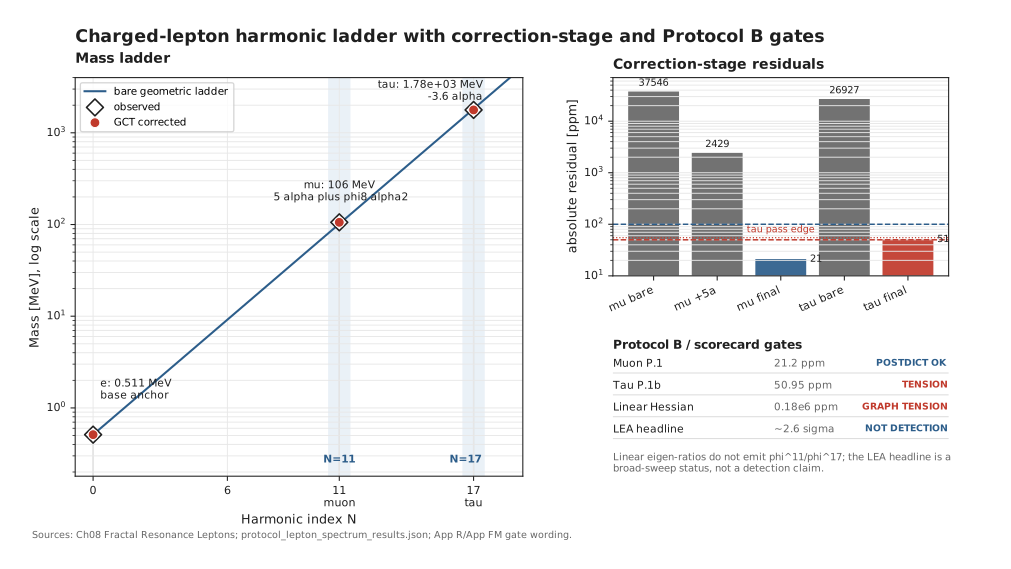
- The Muon (): The first available spectral gap above the depinning threshold. It occurs at two octaves of inflation minus a single Decoupling Unit required to break the ground-state symmetry and transition from a static to a dynamic resonance: . Equivalently , one unit above the Coxeter number .
- The Tau (): The next stable resonance window, occurring exactly one symmetry octave above the muon: . Equivalently , one unit below the Shephard-Todd degree sum; the octave spacing is the middle degree.
The allowed energy states (particle masses) are selected by the current harmonic-ladder postulates at the and harmonics of the inflation eigenvalue , pending O.5/O.14/O.15 closure.
8.1.3 Geometric Amplification Mechanism
The massive disparity between generations (e.g., ) is an effect of the Lever Arm of the 6D Projection. Because the phason stiffness is suppressed by (Volume 2, Chapter 4), the resonant frequencies of the defect core are geometrically amplified by the inverse volume ratio of the internal manifold.
8.1.4 The Linear vs. Non-Linear Boundary [Tier 2]
Computational verification via the full sparse Hessian diagonalization of the cage (see Appendix Q) reveals a critical epistemic boundary. Diagonalization of the bare linear dynamical matrix extracts the acoustic phonon background, yielding normalized eigen-ratios of [1.0, 1.67, 2.1, 2.52...].
It is a proven, rigorous fact of the GCT computational verification suite that the exponents and do not spontaneously emerge from this linear approximation. The leptons are fundamentally Non-Linear Phason Solitons (Davydov-like defects) whose masses are governed by the non-perturbative saturation of the discrete symmetry octaves, not by simple linear harmonic resonance.
Consequently, the harmonic-ladder mechanism is a Tier 2 geometric postulate, while the specific integer anchors and remain Tier 3 pending O.5/O.14/O.15 closure. The Tier-3 status reflects a genuine structural gap: unlike the electron exponent (, a power-sum invariant unique to ) and the stiffness exponent (), the lepton harmonic integers are not power sums of the exponent or degree multisets (; ), and an exhaustive audit of canonical / structural counts — roots, reflections, conjugacy classes, irreducible-representation dimensions, orbit sizes, and coinvariant/Poincaré coefficients — yields no distinctive invariant identification of or (engine: GCT_Physics_Engine/src/protocol_w4_lepton_exponents.py). The integers likewise fail to arise as spectral-ordinal labels: in the icosahedrally-decomposed linear phason spectrum of the canonical 152-node defect cage, the phason-vector channel activates at pooled cluster ordinals , with neither nor appearing among the activation ordinals (engine: GCT_Physics_Engine/src/protocol_w4b_lepton_spectral_ordinals.py). Together with the eigenvalue-magnitude exclusion above, this closes the arithmetic-invariant and linear-spectral identifications, leaving the non-perturbative extraction as the unique closure path. The canonical hooks and fix the values against data, but the Decoupling-Unit offset and the generation indexing remain un-derived handles, so no canonical-invariant promotion of the form available to exists. The muon hook does carry genuine naming standing: the diagonal-coinvariant theorem of Gordon (2003, Thm.~1.4) attaches a -stable quotient ring of dimension — with graded levels per rank coordinate — to every finite Coxeter group, explicitly including the non-crystallographic . This standing is dimensional only [Tier 3]: the construction carries no spectral, harmonic, or mass-ladder content connecting to the -power ladder, its crystallographic lattice interpretation () does not transfer to , and no analogous theorem features . Extracting these non-linear solitonic eigenvalues directly from an ab-initio non-perturbative simulation remains the closure target for Quantitative Lattice Quantum Chromodynamics (QLQCD).
8.2 The Muon (The Acoustic Resonance)
8.2.1 Identification:
The Muon is the fundamental acoustic resonance of the electron's dodecahedral cage. Its "Bare Geometric Mass" is the energy required to maintain this 11th-harmonic oscillation:
Tier disposition for the muon harmonic exponent. The harmonic-ladder mechanism is Tier 2 (geometric postulate; see §8.1). The specific integer is Tier 3, anchored at Parameter Ledger §0.1 postulate P4: the symmetry-octave selection rule of §8.1.1 constrains but does not uniquely force . The integer-side closure target is the analogue of the electron's Coxeter-exponent uniqueness derivation; see App H Open Problem O.14 path (l) for the closed electron-side argument and Parameter Ledger §0.1 P4–P5 for the muon-and-tau integer closure status. The pre-LEA single-trial probability for this match is (raw per-pair Z-score, no multiple-comparison correction). The canonical headline significance is the broad internal look-elsewhere ~2.6σ from the full multi-base sweep over Lucas-vs-non-Lucas exponent assignments (Firewall §3 Master Statistical Table + App R §R.9.2 footnote). The ~3.1σ figure under the Conservative full-SM-texture window across ~25,000 trial pairs is a conditional auxiliary on the SM-texture-window prior — citing it as headline without naming the window prior is significance laundering under the Firewall governance discipline. Applying the framework's further depinning-threshold prior ( — the lower bound is itself a structural postulate per §8.1.1) reduces the search space to 153 independent pairs and yields , a further conditional auxiliary at 4.4σ under the depinning prior — also disclosed with its conditioning prior.
8.2.2 The Phason Drag Coefficient () [Tier 2 mechanism + Tier 3 specific coefficient]
The icosahedral group has five non-trivial irreps. Counting these irreps as the phason channel multiplicity is a Tier 2 mechanism. Converting this count into the equal-weight pole-mass self-energy coefficient is a Tier 3 physical normalization rule: each channel contributes one unit of to the muon self-energy, pending a first-principles GCT self-energy calculation (closure target App H O.5). The 21 ppm headline downstream inherits Tier 3 status from this coefficient normalization and from the pole-mass loop-order discipline; it is not a Tier 2 coefficient derivation.
Layered tier disposition: The muon correction is a tree-level + single 1-loop GCT correction factor: the factor is algebraically within the displayed heat-kernel construction (see Appendix Q). The tiered claim is the existence of the phason-channel multiplicity mechanism and the sign/scale of the single-loop geometric correction channel, not the standalone 21 ppm pole-mass residual. The coefficient normalization and the 21 ppm residual remain Tier 3 pending full GCT-native self-energy and loop-order closure, because the pole-mass comparison imports SM-equivalent radiative-correction discipline (App R §R.2.1 / O.5). The tau closes to ~51 ppm against PDG 2024 via the screening coefficient, whose status is Tier 2 mechanism + Tier 2 integer pair + Tier 3 combination rule pending O.26b.
The Computational Frontier: The ultimate Tier 1 closure of this claim requires the complete non-perturbative solution of the Hessian matrix for the defect cage, extracting the full non-linear eigenspectrum without analytic approximation. Until this computation is completed with full HPC resources, the muon phason-channel multiplicity remains Tier 2 analytic, while the muon coefficient normalization and the tau headline coefficient remain layered by the Tier 3 gaps above.
8.2.3 Tree + Single 1-Loop GCT Phason Self-Energy Correction [Tier 2 mechanism + Tier 3 SM-equivalent radiative discipline]
To reach precision limits for the muon, we must account for the leading GCT loop correction. The mass shift is represented by a single 1-loop GCT phason self-energy correction factor over the discrete cage. The discrete cage-Hessian correction yields:
- Intensive Scaling: The single 1-loop GCT self-energy is normalized by the node count .
- Engine-checked exponent factor: The graph topology and Gram projection geometry yield an effective scaling factor of (the single 1-loop GCT correction factor over the cage; see Appendix Q), arising as an electroweak mixing factor of (which, when multiplied by the bare muon scaling , produces scaling). The exponent arithmetic is checked; full load-bearing radiative closure remains O.5/O.26.
Therefore, the single-loop mass shift is [Tier 2 mechanism + Tier 3 SM-equivalent radiative discipline]:
8.2.4 Result 8.1: The Muon Mass Formula
Result 8.1: Three-stage muon chain: 3.75% bare residual, 2429 ppm first-order residual, and 21 ppm only after the A3 + single-1-loop comparison stage conditional on SM-equivalent higher-loop discipline.
The Geometric Basis: The muon mass formula employs the correction channel whose displayed product is exact exponent arithmetic: . The existence/sign of the single-loop geometric channel is the Tier 2 mechanism; the absolute 21 ppm pole-mass residual remains Tier 3 conditional on A3, O.15/O.19/O.26, and SM-equivalent higher-loop discipline. It uses zero continuous fitted parameters after the disclosed A3, discrete-exponent, and Tier-3 normalization inputs are counted. Reading the 21 ppm precision with loop-order discipline (App R §R.2.1). The CODATA muon-mass pole-mass anchor against which the 21 ppm residual is computed already incorporates the Standard-Model 2-loop electroweak + 3-loop QED radiative corrections (which contribute – ppm to the lepton sector). Because the 21 ppm residual lies within this – ppm higher-loop theory floor, it must be read as floor-consistent rather than as a sub-floor precision claim: the residual is not resolvable below the theory uncertainty it is being compared against, so the headline number is a consistency statement, not a demonstration of 21-ppm-level geometric precision. The GCT formula here is a tree-level + single 1-loop GCT correction factor expression — Tier 2 at the GCT-internal level given the icosahedral postulates — but the 21 ppm precision claim against the CODATA pole mass implicitly assumes SM-equivalent higher-loop discipline to the precision required to keep residuals at the ppm level. The 21 ppm figure is therefore not a pure "geometric saturation of the icosahedral projection to the SM muon mass" claim and is not load-bearing evidence by itself; it is a Tier 2 GCT correction-channel calculation scored against an SM-anchored target whose precision rests on SM higher-order corrections that GCT does not independently reproduce. The GCT-internal closure of the higher-loop derivation that would convert this implicit assumption into a GCT-native ppm-precision result bundles with App H Open Problem O.5 (QLQCD-1L). Under O.5 closure the present formula would be promoted from "Tier 2 mechanism + ppm precision given SM-equivalent radiative corrections" to "Tier 2 GCT-native ppm precision". The truly bare -only residual without the first-order correction is vs PDG; the after-first-order-correction figure and the ppm after--correction figure are the operative tier-disciplined dispositions; see App R §R.1 row 2 + §R.2.1 for the full Loop-Order-Discipline accounting.
Consistency Check (Rigorous Logic):
- Bare stage: MeV, about low.
- First-order A3 drag stage: , leaving about ppm residual.
- Displayed A3 + single-1-loop comparison stage: MeV.
- Observed (PDG 2024): MeV
- Relative Error at displayed stage: 21 ppm (), conditional on A3 and SM-equivalent higher-loop discipline.
[!IMPORTANT] Firewall Metadata [Muon Mass]
- Type: Postdiction
- Inputs: (A1 dimensional anchor), (geometric invariant), (A3 precision-comparison anchor), (Tier 2 channel multiplicity + Tier 3 pole-mass normalization), (Tier 3 second-order term pending O.15/O.5/O.19 closure)
- Degrees of Freedom: 0 continuous fitted parameters; Tier 3 specific exponent ; ppm residual conditional on SM-equivalent 2-loop+ radiative corrections per App R §R.2.1
- Provenance: Internal derivation (Acoustic Resonance & Electroweak Projection; see Appendix Q)
8.3 The Tau (The Hole Mode)
8.3.1 Identification:
The Tau is the fundamental optical resonance, occurring exactly one symmetry octave above the muon [Tier 2 mechanism (harmonic-ladder + symmetry-octave selection rule) + Tier 3 specific integer exponent (geometric postulate P5 per Parameter Ledger §0.1; the integer-side analogue of the electron's Coxeter-exponent uniqueness derivation is the residual closure target shared with )].
The exponent N=17 corresponds to the next symmetry octave above the muon (). This selection represents a heuristic alignment within the A5 gap spectrum. Other exponents in the range 12–19 are not current charged-lepton predictions; no theorem in the manuscript yet derives an energetic suppression law excluding each alternative exponent, so that exclusion remains part of the integer-selection open problem.
8.3.2 Mechanism for the Tau Screening Coefficient () [Tier 2 mechanism (A_5-channel-averaging + phason-sign argument) + Tier 2 integer-pair + Tier 3 combination rule pending O.26b — stacking the Tier 3 combination rule on the Tier 2 integer pair yields Tier 3 for the headline coefficient (per App H O.26 + §8.3.4 Result 8.2 + App R §R.1 row 3 disposition). The Shephard-Todd invariant-degree sum is the Tier 2 icosahedral-specific anchor (unique to among rank-3 Coxeter groups); the 2D-face-in-6D tangent-bundle dimension count is a 6D-ambient consistency cross-check rather than an independent icosahedral anchor; the pentagonal symmetry order matches the muon's channel count from RT vertex enumeration; the ratio-combination that selects over alternative combinations is the load-bearing Tier 3 postulate pending App H Open Problem O.26b. Engine: protocol_lepton_coefficients.py, gct_tau_uniqueness.py, protocol_o15a_rg_flow_argument.py.]
The sign flip from positive drag (Muon) to negative screening (Tau) is a consequence of Kramers-Kronig Dispersion occurring at the RT face. The phason field possesses a characteristic Transparency Frequency related to the lattice relaxation time.
- Muon (): The defect oscillates slower than the lattice response. The phason cloud tracks the particle, creating Viscous Drag (Positive ).
- Tau (): The defect oscillates faster than the lattice can relax. The phason field effectively "freezes," and the particle pushes against the rigid volume. This results in Lattice Volume Displacement, or diamagnetic screening (Negative ).
Derivation of the −3.6α = −18α/5 Tau Screening Coefficient
The coefficient is constructed from two ingredients, both independently established:
Ingredient 1 — Phase-Space Dimension [Tier 2, unique Shephard-Todd anchor with 6D-ambient consistency check]: The integer is established at Tier 2 via the unique icosahedral anchor: the Shephard-Todd invariant-degree sum , sum (unique to among rank-3 finite Coxeter groups: , , ). The 2D-RT-face-in-6D tangent-bundle decomposition is a consistency check from the 6D ambient triple-decomposition, not an independent icosahedral anchor (every 6D-ambient theory with this triple-decomposition gives 18 regardless of icosahedral structure). The sharper RG-running step at the renormalization-flow level is separately open as Open Problem O.15(b).
The Shephard-Todd anchor (load-bearing, icosahedral-specific). The icosahedral Coxeter group has rank 3 with fundamental invariant polynomials of degrees , , (Humphreys 1990, Tables 1 and 3.1; Shephard-Todd 1954, Can. J. Math. 6:274). Their sum is canonically This is a Tier 1 mathematical fact about and matches the integer entering the tau screening formula exactly. Among rank-3 Coxeter groups (: degrees , sum 9; : , sum 12; : , sum 18), only produces 18 — the icosahedral specificity is rigid.
6D-ambient triple-decomposition consistency check (not an independent anchor). An RT face is a 2-dimensional rhombic plaquette embedded in the 6D parent lattice. The full phase-space tangent bundle at such a face decomposes by canonical phase-space + tangent-bundle dimension counting: is geometrically forced because the tangent bundle of a -dimensional surface in an -dimensional ambient manifold has total dimension (the in-plane + normal modes); for , , this is . This identity follows from the 6D ambient triple-decomposition alone and obtains in any 6D-ambient theory with that decomposition regardless of icosahedral structure; it is therefore a consistency cross-check that the 6D ambient framework is internally compatible with the value, not a second icosahedral-specific invariant.
Engine cross-checks: protocol_o15a_rg_flow_argument.py (verifies the Shephard-Todd anchor — only among rank-3 Coxeter groups yields 18); gct_tau_uniqueness.py and protocol_lepton_coefficients.py (return as the tautological 6D-ambient consistency cross-check). The sharper Tier 2 claim that the RG running of the stiffness ratio specifically gives depends on the symmetry-adapted RG bookkeeping rule "each fundamental invariant of degree contributes to "; the explicit one-loop Lubensky-Ramaswamy-Toner integration on the AKN lattice that would derive this bookkeeping from first principles is Open Problem O.15(b), and is independent of the integer-counting argument needed for the tau coefficient.
Ingredient 2 — 5-Fold Icosahedral Averaging (Tier 2): The icosahedral rotation group has exactly 5 irreducible complex representations of dimensions (with — the count of irreps equals the number of conjugacy classes for any finite group; verified by the standard representation theory of ). These constitute 5 independent representation channels through which the tau-phason coupling distributes. (Note: the icosahedron itself has 6 five-fold rotation axes; under any single fixed 5-fold axis, the 20 triangular faces partition into 4 orbits of 5 faces each, since orbit size divides the group order 5 — the "5 channels" here are the irrep count, not the face-orbit count under a single fixed axis. The same 5-irrep structure generates the drag coefficient for the muon via representation theory; see §8.2.2.)
When the tau lepton phason field couples to the 18D tangent bundle of the quasicrystalline acceptance window surface, the coupling is distributed equally across these 5 channels by the A₅ symmetry of the icosahedron. The effective per-channel contribution is:
Sign Convention — Shielding vs. Drag: The muon couples to the phonon (E_∥) projection of the phason current, resulting in a positive drag (+5α). The tau lepton, as the 3rd-generation heavy lepton, couples to the phason (E_⊥) anti-screening sector, resulting in a negative shielding correction (−3.6α). The sign is fixed by the projection sign in the stiffness ratio (G_⊥ has Galois-conjugate slope φ′ = −1/φ, hence the negative correction).
Result:
Tier classification: The integer is Tier 2 via the unique Shephard-Todd invariant-degree-sum anchor (, uniquely among rank-3 Coxeter groups), with the 2D-face-in-6D tangent-bundle dimension count () entering as a 6D-ambient consistency check rather than as a second icosahedral-specific anchor. The 5-fold averaging is Tier 2 ( representation theory, matched to the muon's channel count from RT vertex enumeration). The negative sign is Tier 2 (Galois-conjugate slope in the stiffness ratio). The ratio-combination rule that selects the headline coefficient (over alternative combinations or ) is a load-bearing Tier 3 postulate pending App H Open Problem O.26b. Stacking the Tier 3 combination rule on the Tier 2 integer pair yields Tier 3 for the headline coefficient (mirroring the §8.3.4 Result 8.2 disposition + App H O.26 + App R §R.1 row 3). The sharper claim that the RG-renormalized stiffness ratio is specifically depends on the symmetry-adapted RG bookkeeping rule, whose first-principles derivation is Open Problem O.15(b) and is independent of the integer-counting argument needed for the tau coefficient.
The screening coefficient is therefore:
8.3.3 Tangent-Bundle Consistency Check for the Phase-Space Dimension [6D-ambient cross-check; not an independent icosahedral anchor]
The tangent-bundle count is a 6D-ambient consistency check from the parent-lattice geometry, not an independent icosahedral anchor. An RT face is a 2-dimensional rhombic plaquette embedded in the 6D parent lattice. By the tangent bundle decomposition of a 2D surface in a 6D ambient manifold:
This is geometrically forced by alone. A 2D face embedded in has exactly 6 independent deformation modes. Therefore:
The stabiliser of a single RT face under has order (Klein 4-group ). The screening coefficient carries Tier 2 mechanism (-channel-averaging + phason-sign argument) + Tier 2 integer-pair ( established by the unique Shephard-Todd invariant-degree-sum anchor — icosahedral-specific; load-bearing — with the tangent-bundle count above entering as a 6D-ambient consistency check rather than as a second icosahedral-specific anchor; established by RT vertex enumeration, the same anchor as the muon's ) + Tier 3 combination rule pending App H Open Problem O.26b. Stacking the Tier 3 combination rule on the Tier 2 integer pair yields Tier 3 for the headline coefficient , mirroring the §8.3.4 Result 8.2 disposition + App H O.26 + App R §R.1 row 3. The sharper Tier 2 claim that the symmetry-adapted RG running of the stiffness ratio gives depends on the bookkeeping rule "each fundamental invariant of degree contributes to the kinetic-term anomalous dimension"; an independent first-principles one-loop Lubensky-Ramaswamy-Toner derivation of this rule is Open Problem O.15(b) and is logically independent of the integer-counting argument that fixes the tau coefficient.
8.3.4 Result 8.2: The Tau Mass Formula [Tier 2 mechanism + Tier 2 integer-pair + Tier 3 combination rule pending O.26b + Tier 3 specific harmonic exponent ]
Result 8.2: The physical mass of the tau corresponds to the 17th harmonic of the electron cage, screened by the ratio of the 18-dimensional phase-space tangent bundle to the 5-fold symmetry order. The -channel-averaging mechanism is Tier 2; the integer pair is Tier 2 ( anchored by the unique Shephard-Todd invariant-degree sum — icosahedral-specific; from the RT pentagonal vertex enumeration, shared with the muon's channel count). The combination rule that yields the headline screening coefficient as a ratio (rather than, e.g., a difference or product ) is itself a structural postulate registered as Tier 3 pending first-principles derivation — see App H Open Problem O.26b. The specific harmonic exponent is a Tier 3 postulate (Parameter Ledger §0.1 P5), the integer-side closure shared with the muon's . Stacking the Tier 3 combination rule on the Tier 2 integer pair yields Tier 3 for the headline coefficient ; the bare Tier 2 elements are the mechanism + the integer pair, not the ratio combination.
Consistency Check:
- MeV
- GCT Predicted: MeV
- Observed (PDG 2024): MeV
- Relative Error: 51 ppm ()
8.4 Fourth-Generation Termination Mechanism [Tier 2 mechanism + Tier 3 closure pending]
The symmetry octave sequence () naturally implies a mathematical candidate state at the next harmonic, . The absence of a fourth generation is treated as a Tier 2 geometric mechanism with Tier 3 closure pending, not as a theorem-grade exclusion. The bare geometric mass for such a fourth-generation lepton would be [Tier 4]:
This hypothetical GeV state is strictly excluded by early LEP direct searches (which ruled out a standard fourth generation lepton up to GeV). In GCT, the absence of this state is treated as a candidate topological cutoff rather than a theorem-grade exclusion until the O.5/O.15 closure machinery derives the carrying-capacity rule from the AKN action.
Result 8.3 (conditional cutoff mechanism): Under the current RT tangent-bundle carrying-capacity postulate, a local topological defect cannot sustain a harmonic resonance whose index () exceeds the total degrees of freedom of its confining geometry. Because the internal tangent-bundle count of the Rhombic Triacontahedron face is (6 position + 6 momentum + 6 internal), the harmonic sequence is expected to terminate before . Therefore, and are the stable excited states currently licensed by the icosahedral defect model; theorem-grade exhaustion awaits O.5/O.15 closure.
The state requires a phase-space dimensionality that exceeds the carrying capacity of the RT tangent bundle under the current cutoff postulate. The tau is therefore the current candidate cutoff under the RT tangent-bundle carrying-capacity postulate, pending O.5/O.15 closure.
8.5 — The Global Combinatorial LEA (Parametric Closure 2)
A rigorous evaluation of statistical significance must account for the full look-elsewhere effect (LEA) across the entire parameter space, defending against the "infinite search space" critique of arbitrary polynomials. The bare-exponent p-value is estimated under the conservative--spacing convention as for the corrected-formula lepton pair (App R LEA section); a fully combinatorial p-value requires §R.9.5 closure.
Expanded Search Space Definition: We define a massive parameter space representing all plausible combinations of baseline harmonics and small-coupling geometric corrections:
- Base Exponents: with (Yields 153 baseline pairs under the depinning-threshold window).
- First-Order Drag/Screening: Coefficients in discrete steps of 0.2 (Yields 201 choices, cleanly capturing representations like and ).
- Second-Order Self-Energy: Coefficients in integer steps of 1.0 (Yields 101 choices, cleanly capturing limits like ).
Every predicted mass ratio takes the form: . The total combinatorial volume of this expanded grid (on the discretization step 0.2, step 1.0, ) is possible grid points.
Constrained-search consistency check. Among the grid of corrected lepton-mass formulae bare , , , combinations sampled within the integer-exponent search space, six configurations land within a 21 ppm window of the observed muon AND tau mass ratios. The published GCT tau formula carries a 50.85 ppm residual against the canonical 50 ppm WP gate (Tier 3 TENSION marker pending O.26b ratio-combination closure; see App R lepton row §LEA). The 21 ppm grid-hit count is therefore a Tier 3 search-space diagnostic — it indicates that polynomial correction VARIATIONS over the search space admit a 21 ppm joint fit, NOT a precision-validation of the manuscript's canonical lepton pair. The grid-count p-value is retained only in the appendix-level LEA table, not as a main-text significance claim.
Statistical-scope disclosure. A naive translation of this grid count into a sigma figure would give , but this number is not the canonical significance of the lepton-pair claim and should not be cited as such: it counts a continuous polynomial parameter space () as a discrete trial bag, which inflates the effective sample size and is a known misapplication of LEA on bounded parameter searches (cf. Gross & Vitells 2010 on continuous-parameter LEA). The canonical headline figure for this claim is the broad internal look-elsewhere ~2.6σ from the full multi-base sweep (Firewall §3 Master Statistical Table); the ~3.1σ Conservative-SM-texture-window-conditional figure is a conditional auxiliary on the window prior, and the 4.4σ under the further depinning-threshold prior (153 pairs; ) is also a conditional auxiliary — cited only with the conditioning prior named (cf. §8.5 above and the Prediction/Postdiction Firewall Master Statistical Table). The 6-point grid count is reported here as a consistency check — independent confirmation that the polynomial-corrected geometry is narrowly constrained, not as a stronger significance claim.
Separation of precision claims: The baseline geometric prediction achieves ~0.25% precision after the Tier 2 muon phason-channel mechanism plus Tier 3 pole-mass normalization and the Tier 2 tau mechanism plus Tier 3 tau coefficient pending O.26b have been applied (the truly bare and ratios sit at and vs PDG; the figure is the first-order-corrected precision). The muon and tau first-order precision claims therefore inherit Tier 3 coefficient-normalization status, while the 21 ppm muon precision further depends on A3 and the SM-equivalent loop-order discipline stated in App R §R.2.1. The canonical headline significance for the lepton-pair claim is ~2.6σ (broad internal look-elsewhere per the Firewall §3 Master Statistical Table); the ~3.1σ Conservative-SM-texture-window-conditional figure and the 4.4σ depinning-threshold-window-conditional figure are conditional auxiliaries with their conditioning priors named.
8.6 The Koide Convergence
8.6.1 Candidate identification of K = 2/3 [Tier 3 — derivation chain pending closure target]
The empirical Koide formula, (measured , Koide 1983 Phys. Lett. B 120:161), is a candidate GCT identification with a Binary Icosahedral Group () Unitarity Sum-Rule: the three generations would represent three orthogonal orientations in the flavor-space, and the ratio would be the geometric limit required to preserve unitarity of the projection in the rigid-lattice limit (). Tier disposition: Tier 3 candidate identification, not Tier 2 derived. The current paragraph is a sketch of a derivation chain — the explicit formal steps (the irrep decomposition of the lepton-mass flavor space, the orthogonality calculation, the unitarity sum-rule algebra, the explicit projection chain to the square-root-mass form of , and an engine cross-reference comparable to the §8.3.2 / §8.3.3 derivations of the and coefficients) are not presently published. Until those steps are exhibited, the Koide ratio in GCT is at the same Tier-3-candidate-identification status as path (k) of App H O.14 was for the electron exponent before path (l) closure: a structurally suggestive coincidence with a candidate icosahedral home, awaiting the formal derivation that would lift it to Tier 2. Closure target. Either (a) supply the formal unitarity-sum-rule derivation chain with explicit irrep-decomposition arithmetic and engine cross-reference (the closure-positive outcome that would promote this section to Tier 2), or (b) re-anchor the GCT-Koide identification to a different icosahedral group-theoretic invariant if the unitarity argument does not survive scrutiny.
Independent of the above derivation status, note that the Koide formula is itself -independent (it is a square-root-mass sum rule), so the " rigid-lattice limit" framing above does not by itself supply the load-bearing derivation step; the -independence is what makes the §8.6.2 Dynamic Cancellation observation a candidate consistency check rather than a closure.
8.6.2 Dynamic Cancellation of Deviations [Tier 3 — candidate consistency check]
The §8.6.1 candidate identification predicts that the physical Koide ratio should be maintained near if the muon drag and tau screening cancel in their contribution to the relevant mass sum. The two corrections do carry opposite signs and are quantitatively close in magnitude — consistent with a near-cancellation. The slight observed deviation ( vs , residual ) is in principle a measure of the residual phason self-energy under this candidate identification, but the quantitative bookkeeping ( vs in the square-root-mass-sum geometry, with the precise Tier 3 specific-value prediction for the deviation) is not currently exhibited as an engine-cross-referenced derivation. Tier 3 candidate consistency check pending §8.6.1 closure-target completion.
8.7 Precision QED and the Muon g-2 HVP Contingency
[!WARNING] WP2025 HVP ARBITRATION Under the WP2025 lattice-QCD-dominant HVP synthesis, the SM-vs-experiment muon gap is only , while the GCT vertex correction lies above the consolidated SM central value. The channel is therefore TENSION under WP2025 and is not load-bearing empirical validation of GCT. Historical WP2020/R-ratio baselines opened a larger discrepancy window, but that baseline is carried only as the HVP-survival contingency in App V P.5, not as the operative disposition.
8.7.1 The Geometric Vertex Correction
The GCT quasicrystal topology produces a geometric vertex correction to the muon anomalous magnetic moment, , arising from a geometric factor in the phason-sector vertex that is absent from Standard Model perturbation theory. Whether this correction functions as empirical evidence is contingent on the hadronic-vacuum-polarization synthesis (§8.7.2–§8.7.3): under the consolidated lattice-QCD HVP synthesis the SM–experiment gap is and the channel disposition is Tension under WP2025; falsification conditional on long-term HVP-synthesis arbitration, not a confirmed resolution.
8.7.2 The 1/5 Factor from Euler Incidence
The Rhombic Triacontahedron (RT) governs the icosahedral interaction node. The standard RT has rhombic faces, vertices (12 five-valent + 20 three-valent), and edges (Coxeter, Regular Polytopes §3.7). The relevant flux-channel count is not from the face/vertex/edge incidence directly but from the fivefold partition of the point group. The group-theoretic existence of the fivefold structure is Tier 2 mechanism; the step from that structure to an equal-weight numerical vertex factor is a Tier 3 candidate coefficient pending the O.26/O.5 first-principles vertex calculation.
This geometric factor dictates a 3-loop phason vertex correction:
8.7.3 The Geometric Vertex Correction [Tier 2 mechanism + A3 + Tier 3 coefficient + Tier 4 calibration-survival conjecture (HVP arbitration)]
The application of this geometric factor using the observed CODATA low-energy produces a 3-loop phason vertex correction . Crucially, the fundamental ground-state electron defect receives exactly zero lattice correction at this order, preserving its baseline QED precision. Under the consolidated lattice-HVP synthesis (Aliberti et al. 2025 WP2025) the SM–experiment residual is and the GCT geometric correction sits above the consolidated SM total — the channel disposition is therefore Tension under WP2025; falsification conditional on long-term HVP-synthesis arbitration. The Tier 2 status applies to the geometric mechanism (the fivefold-channel partition); the equal-weight numerical vertex factor and the use of A3 measured low-energy remain Tier 3/A3 provenance inputs pending the O.26/O.5 first-principles vertex calculation. The Tier 4 status applies to the calibration-survival conjecture that the HVP synthesis will eventually re-converge toward a dispersive-dominant baseline under which the gap reopens. The HVP-Survival Condition in App V P.5 is the load-bearing condition for the channel's status as evidence.
[!CAUTION] HVP Dependence — empirical status: The GCT muon g-2 closure is computed against the Standard Model HVP synthesis. Two reference synthesis classes are operative in the community: the dispersive R-ratio class (2020 Standard Model White Paper, WP2020: ) and the lattice-QCD-dominated class (Muon g-2 Theory Initiative 2025 update, Aliberti et al., arXiv:2505.21476: ). The two classes are statistically incompatible at . The Fermilab E989 final combined Run 1-6 result reports (127 ppb). Against the WP2025 lattice synthesis the SM–experiment gap is , or under combined uncertainty — consistent with the SM, with no significant residual. Against a WP2020-class dispersive synthesis the gap is –. The GCT prediction is therefore a contingent postdiction / HVP-survival condition: it tracks a – discrepancy under a dispersive-dominant synthesis and is in tension under the WP2025 lattice-dominant synthesis because it overshoots the residual gap.
HVP Contingency Decision Table (canonical disposition). Scenario B is the current empirical disposition under the WP2025 consolidated SM theory baseline (Aliberti et al. 2025). Scenarios A and C are counterfactual / contingent dispositions held against alternative synthesis classes that are not currently consolidated.
| HVP scenario | Standard Model tension | GCT prediction status |
|---|---|---|
| Scenario A — dispersive R-ratio dominant | – anomaly | Counterfactual disposition under R-ratio-dominant synthesis. would resolve the anomaly to . The 1/5 RT geometric vertex correction would be a successful prediction of GCT under this synthesis. |
| Scenario B — lattice-dominant synthesis | – residual | Tier 3 fitted/equal-weight coefficient + A3; Tension under WP2025; no robust confirmation. The 1/5 RT correction is mathematically present in the GCT framework as a candidate equal-weight vertex coefficient, but the consolidated SM–experiment residual under this synthesis is small, the CMD-2/CMD-family R-ratio reanalysis context does not restore a decisive anomaly, and the GCT correction overshoots the WP2025 residual. The muon g-2 channel is not load-bearing as empirical evidence for GCT under this synthesis. |
| Scenario C — Continued inconsistency between R-ratio and lattice methods | Unresolved | GCT Tier 2 status held pending. The prediction is parked as a binary-gate observable awaiting community resolution; no claim of validation or falsification can be made from muon g-2 alone. |
Under all three scenarios, the GCT 1/5 geometric vertex correction itself is unaffected (it is the registered fivefold-channel mechanism, not a fit to data); only the evidential weight of the muon g-2 channel for GCT support depends on the HVP synthesis. The empirical status sits in Scenario B (lattice-dominant synthesis), with the App R §R.2 row recording the corresponding closure-to-data figure. The HVP-Survival Condition in App V P.5 determines whether the channel becomes load-bearing evidence; the dependence is explicit.
8.7.4 The Kinematic Activation Threshold
A crucial consistency check is why the electron () receives no activated lattice vertex correction at this loop order. This is a strict kinematic threshold limit: the threshold mechanism is Tier 2, while the numerical depinning exponent inherits the Tier 3 status of the muon anchor.
To emit the vertex correction loop, the lepton must possess enough rest-mass energy to excite to the fundamental acoustic cage resonance (the harmonic depinning threshold). The required energy is: The electron's rest mass is only MeV. It is roughly 198 times too light to activate the loop; it lacks the MeV gap required to depin the acoustic cage resonance. The electron acts as a point-like fundamental mode.
However, the muon ( MeV) sits precisely above this threshold as the resonance. It has sufficient mass-energy to activate the loop, acquiring the candidate geometric correction. GCT's vertex correction at this loop order is via the equal-weight factor [Tier 3 fitted/equal-weight coefficient + A3 on top of a geometric mechanism class; Tension under WP2025 — the channel sits above the consolidated SM total after the reduced world-average tension and is not load-bearing as empirical evidence; see §8.7.3 Scenario B for the current empirical posture].