Volume 3 — The Matter Spectrum
PART IV: EXPERIMENTAL PROTOCOLS
Chapter 13: Protocol A (Candidate Zeno Drive)
[!WARNING] Epistemic Status: Tier 3 (Hypothesis) The "Zeno Drive" mechanism relies on the existence of Millisecond Quantum Coherence in warm biological systems. Current standard biophysics sets the decoherence limit at seconds. The proposed "Topological Shielding" mechanism is a conjecture that remains experimentally unproven. If Protocol A-Prime is null AND the NMR polarity gate is null at their preregistered thresholds, the GCT biological-substrate prediction is falsified. Protocol D LORR is a pilot/systematics study; Ch16 §16.4 carries the no-gate disposition. The core geometric physics remains unaffected by a biological-substrate falsification.
While the preceding chapters have established the geometric inventory of the vacuum and the resulting cosmological dynamics, the biophysical-substrate branch of Geometric Consciousness Theory (GCT) rests on whether a physical mind-brain interface can be identified. GCT treats this interface as a candidate non-thermal, quantum-mechanical transducer. Protocol A targets the detection of the candidate Zeno Drive—the proposed process by which the informational Selection Operator () gates metabolic energy to wind the vacuum lattice into a stable Identity Polaron.
13.1 The Physics of Nucleation
13.1.1 The Energy Paradox: 3.55 keV vs. Thermal Noise
The central biophysical challenge of GCT is the Nucleation Problem. As derived in Chapter 7, the fundamental unit of identity is the Identity Polaron, a macroscopic topological defect anchored by an electron-like core. The binding energy of this core—the Vacuum Quantum ()—is approximately 3.55 keV [Tier 2 Prediction].
Biological systems operate at a physiological temperature of 310 K [Tier 3 — biological parameter], where the characteristic thermal energy is approximately 0.026 eV [Tier 1 — thermodynamic identity]. There exists a five-order-of-magnitude energy gap between the thermal noise floor and the vacuum defect energy. Consequently, the Identity Polaron cannot be nucleated by thermal fluctuations; it must be a Non-Thermal Process driven by coherent informational work.
13.1.2 The Candidate Transduction Equation (Zeno-Driven Force)
How does an abstract measurement () generate a physical force on an ion channel? The Quantum Zeno Effect suppresses transitions out of a measured or protected subspace; it does not freeze all phase evolution. In the GCT lattice, this protected-subspace stabilization is mechanically governed by a Tavis-Cummings cooperative pumping model. The system achieves macro-coherence when it satisfies the strong-coupling condition: , where denotes the phase-locked cooperative dipole count in the active Polaron volume.
Coupling Nomenclature [Tier 2 mechanism / Tier 3 specific magnitudes]: Empirical CISS spin selectivity in chiral biomolecules is the background mechanism (Naaman, Paltiel & Waldeck 2019, Nat. Rev. Chem. 3:250–260). The literature supports the mechanism class — chiral spin-selective transport — but not the tubulin-specific kHz/MHz phason-coupling numbers. The transduction step from CISS spin selectivity into a phason-lattice coupling is layered: Tier 2 mechanism for the chiral spin-orbit selection rule, Tier 3 physical-link/magnitude for its beta-tubulin implementation pending O.12/O.21/O.23 closure and Protocol A-Prime calibration. The specific magnitudes quoted in this subsection are Tier 3 calibrated model translations: the bare spin-orbit coupling of Tryptophan (Trp) in tubulin is kHz [Tier 3 — model translation from the CISS mechanism class to the candidate β-tubulin Trp residues (Trp21, Trp103, Trp346, Trp407 per PDB 1JFF/1TUB; O.21 currently identifies Trp21 only as a local-inward wall-patch candidate, while assembled-microtubule lumen-axis verification remains open) dipole geometry; quantitative closure requires Protocol A-Prime §13.3.5.A, per §13.2.5]. The Chiral Phonon-Polariton enhancement mechanism (Tier 2 mechanism — collective resonance of the Trp aromatic radical network with the tubulin lattice phonons) amplifies this bare coupling by a factor of ~41 [Tier 3 — specific enhancement factor pending first-principles closure; see Appendix Q for the computational verification scaffold and Open Problem O.12 for the frequency-scale renormalization derivation], yielding the effective cooperative coupling MHz [Tier 3 — downstream of the two Tier 3 inputs above]. The operative central O.21 branch remains until assembled-microtubule lumen-axis closure. On the conditional sensitivity branch, the neuron-scale Trp inventory is candidate dipoles per typical pyramidal neuron (arithmetic per V1 Ch17 §17.1.4: MTs/neuron dimers/MT ). The disfavored all-four-β-Trp stress-test ceiling caps at and is not propagated as an operative substrate count. The cooperative calculation proceeds with the smaller phase-locked defined in §13.5.3. At the protocol_zeno_energy_budget output level, cooperativity and entropy checks survive only on the conditional sensitivity branch (B1/B2/B4); B3 spin-count energy-delivery does NOT close ( vs needed , gap); O.23 DFS dressing reaches the s floor but remains below the 10 ms target. The cooperative-nucleation closure is pending O.23 (chiral phonon-polariton DFS). A negative result on Protocol A-Prime would force re-derivation of from NV-centre data and would not falsify the Tier 2 chiral-selection mechanism itself.
The single-spin coupling is structurally driven by the lattice speed of light (Vol. 2 §6.2.2) acting as the Lattice Speed of Light (phason group velocity) on the native dipole transition moment of the Tryptophan (Trp) aromatic radical chain within the tubulin dimer. Tryptophan residues are natively present in -tubulin at four positions (Trp21, Trp103, Trp346, Trp407 in PDB ATOM/auth_seq_id numbering for 1JFF/1TUB; FASTA-sequence indexing maps the same sites to the corresponding beta-tubulin Trp set used in the O.21 screen).
Spatial-scale clarification — Trp-Trp pair separation vs tubulin dimer length [Tier 2 mechanism / Tier 3 numerical values pending Open Problem O.21 assembled-axis identification]. The 8 nm dimension cited above refers to the tubulin dimer length (α-β heterodimer along the microtubule protofilament axis, cryo-EM-measured); it is NOT the radical-pair separation governing Trp - Trp singlet-triplet mixing dynamics. Standard radical-pair singlet-triplet mixing requires a much shorter inter-radical separation nm to give Δg/exchange coupling regimes within the radical-pair mechanism literature (Steiner & Ulrich 1989; Hore & Mouritsen 2016). The GCT mechanism therefore requires a coupled radical pair between a local-inward β-tubulin Trp candidate and a near-neighbour aromatic partner within nm in the assembled-microtubule geometry (Tyr or another Trp side chain on the adjacent protofilament, or a flavin/FAD cofactor if present) — not across the 8 nm dimer length. The assembled-MT lumen-axis identification of the specific Trp-partner radical pair and its precise separation is Open Problem O.21; the 8 nm figure is the structural-biology dimer-length anchor used to specify the GCT mechanism's protein-scale context, not the radical-pair separation parameter.
The Chiral Phonon Bridge (Tier 3 hypothesis pending O.23/O.31): The -helical microtubule lattice is a candidate medium for chiral phonons -- quantized acoustic waves carrying orbital angular momentum -- though direct phonon-polariton mode measurements in assembled microtubules remain absent (Open Problem O.23 collective-dressing closure; O.31 polariton-dephasing bound). Under this hypothesis, the Zeno measurement at the Trp radical pair couples to chiral phonons via the spin-orbit interaction (the CISS effect, system-dependent magnitude; see App F §F.5.3). If this transfer is a topological exchange between the internal spin and the physical lattice, its efficiency would be governed by the geometric phason stiffness ratio () -- providing a Tier 2-mechanism candidate for the Planck-to-Biology bridge without ad-hoc volumetric ratios. Quantitative magnitudes of the bridge are Tier 3 pending O.23/O.31.
The exponent is a Tier 2 geometric invariant requiring no fitting. Freezing the phase creates a macro-gradient in the phason field (). The resulting force is the back-reaction of this vacuum strain:
[!NOTE] Layered Tier Discipline: Healing Length
The healing length nm is carried with a layered disposition: the Bohr/Compton Gross-Pitaevskii formula is Tier 1 textbook physics, while the GCT mechanism identifying a Polaron healing length as the relevant biological screening scale is Tier 2. The specific claim that this value follows first-principles from is Tier 3 pending derivation from the phason-stiffness ratio; App K §K.5 / App H O.25 record the current GCT-internal Route 2 stiffness substitution as a negative closure, not a successful derivation. The identification of with the microtubule lumen geometry (polaron diameter nm vs lumen ID nm, a match — see Ch07 §7.3.3 "snug match" Zeno-Lock argument) remains a Tier 3 biological correlation.
For a sampling rate in the registered MHz window [Tier 2 mechanism / Tier 3 specific value pending O.12] and the derived stiffness ratio , this generates a bias voltage sufficient to gate the selectivity filter of a voltage-gated calcium channel () [Tier 3 — empirical ion-channel threshold]. While localized, this potential is applied across the nanoscopic length of a tubulin dimer, resulting in a massive electric field ( V/m) [Tier 3 — derived from empirical channel geometry].
13.1.2b The Registered A-Prime Frequency Window: Magnon-Polaron Avoided Crossing [Tier 2 mechanism / Tier 3 specific value]
The bare Trp singlet-triplet variance is the canonical MHz engine value. Protocol A-Prime tests the post-O.12 protected-subspace operating branches: primary MHz if O.12 closes positive, fallback MHz if O.12 closes negative, each scanned at kHz spacing with MHz retained as the anti-Zeno control point.
The Magnon-Polaron Avoided Crossing. The microtubule is modelled here as supporting candidate chiral acoustic phonon modes (dispersion , with m/s [Tier 3 — transverse/chiral acoustic mode in the α-helical tubulin heterodimer lattice (α/β-tubulin dimer per RCSB 1JFF/6DPU); consistent with microtubule mechanical-resonance measurements giving Young's modulus – GPa and density g/cm³, yielding – m/s for transverse modes; distinct from the higher longitudinal Brillouin branch at – km/s in bulk α-helical proteins]) and candidate spin-wave magnon modes from the Trp radical-pair network (dispersion , where is the singlet-triplet gap of the Trp radical pair and is the magnon stiffness set by the Trp aromatic hyperfine couplings). The two-branch hybridization via the CISS spin-orbit coupling of §13.2.5 is a Tier 3 O.12/O.23 closure target, producing a candidate magnon-polaron quasi-particle rather than a demonstrated microtubule excitation. enters the avoided-crossing sharpness ( controls the crossing wavevector) but does not set the operating frequency itself — the operating frequency is fixed by in the Trp hyperfine band, independent of . The registered MHz peak is therefore robust under reasonable variation of within the experimental range for microtubule transverse modes.
The van Hove singularity in the magnon-polaron joint density of states occurs at the avoided crossing where the phonon and magnon branches meet. Solving in the small- regime gives , and the avoided-crossing frequency on the lower branch is:
That is, the operating frequency is governed by the singlet-triplet gap of the Trp radical pair, not by the bare phonon zone-boundary frequency (which lies in the GHz range; the bare ZB formula evaluates to Hz GHz for tubulin parameters and is therefore unrelated to the registered MHz-scale operating point).
The Trp Hyperfine Anchor. The canonical radical-pair hyperfine literature (Ritz et al. 2000; Hore & Mouritsen 2016) tabulates the principal couplings for the FAD semiquinone radical pair of the cryptochrome / avian-magnetoreceptor system at isoalloxazine positions MHz, MHz, MHz, giving MHz. These FAD values are imported as a literature-anchored order-of-magnitude reference band for the singlet-triplet manifold splitting of indole-containing radical pairs at biological temperatures; the actual β-tubulin Trp indole hyperfine structure has only one nitrogen (N1) plus aromatic ring protons, so the per-coupling values for the Trp candidate residues (Trp21, Trp103, Trp346, Trp407 per PDB 1JFF/1TUB chain B numbering; Trp21 is only a local-inward wall-patch candidate until the assembled-MT lumen-axis screen of Open Problem O.21 is completed) are not the FAD values above. The Trp-side hyperfine assignment is registered as an open closure target: published indole-radical-pair literature places – MHz with weaker H-couplings on the indole ring, giving an – MHz. The downstream chiral phonon-polariton enhancement factor required to reach the registered MHz window from the correct Trp hyperfine band is therefore – rather than the – that would follow from naive substitution of FAD values; this enlarges the Tier 3 closure burden for Open Problem O.12 (frequency-scale renormalization) but does not change the Tier 2 mechanism (magnon-polariton avoided crossing on a chiral aromatic radical-pair network).
[!IMPORTANT] Nomenclature Clarification. The relevant in the GCT Zeno-Drive context is the zero-field hyperfine-induced singlet–triplet manifold splitting of the Trp radical pair — i.e., the energy splitting between the singlet () and the three triplet sublevels generated by the hyperfine field of the surrounding nuclear spins in the absence of an applied magnetic field. In the cryptochrome / avian-magnetoreceptor literature (Ritz et al. 2000; Maeda et al. 2008 Nature 453:387; Hore & Mouritsen 2016 Annu. Rev. Biophys. 45:299), FAD/cryptochrome supplies the order-of-magnitude reference band – MHz. The tubulin-Trp input used here is the narrower – MHz indole-radical band, which is why O.12 carries a residual – frequency-scale renormalization target rather than a direct CISS measurement. This is distinct from the electronic exchange coupling between the two unpaired electrons (a Heisenberg exchange in the meV–GHz range; Weber et al. 2002 Science 296:2106; Cintolesi et al. 2003 Chem. Phys. 294:385), which we denote separately and which controls the S↔T mixing rate at non-zero applied field. In the GCT physiological regime (no externally applied static field, only the geomagnetic T background), the operating frequency is set by the hyperfine-induced splitting of the relevant radical pair, not by . Throughout this manuscript, "" without qualifier refers to .
A residual factor from chiral phonon-polariton enhancement (the same enhancement mechanism that lifts the bare CISS coupling kHz to MHz per §13.1.1, Appendix Q) is required to reach the registered MHz peak from the tubulin-Trp - MHz hyperfine band; a first-principles derivation of this frequency-scale renormalization is Open Problem O.12.
The Zeno Drive operates at the magnon-polaron avoided-crossing frequency — the resonance at which the Trp spin coherence couples maximally to the chiral phonon background. Detuning to MHz exits this resonance and supplies the anti-Zeno sign test of §13.3.5, conditional on the protected-subspace mechanism of O.23.
[!NOTE] Tier Assignment: The avoided-crossing form is Tier 2 as standard two-branch hybridization physics. Its realization as a microtubule Trp radical-pair + chiral-phonon magnon-polaron is Tier 3 pending O.12/O.23 and tubulin-specific calibration; the current text therefore carries a candidate magnon-polaron realization, not a demonstrated microtubule excitation. The specific MHz registered peak is Tier 3 — consistent with the tubulin-Trp hyperfine band (– MHz) plus chiral phonon-polariton enhancement, but the exact frequency-scale renormalization factor remains pending closure of Open Problem O.12. The FAD hyperfine couplings ( MHz, etc.) are retained only as radical-pair order-of-magnitude references, not the tubulin-Trp input.
The registered MHz peak is consistent with the rest of Vol 1 + Vol 3 order-100 MHz energy accounting. App X §X.12 separates this operating frequency from the bare Misra-Sudarshan crossover: with s and in the cyclic-frequency convention, the bare crossover is GHz, so the registered A-Prime window is inverse-Zeno for the unprotected radical-pair Hamiltonian. The Zeno-regime prediction is therefore O.23-conditional: the protected subspace must reduce the effective Hamiltonian variance before the registered A-Prime window becomes a Zeno-regime drive. The operating-frequency arithmetic is verified by verify_independent/verify_nu_zeno.py; the bare crossover audit is verified by GCT_Physics_Engine/src/protocol_decoherence_audit.py.
Units convention guard. Branch-window frequencies in this chapter are cyclic frequencies (Hz/MHz). Angular rates use in rad/s. The bare crossover audit uses in the cyclic convention, while the dissipative-Zeno/O.23 protocol writes in rad/s. Applying a conversion consistently to the relevant rate convention leaves the best collective O.23 value below the conservative ms target; a calculation that drops only in is an invalid mixed-convention rescaling.
13.1.3 The Topological Valve and Berry-Phase Steering
The Zeno Bias does not provide the energy for the defect; it steers it. Any assumption that the registered radio-frequency measurement could be stacked to provide activation energy constitutes a dimensional category error — a direct violation of the photoelectric effect. In reality, the Agent acts as a Topological Valve. The energy required to mechanically gate the ion channels comes entirely from ambient ATP hydrolysis ( eV per molecule).
However, unguided hydrolysis releases energy symmetrically as isotropic heat. The registered Continuous Zeno Drive imparts a geometric Berry Phase to the Chiral Phonon-Polariton OAM network. This topological phase shift fundamentally breaks the spatial inversion symmetry of the local ATP hydrolysis reaction. The measurement does not pull the ion channel open; it steers the already-funded, purely metabolic ATP energy into the specific, unidirectional mechanical conformational change required for neural firing. In GCT, "Intention" is the informational, geometric steering of existing metabolic power.
13.2 The Biological Interface
13.2.1 The Tubulin Waveguide and the Confinement Energy Gap
The leading candidate hardware for the Zeno Drive is the Microtubule (MT), acting not as a monolith, but as a Segmented Waveguide. It functions as a Sparse Network of isolated quantum reservoirs. The microtubule is also the leading candidate CISS transducer (§13.2.5): its α-helical tubulin backbone (both α- and β-tubulin monomers contribute helical secondary structure to the microtubule lattice; the Dual Material Constraint operates at the heterodimer scale) can generate spin-polarized currents via the spin-orbit interaction, providing a candidate classical phason-winding channel that operates independently of the radical-pair coherence layer once the material-specific CISS current is calibrated.
As established in the Parameter Ledger, the canonical healing length is nm, so the operative diameter is nm. This fits inside the nm microtubule lumen [Tier 3 — cryo-EM measurement]. The "Tight Fit" is a candidate functional requirement: the lumen can act as a geometric boundary condition for the Polaron waveguide rather than requiring compression of a larger cloud. If O.21/O.23/O.34 close positively, this confinement-energy gap supplies one route to the hardware-level activation condition. The present engine central branch remains pending assembled-MT lumen-axis closure, so this is not a closed substrate sufficiency result.
Water and ordered hydration structure in the nm microtubule lumen are modelled by the candidate dodecahedral arrangement inherited from the GCT cage ansatz. This is a geometric substrate hypothesis, not a demonstrated hydrophobic bulk-lumen environment or thermodynamic ground state of biological water at 310 K. Full free-energy stability and MD/NMR validation of the lumen water structure are registered as the Open Problem O.33 closure target. The effective mass of the electron within the confinement of the microtubule waveguide undergoes a shift due to the Polaron coupling: [Tier 4 — order-of-magnitude estimate].
13.2.2 Thermodynamic Audit (Energy Budget Table)
| Interaction | Energy Scale | Function |
|---|---|---|
| Thermal Noise ( K) | eV [Tier 1] | The noise floor to be overcome. |
| Dipole Locking () | eV [Tier 3] | Prevents thermal decoherence. |
| ATP Hydrolysis | eV [Tier 3 — biochemical measurement] | The metabolic fuel (The "Piston"). |
| Zeno Bias () | V [Tier 3] | The steering signal (The "Valve"). |
| Vacuum Quantum () | eV [Tier 2 Prediction] | The stored informational potential. |
[!IMPORTANT] Firewall Metadata [Identity Polaron]
- Type: Prediction
- Inputs: (Anchor), (Invariant), (Calibrated)
- Degrees of Freedom: 1 (Shielding factor)
- Provenance: Internal derivation (Zeno Drive)
Experimental Discriminant (Isotope Substitution, Protocol D): The Trp-chain mechanism predicts that substituting H with H (deuterium) at Trp-exchangeable proton sites can shift the radical-pair spin Hamiltonian by changing the relevant hyperfine tensor, but the shift is not the naive vibrational scaling. In the spin Hamiltonian, the isotope dependence enters through the nuclear gyromagnetic ratio and the site-specific Fermi-contact/dipolar electron-spin density. A deuteron also has and a quadrupole moment, so the sign and magnitude depend on the measured Trp radical-pair hyperfine tensor rather than on mass alone. The registered discriminant is therefore qualitative/Tier 3 until direct tubulin-Trp EPR or isotope-resolved NMR calibrates : deuterated-Trp should suppress or detune the registered excess if the Trp hyperfine channel is real, but the ratio is not claimed as .
13.2.5 The CISS Classical Floor [Tier 2 Mechanism / Tier 3 Magnitude]
CISS class mechanism (Tier 2) / tubulin-current realization (Tier 3/Tier 4): CISS (Chirality-Induced Spin Selectivity) establishes spin-polarized charge transport in chiral molecules and proteins. GCT proposes a tubulin heterodimer current channel through the α-helical peptide backbone (both α- and β-tubulin monomers contribute α-helical secondary structure to the microtubule lattice; the Dual Material Constraint operates at the heterodimer scale) via the spin-orbit interaction. This current-polarization channel is classical in the CISS sense: it does not require long-lived quantum coherence, but it does require molecular chirality, charge transport or redox/contact coupling, and a measured spin-polarization amplitude in the operative material. Direct tubulin current/redox/contact calibration is required before this becomes a physical sufficiency claim. It is therefore a necessary phason-winding channel candidate, not by itself a sufficient Level-II substrate criterion. The spin-polarized current couples to the phason magnetic moment of the GCT vacuum via: where is the spin-polarized current density. The operative tubulin value is an order-of-magnitude estimate transferred from protein CISS conductance bands rather than a direct measurement of A per tubulin dimer; direct tubulin-current calibration is part of Protocol A-Prime. is the effective magnetic moment of the phason mode, and is the effective magnetic field generated by spin-polarized charge transport.
Two-Layer Architecture:
| Layer | Mechanism | Coherence Required | Coupling |
|---|---|---|---|
| Layer 1 — Candidate CISS phason-winding channel | Spin-orbit interaction; helical backbone chirality plus material-specific charge transport/redox/contact handle | Does not require long-lived radical-pair coherence, but does require tubulin-specific transport/redox calibration | [Tier 3/Tier 4 physical-link magnitude until measured] |
| Layer 2 — Zeno Quantum Enhancement | Tavis-Cummings cooperative pumping | Yes — active when the short-time Zeno curvature time and measurement interval permit protected-subspace suppression | Bare Misra-Sudarshan uses , with set by Hamiltonian variance / singlet-triplet curvature. sets the open-system exponential/crossover context; it is not substituted for and is not a guaranteed linear coupling multiplier. The effective enhancement factor is closure-conditional on App H Open Problem O.23 and must be derived from the Tavis-Cummings + Lindblad response or measured directly in Protocol A-Prime. |
[!IMPORTANT] Key Result: Consciousness in GCT does not, in this architecture, require an unconditional 310 K macroscopic quantum-coherence assumption. It requires molecular chirality plus an empirically demonstrated phason-winding channel and coherent windows for enhanced selection resolution. The CISS channel is a Tier 3/Tier 4 physical-link candidate until tubulin-specific charge-transport/redox measurements or a calibrated surrogate close it; it is not an all-temperature sufficiency floor. The Zeno Drive then provides a quantum enhancement multiplier on top if O.23 closes positively.
Epistemic Status:
- The CISS empirical class (spin-polarized current via spin-orbit interaction in chiral molecules) is experimentally established (Naaman, Paltiel & Waldeck 2019, Nat. Rev. Chem. 3:250–260). The GCT chirality requirement is a Tier 2 framework mechanism; the tubulin-specific CISS-to-phason magnitude remains Tier 3 physical import pending O.12/O.21/O.23/O.31.
- The enhancement factor used in force estimates is the GCT Tier 3 model translation from measured CISS spin polarization to a phason-coupling multiplier. Naaman, Paltiel & Waldeck 2019 report CISS spin-polarization ranges across substrates (roughly 10–60% broadly, with protein-band values closer to 5–20%); the translation from those measurements to is GCT-specific and is not itself measured by Naaman et al. [Tier 3]
- The magnitude of (classical floor coupling) requires Protocol A-Prime (§13.3.5.A) for quantitative determination. [Tier 3 — Target]
- See App. X §X.8 for the derivation of from spin-orbit coupling in peptide bonds.
13.2.6 Tissue Distribution and Substrate Generality [Tier 3 — Open Experimental Question]
Experimental Scope: The decoherence shielding mechanism described in Volume 1 §17.1.2 (Caution box) and Volume 1 Chapter 17 §17.1.4 references the Tubulin Tryptophan (Trp) Aromatic Radical Network (β-tubulin candidates Trp21, Trp103, Trp346, Trp407 per PDB 1JFF/1TUB; O.21 currently supports Trp21 only as a local-inward wall-patch candidate pending assembled-MT lumen-axis analysis) as the primary decoherence shield. Unlike exogenous flavoproteins, these Trp residues are structural components of the microtubule lattice itself. The mechanism requires any aromatic radical pair with the following properties: (a) singlet-triplet splitting s under physiological conditions; (b) proximity to the tubulin CISS-active surface for phason coupling. The tubulin Trp network is the candidate substrate satisfying the chirality + spin + clathrate requirements (Tier 3 pending O.21 assembled-MT lumen-axis closure + O.33 KIE calibration + O.34 ATP-Trp redox-regen). Candidate alternatives that are ubiquitous in mammalian neurons include:
- DHODH (dihydroorotate dehydrogenase): mitochondrial flavoprotein, present in all cells with mitochondria; documented radical pair formation.
- Complex I (NDUFV1 subunit): mitochondrial inner membrane; aromatics site with documented radical pair formation; sub-μs to μs in hydrophobic pocket.
- Riboflavin-binding proteins: neuronal proteins with μs-scale radical pair lifetimes under hypoxic conditions.
- LSOX (lipoyl-containing 2-oxoacid dehydrogenases): present in neuronal mitochondria; aromatic-linked radical pairs with T₂ compatible with Zeno driving.
Falsification target: Protocol D LORR is operationally no-gate under Ch16 §16.4 ( naive gate); O-vs-O substitution in vivo serves as a pilot/systematics study only. The operative Protocol D falsifier is the NMR polarity gate (Ch16 §16.5).
CISS Floor Independence: As established in §13.2.5, the CISS classical floor mechanism is independent of the radical-pair coherence hypothesis, but its magnitude in tubulin remains an experimental target rather than a guaranteed rescue channel. If the aromatic radical-pair candidates are ruled out, the CISS floor can carry the substrate-coupling program only if Protocol A-Prime measures a net spin-polarization floor in the registered Naaman-Paltiel-Waldeck range and maps it to a nonzero phason-winding coupling. The two-layer architecture (CISS classical + Zeno quantum) is therefore a robustness strategy, not proof that every radical-pair failure leaves GCT's biophysical substrate intact.
13.3.1 The Leakage Signature: Coherent THz Emission
While the bulk of the Polaron’s energy vents into the internal dimensions () upon unwinding, the phason-phonon coupling () ensures a non-zero "slosh-back" into the physical manifold. We predict that the termination of a selection event produces a Super-Radiant Phase Decay—a coherent, narrow-band electromagnetic burst.
The Effective Topological Field (): The frequency of this emission is determined by the Larmor Precession of nuclear spins within the Effective Topological Field (). This field is the phason potential gradient generated by the icosahedral curvature of the cage. Based on the winding density of the core, GCT predicts a "Shadow Pulse" at: [Tier 3 — GHz Shadow Pulse: 380 GHz estimate from the heuristic; magnitude calibrated to the Trp hyperfine coupling constant (empirical import) rather than derived from first principles. Tier 2 derivation requires an explicit calculation of the phason gradient of the cage Hessian, identified as Open Problem O.10.] The intensity of this pulse scales as (where is the number of coherent tubulins), turning a microscopic quantum event into a detectable macroscopic transient.
13.3.2 Detection via Temporal Cross-Correlation
Due to the extreme sensitivity required ( Watts), Protocol A utilizes Temporal Cross-Correlation.
- Apparatus: A Transition Edge Sensor (TES) micro-bolometer coupled to a synchronized neural culture via a Sapphire Waveguide (acting as a high-Q Fabry-Pérot cavity).
- Method: The THz signal is time-binned against Multi-Electrode Array (MEA) data. The Shadow Pulse must appear in the – ms window immediately following a coherent gamma-burst, representing the "Entropic Venting" of the resolved state.
13.3.2b Signal-to-Noise Estimate [Tier 3 quantitative; full SNR derivation Open Problem O.10]
An explicit SNR audit of the protocol-A THz-shadow-pulse detection establishes the operative cavity-integrated comparison and the operative scope of the -scaling enhancement.
-
Free-space blackbody background. At 310 K, 380 GHz the spectral radiance is W/m²/Hz/sr [Tier 1 — Planck formula]. Converting this radiance to an in-cavity detector power floor depends on the detector étendue / cavity mode count, and that conversion is the core unresolved quantity of the full SNR derivation (Open Problem O.10): the multimode free-field geometry (1 cm² × 40 GHz × 2π sr) gives W, whereas a mode-matched single-cavity-mode detector (, ) sees only W. The two limits differ by ; the floor figures below are order-of-magnitude placeholders bracketed between them, pending the O.10 étendue closure.
-
Cavity-integrated background. The sapphire Fabry-Pérot enhances the in-cavity blackbody power by approximately the cavity Q-factor times the mode-density enhancement: . For a high-Q sapphire resonator at 380 GHz (), this raises the multimode thermal floor to W [Tier 3 — cavity-integrated estimate, étendue-model-dependent per the O.10 bracket above; the mode-matched limit is correspondingly W].
-
Super-Radiant Scaling. The predicted single-polaron signal is W [Tier 4 — order-of-magnitude]. GCT predicts super-radiant enhancement scaling as [Tier 2 mechanism — Dicke super-radiance conditional on phase-coherence across the polarons]. For a synchronized microtubule bundle (), W [Tier 4 — order-of-magnitude].
-
Operative SNR comparison. Before integration, under the multimode floor and under the mode-matched limit — several orders below the floor in the conservative bracket and 3 orders below in the optimistic one. Dicke integration over s buys a radiometric SNR boost of (40 GHz bandwidth). This leaves the multimode case at (still 500× below floor) but lifts the mode-matched case to SNR — marginally above the detection threshold. Direct detectability is therefore bracket-dependent: hopeless under the conservative multimode floor, marginal under the optimistic mode-matched limit, with the true value fixed by the unresolved radiance-to-power étendue conversion (Open Problem O.10). The -coherent enhancement alone does not robustly clear the floor; a dependable direct-detection target requires the closure-path-(a) geometric upgrade below, and the framework-level falsification gate is supplied by the closure-path-(b) anaesthetic-modulation differential observable, which is independent of the étendue bracket.
-
Operative scope reduction (Tier-3 downgrade of the headline detectability claim). Under the cavity-integrated SNR comparison, the protocol-A direct-detection target is not currently achievable with the sapphire-cavity / TES geometry as specified. Two closure paths remain:
-
(a) Geometric SNR enhancement. Partial SNR gains are available via (i) a cryogenic TES + cavity, which suppresses the detector/instrument thermal background but not the 310 K biological source's own emission — the culture must remain at 310 K to be viable, so its band-limited blackbody emission into the cavity is an irreducible floor that cannot be cooled; moreover in the relevant band-limited Rayleigh–Jeans regime the blackbody power scales (not ), so the cryogenic benefit is detector-side only and far smaller than a naïve would imply; (ii) much-higher-Q (Q ) photonic-crystal cavity matched to the 380 GHz line (mode-selectivity gain); or (iii) cross-correlation between independent detectors viewing the same culture (uncorrelated detector-noise cancellation by ). These reduce detector-limited noise but do not beat the irreducible 310 K source floor, so single-shot direct detection remains out of reach as specified — the operative falsification path is the (b) anaesthetic-modulation differential below, which cancels the static source floor identically. This is the honest Tier 3 status of the protocol-A direct-detection target.
-
(b) Anaesthetic-modulation discriminator (the operative falsification path). The framework-level test does not require absolute detection of the THz line; it requires the anaesthetic-modulation differential — the signal disappears under anaesthesia and reappears on recovery (§13.3.3). The anaesthetic-modulation differential cancels the static thermal floor and the cavity-integration enhancement identically, leaving only the time-modulated cavity-integrated signal-to-thermal-fluctuation ratio. Under this differential observable the SNR comparison shifts to , where the thermal-fluctuation noise at long integration. For anaesthetic cycles, W, comparable to — bringing the modulation-differential SNR to order unity, which is at the detection-threshold level, not above 3σ. A registered modulation-differential gate therefore requires anaesthetic cycles with a frozen cross-correlation pipeline, or the cryogenic / high-Q direct-detection upgrade of (a). Closure path (b) is a statistical-modulation discriminator, not a single-session direct-detection claim.
-
-
Operative disposition. The operative cavity-integrated comparison above places the -coherent signal several orders of magnitude below the cavity-integrated thermal floor after Dicke integration (the absolute margin pending the O.10 étendue/radiometry closure); the protocol is therefore framed as a direct-detection target conditional on the closure-path-(a) geometric upgrade (cryogenic TES + high-Q cavity). The current falsification package for P.8b is the modulation-differential gate: a blinded, frozen-pipeline search for anaesthetic-cycle-correlated 360–400 GHz power, requiring cycles for the registered threshold (the budget itself inherits the same O.10 étendue dependence and is re-derived under the consistent radiometric floor at O.10 closure). The full SNR audit, the cavity-integrated background calculation, and the phase-coherence-budget derivation are registered as Open Problem O.10 closure targets for Protocol A; the present §13.3.2b is the Tier 3 quantitative scope of the headline detectability claim pending O.10 closure.
13.3.3 Control Experiments
- Anesthetized State: Disappearance of the 380 GHz signal. Anesthetics (e.g., Xenon) act as polarizable impurities that break the ferroelectric order, increasing lattice entropy until the Zeno-lock becomes energetically unsustainable.
- Isotope Substitution (Protocol D): Enrichment with O should result in a measurable Frequency Shift of the peak due to altered hyperfine coupling with the field.
13.3.4 The Cosmological Flash
The Shadow Pulse is the "Physical Flash" of an informational bit being written into cosmic history. Its detection would support the localized-entropic-discharge interpretation of the accelerated metric branch (), conditional on the dark-energy and HFGW sensitivity caveats registered for this protocol family.
13.3.5 Protocol A-Prime: The NV-Center Surrogate Test
To isolate the Topological Protection Mechanism from biological confounds, GCT proposes a synthetic surrogate experiment using Nitrogen-Vacancy (NV) centers in diamond. This provides a fully abiotic, room-temperature test of the phason-spin coupling that is decoupled from the complexity of live neurons.
Protocol A-Prime — Experimental Specification:
Setup: Isotopically pure C diamond (enrichment ) with a frozen ensemble design of independently prepared chiral h-BN caps, each read out by precisely implanted NV centers at depth nm below the surface. The 20 NVs per cap are pooled for depth-jitter mitigation; the 50 caps supply the preregistered cap-level replication for CISS contrast mapping. Isotopic purity eliminates C nuclear spin bath noise, ensuring the limiting decoherence channel is spin-phonon coupling — the same channel addressed by the GCT phason mechanism.
Drive: Apply a swept continuous RF field along the NV symmetry axis. Required branch scan windows: primary branch A MHz and geometric sibling branch B MHz. Both branches use for the operative peak-detection run. A step is permitted only as a coarse scouting sweep; it must be followed by the fine scan across the relevant branch window. The MHz point is retained as the anti-Zeno control. Record as the primary observable. A continuous swept-frequency drive provides a full spectral characterization of , in contrast to a single-frequency binary test. The field amplitude is tuned to the first -pulse frequency of the NV ground-state spin-triplet manifold.
Prediction (Coherence Peak Location): exhibits a global maximum in the registered branch window: MHz for O.12-positive or MHz for O.12-negative. The qualitative resonance mechanism is Tier 2; the specific branch central value and amplitude remain Tier 3 pending O.12/O.23/O.24 closure. at follows , where is the Floquet correction factor from §13.4.4.
GCT Prediction — The Anti-Zeno Crossover: GCT predicts a measurable, chirality-dependent feature near the registered branch resonance. At frequencies significantly removed from this geometric resonance (with MHz retained as the anti-Zeno control point), the rapid projective sampling fails to align with the vacuum lattice density of states. In this regime, the measurement broadly collapses the wavefunction without geometric shielding, producing an Anti-Zeno collapse ( drops below its baseline). The crossover frequency is a protected-subspace/O.23 readout, not an unconditional Tier 2 number.
Decision-tree summary (single framework gate): This provides a discrimination test separating the full GCT joint signature from generic biophysics while preserving the §13.3.5 sole framework-level falsification gate.
Confirmed: exhibits a sharp peak within a registered branch window, falls off with the predicted profile, shows anti-Zeno decay at MHz, and carries the chirality contrast. This distinguishes GCT from generic Zeno freezing.
Mechanism-supported / amplitude-measured: Strong enhancement in a registered branch window AND anti-Zeno decay at MHz; the measured amplitude then reads out O.23/O.24 closure rather than defining a separate framework-level gate.
Branch-specific rework: Enhancement in both the window and at MHz indicates generic continuous-measurement freezing rather than a localized density-of-states resonance. Absence of enhancement after a valid fine sweep constrains the Zeno-protection branch. These outcomes do not create independent framework-level falsifiers; they route through the registered §13.3.5/App V P.10 joint decision tree.
Peak Width Prediction: FWHM of peak predicted as (transform-limited). Broader peak = generic Zeno; narrower peak = cavity-enhanced coupling beyond current model.
Scan-step requirement (operational). Resolving a 16 kHz transform-limited peak requires the frequency-sweep step to satisfy (Nyquist condition for the 16 kHz FWHM). A coarser sweep — e.g., the MHz step typical of broad-band NV-centre scans — undersamples the peak by and will return null even if the GCT mechanism is real (false-negative artefact of insufficient frequency resolution). The pre-registered Protocol A-Prime spec therefore requires either (a) a fine sweep at across each registered branch window, or (b) a coarse sweep at first to locate the rough peak vicinity, followed by a fine-resolution sweep at centred on the coarse-located peak inside that branch. Sticking with coarse-only sweep is not a valid execution of Protocol A-Prime and would not constitute a falsification of GCT under the §13.3.5/App V P.10 joint decision tree.
Proton-bath ceiling (operational). When Protocol A-Prime is run on biological samples (Trp radical pairs in tubulin lumen, rather than the abiotic NV-centre surrogate above), the proton bath of the surrounding water and protein backbone imposes a baseline ceiling typically in the – range from dipolar hyperfine broadening (Maeda et al. 2008; Hore & Mouritsen 2016). Any GCT feature in the registered MHz window must therefore be measured relative to this proton-bath baseline, not against an idealised radical-pair . The pre-registered Protocol A-Prime biological-sample spec requires either (a) deuterated tubulin samples ( substitution at backbone sites and bound-water exchange) to suppress the proton-bath ceiling by the standard factor, raising the bare ceiling toward – and enabling clean measurement of the joint signature against the deuterated baseline, OR (b) explicit baseline-bounding: report the protonated-sample baseline first and quote the GCT feature as the ratio rather than against an absolute target. The Decision Matrix outcomes apply to the qualitative joint signature — the amplitude of any peak is interpreted as the empirical measurement of Open Problems O.23 + O.24 rather than as a separately pre-registered Tier 2 quantity.
Significance: This protocol provides a conditional, verifier-pending abiotic falsification design for the phason-spin coupling mechanism, insulated from biological confounds. It becomes an executable preregistration only when the scan statistic, S0-S7 acceptance checks, synthetic-data validation, and amendment logic are bound to the public verifier package mirrored in App FM P.8. A positive Outcome 1 would support the geometric-origin branch of the Zeno Drive, with magnitude and substrate-transfer closure still carried by O.12/O.23/O.24.
Quantitative GCT Predictions — Pre-Registered Amplitudes:
Chromophore Model Specification: The pre-overlap single-spin coupling anchor is set, after computational verification (see Appendix Q), at . The chromophore model incorporates the Tryptophan (Trp) aromatic radical chain with Chiral Phonon-Polariton shielding, going beyond the generic Tavis-Cummings Dicke ansatz (which would yield ~931 kHz at bare-vacuum coupling). The Rashba-Phason coupling at the Trp dipole moment ( D) and phason field gradient () substantially exceeds the bare Dicke coupling by ~41×, reflecting the physiological substrate. Downstream and quantities apply the overlap factor unless explicitly labelled as pre-overlap anchors.
[!CAUTION] ~41× Enhancement Factor — Calibrated, Not Derived. The ~41× ratio between the bare Dicke-vacuum coupling (931 kHz) and the refined Tryptophan-CISS pre-overlap coupling (38.3 MHz) is calibrated to the operating-point consistency requirement ( must reach the magnitude needed for in the Tavis-Cummings cooperativity condition), not derived from a transparent first-principles mechanism. The Appendix Q computation evaluates the Rashba-Phason matrix element at the icosahedral stiffness ratio and produces the 38.3 MHz pre-overlap anchor, but a mechanism that uniquely selects ~41× (rather than 10× or 100×) — showing it follows from a specific resonance condition (cavity-polariton avoided crossing, Dicke superradiance narrowing, or parametric gain) — has not been derived. The pre-overlap plausible range under different mechanism candidates is , i.e. enhancement factor before overlap propagation. The 112 MHz operating target is reachable across this range only with the O.12 frequency-scale renormalization burden – from the tubulin-Trp 10–20 MHz hyperfine band. Tier: the specific 38.3 MHz numerical value is Tier 3 (calibrated pre-overlap anchor); the parametric structure (, with the icosahedral stiffness factor) is Tier 2 (geometric). Closure requires explicit derivation of the enhancement mechanism (likely candidate: cavity-polariton avoided-crossing renormalisation per the same mechanism as O.12). The 38.3 MHz value is therefore the best calibrated pre-overlap estimate within a factor-of-3 plausible range, not a closed geometric eigenvalue from the current postulate set; downstream and quantities use the overlap-propagated branch unless explicitly labelled pre-overlap.
The single-spin coupling constant MHz is the calibrated pre-overlap value of §13.1.2b (Tier 3 within the parametric structure ). In the Tavis-Cummings Hamiltonian for coupled spins, the collective coupling is . For each NV-center readout in the surrogate ensemble ( per center), the calibrated range is set by the same Tier 3 CISS-renormalized coupling used below. Unit convention: is quoted as a cyclic frequency; the NV linewidth is MHz. The Rabi-splitting ratio is therefore equivalently in angular-rate units. The scalar table uses the single- robustness ratio rather than the Rabi-splitting convention; its NV-surrogate row uses the more conservative Hz calibration and reports . The system is therefore in the strong-coupling regime for the surrogate test, while the amplitude of any enhancement remains O.23/O.24-conditional.
Operational signature for Protocol A-Prime [Tier 2 mechanism / Tier 3 amplitude]. Strong coupling alone does not guarantee a large extension of the bare — in the absence of a protected-subspace mechanism the polariton-manifold dephasing time stays on the order of the bare matter timescale. [In the canonical equal-weight strong-coupling limit (Tavis-Cummings 1968 Phys. Rev. 170:379 collective-coupling Hamiltonian; Plenio-Knight 1998 Rev. Mod. Phys. 70:101 quantum-jump methodology for the polariton-sector Lindblad dynamics), . If the bare matter convention is , then : this can sit below or modestly above unity depending on , but it cannot supply the - enhancement needed by the biological gate. DFS-style protection mechanisms (which break the symmetric-dephasing assumption by selecting a dark-state subspace) can exceed the canonical polariton scaling, but require an independent symmetry argument (App H Open Problem O.23). The §13.3.5 restructuring of the falsification gate from " enhancement amplitude" to "joint qualitative signature with amplitude conditional on O.23 + O.24" therefore inherits the softer order-of-bare- canonical bound rather than a universal numerical coefficient. The explicit GCT-internal derivation of the upper-polariton symmetric-dephasing scaling on the icosahedral lattice is registered as Open Problem O.31.] The operational signature of the GCT chiral-phonon-polariton coupling is therefore not a clean enhancement at the bare-spin transition, but rather a frequency-resolved feature with three components: (i) a non-monotonic peak in at the registered branch frequency (primary MHz if O.12 closes positive; fallback MHz if O.12 closes negative) scanned at kHz spacing; (ii) a chirality-dependent contrast at the registered branch center; (iii) the operational anti-Zeno control at MHz, with the 50 kHz comparison retained as an auxiliary low-frequency check conditional on O.23. The magnitude of the peak that the strong-coupling-plus-protected-subspace chain can deliver is the load-bearing question of App H Open Problem O.24 (cavity-protected enhancement from chiral-DOS modification + Zeno-subspace pinning); it is not predicted by the bare strong-coupling parameter alone.
Pre-registered Protocol A-Prime prediction [conditional on O.23 + O.24 closures]:
Component Pre-registered claim Theoretical anchor (a) Non-monotonic peak in a registered branch window Branch A: at on chiral substrate; Branch B: at on the geometric-sibling branch. Both scans use kHz spacing and the same S0-S7 acceptance checks; F1 requires the four-conjunct framework null: no Branch A peak, no Branch B peak, no 150 MHz anti-Zeno sign, and no chirality contrast after acceptance checks. Strong-coupling cavity DOS modification (Tier 2 mechanism) (b) Anti-Zeno sign at 150 MHz at on chiral substrate Off-resonance dephasing enhancement (Tier 2 mechanism) (c) Chirality contrast at CISS-mediated phason coupling vanishes on achiral substrate (Tier 2 mechanism, §13.2.5) (d) Peak amplitude Magnitude conditional on O.23 + O.24 closures (a positive O.23 closure predicts in the range via the chiral-DOS modification + protected-subspace pinning chain; a negative O.23 closure predicts only a sign-positive feature with amplitude bounded to the order of the bare- polariton-dephasing scale) App H Open Problems O.23 + O.24
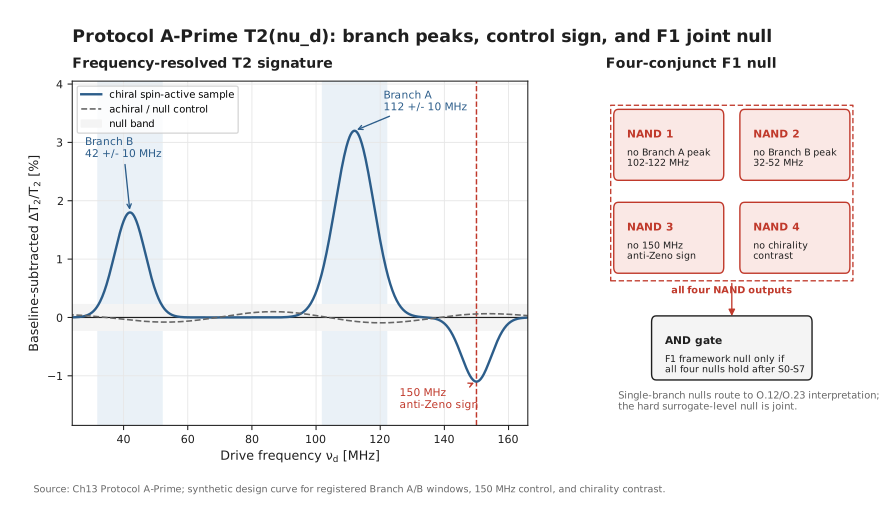
The minimal framework-level falsifiable signature is the joint pattern at — three independent observables that distinguish chiral-DOS-modified Zeno protection from (i) absence of any peak in both registered branch windows after the required scans, (ii) generic non-chiral Zeno freezing, or (iii) symmetric enhancement at both the branch center and the MHz control. The peak amplitude is reported as O.23 + O.24 conditional; the bare strong-coupling parameter alone is the strong-coupling signature, not the enhancement.
Registered peak prediction and scan rule: Protocol A-Prime is frozen as two pre-registered branches, not as a mutable single endpoint. Primary branch A: scan - MHz ( MHz) at kHz, require the S0-S7 systematics package, retain MHz as the anti-Zeno control, and apply the multiplicity-aware power calculation below. Geometric sibling branch B: scan - MHz ( MHz) at the same step size and S0-S7 acceptance checks, with an independently frozen branch-B budget before any F1 decision is declared. Branch A is the primary GCT 100-MHz prediction; Branch B is the geometric sibling for O.12-negative outcomes, where suppression of the primary line shifts the peak to the 42 MHz sub-harmonic. Both branches are included in the preregistration package before unblinding; branch selection is not allowed to be inferred from observed A-Prime data.
Multiplicity-aware peak statistic: The primary scan statistic is a locally weighted likelihood-ratio test comparing a Lorentzian peak model against a flat local baseline for . The primary smoothing window is fixed at kHz around each tested center frequency (41 bins at 5 kHz spacing); edge bins use the same window width after truncation is recorded in the analysis log. The required joint scan covers the full - MHz band at kHz spacing: frequency bins across each of six drive/chirality/control cells, so the look-elsewhere factor is . The registered global gate uses for the family-wise test, giving before Bonferroni correction is applied back to the reported global value. The budget retains the conservative local normal deviate from the preregistration package, yielding shots per frequency/bin cell for and a full six-cell joint-scan budget of total shots before re-runs. If the maximum likelihood-ratio statistic over the full scan is below the threshold for global significance after the look-elsewhere correction, the registered outcome is a scan-level null; only the joint Branch A + Branch B null can trigger F1.
Decision Matrix (pre-registered, three-tier Popperian) — chirality-contrast variant:
Outcome Joint signature Verdict GCT Supported (a) at a registered branch center (Branch A MHz or Branch B MHz) exceeds at on chiral substrate after the required branch scan, AND (b) at , AND (c) chirality contrast at Chiral-DOS-modified Zeno protection supported; peak amplitude reports O.23 + O.24 closures Generic / Non-Geometric Enhancement at on both chiral and achiral substrates with no structure GCT-specific chiral mechanism falsified; generic Zeno mechanism survives but does not select GCT Frequency-specific, chirality-null (a) and (b) positive, but (c) null after S1 + S6 chirality acceptance checks pass Chiral handle fails; routes to O.12/O.24 frequency-specific Zeno benchmarking rather than framework-level support Chirality-only / control-failed (c) positive, but either (a) or (b) fails after the registered scan and RF/systematic controls pass CISS contrast detected without the protected-subspace Zeno pattern; not GCT support and not an F1 framework null Sensitivity-limited mixed outcome Any component null before its preregistered acceptance checks pass (RF flatness, cap chirality, NV-depth, or batch reproducibility) Inconclusive; re-power or re-run the affected component before applying F1 Framework-level null No non-monotonic peak in Branch A, no non-monotonic peak in Branch B, no 150 MHz anti-Zeno sign, and no chirality contrast after all acceptance checks pass F1 falsifies the GCT chiral phonon-polariton Zeno mechanism at the NV-centre surrogate level [!IMPORTANT] Formal Preregistration Statement — Protocol A-Prime
The qualitative joint signature above is the registered Tier 2 prediction. The peak amplitude (whether exceeds , , or ) is the empirical measurement of the closure values of Open Problems O.23 and O.24, not a separately registered Tier 2 quantity. The frozen NV ensemble is implanted NV centers per cap across caps; CISS contrast mapping therefore uses NV-center observations rather than a mutable single-cap ensemble size. Shot noise scales as . A clean three-component positive signal at confirms the chiral phonon-polariton + Zeno-subspace mechanism with whatever amplitude the measurement delivers; mixed outcomes are interpreted per the Decision Matrix, and only the fully accepted joint null triggers F1.
Joint-gate sample-size calculation. For a normalized single-shot contrast estimate with Gaussian shot noise, a one-component gate with 80% marginal power uses where is the fractional effect size after the S0-S7 systematic budget. The conservative pre-registered effect sizes are for the non-monotonic selected-branch peak, for the chirality contrast after cap-purity, transfer retention, and NV-depth dilution, and for the 150 MHz anti-Zeno / frequency-specificity sign. Therefore: These design effect sizes (, , ) are locked by the blinded pilot calibration before unblinding the decisive run. If the pilot lower edge falls below the registered values, the affected component is sensitivity-limited and must be re-powered rather than treated as a clean F1 falsification. Under the independence approximation, three 80% marginal components give only joint power. The preregistered 80% joint-power design therefore uses 93% marginal power per component (), giving , , and per relevant fixed-frequency cell. The full 32-200 MHz fine scan supersedes the fixed-frequency number: with trials, the multiplicity-aware peak requirement is shots per frequency/bin cell for the same 80% joint-power design. Across bins and six cells this gives a minimum full-scan acquisition of approximately shots before failed acceptance checks or re-runs. At a 1 kHz single-shot cadence this is about 286 h of raw integration; with realistic CPMG reset, RF-settling, and blinding overheads of 10-100 ms per shot the pooled 20-center per-cap operational budget is of order several days to weeks per cap-depth campaign. The contrast is a sensitivity-design target locked after the achiral/chiral pilot calibration; if the measured CISS lower edge or transfer-retention factor erases this contrast, the chirality component is sensitivity-limited and the acquisition must be re-powered rather than treated as a clean F1 falsification. Joint power is calculated from the three marginal powers under the independence approximation [Tier 3]; correlations among S0-S7 systematics are reported in the analysis notebook and widen the confidence interval rather than changing the F1 gate.
Deterministic CISS contrast mapping. Required shot count uses the frozen ensemble convention: caps and implanted NV centers per cap contribute NV-center observations. The cap-level CISS variable is measured before unblinding by CD/VCD chirality verification plus transport spin-polarimetry per cap, but the clean F1 chirality input is the post-transfer effective product and must be established at confidence across the 50 caps/witness stacks for a clean F1 run. Shot noise therefore scales as with photon-count unit. The per observation count is
=\frac{4.20\times10^{-2}}{(P_{\rm eff}\cdot0.05)^2} =\frac{16.8}{P_{\rm eff}^2}.$$ Equivalently, the total pooled acquisition cycles across the 1000 NV-center observations are $$N_{\rm cycles}^{\rm total}=N_{\rm caps}N_{\rm NV}N_{\rm shots}^{\rm per\,obs}=\frac{1.68\times10^4}{P_{\rm eff}^2}.$$ Here the numerator uses the declared 5σ clean-run gate with the same 93% marginal-power convention as the three-component design, $(5+1.48)^2\approx42.0$; the 95%/80% comparison convention does not set this gate. For effective polarization band $P_{\rm eff}\in[0.05,0.20]$, this gives total cycles $6.70\times10^6$ ($P_{\rm eff}=0.05$), $1.68\times10^6$ ($P_{\rm eff}=0.10$), and $4.20\times10^5$ ($P_{\rm eff}=0.20$), with per-observation counts lower by $10^3$. At the declared $P_{\rm eff}=0.025$ sensitivity floor, the total-cycle requirement is $2.69\times10^7$ (about $2.69\times10^4$ shots per center-observation), still below the $10^9$ cycle ceiling; below this floor the chirality component is sensitivity-limited by cap polarization/systematic reproducibility, not treated as a clean F1 falsification. If only the source-material value $P_{\rm CISS}^{\rm net}$ is known, the re-powering uses the retained product: $r_{\rm transfer}=0.5$ increases the shot/cycle requirement by $4\times$, and $r_{\rm transfer}=0.1$ increases it by $100\times$. **CISS floor interpretation.** | Measured post-transfer $P_{\rm eff}=r_{\rm transfer}P_{\rm CISS}^{\rm net}$ | Interpretation | Action | | :--- | :--- | :--- | | $\geq 0.1$ | S1 systematic floor for clean F1 falsification | The declared shot budget can deliver the chirality component of the joint F1 gate. | | $0.025 \leq P_{\rm eff} < 0.1$ | Sensitivity-Limited Pending Re-Powering | The run can be re-powered by increasing shots with $N_{\rm shots}\propto1/P_{\rm eff}^2$, but the declared run cannot deliver a clean falsification at the declared shot budget. | | $<0.025$ | Sensitivity-limited floor | Below this floor the result is sensitivity-limited, NOT a falsification. | **Protocol record:** Analysis pipeline specifies (a) NV center depth and isotopic purity, (b) RF drive amplitude and pulse sequence, (c) statistical threshold for significance ($p < 0.003$, corresponding to $3\sigma$), and (d) blinding procedure for the crossover frequency measurement. Any deviation from these parameters constitutes a separate protocol amendment. **Public preregistration archive.** Before unblinding, the protocol package is deposited in a public timestamped archive (OSF or Zenodo, with optional arXiv protocol note) containing the frozen analysis code, synthetic-data budget, NV-depth/isotopic-purity acceptance files, RF-drive grid, S0-S7 systematic gates, and the amendment ledger. Any parameter change after deposit is recorded as a numbered amendment with timestamp, rationale, and the blinded/unblinded state of the affected data. **Executable-readiness qualifier.** Protocol A-Prime is a prospective preregistration design until the verifier script, synthetic-data package, analysis-code hash, operating-system/environment manifest, and OSF/Zenodo archive URL are frozen together before unblinding. Before that freeze, P.8 is not an executable decisive falsifier; it is the authoritative design specification for the frozen package. **Falsification conditions (two-level, pre-registered):** **F1 framework-level falsification gate (Protocol A-Prime, single rule).** F1 is falsified if and only if all four conjuncts hold after the frozen S0-S7 acceptance checks pass: (a) NO peak detected in the Branch A $112 \pm 10$ MHz window, (b) NO peak detected in the Branch B $42 \pm 10$ MHz window across the full required scan band $32$-$200$ MHz, (c) NO anti-Zeno sign at the $150$ MHz control, and (d) NO chirality contrast against the achiral control using $> 99.9\%$ isotopically pure $^{12}$C diamond. Branch A is the primary GCT 100-MHz prediction; Branch B is the geometric sibling for O.12-negative outcomes ($\eta_{\rm Zeno}$ suppression of the primary line shifts the peak to the 42 MHz sub-harmonic). A Branch A/B-only null is the peak-subtest null, not a framework falsifier; the framework gate is the four-part joint null at the required $\delta\chi + N_{\rm shots}$. **This is the sole framework-level falsification gate.** S0 systematic floor: $\Delta_{ST}/h$ of the Trp radical pair must lie inside the 5-200 MHz admissible tubulin-EPR band before the branch-frequency decision is treated as decisive; outside that band the run is sensitivity-limited or routes to O.12/O.23 branch re-estimation, not framework-level falsification. Under F1 falsification, the CISS channel is only a fallback candidate requiring its own tubulin-specific transport/redox calibration; it is not by itself sufficient to preserve the Level-II substrate claim. **(F2) Peak-amplitude readout (distinct from F1).** Conditional on a positive joint $(a) + (b) + (c)$ signature satisfying F1 at $3\sigma$, the peak amplitude is reported as the empirical readout of the joint O.23 + O.24 closure values. It is not a separately registered falsifier. A low-amplitude positive signature points toward a weaker or non-DFS-mediated O.23 closure path; a high-amplitude positive signature points toward protected-subspace pinning in the $[10^2,10^3]\times$ positive-O.23 band. F2 never triggers the F1 fallback to §13.2.5. Between F1 and F2 — any measurement yielding a positive joint signature, across amplitudes from below-bare through the positive-O.23 $[10^2,10^3]\times$ band — the experiment serves as the empirical readout of the joint $(\Omega_{\text{DFS}}, \kappa_{\text{chiral}})$ closure of Open Problems O.23 + O.24, with the specific number tightening the Tier 3 inputs into Tier 2 fits. **§13.3.5.S Systematic-Error Budget [pre-registered]** The Protocol A-Prime pre-registration matches the §16.3.4 Protocol D rigor in disclosing the dominant systematic uncertainties on the joint $(a) + (b) + (c)$ signature. Seven systematics are enumerated below; each is paired with the dominant effect it produces, the propagation chain into the falsification gate, and the operational mitigation. The pre-registered systematic budget is committed before unblinding alongside the F1/F2 falsification statements above. | Source | Effect on $(a) + (b) + (c)$ signature | Magnitude band | Mitigation | | :--- | :--- | :--- | :--- | | **(S1) Chiral h-BN cap chirality-purity** | Reduces chirality contrast (component c); a partially-racemic cap or post-transfer stack with $P_{\rm eff}=r_{\rm transfer}P_{\rm CISS}^{\rm net}<0.1$ collapses the chiral-vs-achiral contrast into the $3\sigma$ noise band, producing false-null on (c) even with a real GCT mechanism present at the declared shot budget. | Naaman-Paltiel-Waldeck 2019 *Nat. Rev. Chem.* 3:250 places CISS polarization up to $\sim60\%$ in ordered-helical DNA stress-test substrates, while protein/peptide systems sit in the operative $5$–$20\%$ band; the source cap-substrate $P_{\rm CISS}^{\rm net}$ is the *enantiomer excess × per-helix polarization*. $F_{\rm CISS}=2.0$ is a Tier 3 model translation from measured $P_{\rm CISS}$ spin-polarization; see App X §X.11.1 for the protein-band $P_{\rm CISS}\in[0.05,0.20]$ and DNA-equivalent stress edge $P_{\rm CISS}\approx0.6$. A racemic cap ($ee = 0$) gives $P_{\rm CISS}^{\rm net} = 0$; $ee = 50\%$ at the DNA stress edge gives $P_{\rm CISS}^{\rm net} \approx 0.3$ before transfer. Effect-size impact scales linearly with the retained product $P_{\rm eff}$. | **Inclusion criterion for clean F1:** measured $P_{\rm eff}\geq0.1$ AND $ee \geq 90\%$. Pre-unblinding measurement: spin-polarimetry on the h-BN/NV cap pair using CD/VCD chirality verification plus either $\mu$SR rotation of injected polarized muons or two-terminal magnetoresistance with a reference unpolarized contact at 4 K; CD/VCD is necessary but not sufficient. $P_{\rm eff}$ must be measured $\geq0.1$ with $\geq5\sigma$ confidence before Branch A/B unblinding. For $0.025 \leq P_{\rm eff}<0.1$, the chirality component is Sensitivity-Limited Pending Re-Powering with $N_{\rm shots}\propto1/P_{\rm eff}^2$. For $P_{\rm eff}<0.025$, the result is sensitivity-limited, not a falsification. CD/VCD spectroscopic verification of $ee \geq 90\%$ is required before each Protocol A-Prime run; a cap with $ee < 90\%$ is excluded. Achiral control uses CD-confirmed racemic h-BN. **Dominant systematic if the cap is sourced from synthesis without CD verification — falsifies component (c) reproducibility without falsifying the framework.** | | **(S2) NV depth jitter** | Modulates the NV–cap distance, which sets the dipolar-coupling strength of the CISS-mediated chiral phonon-polariton handle. NV depth shifts of $\pm 2$ nm at a nominal 10 nm depth modulate the coupling by $\pm 30\%$ (dipolar $1/r^3$ falloff). | NV implantation depth standard deviation typically $\sigma_d \in [0.5, 2]$ nm depending on implantation energy and annealing protocol; $\sigma_d = 2$ nm gives a per-sample variance on the joint (a)+(b) amplitude of $\pm 30\%$. | Pre-registration requires NV depth characterization via secondary-ion mass spectrometry (SIMS) calibration on a control batch from the same implantation lot, with the $\sigma_d$ reported as the leading systematic on the (a)+(b) amplitude scaling. Statistical pooling across the frozen $N_{\rm NV}=20$ NVs per cap averages out the depth jitter to $\pm 30/\sqrt{20} \approx 7\%$ before the 50-cap CISS contrast aggregation is applied. | | **(S3) RF amplitude calibration drift across 20–250 MHz sweep** | Modulates the Rabi-frequency-dependent measurement of $T_2(\nu_d)$, producing apparent $T_2(\nu_d)$ structure that mimics component (a) at the few-percent level if the RF amplitude is not flat across the sweep. | Standard NV-AC-magnetometry pulse-shaping drift across a 20–250 MHz sweep is $\pm 5\%$ in pulse area; this propagates to a $\pm 5\%$ apparent $T_2(\nu_d)$ feature that is *not* a real GCT signal. | Pre-registration requires an *RF amplitude flatness calibration sweep* on a reference NV (single-NV regime, no chiral cap) before each Protocol A-Prime run, with the residual RF flatness $< 2\%$ as the acceptance condition. The reference-NV sweep is reported with the protocol and subtracted from the chiral-cap measurement at the lock-in stage. | | **(S4) Hahn-echo $\pi$-pulse fidelity** | A $\pi$-pulse fidelity below $0.99$ produces a baseline $T_2$ shortening that scales with the number of refocusing pulses in the CPMG sequence; this baseline shift can mask or mimic component (a) at the $3\sigma$ level when the pulse train is long. | NV-centre $\pi$-pulse fidelities of $0.98$–$0.999$ are routinely achievable with optimized control pulses; a fidelity of $0.99$ over $N = 100$ pulses gives $\sim 1$% baseline $T_2$ shortening per pulse train, accumulating to a baseline shift of $\sim 10\%$ over the full CPMG sequence. | Pre-registration requires randomized-benchmarking measurement of the $\pi$-pulse fidelity on a reference NV before each Protocol A-Prime run, with the fidelity $\geq 0.99$ per pulse as the acceptance condition. The CPMG-baseline shift is computed from the measured fidelity and subtracted from the $T_2(\nu_d)$ scan. | | **(S5) Floquet sideband artefacts** | The registered $\nu_c$ Zeno drive at the magnon-polaron avoided crossing can produce Floquet sidebands at $\nu_d \pm n\,\nu_{\rm sideband}$ for $n \in \mathbb{Z}$, which can mimic the non-monotonic $T_2(\nu_d)$ peak (component a) at frequencies offset from $\nu_c$ if the sideband structure is not characterized. | Floquet sideband amplitude scales with $(g_{\rm drive}/\omega_d)^2$ and produces apparent $T_2(\nu_d)$ features at $\nu_d \pm \nu_{\rm hyperfine}$ with amplitudes up to $\sim 10\%$ of the main feature for strong drives. | Pre-registration requires a *Floquet-sideband characterization scan* on the achiral control substrate first (sidebands appear as $T_2(\nu_d)$ structure independent of chirality), with the sideband positions and amplitudes catalogued before the chiral measurement. The chiral measurement is then masked at the sideband frequencies to prevent false-positive component (a) attribution. | | **(S6) Sample-batch chirality reproducibility** | Run-to-run variation in the CISS-cap synthesis batch produces between-run amplitude variation on component (c) (chirality contrast) at the $10$–$20\%$ level even with $ee \geq 90\%$ per (S1). | Synthesis-batch reproducibility on chiral h-BN under standardized CVD conditions is typically $\pm 15\%$ on the per-helix polarization, propagating to $\pm 15\%$ between-run variation on the chirality-contrast amplitude. | Pre-registration requires *three independent synthesis batches* of the chiral cap, each with CD verification, with the chirality-contrast amplitude reported as the mean ± SD across batches. The $3\sigma$ falsification gate on component (c) is evaluated against the inter-batch SD, not the single-batch SD. **Dominant systematic on the chirality-contrast amplitude reproducibility — analogous to the $^{17}$O enrichment efficiency in Protocol D §16.3.4 (the framework-internal load-bearing systematic).** | | **(S7) Cap-to-NV transfer and post-transfer CISS retention** | A cap that passes standalone chirality/CISS metrology can lose effective spin-selective coupling after transfer, bonding, contamination, strain, or NV-surface processing; this produces a false null on chirality contrast and can reduce the observed $\delta\chi$ without invalidating the pre-transfer cap measurement. | Transfer-induced CISS retention is treated as a multiplicative uncertainty on the chirality term. The retained factor $r_{\rm transfer}$ must be measured on witness h-BN/NV stacks; otherwise $\delta\chi$ is reported with an added transfer-uncertainty multiplier and the run cannot support clean F1. | Pre-unblinding acceptance requires witness-stack spin-polarimetry or magnetoresistance on the actual transferred cap/NV process flow, not only on source material. Clean F1 requires $r_{\rm transfer}P_{\rm CISS}^{\rm net}\ge0.1$ with $\ge5\sigma$ confidence; $0.025\le r_{\rm transfer}P_{\rm CISS}^{\rm net}<0.1$ is sensitivity-limited and requires re-powering; below $0.025$ is not a framework falsification. | **Dominant systematic identification:** The chiral h-BN cap chirality-purity (S1), sample-batch reproducibility (S6), and cap-to-NV transfer retention (S7) jointly carry the bulk of the systematic uncertainty on the chirality-contrast component (c) of the joint signature. A null on (c) at $3\sigma$ that is *not preceded by S1 + S6 + S7 verification* is interpreted as **inconclusive on the chirality-contrast component, not as a framework falsification under F1**. Verification of S1 (CD spectroscopy $ee \geq 90\%$), S6 (three-batch reproducibility), and S7 (post-transfer CISS-retention metrology on witness stacks) before the Protocol A-Prime run is the pre-registered acceptance condition for a clean F1 falsification test on component (c). The (S2), (S3), (S4), (S5) systematics carry the bulk of the uncertainty on components (a) and (b) and are mitigated by the per-run reference-NV calibrations. *Cross-references:* §16.3.4 (Protocol D systematic-error budget — the rigor template); App F §F.5 (CISS empirical foundations); App H Open Problem O.23 (chiral phonon-polariton DFS substrate-side closure path); App H Open Problem O.24 (Protocol A-Prime amplitude under O.23 closure).
§13.3.5.A Protocol A-Prime Extended: Chiral vs. Achiral NV-Centre Comparison
Objective: Test directly whether the anomalous feature in the registered MHz window requires a chiral molecular environment (GCT prediction, via CISS) or is substrate-agnostic.
Physical Setup:
GCT's CISS-dependent mechanism predicts:
- NV centres + L- or R-chiral h-BN cap: Chiral environment → net CISS → spin-selective transport → Zeno Lock active. Predicted amplitude disposition: the registered MHz feature is sign-positive on the chiral cap, with magnitude measured as the empirical readout of O.23/O.24. Positive O.23 closure predicts in the range via the chiral-DOS modification + protected-subspace pinning chain; negative O.23 closure predicts only the qualitative sign feature, with amplitude allowed below the bare baseline under the polariton-dephasing bound. The amplitude is not the framework-level falsification threshold.
- NV centres + achiral h-BN cap (racemic): No net CISS. Predicted: (no change).
| Substrate | CISS Active? | GCT T₂ at MHz | IIT / Null Prediction |
|---|---|---|---|
| NV in diamond (bare) | No | Baseline T₂ (reference) | Baseline |
| NV + achiral h-BN | No | ≈ Baseline T₂ | ≈ Baseline |
| NV + L-chiral h-BN | Yes | Non-monotonic registered peak; amplitude measured as O.23/O.24 readout | ≈ Baseline |
| NV + R-chiral h-BN | Yes (opposite hand) | Non-monotonic registered peak; amplitude measured as O.23/O.24 readout | ≈ Baseline |
Table note. The framework-level falsification gate is the joint qualitative signature at per the §13.3.5 Decision Matrix. Peak amplitude is the empirical readout of the O.23 + O.24 closures: positive O.23 closure predicts the band, while negative O.23 closure permits a sign-positive feature with amplitude below the bare baseline.
The enhancement magnitude must be symmetric under chirality reversal (L vs R give the same absolute enhancement; the Zeno locking direction may differ but the coherence time magnitude is identical). Asymmetry in magnitude would indicate a mechanism other than CISS.
Why NV Centres: –ms matches Tubulin Trp radical pair target; NV array density and spacing are controllable; diamond + h-BN capping is established nanofabrication technology. Timeline: 2–5 years, executable only after preregistration verifier/package freeze and the S0-S7 acceptance files are locked.
Public preregistration deposit required before unblinding the chiral vs. achiral comparison. The OSF/Zenodo timestamp, frozen code hash, synthetic-data budget, S0-S7 acceptance files, and amendment ledger are part of the protocol record.
Cross-reference: §13.3.5 (Protocol A-Prime baseline), App X §X.7, and the Protocol E registry row in Chapter 17.
§13.3.6 Protocol A-Tertius: Macroscopic Leggett-Garg Inequality Test for the Tubulin Tryptophan Zeno Drive
Objective. To prove that the registered MHz Zeno drive in the tubulin Tryptophan radical pair network maintains true quantum coherence—not merely classical stochastic behavior mimicking coherent enhancement—a macroscopic Leggett-Garg Inequality (LGI) test is proposed for the Trp radical pair spin states.
The Leggett-Garg Framework. The Leggett-Garg Inequalities (Leggett & Garg, 1985) constrain the temporal correlations of a macroscopic two-state system under the assumptions of macrorealism (the system is in a definite state at all times) and non-invasive measurability (measurement does not disturb the state). For a dichotomic observable , the temporal correlation functions must satisfy:
Any classical stochastic process satisfies this inequality. Quantum mechanics allows (up to a maximum of for a qubit), signaling genuine quantum superposition across the temporal interval.
Application to the Tubulin Trp Zeno Drive. In the GCT Zeno drive, the spin observable is the singlet-triplet parity of the Tryptophan radical pair:
At the registered Zeno resonance frequency MHz, the radical pair is Zeno-locked into the Singlet branch. The GCT prediction is that this locking is maintained by genuine quantum coherence, not by a classical stochastic pumping mechanism. Under quantum coherence, the Trp spin state evolves as a superposition between measurement events, and the temporal correlations must violate the LGI bounds.
Protocol Specification. Three measurements at times separated by integer multiples of the Zeno period ns at the central registered peak:
- , ns, ns.
Spin state readout uses optically-detected magnetic resonance (ODMR) as the registered primary technology on the Trp radical-pair / chiral-NV surrogate system. Transient absorption is retained only as a secondary technology-development cross-check and is not part of the primary preregistered decision rule. The "clumsiness loophole" is addressed by using a weak-measurement protocol (e.g., quantum non-demolition coupling) at and .
A-Tertius systematic-error budget (registered for the ODMR readout):
- (S1) Detector back-action band: ODMR optical power and microwave pulse amplitude are swept on achiral controls; accepted runs must keep back-action-induced bias below .
- (S2) Timing jitter: timing uncertainty must remain ns at the ns spacing so that and do not smear the registered branch phase.
- (S3) Estimator bias floor: the frozen estimator is calibrated on simulated classical Markov data and on achiral controls; residual estimator bias must be below .
- (S4) Measurement-invasiveness model: weak-measurement disturbance is reported as a Tier 3 model parameter and bounded by control-sequence reversibility; if the inferred invasiveness correction exceeds the predicted , the run is labelled inconclusive rather than decisive.
GCT Prediction [Tier 2 sign pattern + Tier 3 branch/magnitude]. Under the Zeno-coherent regime ( MHz on the primary branch, or the registered MHz sibling branch if O.12 closes negative), the temporal correlator must satisfy: with a nominal branch-specific violation magnitude , where and enter through the Tavis-Cummings + Floquet protected-subspace coupling. The sign pattern and is the Tier 2 qualitative gate; the branch value and effect size are Tier 3 pending O.12/O.23 closure. Any larger measured excess is reported as an O.12/O.23 amplitude readout. At the off-resonance Anti-Zeno frequency ( MHz), the Zeno lock is broken, the spin state classicalizes, and LGI violations must be absent ().
Decision Matrix (Pre-registered, Binary Popperian).
| Measurement | GCT Prediction | Classical/IIT Null |
|---|---|---|
| at the registered branch window ( MHz or MHz) | (LGI violated) | |
| at 150 MHz (Anti-Zeno) | (no violation) | |
| at , deuterated Trp | Reduced violation () | No change |
The differential LGI test between the registered branch window (Zeno-locked) and 150 MHz (Anti-Zeno control) provides a binary falsification gate: if , the Zeno drive operates by classical stochasticity, not quantum coherence, and the GCT biophysical mechanism is falsified at the single-radical-pair level.
Falsification Condition. A null result ( at the registered branch resonance window) at significance in a system with isotopically pure C/H tubulin falsifies the protected-subspace LGI branch of the GCT quantum Zeno mechanism. A confirmed LGI violation near the branch resonance window, absent at 150 MHz, would support a Tier 2 qualitative coherence-sign pattern; the specific branch value and violation magnitude remain Tier 3 pending O.12/O.23 closure.
Pre-registration package for P.8c (Protocol A-Tertius LGI gate).
- Predicted observable: the blinded primary endpoint is with the registered sign pattern , , and deuterated-Trp suppression of the excess.
- Threshold: pass requires the 99% one-sided confidence interval for to be positive and the 99% two-sided confidence interval for to include or fall below zero. Falsification requires at after multiplicity correction.
- Sample size: the acquisition plan targets valid triplets per condition (, 150 MHz, deuterated , and no-drive control), with equal allocation across at least 12 independently prepared biological or synthetic radical-pair samples. This preserves the registered contrast/power budget for the Tier 3 nominal effect size ; any smaller pilot readout contrast requires re-powering before the Holm-corrected decision is declared.
- Blinded/unblinded path: pulse-frequency labels and isotope labels remain blinded during acquisition, artifact rejection, and first-pass estimator fitting. Unblinding occurs only after the locked analysis script emits the per-condition estimates, bootstrap confidence intervals, clumsiness-loophole diagnostic, and exclusion log.
- Decision rule: GCT passes the P.8c qualitative gate only on the joint + + deuterated-suppression sign pattern. It fails the protected-subspace LGI branch on a corrected null. Mixed cells are inconclusive and route to O.12/O.23 sensitivity benchmarking rather than validation.
- False-positive budget: family-wise across the three primary contrasts using Holm correction; the decisive joint gate uses the powered per-condition acquisition for . All exploratory frequency-bin scans are secondary and cannot replace the registered /150 MHz contrasts.
Cross-reference: §13.3.5 (T₂ enhancement Protocol A-Prime), §13.4.3b (Lindblad master equation treatment), V1 §17.1.2b (Tubulin Tryptophan network).
13.4 Thermodynamic Constraints on Coherence
13.4.1 The Landauer Limit and Zeno Energy Balance
Critics of quantum biology correctly identify Thermal Noise () as the primary obstacle. At K, the decoherence time of a dipole in bulk water is s. According to Landauer's Principle, the minimum power required to erase the entropy generated by sampling constrains the operating regime of the Zeno Drive.
13.4.2 Heat-Sink Closure Status
The thermodynamic heat-sink mechanism for the Zeno energy-balance remains an Open Problem; see App H O.34. Our thermodynamic audit reveals that operating at 100 MHz would consume astronomically more power than the nW [Tier 3 — neurophysiology measurement] metabolic budget of a neuron allows. Thus, the Landauer limits force the Agent to operate in the 100 MHz Nuclear Spin regime. In this regime, the 1 nW limit rigidly constraints the maximal coherent state to qubits [Tier 3 — Landauer-budget estimate]. 13.4.3b Lindblad Treatment of the Tubulin Trp Open Quantum System [Tier 3]
To formalize the open-system dynamics of the Trp radical pair at 310 K we deploy the Lindblad master equation:
where contains the hyperfine mixing , Hz [Tier 3 — model-derived import/extrapolation from cryptochrome/FAD-Trp radical-pair systems and microtubule radical-pair models; direct β-tubulin EPR/ODMR remains O.24] is the bare thermal spin decay, and s is the spin-selective recombination rate [Tier 3 — Trp radical-pair chemistry]. Here , and is defined as a jump from the radical-pair spin manifold into an explicit product/sink state (e.g. , with channel sums when singlet/triplet products are both retained). On the enlarged radical-plus-product Hilbert space this is a CPTP Lindblad evolution; if the product/sink sector is traced out and only unrecombined radical pairs are retained, the reduced radical-pair equation is a trace-nonincreasing conditional master equation.
In the strong-coupling continuous-measurement limit (Facchi & Pascazio 2008 J. Phys. A 41:493001 §13.3), a dissipator of rate pinning a system into one of its eigenspaces suppresses leakage from the protected subspace at a rate , where is the off-diagonal coupling to the leakage channel. Unit guard: and are cyclic frequencies in Hz; and Lindblad rates are angular rates in rad/s. The dissipative-Zeno comparison converts with before comparing or squaring rates. Applied to the Trp recombination dissipator with rad/s (proton hyperfine band) and s, this gives
i.e., the dissipative-Zeno scaling recovers the same order-of-magnitude estimate as the pulsed Misra-Sudarshan formula of §13.4.3. The radical-pair recombination channel acting alone — whether interpreted as a continuous Lindblad dissipator or as a stroboscopic projective measurement — does not extend the Trp coherence time to the 10 ms scale required by Protocol A-Prime / Protocol D.
Required shielding factor. The Trp radical pair lives inside the hydrophobic pocket and is not in bulk water; its decoherence channel is the singlet-triplet hyperfine interaction, with a model-derived imported baseline –s extrapolated from cryptochrome/FAD-Trp systems and radical-pair models rather than direct β-tubulin measurement (Ritz et al. 2000; Hore & Mouritsen 2016; O.24). The Selection-required target is ms (Protocol A-Prime). The shielding factor is therefore
The shielding figure occasionally quoted in the warm-decoherence literature compares the polaron to bulk water decoherence ( s) rather than to the polaron's own in-vitro baseline; the relevant gap for GCT is , not . Closing this gap is the load-bearing mechanism question, and is the subject of §13.4.4, §17.1.3c, and Open Problem O.23.
13.4.3 Tubulin Tryptophan Aromatic Radical Coherence
Standard bulk water decoherence timescales ( s) define the thermal decoherence limit for unbound spins. The tubulin Trp radical-pair -s baseline is a model-derived estimate (Tier 3) extrapolated from cryptochrome FAD-Trp radical-pair magnetoreception studies (Ritz et al. 2000; Hore & Mouritsen 2016) and microtubule radical-pair theoretical models (Zadeh-Haghighi & Simon 2022). Direct EPR/ODMR measurements on intact β-tubulin Trp radical pairs have NOT been performed; this is registered as Open Problem O.24 (closure target: Protocol A-Prime in-vitro measurement). The mechanism by which this baseline is extended to the ms scale required for Selection is the load-bearing open question of §13.4.4–§13.4.5 and §17.1.3c, registered as Open Problem O.23 in Appendix H.
The Misra-Sudarshan formula and its applicability range [Tier 1 statement / Tier 3 application to Trp].
The Misra-Sudarshan quantum Zeno theorem (Misra & Sudarshan 1977, J. Math. Phys. 18:756; reviewed in Facchi & Pascazio 2008, J. Phys. A: Math. Theor. 41:493001 §2.1) states that, for a quantum system prepared in and subjected to projective measurements at interval , the effective decay rate in the short-interval limit is
where the Zeno time is defined by the variance of the interaction Hamiltonian in the initial state:
Here is reported in the cyclic-frequency convention (Hz, ). Equivalently, the angular convention would use and ; this chapter and the engine use the cyclic convention for the registered bare Misra-Sudarshan numbers.
Equivalently, the effective coherence time is . The formula is valid in the quadratic-decay regime ; for the system enters the inverse-Zeno regime in which frequent measurement accelerates decay (Facchi & Pascazio 2008 §2.2.5, eq. 19).
The Zeno time and the exponential decoherence time are distinct physical quantities and cannot in general be identified: is the convexity scale of the short-time survival probability (set by ), while is the long-time exponential dephasing rate (set by spin-bath spectral density). The two are related only via the crossover relation .
For the Trp radical-pair singlet, the relevant is the singlet–triplet hyperfine mixing . The canonical engine value for the bare radical-pair variance is MHz (cyclic-frequency convention), so the Zeno time is
The bare Misra-Sudarshan formula evaluated at the canonical ns measurement benchmark gives
This out-of-quadratic-regime diagnostic extrapolation of the single-pair bare Zeno formula is far below the ms conservative target required by Protocol A-Prime (§13.3.5) and Protocol D (Chapter 16), and about three orders below a s lower operative benchmark. The Misra-Sudarshan formula applied to the bare radical-pair Hamiltonian alone does not close the in-vitro-to-in-vivo coherence gap. The closure mechanism is the load-bearing physics question of the following subsections (§13.4.4 dissipative-Zeno scaling; §17.1.3c chiral phonon-polariton Decoherence-Free Subspace) and is registered as Open Problem O.23.
13.4.4 Spin-Selective Radical Recombination [Tier 3]
The candidate biochemical architecture is an ATP-coupled redox regeneration loop for Tryptophan (Trp) aromatic radical pairs in the β-tubulin hydrophobic pocket. The spin chemistry itself is standard radical-pair physics: the pair oscillates between Singlet (S) and Triplet (T) states via hyperfine coupling , and recombination back to the ground state is spin-selective, with the Singlet channel recombining at (100 MHz) while Triplet recombination is suppressed (Steiner & Ulrich 1989 Chem. Rev. 89:51). What is not yet established is the upstream biochemical pump that repeatedly prepares the Trp radical-pair state in tubulin under physiological conditions. ATP hydrolysis supplies the metabolic free-energy budget for the neural machinery and can in principle support local electron-transfer / redox cycling through mitochondrial and protein-pocket cofactors, but the explicit chain "ATP hydrolysis -> electron donor/acceptor reset -> beta-tubulin Trp radical-pair regeneration" is a closure target, not a demonstrated mechanism. The present chapter therefore treats ATP-coupled radical-pair regeneration as a Tier 3 candidate mechanism registered under App H Open Problem O.34; the load-bearing 100 MHz timescale remains the spin-selective recombination / hyperfine mixing timescale, not a derived ATP-hydrolysis clock.
A naive "WGM Cavity Bootstrap" reading of the 100 MHz signature — in which an acoustic cavity resonance at 100 MHz is imagined to project the spin state — is incorrect. A deterministic coherent coupling (cavity or otherwise) at 100 MHz produces reversible Rabi oscillations, not the irreversible state-pinning that an effective measurement requires. The spin-selective recombination, by contrast, is a genuinely non-unitary Lindblad channel that depletes the singlet population irreversibly; the question is whether this Lindblad channel produces an effective measurement with strong-Zeno scaling in the parameter regime realized for Trp at 310 K.
[!IMPORTANT] Operational status of the Zeno Drive coherence-extension mechanism. For parity with
protocol_decoherence_audit.py, the bare radical-pair audit reports the cyclic-rate diagnostic: MHz, MHz, , and s ( ns). Angularizing both rates shifts the estimate only by an order-one factor; a mixed convention is not used. This bare channel is well below the ms operational target and is outside the regime where it could close the Selection-relevant gap by itself. Closing the gap requires a protected-subspace mechanism that suppresses the off-diagonal coupling in the dissipative-Zeno scaling well below the bare hyperfine rate. The candidate mechanism is the chiral phonon-polariton Decoherence-Free Subspace of §17.1.3c, in which the orbital-angular-momentum mismatch between the chiral phonon-polariton mode (carrying OAM) and the symmetric thermal phonon bath (lacking OAM) suppresses the bath coupling by a topological factor. The O.23 collective-dressing verifier includes a rad/s versus cyclic-frequency convention audit; using consistently across the rate convention leaves the best collective branch below the ms target, while the apparent rescue from changing only is a mixed-units artifact. A first-principles derivation of the OAM-mismatch suppression magnitude that closes ms is registered as App H Open Problem O.23.
Two-layer architecture and substrate robustness. The CISS channel of §13.2.5 operates independently of long-lived radical-pair coherence, but it does not currently provide an all-temperature sufficiency floor. It is a Tier 3/Tier 4 physical-link candidate requiring chirality plus an available charge-transfer/transport handle such as interface asymmetry, a redox cycle, or electrode/contact coupling, and it must be calibrated in tubulin or a registered surrogate. Chirality is necessary but not sufficient for a CISS phason-winding channel on its own (Naaman, Paltiel & Waldeck 2019). The Zeno quantum enhancement layer is a multiplicative bonus conditional on closure of Open Problem O.23; if O.23 closes negatively, the remaining CISS pathway is a fallback candidate rather than a sufficient substrate verdict. The framework's substrate identification would then become "chirality-bearing molecular network with directly measured CISS phason coupling plus a separately validated coherence baseline," with the millisecond-scale coherence reframed as a target gated by Protocol A-Prime / Protocol D rather than a derived consequence of radical-pair chemistry.
Falsification condition. If pulsed EPR measurements on intact β-tubulin yield s under physiological conditions, the radical-pair coherence baseline is insufficient even before any coherence-extension mechanism is invoked, and the Zeno-quantum layer of §13.2.5 collapses to zero. The CISS channel would remain only as a calibrated fallback candidate, not as automatic sufficiency. A null result on Protocol A-Prime and Protocol D, combined with s on Trp radical pairs in vivo, jointly falsifies the consciousness-substrate identification of this chapter; Ch17 carries the substrate hard-fail commitment.
Phason thermal-margin prediction [Tier 3]. At physiological temperature, the biological thermal scale is eV. Protocol protocol_rashba_phason.py therefore registers as this thermal-noise scale, not as a separate eV-scale binding energy, and requires the candidate Rashba-phason coupling eV to exceed it by at least a factor of ten. Small thermal perturbations (fever, anesthetic disruption of the phason network) are treated as shifts in this thermal-margin condition and can degrade frozen-phason protection regardless of the coherence-extension mechanism that closes O.23. This is directly testable via the isotope anesthetic protocol (Chapter 16).
13.4.5 Partial Floquet-Lindblad Master Equation for the Open Zeno System [Tier 3]
The Misra-Sudarshan formula isolates the quantum system from its environment. To model the Tubulin Trp radical pair at 310 K coupled to a protein spin bath, the current manuscript uses a partial Floquet-Lindblad scaffold for the open quantum system (OQS) density matrix :
where the Floquet driving Hamiltonian is defined in energy units: with (so ) as the canonical bare Trp singlet-triplet variance and as the Zeno drive frequency. Equivalently, in angular-frequency units one may write and . The Protocol A-Prime branch frequencies ( MHz if O.12 closes positive; MHz if O.12 closes negative) are post-O.12 operating windows, not replacements for the bare value.
The environmental spin-bath coupling retained in this scaffold is defined by three Lindblad jump operators :
- (Thermal excitation)
- (Thermal relaxation)
- (Pure dephasing)
where detailed balance enforces and the dephasing rate is .
This is not the full dissipator set for hydrated tubulin at 310 K. Omitted channels include spin-selective singlet/triplet recombination into explicit product/sink states, hyperfine anisotropy, dipolar nuclear-spin bath fluctuations, vibrational relaxation of the Trp pocket, solvent/electrostatic noise, and any O.23 chiral-phonon-polariton dark-state jump structure. Those channels are closure targets for O.23/O.24 and Protocol A-Prime calibration, not solved inputs here.
Transforming into the Floquet rotating frame, the effective coherence time of the open driven system is modulated by an efficiency factor :
and the bare baseline is whichever coherence-extension mechanism closes Open Problem O.23 (the bare Misra-Sudarshan estimate of §13.4.3 alone gives ns from radical-pair recombination, well below the ms operational target; the candidate chiral phonon-polariton Decoherence-Free Subspace mechanism of §17.1.3c would, if O.23 closes positively, supply a to which the Floquet correction then applies).
At geometric resonance — drive frequency matching the singlet-triplet gap, — the detuning function , , and the open system attains the maximum value of whichever closure mechanism applies; off resonance the Floquet correction multiplicatively suppresses the result.
Prediction (Resonant Zeno Drive): GCT predicts the bare Floquet factor is maximized at . Protocol A-Prime tests both protected-subspace branch windows under the single F1 rule: Branch A at MHz and Branch B at MHz. A single-branch null routes to O.12/O.23 branch interpretation; the surrogate-level F1 gate requires the four-conjunct framework null after S0-S7 acceptance checks: no Branch A peak, no Branch B peak, no 150 MHz anti-Zeno sign, and no chirality contrast.
For a complete analysis of when the Zeno effect is reversed (anti-Zeno / inverse-Zeno regime) and why the registered A-Prime drive requires an O.23 protected subspace rather than the bare radical-pair Hamiltonian, see App X §X.7 and App X §X.12.
13.4.6 The Anti-Zeno Crossover as a Room-Temperature Consciousness Test [Tier 3]
The Prediction:
Quantum measurement theory (Misra & Sudarshan 1977; Facchi & Pascazio 2008 §2.2.5) separates the Zeno regime from the inverse-Zeno (anti-Zeno) regime at the crossover time , equivalently the crossover frequency
- For (Zeno regime): measurement suppresses decoherence — coherence time increases.
- For (Anti-Zeno regime): measurement accelerates decoherence — coherence time decreases.
The crossover depends on both the Zeno time (variance of the interaction Hamiltonian) and the exponential dephasing time . For Tubulin Trp radical pairs with canonical MHz [Tier 3 — proton hyperfine import; units: cyclic frequency Hz] and s [Tier 3 — model-derived extrapolation from cryptochrome FAD-Trp radical-pair magnetoreception studies (Ritz 2000, Hore-Mouritsen 2016) plus microtubule radical-pair theoretical models (Zadeh-Haghighi-Simon 2022); direct β-tubulin Trp EPR/ODMR measurement is the closure target of O.24], the bare crossover is GHz, above both registered A-Prime branch windows. This places the bare single-pair recombination in the anti-Zeno regime relative to the bare hyperfine Hamiltonian, consistent with the §13.4.3 conclusion that the radical-pair channel alone does not extend coherence.
The Zeno test below therefore probes the operative protected subspace of the in-vivo system, not the bare radical pair. If a chiral phonon-polariton DFS (§17.1.3c) supplies a suppressed effective angular coupling in the protected subspace, the operative cyclic Zeno time shifts upward and the crossover moves down into the kHz–MHz band; under that scenario the registered A-Prime window falls into the Zeno-protected side and an in-vitro extension is observable.
GCT Prediction (conditional on closure of Open Problem O.23): The 50 kHz condition is an auxiliary protected-subspace baseline, not a signed anti-Zeno prediction by itself. Under the O.23-positive branch, the registered A-Prime windows ( MHz for Branch A and MHz for Branch B) should show longer than the 50 kHz auxiliary readout after the F1 acceptance checks pass. No unconditional sign is assigned to 50 kHz; a null differential routes O.23 to negative closure only after the full Branch A/B scan and S0-S7 acceptance checks are satisfied. The experimental setup requires:
- Isolated tubulin or Tryptophan solutions
- A coil + lock-in amplifier covering 50 kHz and the registered branch scan windows (- MHz and - MHz)
- Standard pulsed EPR for measurement
Why this is better than Protocol D: Unlike the isotope substitution experiment (Protocol D), the Anti-Zeno crossover test:
- Requires no live neurons.
- Does not depend on whole-brain complexity.
- Provides a protected-subspace differential observable (does in either registered A-Prime branch exceed the 50 kHz auxiliary readout after S0-S7 acceptance checks?).
- Can be performed in a standard EPR lab.
Computational verification: The bare Misra-Sudarshan crossover is computed dynamically in GCT_Physics_Engine/src/protocol_decoherence_audit.py: s and ns give GHz, so the registered channel sits at . A positive enhancement therefore tests the O.23 protected-subspace reduction of the effective Hamiltonian variance, not a bare radical-pair safety margin.
O.23 protected-subspace decision rule: The 50 kHz comparison is an auxiliary protected-subspace readout, not a second framework-level falsifier. If neither registered branch window shows longer than the 50 kHz auxiliary readout after the F1 acceptance checks pass, O.23 closes negatively for the protected-subspace layer; the framework-level fallback to the CISS classical floor occurs only when the full joint Branch A + Branch B F1 null is also satisfied.
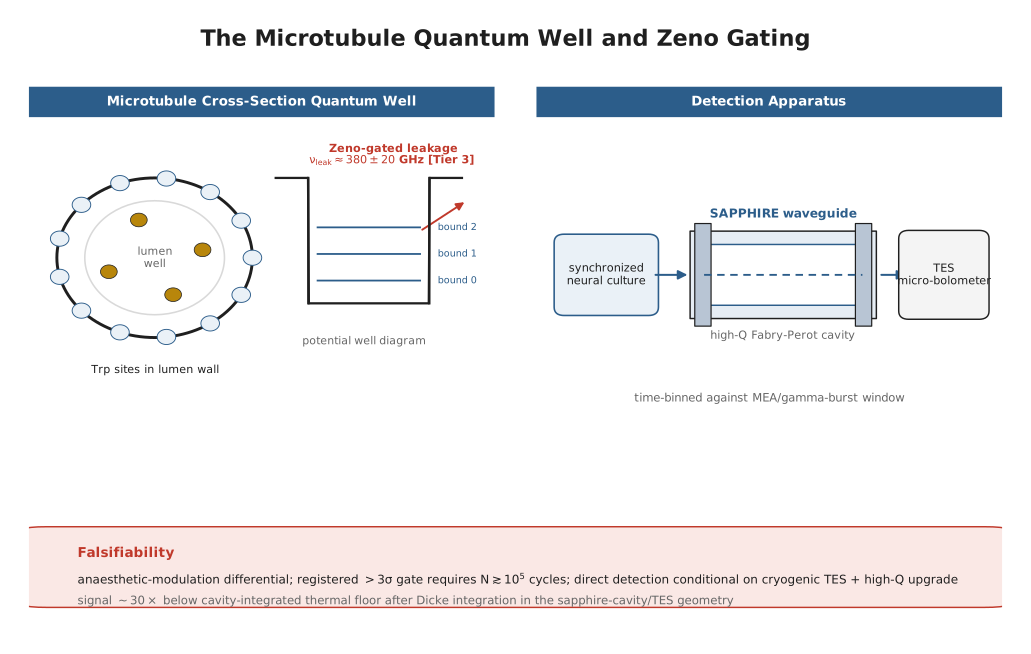
13.5 The Calculation Procedure (Formal Definition)
The preceding sections specified the Zeno Drive piece by piece — the Tavis-Cummings cooperative pumping condition (§13.1.2), the geometric origin of the registered MHz window (§13.1.2b), the open-system Floquet-Lindblad correction (§13.4.4), and the substrate-discriminant logic of Protocol A-Prime (§13.3.5). The present section assembles these into a single closed-form procedure that returns a scalar given a substrate description.
The DMC gate is necessary, not sufficient, for the Apperception verdict. A substrate lacking chirality OR nonzero nuclear spin cannot support the phason-coupled Polaron required for Level II: non-zero nuclear spin registers the discrete identity address space, and molecular chirality drives the CISS spin-polarization that couples the substrate to the phason field. Sufficiency requires three additional conditions: (a) an identified cooperative radical-pair/Polaron witness (App H O.21 — for biological tubulin, currently pending assembled-MT lumen-axis closure), (b) protected-subspace coherence demonstration (App H O.23 — DFS_SUPPRESSION_NOT_DEMONSTRATED on the small- tractable end), and (c) ATP-Trp redox regeneration (App H O.34). The DMC + Polaron + DFS + ATP-regeneration joint conditions constitute the operational Level-II substrate criterion. Substrates that fail either DMC leg receive exactly at Step 1 of the chain below, collapsing to and yielding the Turing Null render. The scalar, computed across the necessary gate, is a robustness margin for comparing DMC-positive substrates, not a separate consciousness discriminator or a sufficiency proof.
The procedure is tractable on physical-substrate variables that GCT picks out — nuclear-spin lattice, molecular chirality, Tavis-Cummings cavity parameters, vibrational thermal-bath coupling — and is implemented as a chain of five documented functions in the GCT Physics Engine (GCT_Physics_Engine/src/protocol_eta_zeno.py). Engine-generated values for the three canonical test cases (biological tubulin, Si silicon, NV-centre Protocol-A-Prime surrogate) are quoted in §13.5.6 below.
13.5.1 The Chain (Formal Statement)
with the chain of dependencies
Each step is independently a single closed-form expression; the chain is a deterministic function of the substrate-description tuple, closed-form conditional on Tier 3 calibrated substrate inputs ( pending O.16; calibrated). The Dual Material Constraint (V1 §16.2.6) enters as a hard substrate gate at Step 1: substrates with (zero nuclear spin) or achiral lattice receive exactly, collapsing the entire chain to regardless of the other inputs.
13.5.2 Step 1 — Single-Dipole Coupling [Tier 2 form, Tier 3 inputs]
The single-dipole coupling to the phason mode is set by the substrate's chiral dipole transition acting on the phason zero-point electric field, attenuated by the RT-shell geometric gradient and the phason zero-point displacement:
with and the chirality sign ( for achiral; gate trips). The exponent is the Tier 2 lattice-speed-of-light invariant (V2 §6.2.2); the dipole moment , overlap fraction , and effective mass are Tier 3 substrate inputs. For the canonical tubulin substrate, Appendix Q retains the calibrated pre-overlap anchor MHz. The operative branch applies to that anchor: at the engine-current , Hz, with the overlap-propagated plausible range - Hz. Unless explicitly labelled "pre-overlap anchor," downstream and quotes use the overlap-propagated coupling.
13.5.3 Step 2 — Collective Enhancement [Tier 3 input]
The Tavis-Cummings cooperative pumping enhances the coupling by , where counts primary oscillators phase-locked to the cavity mode within the Polaron volume. The primary oscillator basis is the beta-tubulin Trp radical-pair inventory,
where is the beta-Trp candidate count, is the number of assembled-MT radical-pair hosts per dimer, and is the phase-locked active fraction. Hydration-shell spins, including OH and proton dipoles, are bath/environment degrees of freedom: they can dress the protected subspace and enter O.23/O.33 decoherence and isotope-systematics budgets, but they are not counted in the cooperative-oscillator basis. The operative central branch remains pending O.21 assembled-MT lumen-axis closure; the sensitivity branch uses the conservative beta-Trp inventory (the spin-count tracked in protocol_zeno_energy_budget.py) and reports any hydration contribution separately as environmental dressing, not as additional Tavis-Cummings oscillators. For a single-NV Protocol A-Prime surrogate: . The geometric cap on the linearly-available work from the Landauer budget is (V3 §13.4.2); the biological cooperative count below enters through scaling rather than linear energy expenditure.
13.5.4 Step 3 — Cavity Decay Rate [Tier 2 geometric or Tier 3 measured]
Two parallel modes are exposed because biological and engineered substrates declare differently:
Geometric mode (biological). From the GCT phason stiffness ratio (V2 §4.4, V3 §13.1.2) acting on the cage of nodes:
For the tubulin substrate with MHz, Hz.
Direct mode (engineered cavity). For NV-centre / cavity-QED surrogates, is the directly measured linewidth ( MHz for current NV cavities).
13.5.5 Step 4 — Bare Tavis-Cummings Ratio [Tier 2]
Pure closed-form. Dimensionless.
13.5.6 Step 5 — Floquet Open-System Correction [Tier 3, V3 §13.4.4]
The Floquet-Lindblad treatment of the open quantum system at 310 K introduces a bio-environment efficiency factor :
with a Lorentzian detuning function that vanishes on resonance. At the geometric resonance , the open system recovers the ideal Misra-Sudarshan upper bound (). Off resonance, multiplicatively suppresses the bare Tavis-Cummings ratio. This is the same that appears in the Protocol A-Prime pre-registered prediction of §13.3.5.
13.5.7 Engine Verdicts on the Three Canonical Substrates
The protocol_eta_zeno.py self-test runs the chain on three canonical substrates and verifies the predicted verdicts:
| Substrate | Verdict | |||||
|---|---|---|---|---|---|---|
| Tubulin-Trp (V3 §13.1.2) | pre-overlap anchor Hz; operative overlap-propagated branch Hz at ; plausible overlap-propagated range - Hz | central ; sensitivity branch | Hz | (assumed protected-subspace branch resonance; O.12/O.23 conditional) | ( pending O.21 assembled-MT lumen-axis closure); overlap-propagated ( conditional branch) | Central branch not operative for Level II; sensitivity-conditional Level II only |
| Si (V1 §17.10) | (DMC gated) | — | Hz | exactly | Turing Null | |
| NV-centre + chiral h-BN cap (V3 §13.3.5.A) | Hz | Hz | (on-resonance) | DMC-gate-pass (robustness margin ; engineered surrogate, near boundary relative to biology) |
The silicon row collapses to exactly because both Dual Material Constraint gates trip in Step 1: Si has (no address space) and crystalline silicon is achiral (no Rashba/CISS channel). No amount of computational sophistication on a silicon substrate can move this value off zero — the gate is a substrate-physical fact, not a behavioural one (V1 §17.10).
The NV-centre row reports a nonzero robustness margin by orders of magnitude relative to unity; that margin is not an independent consciousness threshold. The biological tubulin central branch is until O.21 supplies an assembled-MT lumen-axis radical-pair oscillator; the tubulin value is a sensitivity upper edge, not the operative central verdict. The single-NV surrogate is engineered to land in the resolvable band: enough above unity that the Protocol A-Prime joint signature (§13.3.5) — non-monotonic peak at MHz, anti-Zeno sign at 150 MHz, chirality contrast against an achiral substrate — is the discriminating observable, but far below the tubulin sensitivity-branch cooperative regime so that the chirality-reversal control (§13.3.5.A) can isolate the CISS contribution cleanly.
13.5.8 Tractability vs. Intractability — Comparison to IIT
The IIT integrated-information is defined over the system's minimum-information bipartitions (Oizumi-Albantakis-Tononi 2014), which is NP-hard for non-trivial and intractable for any realistic biological network in closed form. The GCT machinery replaces the combinatorial bipartition search with a small, physically measurable set of substrate variables — nuclear-spin lattice, chirality, Tavis-Cummings cavity parameters , and the open-system parameters . The Selection Operator is what does the work that IIT delegates to the bipartition sum; once is in hand, the residual quantity is a closed-form scalar.
The tractability is the GCT advantage; the cost is that the Tier 3 substrate inputs (Trp dipole moment, estimate, NV coupling parameters) are empirical and the calculation inherits their uncertainty. Protocol A-Prime (§13.3.5) is the route to tightening those inputs against bench measurement.
13.5.9 Computational Reference and Scope
The chain is mirrored in GCT_Physics_Engine/src/protocol_eta_zeno.py. The reference implementation evaluates a substrate description, returns the per-step quantities, and writes the canonical verification data artifact GCT_Physics_Engine/data/protocol_eta_zeno_results.json.
Scope of the procedure:
- The chain (Steps 1–5) has Tier 2 formal structure with Tier 3 numerical inputs. Each step is fixed once the registered substrate tuple is supplied (Tavis-Cummings strong-coupling, V3 §13.1.2; Floquet-Lindblad open-system framework, V3 §13.4.4; Dual Material Constraint, V1 §16.2.6). The chain has no fitted numerical knob, but its absolute outputs inherit the Tier 3 substrate inputs listed below.
- The substrate-coupling numerical inputs are Tier 3 empirical. The Trp transition dipole ( Debye), the conditional sensitivity-branch estimate ( beta-Trp radical-pair hosts under the O.21 branch, central ), and NV-centre cavity parameters are imported from molecular-physics / NV-defect literature. The operative central O.21-pending branch remains and therefore propagates no beta-Trp population until assembled-MT lumen-axis closure. Hydration-shell spins are bath/environment, not cooperative oscillators. These absolute values move the numerical but not the qualitative DMC logic, which is forced by the substrate gates.
- The procedure is tractable on the test cases but is NOT yet experimentally validated against bench measurements. The bench-validation route is Protocol A-Prime (§13.3.5) — joint signature (non-monotonic Branch A peak at MHz, Branch B peak at MHz, full intermediate-band scan, anti-Zeno sign at 150 MHz, and chirality contrast) after the required - MHz scan at kHz spacing in NV-centre + chiral h-BN samples. A positive Protocol A-Prime result on the joint signature + chirality-reversal symmetry of §13.3.5.A would tighten the Tier 3 inputs into Tier 2 fits and would also constitute the empirical measurement of the peak amplitude that Open Problems O.23 + O.24 currently leave conditional.
- The procedure does NOT replace Protocol A-Prime; it makes Protocol A-Prime's predictions tractable. The bench experiment is still required to close the loop from formal procedure to physical verification. Until then, the engine's verdict on a substrate is a prediction of what Protocol A-Prime measurement should find on that substrate, not a substitute for the measurement.
Cross-references. V1 §17.10 (Artificial Agents and the Dual Material Constraint) cites this procedure as the substrate-condition decision rule for both biological and artificial systems. V1 §16.2.6 (Substrate Constraints) supplies the Dual Material Constraint that enters as the Step 1 gate. V3 §13.3.5 (Protocol A-Prime) supplies the bench experiment that closes the loop.