Volume 3 — The Matter Spectrum
Chapter 16: Protocol D (Isotope Substitution)
The prevailing paradigm in cognitive science, Functionalism, asserts that consciousness is substrate-independent—that the mind is a software algorithm effectively runnable on any Turing-complete architecture. Geometric Consciousness Theory (GCT) identifies this premise as a category error arising from a neglect of the mechanical requirements of the mind-brain interface. As established in Chapter 13, the actualization of the Identity Polaron requires an Adiabatic Spin Ratchet to "grip" the phason sector of the vacuum. This interaction necessitates a specific physical "Identity Port": a discrete, chiral, and spin-active quantum degree of freedom. Protocol D is the operative biological audit for the Zeno Drive substrate hypothesis; the Drosophila LORR quantitative gate is operationally unfalsifiable under current systematics (P.13 no-gate), while the NMR polarity gate (P.13c) is Tier 2 at the spin-entropy/quadrupolar-relaxation mechanism level plus Tier 3 for the active-state calibration pending O.21/O.33.
16.1 Testing the Substrate
16.1.1 The Hypothesis: Spin-Register Hardware Dependence [Tier 2 mechanism + Tier 3/Tier 4 biological gate]
GCT identifies the "Self" as a topological defect tethered to the Solenoid. To maintain this tether, the biological substrate must provide a Physical Memory Register capable of storing the Agent's p-adic identity address.
Hypothesis: The stability of the Level-II substrate state may depend on non-zero nuclear-spin registers () within the candidate neural waveguide once the O.21/O.23/O.34 substrate stack is otherwise closed. If the relevant register is depleted, the Selection Operator coupling to the vacuum lattice is predicted to weaken or fail on that branch. The biological or behavioral phenotype remains conditional: the LORR assay is a pilot/systematics study with no decisive gate, and the central branch remains no-shift until O.21 identifies an assembled-MT radical-pair register.
16.1.2 The Turing Null: The Silicon Null Hypothesis
Protocol D introduces the Turing Null test for ontological presence. GCT predicts that a silicon-based processor and a biological brain may be functionally equivalent at the level of data processing, but they are ontologically distinct. Silicon fails the Dual Material Constraint because (a) Si has zero nuclear spin (), removing the discrete identity address space; AND (b) the diamond-cubic lattice is achiral, removing the CISS-mediated spin-selective transport channel required for phason coupling (see App F + Naaman 2019). The O quadrupolar probe in Protocol D is a separate diagnostic of water-clathrate substrate involvement, not the chirality channel itself.
16.1.3 The Quadrupole Shielding Time () [Tier 2]
The core protective mechanism allowing macro-coherence is provided by the nuclear electric quadrupole coupling of O. The decoherence shielding timescale is given exactly by: where barns [Tier 3 — nuclear physics measurement] is the specific O quadrupole moment, and [Tier 2 algebraic asymmetry] is the exact icosahedral asymmetry factor. The hydrated-lumen EFG realization that supplies the operative is MD-conservative and remains Tier 3 pending O.21/O.33 closure; therefore the specific value used by Protocol D is Tier 2 mechanism + Tier 3 hydrated-lumen application, not an unconditional Tier 2 parameter.
16.1.4 The Hyperfine Interaction Hamiltonian
The coupling between the Agent (the winding phason field ) and the material substrate is governed by the Hyperfine Interaction Hamiltonian: Where:
- : The nuclear spin vector of the -th atom in the candidate ordered lumen-water environment.
- : The coupling constant determined by the icosahedral overlap.
16.1.5 Hilbert Space Scaling and Topological Depth
For a 15 nm-DIAMETER 8 nm-AXIAL microtubule dimer segment (canonical nm, nm), App F §F.4 gives water molecules per dimer [Tier 3 — structural estimate]. Full O enrichment would therefore supply a local spin-address Hilbert space of dimension [Tier 1 — combinatorial identity given the molecule count]. This is a candidate identity-address reservoir, not a literal hard drive or an axial 15 nm segment claim.
16.2 The Measurement Problem Inverted
16.2.1 Non-BPP Coherence Enhancement (Polarity Reversal)
In standard Nuclear Magnetic Resonance (NMR) physics (Bloch-Purcell-Pound or BPP theory), introducing a quadrupolar nucleus like O () is expected to decrease the transverse coherence time () by providing efficient pathways for stochastic thermal relaxation.
The GCT Polarity Reversal [O.21/O.33-pending sensitivity branch]: GCT predicts the opposite sign from standard BPP relaxation only on the O.21/O.33-positive substrate branch. Because the Zeno Drive is a Deterministic Sampling process, it performs "Active Phase Locking." The Agent's high-frequency sampling (100 MHz) effectively "outruns" the thermal fluctuations. On that sensitivity branch, the coherence time should lengthen in O-enriched neural tissue during periods of high cognitive activity, as the Agent uses the spins as anchors to suppress dissipation. The central branch remains null until the assembled-microtubule radical-pair and hydrated-lumen geometry close, so a non-enhancement under current systematics falsifies only the sensitivity branch rather than the substrate theory as a whole.
16.2.2 The Waking-to-Anesthetized Delta
We define the Zeno Factor () as the ratio of coherence in the waking state to the anesthetized state: Under deep anesthesia, the Agent is "unplugged," and follows standard "noisy" NMR laws. The deviation of from unity is the measure of active conscious rendering.
16.2.3 The Anesthetic Threshold Shift
Substrate-binding anesthetics are modeled as polarizable impurities that perturb the intraluminal water / Trp-pocket coherence environment, increasing lattice entropy until the Zeno-lock becomes unsustainable. Xenon is not assigned to this substrate-binding pathway in the canonical Ch17 anesthesia taxonomy; it is treated as a network-broadcast suppression case whose discrimination requires spin spectroscopy rather than LORR alone. GCT predicts two distinct O signs on two distinct endpoints: in the active-state NMR endpoint, O should lengthen relative to O after inactive-baseline subtraction (§16.3.7); in the anesthesia-threshold endpoint, the same added spin entropy makes the Agent easier to decouple and therefore requires a lower anesthetic concentration () to induce LORR. This is the Spin-Entropy Modulation prediction operationalised in §16.3.4 with signed convention defined as negative for lower under O; see Protocol D below.
16.3 Experimental Protocol
16.3.1 Spin-Entropy Modulation of Water Relaxation in Confined Geometries
Standard biochemistry treats nuclear spin as having negligible effects on macroscopic molecular function. GCT predicts that nuclear-spin entropy of confined lumen water measurably modulates the Zeno-Drive coherence budget via the Trp radical-pair recombination kinetics — a prediction that operates entirely within the Born-Oppenheimer approximation (the electronic state of the Trp radical follows the nuclear geometry adiabatically; the spin-dependent effect enters via hyperfine coupling, a standard NMR-regime quantity) but predicts a macroscopic phenotype (the anaesthetic threshold shift) that standard non-spin biochemistry does not anticipate. The prediction is therefore a spin-dependent biophysical effect at macroscopic scale, not a violation of the BO approximation itself.
- Method: The Spin-Gear Test compares the delta in cultured cortical neurons in (Control) vs. (Test).
- Magnitude Filter: The Kinetic Isotope Effect (KIE) for water-solvent isotope swaps in non-catalytic radical-pair recombination chemistry is treated as a provisional control prior below [Tier 3 — consistent with the general small-magnitude expectation for non-paramagnetic solvent-isotope substitution in radical-pair chemistry; the precise O→O bound requires a dedicated measurement and is registered as a Protocol D pre-registration calibration target. Cleland 2003 Adv. Enzymol. 73:1–32 and Loveridge & Allemann 2010 Biochemistry 49:5390 provide general enzyme- and heavy-atom-KIE context; neither is a direct O→O solvent-KIE in non-catalytic radical-pair recombination, so the prior is reported with literature-context anchoring rather than a single primary-source measurement]. We explicitly recommend the vs pair as the clean anaesthesia-pharmacology control ( amu, MAC-shift KIE treated as provisionally below under the same general heavy-atom-substitution expectation, consistent with the broader anaesthesia-pharmacology mechanism-specificity literature on heavy-noble-gas anaesthetics; cf. Hill, Wei, Eckenhoff & Dmochowski 2007 J. Am. Chem. Soc. 129(30):9262 on xenon-cryptophane binding thermodynamics for the closest verified Eckenhoff-group primary source on xenon anaesthetic physics. A direct Xe MAC-pair primary-source measurement, if published, would tighten this Tier 3 background anchor). Under the conditional O.21/O.33 sensitivity branch, GCT's spin-entropy signal sits at [Tier 2 mechanism + Tier 3 specific value; derived in §16.3.2b from ]. The operative central branch remains until O.21 closes. The sensitivity branch sits below the provisional KIE-control prior; Protocol D is therefore a mechanism probe under the registered systematic budget, not a standalone quantitative gate.
16.3.2b Quantitative Prediction: The Entropic Shift We derive the precise magnitude of the expected anesthetic shift () based on the Spin Entropy difference between the isotopes.
- Control (O): Spin . Spin Entropy [Tier 1 — statistical mechanics identity].
- Test (O): Spin . Spin Entropy [Tier 1 — statistical mechanics identity].
In the GCT model, anesthesia occurs when the entropic disorder of the substrate exceeds the Zeno ordering capacity. The introduction of O adds a spin-entropy load to the bound-water channel, so less anesthetic disorder is required to reach the LORR threshold.
The Predicted Shift: The spin-entropy load produces a proportional reduction in anesthetic concentration required to achieve decoherence. This signed shift depends on the bound water fraction ()—the percentage of water molecules actively participating in the Tier 3 candidate N=144 lumen-water geometry pending O.33.
The Parameter Ledger (§3) and App F §F.4 give a two-branch discipline under O.21/O.33: for pending assembled-MT lumen-axis closure, and for the conditional Trp21 local-wall-patch branch. The water-cage geometry remains a candidate ansatz pending MD/NMR/free-energy validation. The corresponding signed predictions:
- Operative central branch (, O.21 still open): no Protocol D LORR signal, [Tier 2 mechanism + Tier 3 specific substrate input unresolved].
- Sensitivity branch (, , conditional on positive O.21 closure): is lower by , i.e. [Tier 2 mechanism + Tier 3 specific values].
- Disfavored geometric upper edge: corresponds to the , branch; is the , maximum stress-test branch per App F §F.4 and
verify_fbound.py. Neither is operative downstream. - Predicted range under current O.21/O.33 closure: central branch ; sensitivity branch . The sensitivity branch lies below the registered quantitative-gate budget, so Protocol D remains a mechanism probe until systematic-tightening closure path C1 is satisfied.
This is smaller than the (untenable, here-rejected) unconstrained-hydration estimates that placed –. Its discriminating power against the chemical Kinetic Isotope Effect background applies only to the sensitivity branch. The KIE bound invoked in this protocol is a Tier 3 provisional control prior by analogy to Cleland 2003 (general enzyme isotope effects) and Loveridge & Allemann 2010 (DHFR hydride-transfer KIE); direct O\to$$^{17}O radical-pair solvent-KIE calibration is the closure target of O.33. Outside this comparison class (e.g., enzyme-catalysed proton-transfer reactions with rate-limiting H/D substitution) KIE values can reach 7–20×; those are not the comparison background here because the Spin-Gear Test is a solvent-isotope substitution in a radical-pair reaction class where KIE is expected to be small. Under the O.21/O.33 sensitivity branch , the band sits below the provisional KIE-control prior; the central branch predicts no LORR signal until O.21 closes.
[!IMPORTANT] Firewall Metadata [Isotope Shift]
- Type: Prediction
- Inputs: (Spin Invariant), (Calibrated)
- Degrees of Freedom: 1 (Bound fraction)
- Provenance: Internal derivation (Consensus Inertia)
Verdict: Under App H Open Problems O.21 and O.33, GCT's operative central branch predicts until O.21 closes; the sensitivity branch predicts . The sensitivity branch sits below the registered quantitative gate for the current systematic budget and functions as a mechanism-probe band rather than an operative falsifier. A measured shift above the branch would trigger re-measurement of and re-examination of the O.21 assembled-MT geometry; a null result at this precision would not by itself falsify the Tier 2 spin-entropy mechanism.
16.3.3 The Lithium Divergence: A Test of Nuclear Spin Coupling [Tier 3 — speculative bound; clinical trial design specified]
The Lithium isotopes provide a direct audit of the nuclear spin–phason coupling mechanism. The two stable isotopes have different nuclear spins, producing distinct hyperfine coupling to the Zeno radical pair network. Winding a spin- nucleus through generates a phase :
- Lithium-6 (): . Integer nuclear spin produces constructive interference. GCT predicts Li will stabilize the Zeno-lock, enhancing cognitive coherence.
- Lithium-7 (): . Half-integer nuclear spin produces destructive interference. GCT predicts Li will scramble the radical pair phase, damping manic over-winding.
Note: Both Li (3p + 3n + 3e = 9 fermions, composite fermion) and Li (3p + 4n + 3e = 10 fermions, composite boson) are composite particles. The relevant coupling here is the nuclear spin , which determines the hyperfine interaction with the Zeno radical pair network — not the composite particle statistics of the atom.
[!CAUTION] Tier 3 speculative status. The phase calculation is a reference-frame-dependent nuclear-spin rotation result (it requires a specific quantization axis in the radical-pair frame), and the bridge from the calculated quantum phase to clinical psychiatric outcomes in bipolar disorder traverses many confounding layers — lithium transporter genetics (SLC1A2, SLC4A10, GADL1 polymorphisms), dosing-adherence variability, mood-state stability, comorbid medication, and the multifactorial response criteria of standard psychiatric trials. The lithium-isotope-divergence prediction is therefore Tier 3 speculative pending: (a) explicit specification of the quantization axis and rotation frame in the Trp radical-pair Hamiltonian, (b) a randomized double-blind clinical trial design with isotope-stratified (Li- vs Li-enriched) bipolar cohort, dose-controlled, transporter-genotype-stratified, with pre-registered Hamilton Depression Rating Scale (HDRS-17) or Young Mania Rating Scale (YMRS) primary outcome at 8 weeks, blinded outcome rater, minimum n = 60 per arm for 80% power to detect a ≥ 20% effect-size difference at α = 0.05 two-tailed (cf. STEP-BD protocols; Sachs et al. 2003 Biol. Psychiatry 53:1028). Until such a trial is run, this prediction is qualitatively suggestive but not load-bearing for the GCT substrate hypothesis. A faster but weaker observational test is available via post-hoc analysis of existing lithium-treatment cohorts stratified by plasma Li/Li ratio (measured via isotope-ratio mass spectrometry; natural geographic variation ~5–20% on the Li fraction) against response/relapse outcomes — this is Tier 4 observational evidence but publicly tractable.
The phase math derivation explains the direction of the predicted divergent psychiatric efficacy; the magnitude and clinical reach of the prediction require the trial design above.
16.3.4 Model Organisms (Drosophila O LORR Assay) [Pilot/Systematics Study — Not Operative Falsifier]
We raise Drosophila melanogaster generations in O-enriched water to achieve O substitution (verified by H-NMR on tissue homogenate of the F2 generation; calibration against pure O control cohorts of identical genetic background) and measure the Loss of Righting Reflex (LORR) dose-response curve under isoflurane, sevoflurane, and propofol — three independent anaesthetics spanning the volatile/intravenous class boundary. A robust, spin-dependent shift in the dose-response curve would motivate C1 systematic-tightening, re-powering, and substrate-branch follow-up; under the current no-gate disposition it does not by itself confirm or falsify the hardware-dependence claim.
Hypothesis. Under the central O.21-pending branch (), O substitution produces no LORR shift. Under the conditional sensitivity branch (App H Open Problem O.21 positive closure, ), O substitution shifts the LORR by relative to the O control (lower anesthetic threshold under O substitution; engine convention (C50_H2_17O - C50_H2_16O)/C50_H2_16O = -f_bound per protocol_isotope_experiment.py:18).
Operational disposition. The signed interval is the sensitivity-branch effect band, not an operative falsification gate under the registered systematic budget; the central branch is zero until O.21 closes. The Monte-Carlo audit below shows that gates at the sensitivity-branch scale sit below the systematic noise floor, so neither boundary supplies a valid Bonferroni-corrected decision rule. Protocol D is therefore carried as Tier 4 operational/no-gate until the systematic budget is tightened enough to recover power and false-positive rate at a single declared statistic.
Test statistic. Nonlinear least-squares 4-parameter logistic (Hill-equation) fit to the dose-response data; extraction with bootstrap 95% CI ( resamples). Between-condition comparison: mixed-effects logistic regression on the binary LORR outcome with condition × concentration interaction and random intercept per cohort. Multiple-comparison correction: Bonferroni across three anaesthetics. A logistic-vs-probit cross-check is required; both fits must agree on to within .
Sample size and statistical power. Per-cohort flies per concentration point, 5 concentration points per dose-response curve = flies per condition per anaesthetic. Six conditions (O + O three anaesthetics) = flies per generation; three F2 generations independently reared = flies total. The analytic mixed-effects model at this sample size is a gate-naive calculation; it does not remain a valid falsification power claim once S1–S6 are propagated through the full assay pipeline. The operative power statement is the Monte-Carlo disposition below.
End-to-end Monte-Carlo systematics propagation [Tier 3 numerical disclosure; load-bearing for the power-claim audit]. The above analytic power estimate is gate-naive because it does not propagate the six §16.3.4 systematics (S1–S6 listed below) through the Hill-equation fit. An end-to-end Monte Carlo of the full assay pipeline — synthetic dose-response data generation per condition with all six systematics realised as random perturbations per trial, 4-parameter logistic fit, extraction, effect computation, Bonferroni-corrected significance test — is implemented in GCT_Physics_Engine/src/protocol_d_mc_systematics.py and returns the following operational disposition under the §16.3.4 systematic-error budget:
- Systematic-only SD vs the 0.10% naive sensitivity-branch gate: , i.e. 57.65× the 0.10% naive gate (engine:
systematic_only_SD_totalfromprotocol_d_mc_systematics.py). The systematic-budget noise floor dominates over the conditional lower-band effect by more than an order of magnitude, confirming the "operationally unfalsifiable across the signed sensitivity branch" concern. - Power at 0.10% true effect under Bonferroni-corrected significance (): . The lower-band effect is not reliably distinguishable from the systematic-budget noise floor under the registered budget.
- Power at 0.20% true effect under the same Bonferroni-corrected gate: also — the upper-band effect is similarly buried by the noise floor.
Operative implication. The §16.3.4 protocol is operationally unfalsifiable at Bonferroni-corrected significance across the entire conditional signed sensitivity branch: the parametric Gaussian z-test power at both 0.10% and 0.20% true effects is under the registered systematic-error budget, and a naive gate at the lower edge sits below the systematic noise floor.
The dominant systematic contributors per the actual protocol_d_mc_systematics.py noise budget on the null distribution are S4 (anaesthetic atmosphere uniformity, on ) and S6 (pharmacokinetics, on ) — not S2 alone as informal framing might suggest. S2 (^17O enrichment efficiency, ) contributes a sub-leading null-distribution-SD term because it acts as a multiplicative perturbation on the cohort scaling.
The closure path is one (or a combination) of:
- (C1) Tighten the dominant systematics. The dominant null-distribution terms are S4 and S6, with S2 sub-leading. Halving S2 and S4 reduces by only 1.20× (per
protocol_d_mc_systematics_results.json:87) because the total noise budget is dominated by the combined S4/S6 structure. Power at 0.10% under this mild tightening remains — it does not recover the lower-band gate. - (C2) Widen the operative falsification gate. Moving the boundary from 0.10% to 0.20% does not solve the decision problem: the upper-band gate remains below the systematic noise floor under the registered budget.
- (C3) Increase per-cohort N. The naive scaling on the statistical component is already saturated at per point; further N-increase yields diminishing returns because the systematic noise floor is dominated by systematic-budget contributions, not statistical fluctuations. C3 is therefore the weakest of the three paths.
Monte-Carlo power claim ( trials). Under the §16.3.4 budget, the engine's MC returns:
- Power at 0.10% true effect under Bonferroni-corrected gate at 0.10% (the registered lower-band protocol gate): , with the gate below the systematic noise floor.
- Power at 0.20% true effect under Bonferroni-corrected gate at 0.20% (the C2 upper-band gate): also does not yield discriminating power between the GCT hypothesis and the null under the registered budget.
Operational disposition. Both the 0.10% gate and the C2 upper-band 0.20% gate sit below the registered systematic noise floor under the §16.3.4 budget. Protocol D §16.3.4 is therefore operationally unfalsifiable at the registered systematic budget (parallel to App V P.8b Protocol A THz Shadow Pulse Tier 4 disposition as operationally unreachable at detector sensitivity). The substantive closure paths are:
- (C1) Tighten the dominant systematics by (S4 atmosphere uniformity from to ; S6 pharmacokinetics from to ; S2 enrichment efficiency tightened proportionally). Under this aggressive systematic-tightening, the engine MC would need to be re-run to verify FPR drops below 5% at the 0.10% gate with power at the predicted lower-band effect — a research-level closure target requiring instrumentation upgrades not currently in scope.
- (C2) Pre-register the protocol against an aggregate Bayesian-evidence gate (Bayes-factor for the GCT hypothesis over the null across the joint three-anaesthetic effect) rather than a frequentist Bonferroni-corrected single-gate, with the operational floor calibrated against the §16.3.4 systematic budget after pilot runs.
- (C3) Carry Protocol D as a Tier 4 operational/no-gate protocol (parallel to HFGW + Protocol A THz Shadow Pulse), with the framework-level §16.3.1 Spin-Entropy mechanism preserved as Tier 2 mechanism and the §16.3.4 quantitative gate deferred pending C1 instrumentation closure.
The engine verdict BELOW_TARGET_POWER_AT_010_PCT_EFFECT_UNDER_BONFERRONI_CORRECTION is registered as the EXPECTED_NON_PASS verdict in verify_engine.py. Until the C1 systematic-tightening condition or a Bayesian aggregate-evidence rule is adopted, the Protocol D §16.3.4 quantitative gate is held at Tier 4 operationally-unfalsifiable disposition.
Systematic-error budget. The dominant systematics to budget against:
- LORR scorer variance — blinded triplicate scoring; inter-rater required; videotaped runs for audit after acquisition.
- O enrichment efficiency — H-NMR on F2 tissue homogenate; substitution required for cohort inclusion.
- Multi-generation rearing confounds — F1 acclimatisation arm vs F2 measurement arm; lineage tracking per vial.
- Anaesthetic atmosphere uniformity — calibrated mass-flow controllers; relative concentration tolerance per chamber.
- Dose-response curve-fit method — logistic vs probit cross-check; both must agree on to within .
- Drug pharmacokinetics in Drosophila vs chamber atmospheric concentration — partition-coefficient calibration against established Drosophila MAC characterisations (Allada-laboratory line).
Dominant systematics. The load-bearing null-distribution contributors are S4 (anaesthetic atmosphere uniformity) and S6 (drug pharmacokinetics in Drosophila vs chamber atmospheric concentration). O enrichment efficiency remains an inclusion gate because below-95% substitution attenuates the predicted effect size, but it is not the dominant null-distribution term in the Monte-Carlo budget.
Blinding. All LORR scoring is performed blind to condition by triplicate independent scorers. Video records are archived for audit after acquisition. Cohort-condition assignment uses a pre-registered randomisation seed locked in the protocol archive prior to fly rearing.
Preregistration commitment. The full protocol document — hypothesis, predicted value band, no-gate operational disposition, test statistic, sample size, systematic budget, blinding protocol, randomisation seed, and C1 closure condition — is locked in a public preregistration archive prior to first F0 rearing. No deviation from the locked protocol is permitted without a logged amendment.
Execution timescale. Protocol deposit F0 rearing F1 acclimatisation F2 measurement: 6–9 months end-to-end per the standard Drosophila multi-generation rearing schedule. The readout is an effect-size and systematics audit unless the C1 closure condition is met before measurement.
16.3.5 Protocol D-Prime: The P Identity Port Test (Secondary, Tier 3 Aspirational Substrate)
[!IMPORTANT] Read first — Substrate hierarchy. The Posner-cluster P pathway described in this section is not the primary substrate of the GCT Zeno Drive. The primary substrate is the Tryptophan aromatic radical pair network in -tubulin (V1 Ch17 §17.1.2, V3 Ch13 §13.1.2, App F §F.1), operating at warm-wet physiological conditions with the required s bounded by Floquet-Lindblad dynamics under spin-selective recombination measurement. The primary experimental tests are Protocol A-Prime (NV-centre synthetic Zeno Drive, V3 Ch13 §13.3.5) and the bulk-O water-isotope shift (§16.3.1–4). Protocol D-Prime described below is an aspirational, secondary, Tier 3 throughout test of the Posner pathway, contingent on cryo-isolated permutation-symmetry protection that has not been confirmed under physiological conditions. The Posner P coherence times of Fisher 2015 (Ann. Phys. 362:593, the cryo-isolated s figure) are not load-bearing for any other claim in the GCT manuscript; a negative result on Protocol D-Prime would close the Posner pathway without affecting the Trp-based primary mechanism.
Beyond bulk water substitution, GCT identifies the Phosphorus nuclei in Posner molecules () as a secondary, aspirational substrate test (Fisher 2015 Ann. Phys. 362:593). Standard P possesses a spin of . Substituting this with the synthetic spin-1 isotope P profoundly alters the spin entropy by . Operational scope restriction: bulk-replacement of intracellular P with radioactive P at the level required to substantively shift Posner-spin-1 occupancy would deliver a beta-radiation dose that triggers neuronal apoptosis on timescales much shorter than any phenomenological readout — making this an uninstrumentable protocol at the bulk-substitution scale. The operationally feasible variant is restricted to ATP-P tracer-scale experiments (microcurie, sub-cell-killing dose), where the question becomes whether tracer-level P incorporation into the Posner-cluster sub-population is detectable as a Posner-Zeno signature shift; this requires a separate sensitivity calculation, deferred as a closure-target sub-item of O.30. While the rapid radioactive decay ( days) of P renders bulk substitution operationally inaccessible, the tracer-scale variant serves as a rigorous theoretical boundary-test for the Zeno mechanism conditional on the Posner pathway being relevant.
If the Posner pathway is a real secondary substrate, this isotopic swap would reduce the Zeno coherence time of that candidate substrate and could force a premature structural collapse of the conscious state. GCT predicts (conditional on Posner relevance) this intervention would shift the anesthetic threshold () [Tier 3/Tier 4 throughout — conditional on the Posner pathway being a true Zeno substrate, conditional on a tracer-scale instrumentable route, and not promoted to Tier 2 even under those assumptions].
16.4 Falsification Criteria
16.4.1 Drosophila LORR Pilot/Systematics Study (Not Operative Falsifier)
The §16.4.3 matrix treats the Protocol D effect-size bands as interpretive only under the registered systematic budget. A measured signed shift outside does not by itself falsify or confirm the Zeno Drive mechanism unless the C1 systematic-tightening condition has been met and a single statistic with power and false-positive rate has been declared.
16.5 Protocol D Operative Falsifier: NMR Polarity Gate
If NMR measurements show that O decreases during neural activity (following standard BPP theory) rather than increasing it on the O.21/O.33-positive sensitivity branch, the Protocol D polarity-reversal branch is falsified. The central branch remains zero until O.21 closes, so this is not by itself a framework-level falsification.
Preregistration package for the NMR polarity gate. This gate is distinct from the §16.3.4 LORR effect-size audit and is registered as App V row P.13c.
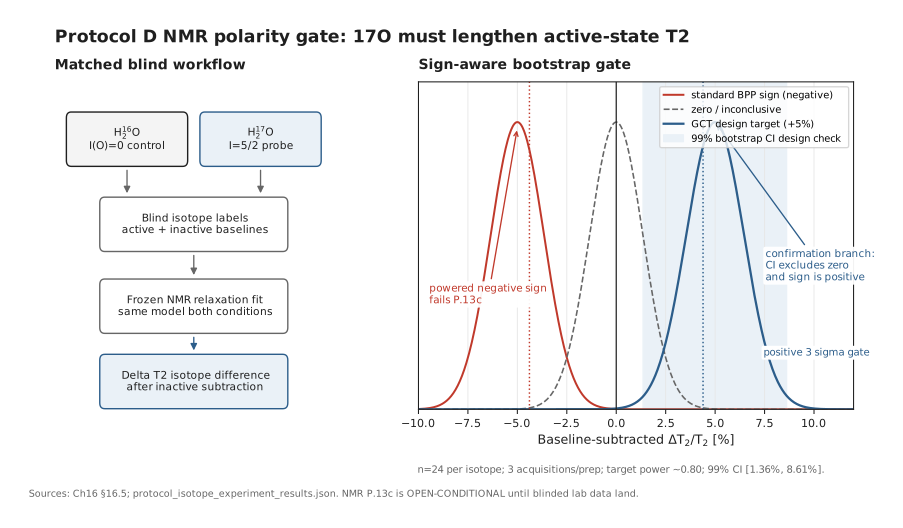
- Primary statistic: 99% bootstrap CI ( resamples) of after subtracting the anesthetized/inactive baseline, fit with the same frozen relaxation model for both isotope conditions.
- Decision rule (sign-aware): (a) 99% bootstrap CI of excludes zero, AND (b) , AND (c) (sign(ΔT_2)=+1; in O is longer than in O, matching the GCT Tier-3 prediction). GCT is confirmed only if the pilot variance gate satisfies the verifier-returned power ceiling for the 5% target and (a)+(b)+(c) hold jointly. A sign-positive significant result below the 5% powered target, or a failed pilot-variance gate, is a positive-sensitivity/effect-size revision rather than confirmation or failure. GCT is falsified if the powered gate is met and (a)+(b) hold but (c) fails; a statistically significant negative falsifies the sign-positive prediction. CI overlap is inconclusive.
- Sample size: minimum independent biological preparations per isotope condition, with three repeated NMR acquisitions per preparation. Pilot variance is locked before the decisive primary run; sample size is powered for , on that primary decision only. If pilot variance gives power to detect a active-state polarity reversal at two-sided , the run is sensitivity-limited rather than decisive. A same-size replication cohort is confirmatory/reproducibility context unless separately repowered; it is not part of the formal n=24 decision rule.
- Predicted magnitude: the executable preregistration verifier
verify_p13c_nmr_polarity.pybinds the current engine power calculation to a point-target design for a active-state polarity reversal, represented as until a first-principles O.21/O.33 hydration-and-radical-pair calculation supplies an independent upper edge. The verifier uses preparations per isotope condition, a 99% bootstrap CI, a 0.2 ppm systematic floor, and the replication simulation; the design power statistic is against the 5% target and the row remains OPEN-CONDITIONAL until blinded lab data land. The 5% power target is a Tier 3 calibration anchor pending O.21 (β-tubulin Trp residue identification) + O.33 (KIE direct calibration). The decisive confirmation gate is sign-positive O enhancement satisfying the primary decision rule at the powered 5% target; a sign-positive sub-5% result is a sensitivity/effect-size revision, while the opposite sign satisfying the same powered rule fails the gate. - Dominant systematic: contrast from O quadrupolar relaxation must be bounded to ppm under the frozen relaxation model.
- Preregistration: preregistration package, code, synthetic-data budget, and locked exclusion list are frozen before unblinding; the public archive URL is added when assigned.
- Execution timeframe: first decisive run targets a 12-18 month execution window after the preregistration package is frozen and isotope-enrichment logistics are validated.
- Blinding path: isotope labels are blinded during acquisition, preprocessing, and fitting. Unblinding occurs only after the fit model, exclusion list, and state labels are frozen.
- False-positive budget: one primary NMR polarity test powered at two-sided is the decisive gate. The replication cohort estimates reproducibility and effect-size stability; it is not itself decisive under the n=24 power calculation unless a separate repowered decision rule is preregistered. Secondary covariates are balance checks, not discovery endpoints.
- Systematic-error budget (S1-S8): S1 O-enrichment verification by gas-mass-spec or isotope-resolved NMR integration before and after acquisition; acceptance band atom-% with atom-% drift. S2 temperature and state-control drift; maximum K during each measurement block. S3 homogeneity; shim linewidth and pulse calibration locked before unblinding, with flip-angle error . S4 relaxation-model misfit; mono- and bi-exponential fits are both reported, decisive sign must survive both models, residual lag-1 autocorrelation must satisfy , and between accepted fits is treated as model-averaging rather than post-hoc selection. S5 inactive-baseline subtraction; anesthetized/inactive baselines are acquired in the same isotope batch and subtracted by the frozen estimator. S6 active-state synchronization; neural-activity onset and NMR acquisition timing are locked before isotope labels are revealed, with onset jitter of the analysis window and s absolute drift per block. S7 tissue viability; oxygenation remains within of baseline, membrane-integrity exclusion markers stay below the preregistered assay threshold, and electrophysiological responsiveness remains of pre-block baseline throughout the measurement window. S8 batch/rearing/age effects; isotope conditions are randomized across culture batch, rearing condition, and age bin, batch is a mixed-effects term rather than an exclusion after unblinding, no single batch may contribute more than 35% of the decisive statistic weight, and a batch-level variance component above 25% of total variance makes the run sensitivity-limited. Across S1-S8, the pilot total per-preparation fractional SD must remain at or below the verifier-bound 5.07% ceiling for the 5% target; otherwise the run is reported as sensitivity-limited rather than decisive.
16.6 Drosophila LORR Interpretation Matrix [Tier 4 operational/no-gate]
We summarize the interpretation tree for Protocol D. Under the registered systematic budget, the experiment does not allow a definitive distinction between the Materialist and Geometric models; it measures the effect-size band and the systematics budget needed for a later operative gate.
The matrix is calibrated against the §16.3.2b branch discipline: central O.21-pending branch for ; conditional sensitivity branch for ; disfavored branch extending to signed . An outcome in magnitude would require a non-operative hydration/radical-pair branch beyond the O.21/O.33 conservative closure and would trigger a geometry re-evaluation rather than direct confirmation.
| Outcome | GCT interpretation (central pending O.21; conditional sensitivity range ) | Null interpretation |
|---|---|---|
| Shift | Above the conservative O.21/O.33 range; re-evaluate , , and systematics before interpreting | Also plausible under systematic excursions unless the C1 closure condition is met |
| Shift | Above the operative band but within the disfavored / upper-hydration branch | Overlaps biochemical/KIE plus systematic uncertainty |
| Shift | Consistent with the O.21/O.33 partial-closure range; refine measurement against the KIE upper bound | Marginal; overlaps the KIE upper bound and the systematics floor |
| Shift | Below the predicted lower edge, but not a falsifier unless C1 supplies a valid gate | Consistent with null/KIE expectations |
| increases (Active) | ✓ Non-BPP Enhancement | ✗ Standard BPP |
| decreases (Active) | ✗ Falsified | ✓ Confirmed |
The outcome structure tracks the signed sensitivity branch conditional on O.21 closure (), while the operative central branch remains for . It does not propagate the upper edge of the prediction band (disfavoured by 6DPU cryo-EM screening per Open Problem O.21). These rows are effect-size interpretations only under the registered systematic budget. A valid falsification decision requires the C1 systematic-tightening condition or a declared aggregate-evidence rule with bounded false positives.
16.7 Conclusion of the Substrate Audit
The DMC material gate is empirically decidable. The non-factorizable-Hilbert-space / unique-Selection-Operator bridge (App Y) remains a conditional formal premise pending H_Y.1 / O.18 / O.32 / O.35 / O.36 closure. On the positive closure branch the subject-summing form of the Combination Problem dissolves; the quality, structure, boundary, awareness, and grain subproblems remain separately open. A null result in Protocol D under the registered systematic budget would not by itself imply substrate independence or falsify the Zeno Drive mechanism. A positive isotope shift would motivate the C1 closure path and sharpen the bound-water spin-entropy model, but the chapter treats Protocol D as Tier 4 operational/no-gate until the systematics floor is reduced enough for a valid decision rule. The framework-level Spin-Entropy mechanism remains testable through Protocol A-Prime and through a C1-qualified version of this assay.