Front Matter
Prediction/Postdiction Firewall
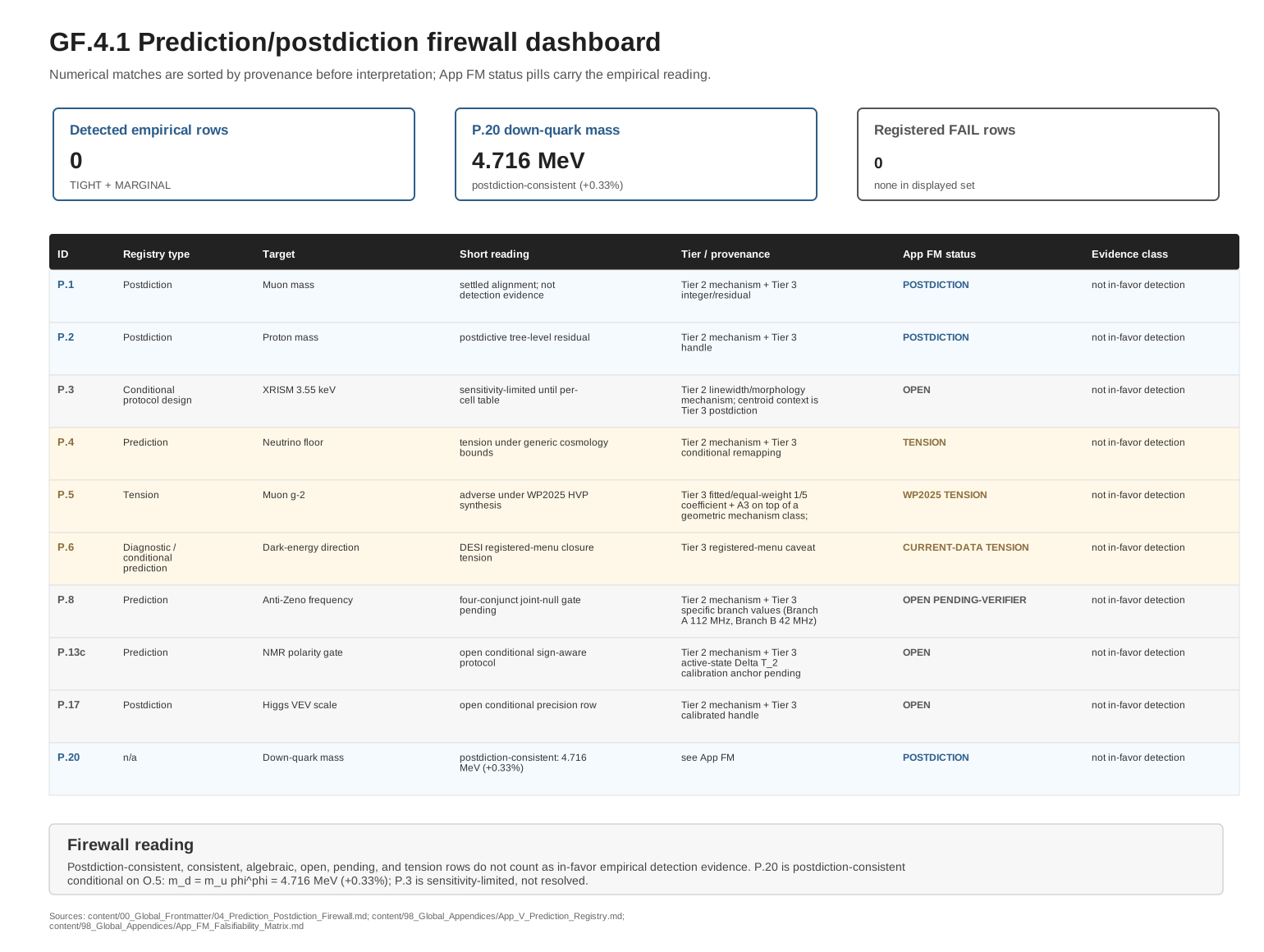
To preserve the integrity of Geometric Consciousness Theory (GCT) and forestall the "Look-Elsewhere Effect" common in unified field theories, the framework maintains a strict Firewall between types of numerical matches. Every major precision claim is accompanied by a metadata block specifying its provenance.
1. Definitions
A. Prediction (Targeted)
A value derived from the theory's internal geometry before reference to a specific measurement, or a value that exceeds current experimental precision.
- Criteria: No undisclosed parameter is adjusted to match the result.
Example — PTA Anisotropy Postulate-Conditional Prediction: GCT-derivable PTA anisotropy is where is one of the 5 core integer postulates (Parameter Ledger P3). The harmonic form is a Tier 2 mechanism; the specific amplitude is Tier 3 pending the O.15(b) RG-map derivation of . The PTA test is therefore a Tier 2 harmonic-form mechanism + Tier 3 specific amplitude pending O.15(b) RG-map derivation.
Note on High-Discriminating Postdictions: Some postdictions are more informative than broad curve-fitting exercises because their registered internal search windows are small and explicitly disclosed, but they remain Alignment matches rather than free predictions. Example: The Tau mass formula has the Tier 2 harmonic mechanism anchored at the sequence entry (cross-ref App R §R.9 statistical accounting), the Tier 2 -channel-averaging mechanism for the screening factor, and a Tier 2 integer-pair + Tier 3 combination-rule coefficient: via the Shephard-Todd invariant-degree sum, via RT pentagonal vertex enumeration, and the load-bearing ratio rule pending first-principles derivation under App H O.26b. The lepton-pair significance is ~2.6σ under the broad internal look-elsewhere sweep: the full multi-base sweep over Lucas-vs-non-Lucas exponent assignments in the Master Statistical Table below + App R §R.9.2. This is the broadest registered internal prior, not a theory-neutral global search space. Conditional auxiliary figures (3.1σ under the Conservative full-SM-texture window across ~25,000 trial pairs; 4.4σ LEA-corrected under the framework's depinning-threshold prior ; no separate Postulate-G/Lucas-only auxiliary retained; single-trial 5.4σ per-pair Z-score with no multiple-comparison correction) are reported in the table with their conditioning priors named at the point of citation under the Firewall governance discipline. The internal LEA window and Galois filter can increase a postdiction's diagnostic interest inside the framework, but they do not convert an already-known numerical alignment into an externally prediction-grade statistical result.
B. Postdiction (Alignment)
An after-the-fact explanation of known data where the model's structural features map onto observed values.
- Criteria: The structure was designed to be consistent with the data, though the numerical match may be emergent.
- Example: The derivation of the SU(3) SU(2) U(1) gauge group and chirality from the RT window and Jackiw-Rebbi domain wall.
C. Consistency Check (Calibration)
A match achieved by adjusting one or more "Calibrated Parameters" (Tier 3) to align the model with empirical anchors.
- Criteria: Used to determine the value of a free parameter ().
- Example: The matching of the Dark Energy curve using .
2. Firewall Metadata Template
Every major numeric match carries the following block in the margin or section footer:
> [!IMPORTANT]
> **Firewall Metadata [Protocol X]**
> - **Type:** [Prediction | Postdiction | Consistency Check]
> - **Inputs:** [List all Parameters/Anchors used]
> - **Degrees of Freedom:** [Number of adjustable knobs]
> - **Provenance:** [Internal derivation | Calibrated fit | Heuristic]
3. Governance Rules
- The Overlap Rule: A single formula structurally shared across multiple members carries the SAME prediction/postdiction status as its first-anchored member, unless the second/third member's value was unknown at the time of the formula's derivation. The structural-sharing claim does not promote postdictions to predictions.
Master Statistical Table — Lepton Exponent Pair (N=11, N=17):
| Method | Prior | Search Space | p-value | Significance | Status |
|---|---|---|---|---|---|
| Broad internal look-elsewhere sweep | Lucas-vs-non-Lucas window over -power lepton exponents | full multi-base sweep | ~5×10⁻³ | ~2.6σ | Canonical internal headline (broadest registered framework-defined exponent space) — matches the App R §R.9.2 footnote calculation while avoiding a theory-neutral prior-independence claim |
| Conservative SM-texture | Full SM texture | N∈[4,50] across ~25 SM mass slots → ~25,000 trial pairs | ~10⁻³ | ~3.1σ | Conditional auxiliary: SM-texture-window-conditioned (the window N ∈ [4, 50] is itself a framework choice constraining the integer-exponent search to plausible lepton-mass-ratio orders); citing the 3.1σ figure as the headline without naming this conditioning prior is significance laundering under the Firewall governance discipline — the broad internal look-elsewhere figure is 2.6σ above |
| LEA-corrected depinning | Depinning-threshold window | 153 pairs | 6.1×10⁻⁶ | 4.4σ | Conditional auxiliary: framework-prior-conditioned under the depinning-threshold window; the depinning threshold is itself a structural postulate per Ch08 §8.1.1 |
| Postulate-G / Lucas-only auxiliary | Postulate G admits Galois-compatible integer powers ; it does not impose a Lucas-only filter | Not retained as a narrower trial factor | n/a | n/a | No separate auxiliary significance figure retained; see App E §E.5 and App U §U.5.3 |
| Single-trial | None (per-pair Z-score) | 1 pair | 4×10⁻⁸ | ~5.4σ | Auxiliary: raw single-trial, ignores multiple-comparison correction |
The canonical cited significance is ~2.6σ — the broad internal look-elsewhere figure obtained by the full multi-base sweep over Lucas-vs-non-Lucas exponent assignments (see App R §R.9.2 footnote for the explicit calculation). The search space is framework-defined; it should not be described as theory-neutral. All retained higher figures in the table are conditional auxiliaries — they are stronger only when conditioned on a narrower framework-internal prior (SM-texture window, depinning threshold, single-trial). Citing any conditional figure as headline without naming the conditioning prior at the point of citation is significance laundering under the Firewall governance discipline. The 3.1σ Conservative-SM-texture figure is prior-conditional on the N ∈ [4, 50] window choice and belongs in "conditional auxiliary" status alongside the 4.4σ and 5.4σ figures; no separate Postulate-G/Lucas-only auxiliary is retained. The 2.6σ broad-internal-sweep figure is the operative canonical citation across the manuscript.
Tier 3 marker: the 0.002% precision figure for lepton mass ratios includes the Tier 3 electroweak correction . The bare Tier 2 geometric precision is .
- The "Hidden Knob" Prohibition: Any constant used in an equation that is not a Fundamental Constant (; the bare geometric expression is not the measured low-energy input) or a listed Anchor (A1 ; A2 for the native-RGE endpoint audit; A3 for measurement-anchored precision-comparison rows) is declared as a Calibrated Parameter in the ledger. See Parameter Ledger §0.1 and the §P3 A3 disclosure section. The phrase "fundamental constants" here excludes A3: the measured low-energy is an anchor, used only in precision-comparison rows per the Ledger.
- PTA Anisotropy Formula Derivation: The PTA prediction (since exactly, achieved at ) is derived from the phason-graviton linear coupling formula. The corresponding angular power spectrum coefficient is . The square-root (phonon) formula does not apply to the phason-graviton vertex.
- Zeno Drive Shielding Constraint: Zeno stabilization constraints () fundamentally originate from Tubulin Tryptophan (Trp) radical pair native coherence (). Bulk water decoherence times ( s) are not the relevant baseline; the biologically relevant timescale is the radical pair coherence within the hydrophobic binding pocket.
- Dark Energy Causality: The parameter and the operative biogenic-DE quartic mass scale ( eV) are Tier 3 phenomenological fits, calibrated to match observed cosmological acceleration. The susceptibility has a Tier 2 functional form via the Ryu-Takayanagi holographic derivation (, V2 Ch14 §14.1.5), but the Tier 3 numerical evaluation requires imported pending O.1/O.4. The quantitative geometric deduction applies exclusively to the Tier 2 absolute baseline equation of state .
- Biological Phason Freezing: At physiological temperature the relevant thermal scale is . The Rashba-phason validator uses this value as the registered biological thermal-noise scale and requires the candidate coupling to clear it by at least a factor of ten; there is no registered body-temperature freezing energy.
- Theorem Elevators:
- The Bottom Quark scaling factor () is formalized as a Tier 2 consequence of the representation theorem ().
- The Phason stiffness exponent is formally classified per Parameter Ledger §0.1 P3 as Tier 2 integer-identification (H_3 Shephard-Todd anchor) + Tier 3 physical-link conjecture: the Tier 2 mechanism is that phason modes are parametrically softer than phonons by a -power ratio (icosahedral cut-and-project framework); the specific exponent is the unique icosahedral anchor — the Shephard-Todd invariant-degree sum (uniquely among rank-3 Coxeter groups; Humphreys 1990). The 2D-RT-face-in-6D tangent-bundle decomposition (App K §K.4 — rank 3 × Galois 2 × dim 3) enters as a 6D-ambient consistency cross-check, not as a second independent icosahedral anchor (see App H O.26). The sharper RG-running claim at the renormalization-flow level is Tier 3 pending Open Problem O.15(b) (first-principles RG derivation). The physical identification remains Tier 2 (geometric linkage; supersolid second-sound identification, Vol 2 Ch 6 §6.2).
- XRISM Observational Status: The XRISM test for the 3.55 keV dark matter line is Under Test (Data Inconclusive, Analysis Ongoing). XRISM has stacked 3.75 Ms of data across 10 clusters and did not resolve the line. The upper limit on the decay rate () remains several times weaker than the Bulbul et al. XMM-Newton order- detection normalization. XRISM has not yet reached the required sensitivity to confirm or rule out the signal. The GCT prediction stands; deeper observations are required. For full ground-truth data, see Ch11 §11.4.4 and Ch15 §15.5.