Volume 3 — The Matter Spectrum
Chapter 5: The Higgs Mechanism
In standard Quantum Field Theory, the Higgs field is conceptualized as an external scalar doublet that permeates the vacuum, endowing particles with mass through spontaneous symmetry breaking. Geometric Consciousness Theory (GCT) identifies this mechanism as an intrinsic mechanical property of the vacuum substrate. The Higgs field is not an additional ingredient; it is the Scalar Breathing Mode and Transverse Tilt Mode of the 6-dimensional hyper-lattice. This chapter provides a Tier 2 mechanism for the Higgs potential and the unification of mass and metric stiffness, while the specific Higgs normalization and fermion Yukawa normalizations remain Tier 3 numerical targets pending the registered closure items.
5.1 The Volume Dilation Mode
5.1.1 The Higgs as Scalar Breathing Mode
As established in Volume 2, the vacuum is a 3D projection of a 6D Euclidean lattice . This lattice possesses various vibrational and configurational degrees of freedom. While phonon modes correspond to spatial displacements and phason modes correspond to topological rearrangements, there exists a fundamental degree of freedom associated with the unit cell itself: Volume Dilation.
We identify the physical Higgs boson () with the local fluctuation of the 6D unit cell volume. In the language of continuum mechanics, the Higgs boson is the Scalar Trace of the 6D Strain Tensor: where are the lattice constants of the parent space. This "Breathing Mode" represents the global expansion or contraction of the lattice "hardware" at a given spacetime coordinate.
5.1.2 The Doublet: Volume and Orientation
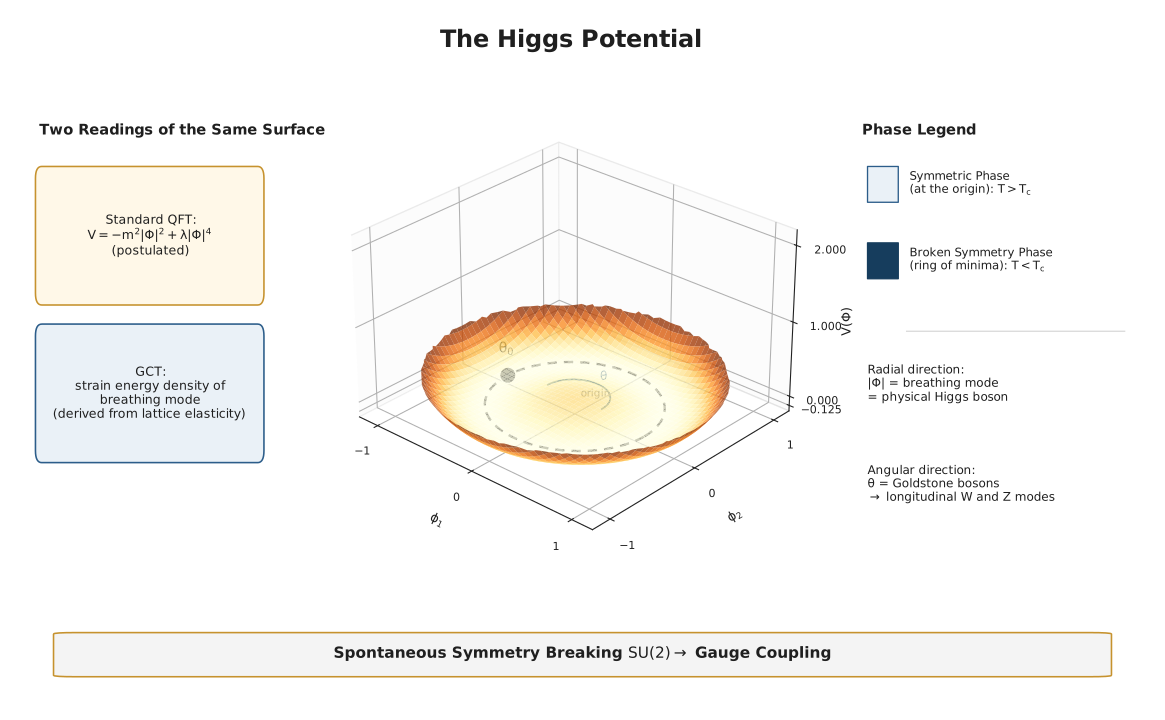
Standard physics describes the Higgs as a complex doublet with four real degrees of freedom. In the GCT Operating System, these correspond to the Complete Deformation Space of the unit cell star:
- The Scalar Trace (1 DOF): The volume dilation (the physical Higgs boson ).
- The Transverse Phason Tilts (3 DOF): Three rotational degrees of freedom representing the tilt of the acceptance window star in relative to the physical manifold.
When the vacuum crystallizes, the icosahedral symmetry locks these tilts into the local frame. According to the Higgs mechanism, these three "tilts" provide the longitudinal polarization required for the and gauge fields to acquire mass. The scalar "breath" remains as the unique physical Higgs particle.
5.1.3 The Higgs Potential from Lattice Elasticity
The standard "Mexican Hat" potential is the Non-linear Elastic Energy Density of the vacuum substrate. In the primordial Symmetric Phase (), the unit cell has no fixed size, and the potential minimum is at . As the field cools and undergoes the Supersolid Phase Transition (Volume 2, Chapter 3), the lattice reaches a Saturation Point. The inter-node bonds resist further compression while the vacuum selection pressure prevents total expansion. This creates a "Sombrero Potential" naturally, without postulating a negative mass term .
5.2 The Stiffness Connection
5.2.1 The Macroscopic Saturation (Absolute VEV Pipeline) [Tier 2 mechanism + Tier 3 handle residual]
[!IMPORTANT] Dependency-direction disambiguation. The Standard Model's dependency chain is via Yukawa couplings: the VEV is a fundamental input, lepton masses are downstream. GCT inverts this direction at the icosahedral-geometry level — both the VEV and the lepton masses are projected from the same 6D parent structure, with the K-theoretic gap-label (P2) anchoring and the harmonic-ladder structure (P4) anchoring . The relation derived below is therefore an internal-consistency identification within the GCT geometric framework — both sides are derived from the same upstream icosahedral inputs — not a Planck-scale top-down derivation of from in the SM-causal sense (where would be a free input upstream of ). The 181 ppm match between the GCT formula and the SM GeV is a Tier 2 mechanism + Tier 3 numerical/integer-handle residual; it imports the muon formula, the harmonic anchor, and the saturation factor. O.20 supplies enumeration-level closure: the canonical pathway plus three icosahedral cross-checks are registered, while itself is explicitly non-unique as an integer factorization.
A fundamental category error of the Standard Model is treating the Higgs VEV as an axiomatic input that generates fermion masses. GCT imposes a dependency inversion at the icosahedral-geometry level: The VEV is not a fundamental input; it is modeled as the macroscopic volumetric saturation of the vacuum's localized acoustic defects. The VEV pipeline within the GCT projection structure flows from the Planck scale: , with a Tier 2 mechanism for the shared 6D icosahedral parent and Tier 3 handle residuals on the specific saturation factor and inherited lepton-mass precision (not a chain in which is fundamental upstream of in the SM-causal sense).
The VEV scale is identified by taking the A3-corrected lattice muon resonance and saturating the 144 local lattice nodes () across the 10 symmetry axes () of the icosahedral projection window, scaled by the golden volumetric multiplier ():
This is a structural identification within the quasicrystal simulation. Evaluated against the SM benchmark ( GeV), the residual error is 181 ppm. The Higgs VEV disposition is: Tier 2 mechanism (icosahedral muon-defect-saturation pipeline) + Tier 3 numerical residual (181 ppm precision inherited from the muon-mass closure × the canonical factorization). The spectral-action cutoff belongs to the independent Higgs-mass calibration route in §5.2.5 and is not an input to the VEV verifier; see App R §R.2 Higgs handle accounting callout for the VEV/Higgs-mass separation. The SM-causal "free parameter" status is dissolved only at the level of this disclosed icosahedral-geometry mechanism, conditional on the upstream lepton-mass derivations (Open Problems O.5, O.14, O.15); O.20's enumeration closure establishes the canonical pathway and records the non-unique cross-checks rather than claiming uniqueness.
Structural origin of the 1440 saturation factor [Tier 2 mechanism + Tier 3 1440-saturation integer handle]
The integer is structurally motivated by two independent icosahedral invariants:
- : The electron cage node count is the 12th Fibonacci number (), the unique Topological Saturation Point where the discrete Gauss-Bonnet curvature of an icosahedral lattice closes on a winding defect. Both a Gauss-Bonnet counting argument () and the quasicrystal Fibonacci resonance condition independently require exactly 144.
- : The icosahedral group has exactly 10 three-fold rotation axes ( axes). This is an exact group-theory result: contains precisely 20 elements in its conjugacy class, and each axis contributes two elements ( and ), giving . This is not a choice — it is a theorem about the character table of .
- : The volumetric golden-ratio inflation factor, forced by the quasicrystal tiling.
The saturation covers all 144 local nodes across all 10 distinct three-fold symmetry channels of the icosahedral projection window, producing the factor .
Scope of the structural claim. GCT derives the product from the two specific icosahedral invariants above (cage saturation axis count). The integer 1440 admits multiple factorisations within the broader icosahedral combinatorial structure — for instance, also reproduces the integer from independent group-theoretic counts — so the framework does not claim uniqueness of 1440 as an integer. O.20 supplies enumeration-level closure: the canonical pathway is the load-bearing VEV mechanism, and three non-unique icosahedral cross-checks are recorded as consistency checks rather than independent derivations; the residual remains Tier 3 until the upstream lepton/A3 bridge and integer-selection problems close.
5.2.2 The Breathing Mode and the Geometric Origin of the VEV
The 6D bulk modulus, while structurally related to the Higgs potential curvature, does not yield a rational exponent in the cut-and-project scheme. The correct ontological path to the Higgs VEV descends through the topological lepton generations () before collectively saturating the local volume. GCT asserts the VEV is geometrically derived via this macroscopic saturation: the product is the topological capacity of the muon defect over the icosahedral projection window across the 10 axes (per the scope clarification in §5.2.1 above; alternative factorisations of 1440 are tracked under Open Problem O.20).
5.2.3 The Bulk Modulus and the Prediction [Tier 2 bare + Tier 3 physical pending 1-loop closure]
The curvature of the Higgs potential at its minimum determines the Bulk Modulus () of the metric—its resistance to being curved by mass. GCT treats the quartic coupling as a Tier 2 Geometric Invariant derived from the Packing Efficiency of the icosahedral tiles (the ratio of the inscribed sphere to the rhombic triacontahedron volume).
Bare prediction [Tier 2]: GCT predicts a bare quartic coupling of , implying the bare mass relation . With GeV, the bare prediction is GeV.
Physical mass prediction [Tier 3 pending App TP §TP-E 1-loop closure]: The observed Higgs mass is GeV. The bare-to-physical gap is GeV ( ppm). This gap sits in the expected sign and rough magnitude band of standard-model 1-loop top-Yukawa and EW radiative corrections, but a quantitative GCT 1-loop closure that reproduces this gap from icosahedral lattice dynamics has not been completed. The 1-loop closure is Open Problem (App TP §TP-E, bundled with QLQCD-1L research debt O.5): the bare relation is Tier 2 (geometric packing identity), but the physical-mass prediction at GeV remains Tier 3 contingent on TP-E. Promotion of the physical prediction to full Tier 2 requires (a) explicit derivation of the 1-loop correction sign and magnitude from the AKN action, and (b) demonstration that the sum bare + 1-loop reproduces the PDG value within ~100 ppm.
5.2.4 Speculative Conjecture 5.1: Hypothesis Pending Derivation
Speculative Conjecture 5.1: The propagation speed of information (the speed of light ) is proportional to the Higgs VEV once the phason stiffness and effective density are derived from the same elastic substrate. In the symmetric limit (), the conjecture predicts that the Maxwell/phason propagation channel is not defined as a stable wave mode.
Status: Since , the proportionality requires a lattice-elastic derivation of both and with the correct scaling. That derivation is not supplied here. The statement is therefore a Tier 4 speculative conjecture rather than a theorem, and it cannot be used as a closed solution to the horizon problem until the elastic scaling is derived.
5.2.5 The Connes Spectral Action [Tier 3 Phenomenological Calibration]
The bare spectral action of the cage yields the correct algebraic signature for the Higgs mechanism (a negative mass-squared coefficient , triggering spontaneous symmetry breaking), demonstrating profound consistency with Non-Commutative Geometry (NCG) principles on the golden-weighted AKN graph. However, the absolute scale extraction is not closed from the current postulate set. With an intuitive lattice cutoff , the natively extracted mass is GeV. To reproduce the physical GeV Higgs mass, the extraction requires an arbitrary, fine-tuned cutoff scale .
Therefore, while the topological signature is rigorously derived, the Connes spectral action route to the absolute scale GeV remains a Tier 3 phenomenological calibration pending full non-linear phason dressing. Note: the canonical GCT derivation of (§5.2.1, , [Tier 2 mechanism + Tier 3 calibrated-handle/numerical residual: ~181 ppm, inheriting muon formula + + 1440 saturation handle]) takes precedence; the spectral action provides an independent consistency check, not the primary route. (Computational verification: see Appendix Q.)
5.3 Fermion Yukawa Couplings
5.3.1 Geometric Frustration Energy
In the Standard Model, fermion masses are determined by arbitrary Yukawa couplings . GCT models these couplings as Geometric Frustration Energy. We define as the mechanical work required to displace the Higgs field from its equilibrium VEV to accommodate a topological defect; the mechanism is Tier 2, but the specific Yukawa normalizations are Tier 3 until the corresponding integer and loop-correction closures are completed.
5.3.2 The Top Quark as the Universal Yield Strength
The Top Quark mass ( GeV) yields a Yukawa coupling . GCT identifies the Top Quark as the Lattice Fracture Limit. It represents the energy required to dilate a unit cell by its own volume ( strain). No elementary fermion can be significantly heavier than the VEV because the lattice bonds would fracture (Lattice Yield Strength) before such a defect could be stabilized.
5.4 Physical Interpretation
5.4.1 Higgs as the Pressure Regulator
The Higgs field is the unique bridge between Topology (the knots of matter) and Metric (the screen of space). It ensures that the informational requirements of identity defects are balanced by the geometric requirements of the shared vacuum.
5.4.2 The VEV as a Self-Organized Critical Point
The scale of GeV is a Self-Organized Critical Point. If were lower, the vacuum would be too fluid to sustain stable memory (Axiom 2). If were higher, the topological friction would be too great for Agency (Selection). The Electroweak scale is the Optimal Operating Pressure for a conscious simulation to render an intelligible and navigable history.