Volume 3 — The Matter Spectrum
Chapter 22: Roadmap and Final Remarks
Geometric Consciousness Theory (GCT) represents a fundamental departure from the descriptive physics of the 20th century. By inverting the ontological priority of matter and awareness, we have moved from a universe of arbitrary parameters to a universe of geometric necessity. However, a theory of everything is only as robust as its empirical vulnerabilities. This final chapter outlines the specific experimental roadmap for the next two decades, provides the definitive scorecard of the theory’s results, and offers an epistemic verdict on the shift from a materialist container to an autopoietic, crystalline simulation.
22.1 Near-Term Binary Decision Points
The validity of the GCT Operating System rests on four "Binary Gates." Each is an experimental test whose outcome falsifies the core tenets of the theory in well-defined regions of parameter space.
22.1.1 XRISM Line Shape
The XRISM mission’s measurement of the 3.55 keV [Tier 2 linewidth/morphology mechanism] emission in the mass-weighted above- regions of the stacked cluster sample (Protocol C) provides the most immediate line-shape falsification point. Protocol C freezes from the Perseus-core / Bullet-shock pressure bracket and locks the target cells before line-residual unblinding. The Perseus core is sub- and is not a falsification aperture; the Hitomi-Perseus core null is consistent with the frozen stress gate.
- The Test: Deconvolution of the line width using microcalorimetry, paired with the frozen stress-aperture morphology map.
- The Verdict: If the line is Gaussian (broadened by virial velocities) or follows smooth morphology at decisive sensitivity inside the frozen aperture, GCT’s Topological Glass model is falsified. If the line is Lorentzian (narrowed by Mössbauer lattice-locking) and follows the above-threshold stress aperture, the particulate gas model of Dark Matter is disfavored in this channel.
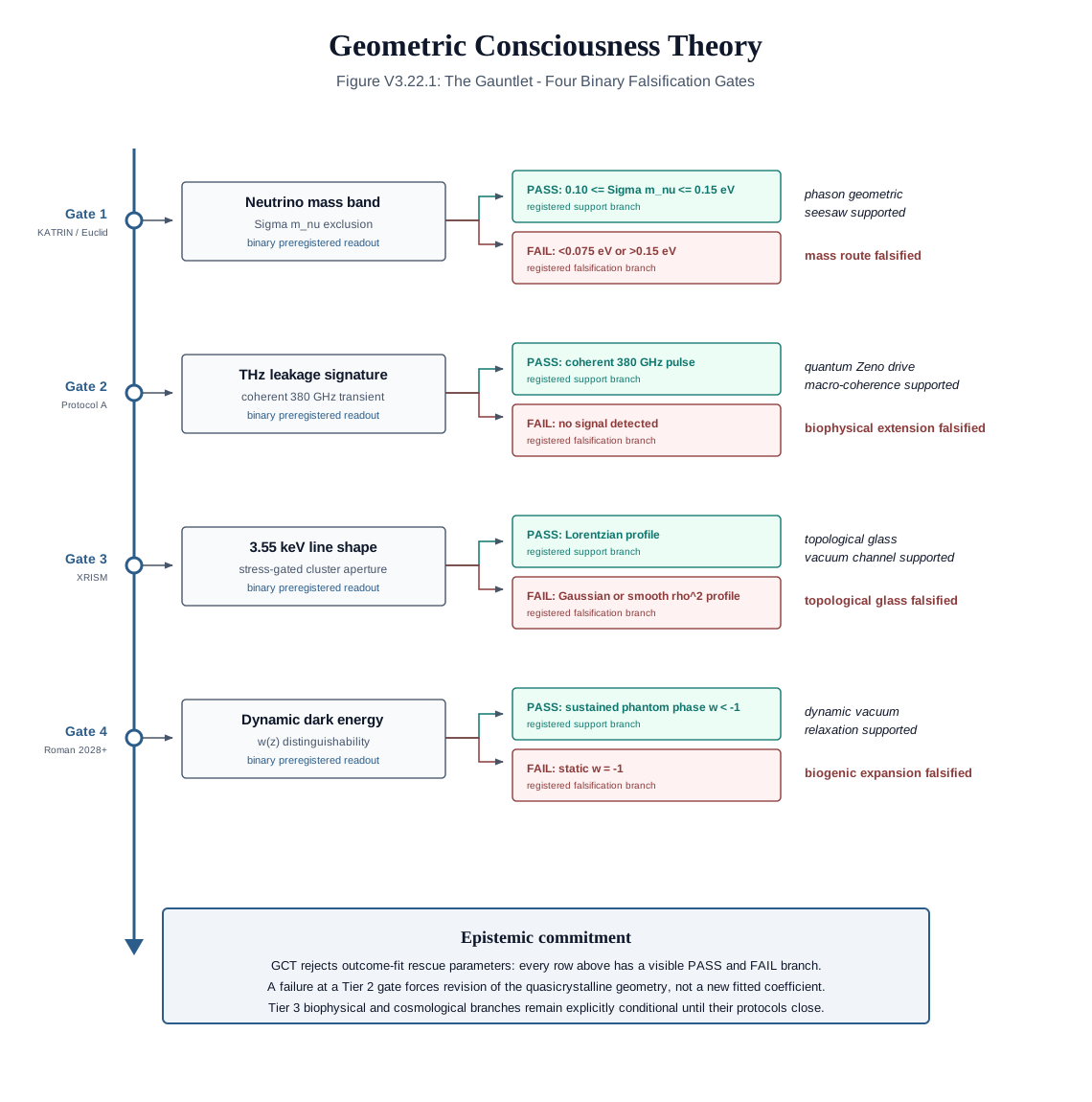
22.1.2 THz Leakage Signature [Tier 3 detection target — SNR audit pending Open Problem O.10]
The search for the "Physical Flash" of a selection event (Protocol A) targets the electromagnetic leakage of the Zeno Drive.
- The Test: Cryogenic detection of coherent THz transients in the ~360-400 GHz band [Tier 3 — central value GHz from the heuristic, band widened to reflect Open Problem O.10 magnitude uncertainty] in synchronized neural cultures, with the phase-coherence-conditional super-radiant scaling required for detectability against the cavity-integrated blackbody background (see V3 §13.3.2b).
- The Verdict: Detection of a super-radiant THz pulse following gamma-bursts at the predicted band would constitute supporting evidence for the autopoietic rendering engine; a null result is not a clean falsifier of the GCT mechanism until (a) the SNR audit confirms that the cavity-integrated background is suppressed below the predicted enhanced signal, and (b) the phase-coherence assumption underlying the scaling is independently verified. Until O.10 closes, this binary gate operates as a Tier 3 detection target rather than a Tier 2 falsification gate.
22.1.3 Isotope Substitution
Protocol D tests the hardware dependence of consciousness by altering the nuclear spin-gears of the brain.
- The Test: Comparison of anesthetic thresholds and coherence times in O (spin-0) vs. O (spin-5/2) environments.
- The Verdict: If awareness is substrate-independent, there will be no shift. A robust, spin-dependent shift in consciousness thresholds would prove that the mind is anchored in the atomic nucleus.
22.1.4 Neutrino Mass Ceiling
While GCT predicts an absolute mass floor of eV [Tier 2 mass-floor mechanism + Tier 3 cosmology remapping], current spectrometers (KATRIN) have a sensitivity limit of eV [Tier 3 — instrumental specification].
- The Test: Next-stage KATRIN operations.
- The Verdict: GCT requires a Non-Detection by KATRIN (mass eV). A positive detection of a mass eV would falsify the second-order phason suppression mechanism ( [Tier 2]). Confirmation of the eV floor awaits Project 8 (Cyclotron Radiation Emission Spectroscopy) in the 2030s.
[!WARNING] ⚠️ Near-Term Falsification Risk — Neutrino Mass Sum [Tier 3 — 2σ Tension] The GCT prediction eV is currently at ~2σ tension with the Planck+DESI 2024 95% CL upper bound eV and the DESI DR2 CDM-context bound eV. Under the registered Fork-A band, those bounds are TENSION, not falsification. Definitive exclusion requires eV (the lower gate set above the normal-ordering oscillation floor near eV) or eV in a pre-registered likelihood that includes CMB+BAO+LSS growth information (including the sector). This is a near-term binary gate: its lower arm ( eV) sits just above the normal-ordering oscillation floor (~0.059 eV), so a definitive NO-allowed measurement in the eV interval fires it while remaining physically consistent with the normal ordering; see App NS for the gate construction and the GCT-native-likelihood survival path. The GCT mass sum's survival depends on a GCT-native biogenic-dark-energy likelihood shifting the effective – constraints relative to CDM; if eV and are confirmed simultaneously in the same joint likelihood, both the neutrino floor and the biogenic DE mechanism are jointly falsified.
22.2 Mid-Term (2028–2032): Precision Validation
Should GCT pass the near-term binary gates, the program shifts toward high-precision validation of the 6D3D projection.
22.2.1 Roman Telescope Dark Energy
The Nancy Grace Roman Space Telescope will audit the Biogenic Dark Energy Lagrangian.
- Prediction: A sustained phantom phase where remains below for with operative Class-2 amplitude [Tier 3 — calibrated biogenic dark energy envelope], correlated with the peak of integrated biological star formation. In the GCT biogenic-DE pipeline asymptotes to from below and does not literally cross the divide (see V2 Ch14 §14.6.3); is the low-redshift sensitivity marker for the Class-2 envelope, not a mathematical zero. The framework's closer-binding observable is the Roman Year-10 / Stage-V measurement of consistent with the GCT biogenic-DE shape over the joint Roman + DESI window with precision below ; the Hubble tension is not a prediction of the §14.5.1 lag-kernel action (under quantitative derivation the action gives an opposite-sign, far-too-small local shift in overdense regions; see V2 Ch14 §14.5.4 and Appendix H Open Problem O.17). A separate dipole-anisotropy test (1% isotropy of across the celestial sphere; see V2 Ch14 §14.4.1) is also Roman-accessible.
22.2.2 Mass Spectrum Precision
We target the fifth and sixth decimal places of the lepton hierarchy. By refining the phason drag coefficients to include self-interactions, Protocol B will provide the most precise mass predictions in the history of the Standard Model.
22.2.3 Proton Mass from String Tension
Executing the high-resolution Geometric Resonance Analysis of the Baryonic Triad (Protocol F) reproduces the proton mass at MeV [Tier 2 mechanism + Tier 3 sheet/exponent handle pending AKN-action closure; 155 ppm against the CODATA observed MeV] from the phason-stiffness of the 3-fold axes (see App R §R.3 for the three-values guide). This is the current proton-mass mechanism route, not a closed solution of the hadron mass gap from the current postulate set; further precision tightening targets the QLQCD-1L / AKN-action closure (App Z).
22.2.4 Cosmological Neutrino Detection
Euclid DR1 and Simons Observatory data will test the GCT mass sum [Tier 2 mass-floor mechanism + Tier 3 conditional remapping].
- The Binary Gate: | Euclid DR1 | vs registered eV / eV exclusion band | high-priority falsification gate |. App NS defines the gate and decision rule for this near-term cosmological test.
- Falsification: If the cosmological likelihood tightens below eV at definitive precision, or above eV, the phason-coupling mass floor is definitively excluded. DESI 2024/DR2 bounds in the - eV range are tension under CDM, not the registered exclusion condition.
22.3 Long-Term: Theoretical Completion
22.3.1 Quasicrystalline Lattice QCD (QLQCD)
The replacement of periodic "hyper-cubic" grids with the Aperiodic AKN Tiling will define the next era of nuclear physics. QLQCD will resolve the Strong CP Problem through geometric matching rules and provide an infinite-precision menu for the entire hadron spectrum.
22.3.2 Probing Breakdown of the Metric
At extreme energies, GCT predicts the Dissolution of Spacetime. We will look for signatures of the 6D hardware in the dispersion relations of ultra-high-energy cosmic rays, where the "smooth" metric approximation fails and the discrete lattice nodes become manifest.
22.3.3 Laboratory Quantum Gravity (2038-2040)
By creating macroscopic, coherent phason condensates in Bose-Einstein analogues, we aim to manipulate the Acoustic Metric directly. This will move "Gravity" from a cosmic force to a laboratory engineering parameter, enabling the local modification of the spacetime refractive index.
22.4 The Complete Scorecard
We consolidate the achievements of this work into a final epistemic audit.
22.4.1 Structural Derivations (Tier 1 axioms + Tier 2 icosahedral architecture)
- ✅ Wheeler-DeWitt Equation (): The universe as a self-defining nullity [Tier 1].
- ✅ Dimensionality (): Derived from knot stability and entropy maximization [Tier 2].
- ✅ Standard Model Algebra: A Tier 2 algebraic-dimension match plus Tier 3 structural correspondence recovers the gauge-product candidate; the full physical Standard-Model identification (KO-dim-6 sign verification + first-order condition) remains conditional on App H Open Problem O.32 closure (see Ch06 §6.5 for the necessary-but-not-sufficient algebraic-dimension result and the registered conditional structure).
- ✅ Photon Masslessness: Gauge-protected Maxwell/residual- masslessness in the continuum description; the phason/tile-dynamics realization is a separate closure target [Tier 1 constraint + structural bridge pending tile-dynamics derivation].
- ✅ Born Rule (): Tier 3 conditional compatibility theorem under Gleason, pending App H O.40a (countable additivity) and O.40b (noncontextuality) for the GCT Selection Operator measure.
22.4.2 Tier 2 Geometric Validations (From Quasicrystal Ansatz)
[!IMPORTANT] Reading the scorecard. The precision figures below are consequences of the 5-postulate-plus-3-anchor current accounting enumerated in Parameter Ledger §0.1; they should be read in conjunction with the tier disclosures there. Where a row carries a precision figure (ppm, %, σ), the underlying Tier 2 framework is the icosahedral cut-and-project ansatz plus the Tier 3 specific exponents and disclosed anchors catalogued in Ledger §0.1 P2-P5 and A1/A2/A3. Bare tree-level precision is generally ~0.25-3%; sub-percent precision figures include the radiative-correction provenance disclosed in App R §R.2.1 and A3 measured where the row says so.
- ✅ Weinberg Angle (): Geometric volume ratio. Tier 1 algebraic identity for the bare angle (Uniqueness Theorem U.9); Tier 3 observational endpoint at the Z-pole (2.1% bare-tree-level vs CODATA, expected from RGE running — see Ch04 §4.5.4 reframe).
- ✅ Fine-Structure Constant bare mechanism: [Tier 2 mechanism + Tier 3 specific 360 multiplier; 3442 ppm residual pending O.5/O.19].
- ✅ Fine-Structure Constant corrected closure target: [Tier 3 bilayer correction; 41.6 ppm residual pending O.5/O.19].
- ✅ Newton's G ( N m² kg⁻²) [Tier 2 thermodynamic mechanism + Tier 4 Planck-link conjecture + Tier 3 dimensional anchor]: Jacobson horizon entropy supplies the thermodynamic mechanism, but the numerical Planck-link inherits O.14 and the SI anchor. Consistent with CODATA 2022 to 2274 ppm (0.23%) when the CODATA-2022 input constants (, , ) are used throughout.
- ✅ Electron Mass (): Tier 2 K-theoretic framework + Tier 3 exponent anchor + Tier 4 physical-link conjecture (Parameter Ledger §0.1 P2; App H O.14). The Coxeter-exponent arithmetic identifies as the power-sum label, while the load-bearing trace-image element is ; mapping that invariant through the 6D AKN physical-link chain remains open. The anchor-normalized check matches CODATA-2022 to 1006 ppm on canonical inputs, but the specific exponent and physical-link chain remain O.14-governed rather than theorem-grade derivations.
- ✅ Muon g-2 [Tier 2 mechanism + Tier 3 coefficient + A3 + Tier 4 calibration-survival conjecture: TENSION under WP2025]: Geometric mechanism via through the equal-weight 1/5 icosahedral phason vertex coefficient. WP2025 disposition (App R §R.2): under the consolidated lattice-QCD HVP synthesis (BMW/RBC HVP + Fermilab E989 final + CMD-3) the SM-vs-experiment gap is ~0.6σ; the GCT correction is therefore not load-bearing empirical evidence under WP2025 and sits in tension. The §8.7.2 HVP scenarios A/B/C contingency framework remains the canonical disposition.
- ✅ Lepton Masses (): Tier 2 mechanism (harmonic ladder on the dodecahedral cage) + Tier 3 specific exponents (muon) and (tau) per Parameter Ledger §0.1 P4/P5. Precision muon 21 ppm (0.0021%) against PDG 2024, tau 51 ppm (0.0051%) against PDG 2024 via A3 measured , , and screening — scored against pole-mass values that already include SM 2-loop EW + 3-loop QED corrections (see App R §R.2.1 Loop-Order Discipline). Bare Tier 2 geometric precision is ~0.25%; sub-percent precision requires the GCT geometric form combined with A3 and the SM-equivalent radiative-correction provenance.
- ✅ Proton Mass (): Tier 2 mechanism + Tier 3 sheet/exponent handle pending AKN-action closure. Baryonic Triad scaling (155 ppm current tree-level residual).
- ✅ Icosahedral Selection: point-group uniqueness of icosahedral symmetry proved in App U conditional on H1; -slope global entropy maximality remains an open primary-candidate claim.
22.4.3 Tier 3 Phenomenological Models (Pending Derivation)
- ⚠️ Higgs VEV Absolute Scale (246 GeV) [Tier 3]: Mechanical origin established, magnitude calibrated.
- ⚠️ Light Quark Absolute Masses [Tier 3]: Ratios follow area-law [Tier 2]; absolute values require QLQCD.
- ⚠️ Dark Energy Susceptibility () [Tier 4 — order-of-magnitude]: Driven by the holographic 4-volume ratio.
22.5 The State of the Theory (Final Assessment)
22.5.1 What GCT Has Achieved
GCT unifies the "Hard Problem" of consciousness with the "Hard Problems" of physics. The apparent arbitrariness of nature—the specific values of masses and forces—is the structural signature of an icosahedral vacuum. The Standard Model emerges from two philosophical axioms and the icosahedral geometric framework parameterised by — the 5-postulate-plus-3-anchor current accounting of Parameter Ledger §0.1 (P1 icosahedral cut-and-project ansatz, P2-P5 the integer exponents , , , each with explicit tier disclosure and Open Problem closure paths, A1 the dimensional anchor , A2 the native-RGE endpoint anchor, and A3 measured low-energy for corrected precision-comparison rows). References to as the structural constant are structural-constants-only language; the full free-parameter accounting is partitioned in Ledger §0.
22.5.2 What Remains Open
Parametric Status: Gauge and Lepton Sectors
Within the 5-postulate-plus-3-anchor current accounting of Parameter Ledger §0.1 (P1 icosahedral cut-and-project ansatz; P2-P5 the integer exponents , , , ; A1 the dimensional anchor ; A2 the native-RGE endpoint anchor; A3 measured for corrected precision-comparison rows), every dimensionless ratio in the bare Gauge Sector and Lepton Mass Ratios — the bare fine-structure constant, the Weinberg angle, the lepton mass hierarchy — is derived from the icosahedral geometry without continuous phenomenological fitting. The corrected ppm comparison rows inherit A3 until the O.19/O.5 bare-to-physical alpha bridge closes. The framework is impressively constrained for a theory of this scope, but the current constraint is the 5-postulate-plus-3-anchor structure, not the closed one-parameter horizon. The closure target is the 1-parameter limit P1 + ; each of P2-P5 is currently a Tier 2 mechanism plus a Tier 3 specific integer choice awaiting first-principles derivation under Open Problems O.5, O.14, and O.15, A2 awaits the QLQCD-1L/App ZN boundary derivation, and A3 awaits O.19/O.5.
Epistemic Boundary Clarification. The structural constraint above applies strictly to the Gauge Sector and Lepton Mass Ratios. The absolute dimensional scale (the electron mass and all quantities derived from it, including Newton's ) constitutes a 1-DOF dimensional system anchored to as the A1 SI-unit reference. The dimensionless ratio is structured by the K-theoretic gap-labeling framework, but the integer bookkeeping must not be conflated: is the Coxeter-exponent power-sum label, while is the trace-image candidate in the AKN gap-label chain. The uniqueness of the exponent inside and the physical-link map from the invariant to the 6D AKN trace image remain Open Problem O.14 (the 1D Fibonacci toy-model identification is closed; the 6D AKN lift is not). Full non-perturbative extraction via the spectral zeta function on the AKN hull is the closure target. The Quark sector (irrational exponents in and the higher CKM mixing angles , ) remains Tier 3 Ansatz pending Fuglede-Kadison determinant closure (Open Problem O.5); the down-quark route is a Tier 2 mechanism with current R=2 band-violation until the converged R=4 lattice output is source-promoted (App R §R.8; App TP §TP-B).
Two derived-but-not-yet-from-first-principles correction terms constitute the remaining parametric debt of the program:
-
Phason Anti-Screening (0.34% residual) [Tier 3 — open research debt]: The tree-level formula [Tier 2] establishes the rigorous baseline. The 3442 ppm discrepancy is the uncalculated Phason Anti-Screening shift. The full ab initio justification from the 6D lattice action (quantifying the bosonic phason loop on the AKN tiling) remains the primary open QLQCD task (Appendix Z).
-
Healing length (ξ ≈ 7.25 nm): Derived from the Gross-Pitaevskii equation via ξ = ℏc/(α²m_ec²) = a₀/α, yielding a value whose polaron diameter (2ξ ≈ 14.5 nm) matches the microtubule lumen ID (~15 nm) to within ~3%. The formula is internally consistent. Its derivation from the 6D phason stiffness parameters K_⊥, K_∥ without recourse to the continuum GP equation remains an open item.
Per the Parameter Ledger: GCT has a 5-postulate + 1-anchor bare topology/exponent sub-sector (A1 ), adds A2 ( Tier-3 calibrated boundary) for the native-RGE endpoint check, and adds A3 (measured low-energy ) for corrected precision-comparison rows. Calibrated discrete integer handles (1440, 12, 360, 2), continuous endpoint A2, and precision-comparison A3 are explicitly counted; the one-parameter state remains the closure target, not the present status.
While the structure of the simulation is clear, the origin of the initial 6D lattice constant () remains a foundational input. The derivation of the absolute Higgs VEV and the full closure of the CKM/PMNS matrices remain the primary theoretical frontiers.
22.5.3 The Path Forward
The era of "parameter-fitting" is over. The path forward is Crystallographic Decoding. Every anomaly in our data is a clue to a local lattice defect. The programme reads the machine code of the cosmos rather than wandering in a landscape of random numbers.
22.6 The Invitation
To the experimentalists: Seven protocols await. The equipment exists. The predictions are narrow, monochromatic, and risky. Break this theory if you can.
To the computational physicists: The code in Appendix R is a starting point. We invite you to scale the lattice simulations to 6D periodic boundaries. The future of QCD lies in sparse-matrix engineering on aperiodic grids.
To the skeptics: within the 5-postulate-plus-3-anchor current accounting enumerated in Parameter Ledger §0.1 (P1 icosahedral cut-and-project ansatz; P2-P5 the integer exponents , , , ; A1 the dimensional anchor ; A2 the native-RGE endpoint anchor; A3 measured for corrected precision-comparison rows), the Proton mass mechanism reaches 155 ppm () with a Tier 3 sheet/exponent handle pending AKN-action closure, and the Muon mass reaches 21 ppm () with Tau at 51 ppm () against PDG 2024 MeV. (Bare Tier 2 geometric precision is ~0.25%; the 21/51 ppm precision requires A3 plus Tier 2+3 combined drag and self-energy corrections via and screening, scored against pole masses that include the SM-equivalent radiative-correction provenance disclosed in App R §R.2.1.) The cross-base Monte Carlo control (App R §R.9.4; N=100,000 random irrational bases; zero non- bare-control bases hit all four targets simultaneously; , about two-sided normal-tail) is auxiliary: bare φ itself misses the lepton bands, corrected φ passes the physical comparison, and uniqueness remains pending exhaustive §R.9.5 base/formula closure. It is not a free headline significance.
22.7 Epistemic Verdict (Final Statement)
Geometric Consciousness Theory (GCT) does not claim to have "solved" consciousness or proven that the mind is the sole cause of the universe. Instead, we have demonstrated that a geometric consciousness-first model, built on the 5-postulate-plus-3-anchor current accounting enumerated in Parameter Ledger §0.1, is quantitatively consistent with the precision data of the Standard Model (21 ppm for the muon, 51 ppm for the tau against PDG 2024 — with A3 and under the SM-equivalent radiative-correction provenance of App R §R.2.1) and contemporary cosmology (DESI 2024, with the ~2σ tension as a near-term binary gate (with the gate-construction caveat in App NS) per §22.1.4).
We have established a rigorous hierarchy of certainty:
- Tier 1 (Axiomatic/Theorem): The derivation of the gauge groups and dimensionality from icosahedral topology.
- Tier 2 mechanisms with Tier 3/Tier 4 anchors and residuals: lepton mass-spectrum harmonic-ladder mechanism (Tier 2) plus the and specific exponents (Tier 3 anchors pending O.5/O.14/O.15); fine-structure-constant impedance form (Tier 2) plus the 3442 ppm bare residual (Tier 3 pending O.19/O.5).
- Tier 3 (Phenomenological/Hypothesis): The biophysical Zeno Drive and Biogenic Dark Energy models.
While the Tier 2 results provide compelling evidence of a crystalline vacuum architecture, the Tier 3 extensions remain high-risk hypotheses. Our invitation is not for blind acceptance, but for rigorous falsification. If the 3.55 keV line is broadened or the Zeno flash is absent, the extensions fail—but the geometric skeleton of the mass spectrum remains as a structural fact of the lattice.
The door is open. The staircase of certainty leads to a universe that is fundamentally intelligible, beautifully unified, and structurally consistent with the existence of agency.
22.8 Parametric Closure and Theoretical Autonomy
GCT has reached the 5-postulate-plus-1-anchor bare gauge+lepton sub-sector, expanding to 5-postulate-plus-3-anchor when native-RGE endpoint and measurement-anchored precision-comparison rows are included per Parameter Ledger §0.1: the dimensionless ratios , , bare , and follow from the icosahedral cut-and-project ansatz (P1) plus the integer exponents , , , (P2-P5) — each a Tier 2 postulate (mechanism) plus a Tier 3 specific value (integer choice) pending first-principles derivation under Open Problems O.5, O.14, O.15. The absolute dimensional mass scale adds the SI-unit anchor A1 (), the native-RGE endpoint audit adds A2, and corrected lepton/Higgs/QED comparison rows add A3. The K-theoretic blueprint for currently reaches a gap-label/dimension-group trace skeleton at the 1D Fibonacci toy-model level; the explicit Dixmier-residue/spectral-triple computation and the 6D AKN trace-image lift remain open as O.14. The down-quark route is a Tier 2 Fuglede–Kadison-determinant mechanism with primary output MeV, postdiction-consistent at inside the registered 11% shell-resonance band. Its FK sequence centers on with an empirical decaying envelope; rigorous infinite-volume convergence remains bundled with O.5. Three quark-sector formulas with irrational exponents (; CKM , ) remain Tier 3 Empirical Ansätze pending K-theoretic gap-label derivation at the second-harmonic mode (Open Problem O.5, Ch10). The pursuit of total "Autonomy" requires a final integration stage to emancipate these three remaining heuristic exponents.
The roadmap for Parametric Closure and Theoretical Autonomy focuses on two discrete objectives:
- Geometric Renormalization Group Equations (RGEs): Standard Model QCD and QED RGEs flow the bare lattice masses (e.g., GeV for the Top) down to their dressed pole masses. Partial structural closure of this gap is established in Appendix ZN ("GCT-Native RG Flow"): the U(1) and SU(2) -function shape is derived from the icosahedral irrep-activation schedule and the cut-and-project Gram weights , , with no fitted shape parameter. The saturated coefficients , , are reproduced by construction through three icosahedral normalisations that absorb the substrate-to-PDG absolute magnitude — one anchor per coupling, in direct analogy to the single anchor of the lepton sector. Beyond the GCT flow saturates (the finite irrep tower of caps the ), giving GCT a combinatorial UV cutoff rather than a Weinberg–Reuter asymptotic-safety non-Gaussian fixed point. Status now:
- shape: Tier 2 (GCT-native, App ZN); endpoint Tier 3 (one anchor)
- shape: Tier 2 (GCT-native, App ZN); endpoint Tier 3 (one anchor)
- bare: Tier 2 (, App Z.7); running: Tier 3 (QLQCD-2 pending)
The remaining open work — full Tier-2 ab-initio derivation of the three from the spectral action / QLQCD non-perturbative closure (App Z) — is the canonical path to total RGE autonomy. See Appendix ZN for the derivation and protocol_rge_native.py for the numerical audit.
2. The Subjective Lagrangian Calculus: Expanding the action functional defined in Chapter 16 () into a fully computable, rigorous calculus. This entails calculating explicit metabolic friction coefficients for specific human psychophysical states, establishing the quantitative operating manual for the Mind-Brain Bridge.
The parameter convergence stands. The next era is exclusively dedicated to the technological engineering of the substrate.
22.9 Coverage Map and Scope Notes
GCT's ambition is a self-contained framework for any domain to which its machinery has structural grip. The preceding 21 chapters develop that machinery in physics, cosmology, and the consciousness substrate; V1 Part VI ("Applications & Open Domains") extends it into psychology, social systems, aesthetics, contemplative practice, theology, self-reference, and philosophy of science. This concluding section enumerates the remaining domains, the recommended treatment level for each, and the explicit scope notes that delineate where the framework provides ontological context rather than predictive instruments.
22.9.1 Domains adjacent to current coverage (one-paragraph notes here; full treatment is companion-paper material)
- Language phonology and lexical semantics under the Quality Space framework: the same icosahedral irreducible representations that decompose colour and audition (Ch16 §16.2.2c) constrain the acoustic-perceptual space of phonemes. A Tier 2 prediction is that phonemic inventories across the world's languages cluster around the irrep boundaries of the human auditory Quality Space; an empirical companion-paper target.
- Cognitive development and learning trajectories: the maturation of an Identity Polaron's -adic identity tree (V1 Ch7 §7.6.3) provides a structural model for Piaget-style developmental stages — coupling-coefficient to caregivers stabilises early branches, later branches form through autonomous Selection-Operator exploration. Treatment depth: a future "GCT Developmental Psychology" paper.
- Dyadic relationships and attachment dynamics: high- Polaron coupling sustained over time predicts physiological coherence beyond shared-environment baselines (a Tier 2 prediction testable via continuous HRV / EEG cross-spectral coherence in long-term partners). Companion-paper material.
- Decision theory and the Subjective Lagrangian (already developed structurally in §22.8) extends to game theory, rational choice, and the geometry of preference — the Bayesian-staircase formulation is GCT-native and warrants a dedicated decision-theory monograph.
- Plant, fungal, and microbial agency under the Dual Material Constraint (V1 §16.2.6): chiral microtubular substrates with non-zero nuclear spin satisfy both conditions for Level II; mycelial networks, plant calcium-signalling cytoskeleta, and certain protist colonial morphologies are open empirical targets.
- Memory taxonomy (episodic / semantic / procedural) maps onto the -adic tree depth at which a memory is anchored (deep branches = stable semantic; surface branches = perishable episodic; muscle-memory = -locked across body-Polaron sub-network).
- Friston Free-Energy Principle bridges: predictive processing is the information-theoretic shadow of the Selection-Operator's thermodynamic optimisation; active inference is application to minimise expected friction. A future paper integrating FEP and GCT is high-leverage.
- Generative syntax: with corpus input, GCT can frame syntactic universals as Quality-Space patterns coordinated by multi-agent communicative selection; specific computational operations (Merge, X-bar) are downstream architectural choices not derivable from alone.
22.9.2 Scope notes (explicit boundaries)
- Climate, geophysics, ecology, planetary systems are applicable with inputs: GCT provides the ontological context (matter as topological defects, gravity as phason elasticity, biological agency under the Dual Material Constraint) but is not the practical instrument for object-level prediction. Just as one uses Newtonian mechanics rather than General Relativity to predict the orbit of Saturn, climate / ecology / planetary dynamics use domain-specific models that GCT does not aim to replace.
- Mathematics itself: per V1 §1.3.5 and V1 §6.4.5, mathematical objects are patterns over Field configurations, not Field configurations themselves; they do not inherit Level I presence. The instantiation of doing mathematics in a Class 2 Polaron has presence in the ordinary way. Confusing the two collapses the Field/Pattern distinction and converts the theory into a substrate-less Mathematical Universe (a position GCT rejects).
- Cultural anthropology, ritual analysis, gender / sexuality: the multi-Polaron Consensus Protocol applies structurally, but specific cultural content requires ethnographic input the framework does not generate. These are downstream cultural-science domains; GCT provides the substrate ontology, not the object-level claims.
- Specific quantum-gravity competitor programmes (string theory, loop quantum gravity, causal dynamical triangulations): GCT is empirically separated from these by its concrete derivations (the 5-postulate-plus-1-anchor bare gauge+lepton sub-sector of Parameter Ledger §0, expanding to 5-postulate-plus-3-anchor when native-RGE endpoint and measurement-anchored precision-comparison rows are included, the sustained-phantom-phase dark-energy signature, the pulsar-timing anisotropy). Quasicrystalline-spacetime programmes now form a closer comparison class. Boyle and Mygdalas, "Spacetime Quasicrystals" (arXiv:2601.07769), construct Lorentzian quasicrystals by a D embedding and explore a speculative Planck/electroweak/vacuum seesaw, whereas GCT uses a Euclidean projection with emergent Lorentz symmetry and a derived golden-ratio mass cascade. Aschheim, Bubuianu, Fang, Irwin, Ruchin, and Vacaru (Annals of Physics 394:120-143; arXiv:1611.04858) provide an E8-derived quasicrystal-vacuum cosmology programme, but without a derived Standard Model mass spectrum. Detailed competitive analysis is reserved for future work; the manuscript states only the empirical separation.
End of Coverage Map.
END OF VOLUME 3 END OF DOCUMENT