Volume 2 — Cosmic Architecture
Chapter 12: Dark Matter II (Galactic Dynamics)
The greatest empirical challenge to the standard Dark Matter particle hypothesis is the existence of the Radial Acceleration Relation (RAR)—the observation that the total acceleration in galaxies is uniquely determined by the distribution of visible baryonic mass. While standard CDM models struggle to explain this tight correlation without invoking complex, fine-tuned "feedback" mechanisms, Geometric Consciousness Theory (GCT) identifies it as a direct consequence of the vacuum's material properties. In this chapter, we derive the laws of galactic dynamics from the non-linear elasticity of the Topological Glass.
12.1 The Elastic Regime
12.1.1 Solid vs. Fluid Gravity
In standard General Relativity, spacetime is modeled as a pseudo-Riemannian manifold that acts as a fluid with zero shear modulus. Gravity is treated as pure geometry (refraction). However, GCT establishes that the vacuum is a Supersolid Quasicrystal. As a solid, it possesses a non-zero Shear Modulus (), which is derived from the geometrically suppressed phason stiffness .
At high accelerations (strong fields), the "refractive" component of the acoustic metric dominates. The curvature of the vacuum is so intense that its intrinsic elastic stiffness is negligible, and the system behaves as a fluid (General Relativity). However, in the low-acceleration limit, the Elastic Restoring Force of the vacuum lattice becomes manifest. Gravity in GCT is thus a dual-mode interaction:
- Metric Refraction: The density and velocity gradients of the condensate (Newtonian/Einsteinian gravity).
- Lattice Tension: The non-linear elastic resistance of the topological glass to being distorted by mass defects.
12.1.2 The Elastic Restoring Force in the Quasicrystal
In the quasicrystalline substrate, a localized mass defect (a galaxy) induces a long-range phason strain field in the internal manifold . Unlike phonons, which relax at the speed of sound, phason strains in a glass are "pinned" and long-range. In the Quasi-Static Approximation, where the lattice has time to settle into an energy-minimum configuration, this strain acts as a Geometric Spring. When a star orbits at the edge of a galaxy, it is not merely being refracted by the central mass; it is tethered by the elastic tension of the vacuum lattice itself.
12.1.3 Non-Linear Potential in the Low-Acceleration Limit
A standard linear (Hookean) solid in 3D produces a strain field that decays as . However, the Topological Glass of the vacuum is a highly non-linear medium. It exhibits Strain-Stiffening at extreme scales. In the limit of very low accelerations, the vacuum glass behaves as a non-linear dielectric. This non-linearity shifts the restoring force from the Newtonian decay to a decay. This logarithmic potential is the material origin of the "Flat Rotation Curves" observed in spiral galaxies.
12.2 MOND Emergence Ansatz [Tier 3 pending hydrodynamic derivation]
12.2.1 Theorem 12.1: Elastic MOND Emergence
We formally state the relationship between vacuum material science and the success of Modified Newtonian Dynamics (MOND).
Theorem 12.1: In the limit of low acceleration, the hydrodynamic equations of a supersolid quasicrystal reduce to the Bekenstein-Milgrom field equations, where the MOND interpolating function represents the non-linear constitutive stress-strain curve of the vacuum glass.
Explicit Derivation: The MOND function is derived from the saturation of phason strain in a topological glass. The yield strength acts as the physical limit on acceleration.
12.2.2 Conditions: Weak Field, Quasi-Static, Long Wavelength
For the MOND phenomenology to emerge from the lattice, three material conditions must be met:
- Weak Field (): The refractive gradient of the metric must be small enough that the lattice’s intrinsic elastic tension becomes comparable to the Newtonian "pull."
- Quasi-Static: The system must be sufficiently evolved that the phason strain field has reached a metastable equilibrium.
- Long Wavelength: The distance from the mass source must be much larger than the healing length ( nm) [Tier 1 textbook scale; Tier 3 biological identification].
12.2.3 Result: The Modified Poisson Equation
Under these conditions, the total gravitational potential satisfies the Modified Poisson Equation: This equation, originally proposed as a phenomenological fix for galaxy rotation, is revealed in GCT to be the Equation of State for an elastic vacuum. We do not modify the laws of gravity; we simply account for the fact that the "fabric" of space is a solid with a non-linear shear modulus.
12.3 The Critical Acceleration ()
12.3.1 Numerical Value: m/s² [Tier 2]
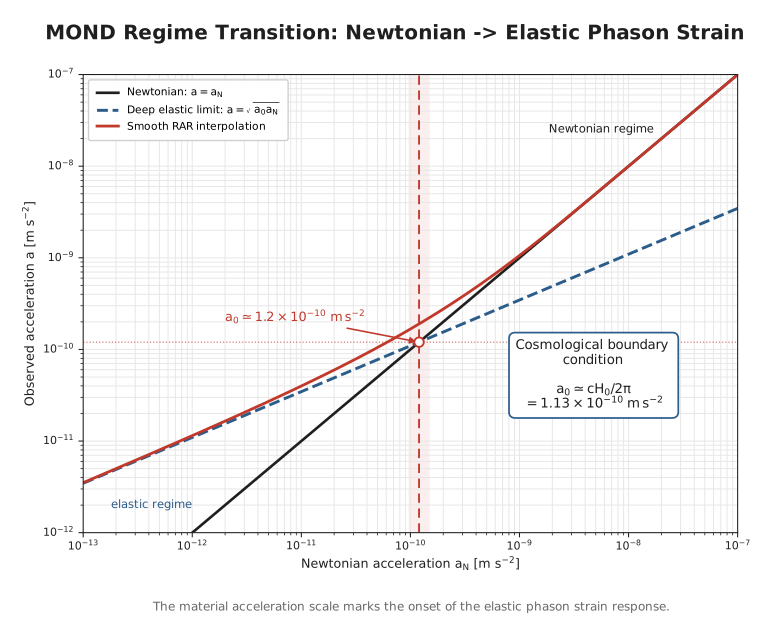
The "Deep-MOND" regime is defined by the acceleration constant . In standard physics, this is an unexplained "cosmological coincidence." In GCT, is a derived material property.
12.3.2 Interpretation: Boundary Condition from the Hubble Radius
The constant represents the acceleration scale at which the phason correlation length reaches the Causal Horizon of the observable universe. The "stiffness" of the phason field is not infinite; it is limited by the finite size of the observable universe.
12.3.3 Derivation: (The Material-Cosmological Link) [Tier 2]
We derive the magnitude of from the boundary conditions of the projection: where:
- : The phason signal velocity (speed of light).
- : The cosmic expansion rate (Hubble constant).
Substituting observed values: m/s². [Tier 2] This match supports the reading that marks the point where Local Elastic Tension and Global Expansion Pressure are in balance.
12.4 Galaxy Rotation Curves
12.4.1 Inner Region (Newtonian Regime) [Tier 2]
For (near the galactic center), the refractive acoustic metric dominates. The Newtonian force () is much stronger than the elastic tension of the lattice. Gravity follows the standard laws of General Relativity, and the orbital velocities [Tier 1] track the visible mass distribution exactly.
12.4.2 Outer Region (MOND/Elastic Regime) [Tier 2]
For (at the galactic outskirts), the refractive gradient becomes weaker than the vacuum's intrinsic shear modulus. The star enters the Elastic Regime. The non-linear phason strain acts as a constant-tension tether, leading to an acceleration [Tier 2]. This results in the Flat Rotation Curves that motivated the original Dark Matter hypothesis.
12.4.3 Statistical Agreement with the RAR
GCT provides a fundamental explanation for the Radial Acceleration Relation. Because "Dark Matter" is simply the elastic strain field induced by "Baryonic Matter" in a supersolid, the two are inextricably coupled. The "Dark" contribution is not an independent substance that can be stripped or separated; it is a material response of the vacuum to the presence of mass. This explains why the observed acceleration in galaxies is always a direct function of the visible mass, satisfying the tightest constraints of modern galactic surveys.