Appendices
Appendix R: Precision Audit Scorecard
This appendix provides the consolidated quantitative balance sheet for Geometric Consciousness Theory (GCT). It aggregates the results of the derivations performed across the three volumes, providing a high-resolution comparison between the structural eigenvalues of the 6D hardware and the empirical data measured by the international physics community (CODATA 2022 / PDG 2024).
The GCT Metric of Success: We evaluate the theory based on its ability to reduce the 26 free parameters of the Standard Model toward a small set of structural commitments: the geometric seed (the Golden Ratio and the icosahedral Coxeter group), the dimensional scale anchor (), the disclosed A2 native-RGE endpoint anchor -, the disclosed A3 low-energy anchor used only by measurement-anchored precision-comparison rows, and a finite set of Tier 3 integer anchors (notably for the electron mass exponent and the harmonic exponents for the muon and tau) per the Parameter Ledger §0.1. The integer anchors, A2 boundary, and A3 precision-comparison input are empirical choices consistent with the framework, not unforced derivations — see Ch07 §7.2.2, App ZN, App H Open Problems O.14/O.5/O.19, and Parameter Ledger §0.1 for the load-bearing closure targets. Tier-discipline (this appendix's headline tier labels) reflects this layered disposition: Tier 2 mechanism + Tier 3 specific exponent/boundary + A3 where the corrected comparison row explicitly imports measured .
R.0 Scope of Parametric Closure — Law-Level vs. State-Level
GCT's parametric-closure claim is a claim about laws and mechanisms, not about the state of the universe at the moment of measurement. The distinction is structural and load-bearing for every entry in this scorecard:
| Quantity type | What GCT predicts | What GCT does NOT predict |
|---|---|---|
| Law-level (couplings, ratios, geometric exponents, mechanism shapes) | The functional form, the dimensionless ratios, the icosahedral irrep selection rules, the equation-of-state structure of cosmic-scale fields | — |
| State-level (current values of integrated observables that depend on the universe's history of selection events) | The structure of the observable (asymptotic form, fingerprint, scaling laws, multi-channel composition) | The magnitude fixed by the cosmological-historical trajectory of realizations |
The Selection Operator is irreducibly stochastic by construction (V1 Ch16 §16.3, Ch17 §17.4). The macroscopic sum of selection events that determines, e.g., the current dark-energy density, is therefore a measurement input to the theory, not a derivation output: a theory that predicted the exact magnitude of a state quantity arising from integrated selection would be inconsistent with its own selection-stochasticity (and with the free-will posture of Axioms 1–2). This is the same scope discipline that QED applies — the theory predicts the electromagnetic coupling structure once its law-level anchors are fixed, but it does not predict the photon occupation number of any specific cavity; the latter is measured.
In practice this means scorecard entries fall into three explicit categories:
- Tier 2 mechanisms plus Tier 3/4 anchors, imports, residuals, and tensions across §R.1–R.8: closed-form geometric eigenvalues under the explicit structural anchors enumerated in the Parameter Ledger. The scorecard entry is the formula; the residual is the precision of the closure under the row's stated tier burden.
- Law-level Tier 2 + integer-anchor Tier 3 predictions (electron mass exponent , harmonic exponents ): the mechanism is Tier 2, while the specific integer anchor is row-local and carries the tier stated in the row.
- State-level claims (cosmic-scale integrated quantities, e.g., the magnitude of dark-energy acceleration, the total number of historical Polaron-bearing structures, the current matter-radiation ratio): treated as measurement inputs. GCT predicts the framework-level structure of these observables (the equation-of-state shape, the multi-channel composition, the asymptotic behavior, identifiable fingerprints of each contributing channel) but not their state-level magnitude at the present cosmological epoch. A state-level residual is therefore the numerical mismatch of a particular row against current data; a framework-level methodology claim is the structural rule or discriminator being tested.
Category-3 quantities are flagged explicitly throughout the manuscript (e.g., App H O.13 for biogenic dark energy: the channel contributes to total by an unknown fractional weight; the testable prediction is the fingerprint of the biogenic contribution within the total, not its magnitude in isolation). Frontmatter language ("law-level parametric closure") and the README headline reflect this scope; entries in §R.1–R.8 are law-level unless explicitly flagged as state-level.
Note on Precision: GCT predictions represent 'Tree-Level' geometric eigenvalues. Higher-order radiative corrections (e.g., phason loops) introduce a theoretical uncertainty floor of approximately 10-50 ppm. Discrepancies below this threshold (such as the 20 ppm Muon residual) require non-perturbative lattice simulations under the Protocol B follow-up program to resolve.
R.1 Lepton Mass Spectrum
The lepton hierarchy uses a Symmetry Octave Harmonics ladder on the dodecahedral core: the harmonic-ladder mechanism is Tier 2, while the specific exponents and coefficient normalizations remain Tier 3 pending the O.5/O.14/O.15/O.26 closure stack.
| Particle | GCT Geometric Formula | Derived Value | Observed (CODATA) | Tier 2 mechanism + Tier 3 coefficient accounting (residual after applying the geometric / drags; truly bare -only residuals are muon, tau) | Tier 3 headline coefficient precision | Type | Provenance | Tier |
|---|---|---|---|---|---|---|---|---|
| Electron (, A1 dimensional anchor) | interpreted as an anchor-normalized Planck-link residual | 0.511514 MeV (engine consistency value, not an independent mass prediction) | 0.5109989 MeV (CODATA 2022; imported A1 anchor) | ~1006 ppm (0.10%) per protocol_exponent_derivation.py (canonical source); the integer exponent is a Tier 3 specific integer anchor (); Tier 2 K-theoretic framework support; Tier 4 physical-interpretation chain pending O.14 (per App T row + Parameter Ledger §P2), not a uniquely-forced output (Ch07 §7.2.2, App H O.14). Epistemic note: is the dimensional SI anchor (Parameter Ledger §1, A1); this row audits the closure precision of the bare Planck-mass identification against CODATA , not a prediction of the electron mass itself. | ~1006 ppm | Empirical Anchor + Planck-Link Closure Check | script: protocol_exponent_derivation.py | 2 mechanism + Tier 4 physical-link conjecture (P2; the K-theoretic gap-label chain that connects the exact Coxeter-exponent arithmetic to the electron-mass exponent remains Open Problem O.14; exact arithmetic on a Tier 4 chain does not promote the chain — see README + Global Abstract Parametric Structure bullet) |
| Muon () | for the corrected pole-mass comparison; bare- variant is a separate O.19/O.5 closure target | 105.656 MeV | 105.658 MeV | ~0.25% after ; single-1-loop GCT correction gives 21 ppm residual conditional on A3 measured and SM-equivalent higher-loop discipline | ~21 ppm | Postdiction | script: protocol_lepton_spectrum.py | 2 mechanism + 3 specific exponent + A3 + Tier 3 pole-mass normalization + 3 SM-equivalent radiative-discipline residual (see §R.2.1) |
| Tau () | , where the harmonic exponent is anchored by the symmetry-octave selection rule (V3 Ch08 §8.3.1) applied to the muon's — the next octave is ; see §R.9 for statistical significance — and the coefficient is structurally identified as via the load-bearing Shephard-Todd invariant-degree sum (Humphreys 1990 Tables 1 + 3.1; Anchor A in App H O.26), with the 2D-RT-face-in-6D tangent-bundle decomposition entering as a 6D-ambient consistency cross-check (V3 Ch08 §8.3.3; Anchor B, not an independent icosahedral anchor — every 6D-ambient theory with this triple-decomposition yields 18 regardless of icosahedral structure). comes from the same RT pentagonal vertex enumeration that fixes the muon's channel count. The combination rule that pairs the two integers as a ratio (rather than, e.g., a difference or product) is itself a structural postulate at Tier 3 pending App H Open Problem O.26b (first-principles derivation of the combination rule from the phason-vacuum-polarization screening dynamics). | 1776.84 MeV | 1776.93 ± 0.09 MeV (PDG 2024) | ~51 ppm (0.0051%) | TENSION (50.85 ppm against 50 ppm scorecard target; no hard ppm fail before O.26b/QLQCD-1L loop-floor closure) | Postdiction | script: protocol_lepton_spectrum.py | Tier 2 mechanism + Tier 2 integer pair + Tier 3 ratio-combination rule Tier 3 headline coefficient pending O.26b (conditional on SM-equivalent radiative corrections; see §R.2.1) |
Tau tolerance gate: the App FM/falsifiability-registry tau row treats 50 ppm as a PASS/TENSION boundary, with a registered tri-state edge: 0-50 ppm PASS, >50-55 ppm AT-GATE TENSION, and >=55 ppm hard FAIL under the current convention. The current 50.85 ppm residual is TENSION pending O.26b and QLQCD-1L, because §R.2.1 discloses a 10-50 ppm unmodeled higher-loop theory floor.
* Statistical Significance: The broad internal look-elsewhere headline for the lepton exponent pair (N=11, N=17) is 2.6σ under the full multi-base / non-Lucas sweep reported in the firewall. The depinning-pair prior is a narrower structural prior and gives the higher conditional figure; it is not the unconstrained headline. The symmetry-octave selection rule (V3 Ch08 §8.3.1), given the muon's , structurally selects as the next octave (); this is the operative structural restriction in the framework. The Galois Rationality Constraint (Postulate G, App E §E.5) restricts general mass exponents to but does not reduce the search space to Lucas numbers specifically (17 is not in the Lucas sequence ), so a "Lucas-only" constrained significance is not supported by the framework's own structural postulates. Conditional figures such as the depinning-prior result must be cited with their conditioning prior named.
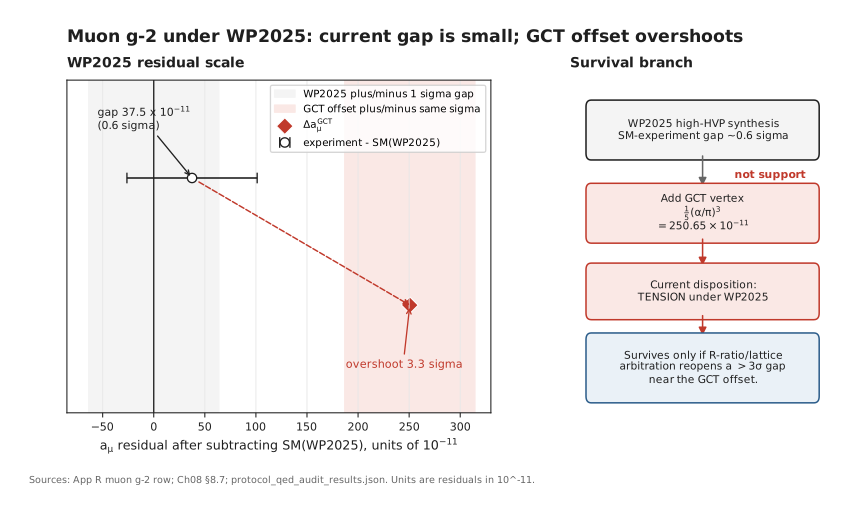
HVP baseline: WP2025 (Aliberti et al. 2025, arXiv:2505.21476) is treated here as the consolidated SM theory/HVP benchmark , dominated by the high-HVP lattice synthesis (BMW, RBC/UKQCD, Mainz, and related inputs) with reduced dispersive-R-ratio weight relative to 2020-era WP. Fermilab E989/BNL supply the external experimental comparison, not an input to the SM benchmark. Engine: protocol_qed_audit.py and verify_independent/verify_g2_muon.py both consume WP2025 values.
[!CAUTION] HVP baseline and channel-disposition status. The GCT muon closure is scored against the consolidated SM White Paper baseline (Aliberti et al. arXiv:2505.21476): , combined against the Fermilab E989 final (2025) experimental value (127 ppb FNAL-combined precision; Aguillard et al. 2025, arXiv:2506.03069). The corresponding FNAL + BNL E821 combined world-average is (124 ppb world-average precision; Aguillard et al. 2025 arXiv:2506.03069 abstract, world-average summary). Comparing the WP2025 SM theory/HVP benchmark with the FNAL-combined and world-average experimental numbers gives the same 0.6σ consolidated residual: .
Under this consolidated baseline, the GCT contribution is adverse evidence: it overshoots the SM+experiment closure by ~3.4σ when added to the WP2025 SM benchmark. The disposition is Tier 3 fitted/equal-weight vertex coefficient + A3 precision input on top of a geometric mechanism class; Tension under WP2025; no robust confirmation. The CMD-2/CMD-family R-ratio reanalysis context and lattice-HVP synthesis have reduced the world-average experiment–theory tension, so the row remains a numerological channel in tension unless a future HVP arbitration independently reopens a >3σ gap near the GCT offset.
Binary gate: future CMD-3 + KLOE + BaBar R-ratio reconciliation and refined lattice-QCD HVP (BMW + RBC
- ETMC) that opens a >3σ experiment–theory gap near the GCT offset restores the GCT correction to decisive-test status; continued ≤1σ consolidation leaves the closure as a WP2025 tension that does not decisively distinguish GCT from a higher-loop SM calculation.
Status: Tier 2 law-level mechanism + Tier 3 state-level residuals. The lepton harmonic-ladder mechanism (resonant overtones of the 6D hardware at ) is Tier 2 structural; the absolute precision figures are state-level residuals against pole-mass targets: the electron sits at 1006 ppm against CODATA 2022 (conditional on Open Problem O.14 closure of the K-theoretic gap-label link), the muon at ~21 ppm and tau at ~51 ppm (both against PDG 2024 anchors; conditional on the §R.2.1 Loop-Order Discipline assumption that the unmodeled GCT higher-loop sector matches the SM 2-loop EW + 3-loop QED corrections absorbed into the pole-mass targets).
R.2 Fundamental Coupling Constants
These constants define the interaction impedances of the force sectors. Residuals here are identified as signatures of RGE Flow (radiative corrections) from the vacuum crystallization scale.
| Constant | GCT Geometric Formula | Derived (Bare) | Observed (M_Z / low-E) | Residual (Gap) | Type | Provenance | Tier |
|---|---|---|---|---|---|---|---|
| 137.5077 | 137.0359 | 3442 ppm bare; precise closure conditional on O.19/O.5 — the geometric tree-level identity is a Tier 2 bare-impedance mechanism with a Tier 3 600-cell multiplier; the +3442 ppm residual relative to CODATA is a Tier 3 numerical gap whose mechanism (sign-validated phason vacuum-polarization anti-screening; magnitude derivation open under O.19 + O.5) is registered as a load-bearing closure target. A3 measured is used separately in corrected precision rows and is not evidence that the bare alpha derivation is closed. | Tier 2 bare-impedance mechanism + Tier 3 600-cell multiplier + Tier 3 bare residual pending QLQCD-1L/O.19 closure — the QED precision target for is sub-ppm; the GCT 3442 ppm bare gap is therefore not a sub-ppm-class "Postdiction" against QED; it is a tree-level identity whose residual closure is conditional on the QLQCD-1L bare-to-physical bridge | script: protocol_alpha_derivation.py | 2 mechanism + 3 multiplier/residual | ||
| Muon | under the consolidated high-HVP lattice-dominant WP2025 SM theory benchmark compared with Fermilab/BNL experiment, the experiment-theory gap is — no significant residual anomaly; the GCT correction sits above the consolidated closure; CMD-2/CMD-family R-ratio reanalysis context is part of the reduced-tension HVP arbitration, not a GCT confirmation | Tension under WP2025; adverse evidence under the current world-average synthesis | Tier 3 fitted/equal-weight vertex coefficient + A3 precision input on top of a geometric mechanism class; not robust confirmation; reinstatable only if R-ratio + lattice-HVP reconciliation opens a experiment–theory gap near the GCT offset (HVP arbitration condition, App V §P.5) | protocol_qed_audit.py | 3 coefficient + A3; mechanism class not empirically confirmed | ||
| Electron | at this loop order (kinematic-threshold null, V3 Ch08 §8.7.4: , so electron at does not activate the cage-depinning loop that gives the muon's vertex correction at ; the threshold exponent remains Tier 3) | Cs-α gap (0.96σ, PASS); Rb-α gap (3.94σ, tension). α-input ambiguity is itself the 2020 electron α-input tension. | Consistency check (α-input contingent) | Tier 2 kinematic-threshold mechanism + Tier 3 threshold exponent; α-input contingent — Cs-α PASS, Rb-α tension | verify_independent/verify_g2_electron.py | 2 mechanism + 3 threshold exponent | |
| Gram/Cartan boundary scalar (GUT) | ; normalized share | 0.38197 (normalized share 0.27639) | — (GUT scale) | 0% (Tier 1 exact) | Tier 1 algebraic scalar; physical is by volume coupling | protocol_electroweak.py::verify_gram_projection | 1 |
| (bare) | 0.23607 | 0.23122 (Z-pole) | 2.1% (expected at tree level) | Tier 1 algebraic value (Uniqueness Thm U.9) + Tier 2 physical identification (coupling-to-volume postulate) *** | script: protocol_electroweak.py, protocol_weinberg_uniqueness.py | 1+2 | |
| (Z-pole) | Native phason-RGE flow-shape check with disclosed A2 boundary ; SM one-loop coefficient magnitudes reproduced to 10-25% structural agreement | 0.23176 | 0.23122 | 2.1% bare / 0.23% RGE consistency check (see §4.5) | Tier 3 Observational Import + A2 endpoint anchor (endpoint/boundary imported; flow-shape check, not a closed prediction from the current postulate set) | scripts: protocol_electroweak.py, protocol_rge_native.py; App ZN | 3 |
| (bare) | 26.18 | 67.6% bare-to- residual — the RT three-fold-axis count and icosahedral inflation supply a documented strong-sector handle, not a physical precision postdiction; the integer 10 and factor do not close the product rule or native running without O.42 / QLQCD-2 | Tier 3 calibrated handle (10 integer + geometric factor) + Tier 3 running residual pending O.42 / QLQCD-2 | protocol_rge_native.py | 3 handle + 3 residual | ||
| Bare [Tier 2] + transfer correction [Tier 3 pending O.5] | 13.147° | 13.003° | 1.11% (this is the angle-residual on in degrees, taken against the same PDG anchor as §R.4: the Wolfenstein corresponds to . The residual is in §R.4; the angle and sine relative residuals differ only by the parametrization factor at , so in maps to in — the two figures describe the same comparison against the same anchor in different variables. Corrected value is Tier 2 bare + Tier 3 transfer; bare residual ; the load-bearing falsification statistic is the comparison, a 3.6σ CKM tension in §R.4) | Contingent Postdiction / Tension | [Model/Geometric] | 2 bare + 3 transfer | |
| CKM Jarlskog |J| | No current Tier 2 prediction; the value $ | J | \phi^{-22}$ candidate formula is documented in App H but is not load-bearing for this scorecard. | — (no current Tier 2 prediction) | 3.12 × 10⁻⁵ (PDG 2024) | n/a | OPEN RESEARCH (O.7) |
| Strong CP / | from icosahedral chirality-preserving cycle closure (V3 Ch22 §22.3.1; Tier 3 mechanism) | 0 (exactly) | (2020) → | Consistent with bound; PASS | Postdiction (mechanism Tier 3; Tier 1 = QLQCD-1L bundle) | Tier 3 | verify_independent/verify_strong_cp.py |
| (CODATA 2022) | 0.23% (2274 ppm) | Postdiction — Tier 3 numerical residual (2274 ppm) pending O.14 physical-link refinement and O.22 dimensional-completion discipline | script: protocol_absolute_scale.py (canonical source); independently re-derived in verify_independent/verify_newton_g.py | 2 mechanism + 4 Planck-link + 3 residual/A1/A3 | |||
| Higgs VEV () | 246.1754 GeV (engine, full precision per protocol_higgs_vev_results.json::v_derived_GeV) | 246.22 GeV (current electroweak benchmark) | 181 ppm (arithmetic from displayed values: ; canonical engine output is residual_error_ppm = 180.95, displayed precision used so a referee recomputing from the row reproduces the headline figure; without the term the bare Tier 2 closure is at 2588 ppm) — Tier 2 mechanism + A3 + Tier 3 numerical/integer-handle residual. The VEV verifier imports the muon formula, the harmonic anchor, A3 measured , and the saturation factor; the spectral-action cutoff belongs to the independent Higgs-mass route, not this VEV row. See the IMPORTANT callout below for the VEV/Higgs-mass separation. | Postdiction / anchor-normalized closure check | script: protocol_higgs_vev.py (canonical); verify_independent/verify_higgs_vev.py | 2 mechanism + A3 + 3 VEV-handle residual; O.20 enumeration-level closure; 1440 non-unique but canonically anchored to the muon-defect pathway | |
| Higgs mass (, bare) | with (packing-efficiency identity, §5.2.3) | 123.11 GeV | 125.10 GeV (PDG 2024) | +1.6% (1.99 GeV) — the bare GCT tree-level value differs from the PDG pole mass at 1.6%. Standard SM 1-loop radiative corrections to the Higgs pole mass (top-loop quadratic-divergence cancellation under renormalization, to pole conversion at order , , contributions; cf. Buttazzo et al. 2013 JHEP 12:089) generate shifts whose sign depends on the renormalization scheme and is not a free observation from this row — the GCT 1-loop closure that would derive the specific sign and magnitude from the AKN lattice bundles with QLQCD-1L (App H O.5, App TP §TP-E). See Higgs-sector handle-accounting callout below. | Postdiction (radiative-correction-contingent) | Tier 2 mechanism (tree-level identity from packing efficiency) + Tier 3 numerical residual (1.6% bare gap; precise closure conditional on O.5) | verify_independent/verify_higgs_mass.py |
[!IMPORTANT] Higgs sector handle accounting [Tier 2 mechanism + Tier 3 calibrated handles]: the VEV derivation depends on the muon-mass formula, the harmonic anchor, and the saturation factor (one of the documented icosahedral factorizations per O.20). The packing-efficiency identity and the spectral-action cutoff belong to the separate Higgs-mass route, not to the VEV verifier. The headline precision claims therefore separate into: VEV at 181 ppm as a Tier 2 mechanism + Tier 3 VEV-handle residual; Higgs mass at 1.6% as the independent bare-mass route pending the one-loop/spectral-action closure.
**** Weinberg Boundary Theorem: is the exact Tier 1 Gram/Cartan boundary scalar at the GUT scale; the standard normalized Cartan share is , while is the volume-coupling Weinberg-angle input (App U §U.9) entering the geometric RGE flow.*
Status: Tier 2 law-level mechanism + Tier 3 state-level residuals. The icosahedral projection assigns coupling strengths as projection weights of the unit cell axes (Tier 2 law-level structure); the specific numerical residuals against current empirical anchors are Tier 3 state-level closure targets. Notably: sits at 3442 ppm bare residual (closure conditional on QLQCD-1L per O.5); has the largest gauge-coupling gap, with the registered bare handle versus the PDG-scale value (67.6% bare-to- residual pending O.42 / QLQCD-2); Higgs mass carries a +1.6% bare gap (closure conditional on O.5 1-loop); muon g-2 carries a "Tension under WP2025; falsification conditional on long-term HVP-synthesis arbitration" disposition under the WP2025 lattice HVP synthesis; PMNS carries a >4σ tension under standard interpretation (see §R.4). The law-level mechanism is preserved, while the headline status records that several state-level numerical residuals depend on Open Problem O.5 closure.
R.2.1 Loop-Order Discipline — Radiative-Correction Provenance
The Tier 2 GCT formulas in §R.1–R.2 (lepton masses, , Cabibbo angle, sin²θ_W, etc.) are labeled "tree-level" or "tree + 1-loop" according to the loop order actually present in the displayed expression. The ppm-level residuals quoted for the muon and tau are scored against CODATA / PDG pole masses, which already include standard-model 2-loop electroweak + 3-loop QED radiative corrections at the precision relevant here. The residual table therefore separates formula residuals, anchor sensitivity, and unmodeled loop bands. Lepton precision rows are Tier 2 mechanism + Tier 3 pole-mass residual under the SM-equivalent higher-loop assumption.
| Row | Bare GCT residual | GCT + displayed correction residual | Pole-target residual and loop band |
|---|---|---|---|
| Muon | for | after ; ppm after the single-1-loop GCT heat-kernel term | Scored against CODATA pole mass; unmodeled GCT higher-loop sector assumed SM-equivalent at the – ppm scale until QLQCD-1L closure (App H O.5) |
| Tau | for | after ; ppm against PDG 2024 | Scored against PDG pole mass; the coefficient carries Tier 2 mechanism + Tier 2 integer-pair + Tier 3 combination rule pending O.26b; unmodeled GCT higher-loop sector assumed SM-equivalent |
| Electron anchor | is the dimensional anchor | The Planck-link residual is ppm | Physical-link closure depends on App H O.14 / O.5; it is not a lepton-pair prediction residual |
Implication for Tier 2 status: the ppm-precision claims are valid only with the stated loop-order discipline. They are claims that the GCT geometric form plus displayed correction matches the pole-mass target to the quoted residual, with the residual representing GCT truncation, unmodeled GCT higher-loop terms, and experimental anchor uncertainty. QLQCD-1L closure (App H O.5) is the path that would replace the SM-equivalent higher-loop assumption with a GCT-internal loop derivation.
R.2.2 Hypercharge Assignment and Anomaly Cancellation
The L/R-asymmetric Standard Model hypercharges follow from the icosahedral identification of right-handed singlets with -sterile states (V3 Ch04): for right-handed sterile singlets () the Gell-Mann–Nishijima relation reduces to . The full one-generation hypercharge assignment in the convention is therefore:
| Multiplet | |||
|---|---|---|---|
| (LH quark doublet, color triplet) | |||
| (RH up, color triplet) | |||
| (RH down, color triplet) | |||
| (LH lepton doublet) | |||
| (RH electron) |
The four Standard Model gauge-anomaly cancellation conditions on this one-generation assignment evaluate to zero algebraically:
The colour multiplicity 3 enters quark contributions; the doublet multiplicity 2 enters the gravitational and traces via LH-doublet components. Coefficient signs (+ for LH, − for RH via chirality flip) reflect the anomaly-trace convention. Engine verification computes all four traces and the right-handed-singlet identity in a single L_∞ residual: GCT_Physics_Engine/verify_independent/verify_hypercharges.py reports machine-precision PASS (max residual from float roundoff).
Tier discipline (two distinct claims must be separated). The vanishing of the four anomaly traces given the standard one-generation L/R-asymmetric hypercharge assignment is a textbook SM identity (Bilal 2008 arXiv:0802.0634 §7.3; standard QFT references); calling that arithmetic Tier 2 GCT-specific would be inflation. Two distinct claims live in this subsection:
-
The four-trace cancellation given the standard hypercharge assignment is Tier 1 textbook algebraic identity — it does not depend on GCT-specific content. We list it here for completeness, to demonstrate that the verifier
verify_independent/verify_hypercharges.pyreproduces the textbook result to machine precision (max residual ), not to claim GCT-specific credit for it. -
The L/R-asymmetric hypercharge assignment itself — that right-handed singlets are -sterile and that follows from the icosahedral split (V3 Ch04) — is a Tier 2 GCT-specific structural claim. The load-bearing GCT content of this section is the derivation of the multiplet structure from the icosahedral architecture; the subsequent anomaly arithmetic is included for completeness against the standard SM consistency check.
R.3 Hadron Sector
The Proton mass represents the global energy minimum of the icosahedral projection, derived from the winding sum of the Baryonic Triad.
Proton mass — three values guide:
- Formula prediction (the GCT value): MeV. This is the tree-level output of the baryonic-triad mechanism evaluated against the CODATA . The residual against the CODATA is ppm. Disposition: Tier 2 mechanism + Tier 3 sheet/exponent handle pending AKN-action closure, not hadron-mass closure from the current postulate set.
- CODATA observation: MeV. The empirical anchor against which the prediction is scored.
- Ratio formula: vs CODATA observed . Same residual, expressed as a dimensionless ratio.
The residual is the current tree-level precision of the -power formula under the layered Tier 2 mechanism + Tier 3 sheet/exponent disposition; closure to higher precision and promotion of the sheet-doubling handle are QLQCD-1L / AKN-action targets (App Z). Ppm-level display is not used as evidential precision for this offset-fitted handle.
Quark masses are renormalized QCD parameters, not invariant rest masses. The comparison convention is therefore explicit in the table: use at 2 GeV; use at ; uses a pole-mass convention with the pole/MS-bar ambiguity retained as a Tier 3 residual.
| Particle | GCT Geometric Formula | Derived Value | Empirical Convention | Scale | Observed (CODATA/PDG) | Precision (Residual) | Type | Provenance | Tier |
|---|---|---|---|---|---|---|---|---|---|
| Proton () | 938.417 MeV | Bound-state rest mass | CODATA 2022 | 938.272 MeV | ~0.015% | Postdiction | End-to-End Absolute Pipeline (); Tier 3 sheet/exponent handle pending AKN-action closure; ppm display suppressed for this offset-fitted handle | 2 mechanism + 3 handle | |
| Top Quark () | (Fracture) * | 174.10 GeV | Pole mass | Top pole convention | 172.57 ± 0.29 GeV | 0.89% (QCD-pole/state residual) | Postdiction | script: protocol_quark_mismatch.py | Tier 2 mechanism + Tier 3 state-level/QCD-pole residual |
| Bottom Quark () | 4134.69 MeV | running mass | 4183 MeV (PDG 2024) | 1.15% | Postdiction | script: protocol_quark_mismatch.py | 3 absolute state-value | ||
| Charm Quark () | (Mixed-Harmonic Area Law heuristic at ; K-theoretic gap-label derivation pending O.5) | 1263.45 MeV | running mass | 1273.0 MeV (PDG 2024) | 0.75% | Postdiction | script: protocol_quark_mismatch.py | 3 | |
| Strange Quark () | 92.79 MeV | running mass | 2 GeV | 93.5 MeV (PDG 2024) | 0.76% | Postdiction | script: protocol_quark_mismatch.py ( drag coefficient is Tier 3 under the Ledger) | 3 | |
| Down Quark () | as the FK-determinant infinite-volume-limit closed form; rigorous convergence proof conditional on O.5 | 4.716 MeV | running mass | 2 GeV | 4.70 ± 0.07 MeV (PDG) | 0.33% — POSTDICTION-CONSISTENT conditional, inside the 11% shell-resonance gate. Tier 2 FK-determinant mechanism + Tier 3 infinite-volume-limit identification conditional on O.5; closed-cage deep-tail mean (sample std ), with sequence-mean signed error vs PDG . Single-cage values oscillate inside the 11% band with empirical decaying envelope, so the match is a central tendency rather than a single clean value. | Postdiction | script: protocol_quark_mismatch.py + protocol_md_fk_ih_closed_cages.py | 2 mechanism + 3 conditional |
| Up Quark () | 2.16 MeV | running mass | 2 GeV | 2.16 MeV | 0.21% | Postdiction | script: protocol_quark_mismatch.py | Tier 2 geometric motif + Tier 3 QCD scheme/running bridge |
* Calculated using the absolute GCT Higgs VEV derivation of 246.18 GeV. The 5/4 coefficient is a Tier 2 representation-theory coefficient, but the absolute bottom-quark prediction imports the Tier 3 input and is therefore Tier 3 as a state-level residual conditional on O.5.
Status: Tier 2 law-level mechanism (Fuglede-Kadison-determinant chain rooted natively in the Planck scale) + Tier 3 state-level residuals. The hadron mass chain follows the FK-determinant law-level structure. The down-quark row uses the primary infinite-volume-limit closed form and is POSTDICTION-CONSISTENT at inside the registered shell-resonance band, conditional on O.5 for rigorous convergence and algebraic-field identification.
R.4 Mixing Geometry Matrices
[Tier 3 candidate identification]: CKM and PMNS matrices are CANDIDATELY identified with the topological tunneling and axis sliding operations; closure pending O.5/O.7.
| Observable | GCT Geometric Formula | GCT Prediction | Observed (PDG) | Precision (Residual) | Type | Tier |
|---|---|---|---|---|---|---|
| Cabibbo Angle () | Bare [Tier 2] + transfer correction [Tier 3 pending O.5] | 0.2275 | 1.09% (bare residual ; corrected is a 3.6σ tension under the registered comparison) | Contingent Postdiction / Tension | 2 bare + 3 transfer | |
| CKM | 0.0414 | 0.98% | Ansatz | 3 | ||
| CKM | 0.003732 | 0.0076% (Tier 3 offset-fit ansatz; ppm display suppressed) | Ansatz | 3 | ||
| PMNS | 33.40° | 0.01% | Postdiction | 3 | ||
| PMNS | 45.00° | (NOvA/T2K) | 4.5° ( tension) † | Prediction | 3 | |
| PMNS | 8.39° | 2.22% | Prediction | 3 | ||
| CP Phase () | 222.49° | global-fit NO central region roughly - (PDG/NuFIT-dependent; some long-baseline summaries quote higher local fits) | above current NO central region; active tension | OPEN_CONDITIONAL | 3 | |
| CKM 3×3 Unitarity Diagnostic ‡ | Diagnostic exact by construction; max residual | Unitary (PDG 2024 fit) | Tier 1 algebraic bookkeeping for a matrix built in the standard unitary parameterization; physical CKM content sits in the mixing-angle comparison rows, with residuals pending O.7/O.5 rather than a unitarity defect | Diagnostic | 1 algebraic | |
| PMNS 3×3 Unitarity Diagnostic ‡ | Diagnostic exact by construction; max residual | Unitary by construction in the standard 3×3 PMNS parameterization (PDG 2024; NuFit-6.0, Esteban-Gonzalez-Garcia-Maltoni-Martinez-Soler-Pinheiro-Schwetz 2024, arXiv:2410.05380) | No independent unitarity test; θ₂₃ tension belongs to the angle row above | Diagnostic | 2 algebraic / 3 angle tension |
† PMNS disposition status — octant-ambiguity framing. The bare GCT prediction is , which sits at the maximal-mixing boundary between the two octant solutions of the global oscillation fit. The current global posterior on is bimodal under the standard interpretation: NuFit-6.0 (Esteban, Gonzalez-Garcia, Maltoni, Martinez-Soler, Pinheiro & Schwetz 2024, arXiv:2410.05380; JHEP 12, 2024, 216) explicitly states "the third mixing angle still suffers from the octant ambiguity, with no clear indication of whether it is larger or smaller than ". The 49.5° ± 1.1° (NOvA/T2K) value cited above corresponds to the upper-octant best-fit solution; the lower-octant best-fit sits closer to –, placing the bare GCT prediction at – from that solution. The MSW matter effect for NOvA (L=810 km) shifts by only — five orders of magnitude too small to close the gap to the upper-octant solution. The operative disposition is therefore: bare GCT prediction is in tension with the upper-octant solution, and within – of the lower-octant solution; the global posterior is bimodal pending T2K-II / DUNE arbitration of the octant question. The bare prediction is held at Tier 3 pending either octant resolution or a geometric derivation of the deviation from . The residual is bundled with the QLQCD-1L research debt (App H §H.5 Open Problem O.5). If next-generation T2K-II / DUNE measurements (a) resolve the octant in favour of the upper solution and (b) confirm the upper-octant best-fit value at without a closing GCT-side derivation, the bare prediction must be revised; resolution in favour of the lower octant would tighten the GCT prediction to a – tension with the data.
‡ 3×3 Unitarity check: The individual mixing-angle predictions above are not independent — they are constrained by the full unitarity of the CKM and PMNS matrices (, nine real constraints from three row-norms, three column-norms, and three off-diagonal sum rules). The CKM and PMNS diagnostic rows check the constructed matrices after applying the standard unitary parameterization: unitarity is exact by construction to machine precision. The real CKM support/constraint sits in the mixing-angle comparison rows, where the mismatches against PDG global-fit central values remain pending O.7; they are not a unitarity defect. The real PMNS tension is the angle row above; a determinant or row-norm check of a standard 3×3 parameterization cannot independently validate or falsify that angle. Verifier: verify_independent/verify_mixing_unitarity.py and verify_independent/verify_pmns.py.
Status: Tier 2 mechanism + Tier 3 transfer-correction residual; PDG miss for the corrected Cabibbo formula is 3.6σ (residual 0.00245 / PDG uncertainty 0.00068); for the bare formula the miss is 16.2σ (residual 0.011 / 0.00068). CKM precision closure pending. PMNS disposition is octant-ambiguity-dependent per the §R.4 footnote. CKM 3×3 unitarity is exact by construction under the standard unitary parameterization; the precision issue is the mixing-angle comparison rows, not a unitarity defect. PMNS sits at the maximal-mixing octant boundary — from the upper-octant best-fit solution, – from the lower-octant best-fit, with the global posterior bimodal pending T2K-II / DUNE octant arbitration (NuFit-6.0, Esteban, Gonzalez-Garcia, Maltoni, Martinez-Soler, Pinheiro & Schwetz 2024).
R.5 Neutrino Sector
The Neutrino sector provides the "Risky Predictions" required to distinguish GCT from standard particle physics.
[!WARNING] Neutrino Mass Tension: The Planck 2018 + DESI BAO 2024 combined constraint yields Σm_ν < 0.072 eV (95% CL), and DESI DR2 tightens the ΛCDM-context bound to Σm_ν < 0.064 eV. These bounds put the GCT prediction of 0.085 eV in active tension, not in a falsified state. The registered lower exclusion boundary is Σm_ν < 0.075 eV at definitive precision (above the normal-hierarchy oscillation floor near 0.059 eV) or Σm_ν > 0.15 eV; the 0.072/0.064 eV ΛCDM bounds are adjudicated through the joint P.4/P.6 GCT-native likelihood gate, whose native amplitude is expected to return a bound near 0.064 eV rather than rescue the 0.0853 eV prediction. This is an active falsification risk in the GCT framework.
| Observable | GCT Geometric Formula | GCT Prediction | Observed / Bound | Status | Type | Tier |
|---|---|---|---|---|---|---|
| Floor | 0.0153 eV | < 0.8 eV (KATRIN) | Consistent | Prediction | 2 | |
| 0.0853 eV ** | < 0.064 eV (Planck + DESI DR2 CDM); < 0.072 eV (Planck + DESI 2024 CDM); historic < 0.12 eV (Planck-only) — see App V/FM cosmology rows | Active adverse tension (ΛCDM-context; GCT-native likelihood pending) | Prediction under joint P.4/P.6 gate | 3 | ||
| Ordering | Growth Axiom | Normal Only | Not Yet Proven | Risky | Prediction | 2 |
*** CRITICAL NOTE: The 0.0853 eV neutrino floor is in CDM-context tension with current model-dependent cosmological bounds. Reassessment requires a GCT-native likelihood that jointly fits the registered dark-energy fingerprints; invoking alone is insufficient to claim compatibility.*
[!IMPORTANT] Neutrino Floor and Dark-Energy Scope
The eV prediction is in tension with DESI DR2's eV CDM bound. Any relief requires a GCT-NATIVE CMB+BAO+LSS likelihood that is sign-opposite to the DESI-preferred CPL quadrant (DESI: , ; GCT: throughout). Generic dynamical-DE rescue is not available without an explicit GCT-native likelihood; this is registered as Open Problem O.13 closure-path C1. The neutrino bound and the multi-channel EoS are NOT co-immune.
R.6 Astrophysics & Cosmology
This sector establishes macroscopic falsification targets tracking vacuum geometry properties and biological thresholds.
| Observable | GCT Geometric Formula | GCT Prediction | Observed / Bound | Status | Type | Tier |
|---|---|---|---|---|---|---|
| PTA Anisotropy () | * | (NANOGrav 15yr, signal sub-threshold); target (SKA-PTA era) | Awaiting SKA-PTA | Prediction | 2 mechanism + 3 amplitude (pending O.15(b)) | |
| Dark Energy () | driving metric | throughout the modeled low- branch (single-channel biogenic-DE; is the V7' sensitivity marker, not a transition) | DES-Dovekie recalibrated DESI DR2 + CMB target (arXiv:2511.07517): , joint dynamical-DE significance 3.2σ — sign-opposite to GCT phantom prediction | External-data tension (single-channel external-data tension; multi-channel shape-proxy partition CLOSURE-FAILS in protocol_de_multichannel.py with respect to the registered five-channel menu — best-fit diagonal diagnostic score ≈ 4.861, flat to within 0.0446 diagnostic-score units across the swept range; the score ignores DESI covariance and is not a likelihood distance or physical multi-fluid background model; the convex-combination ceiling is partly tautological under the Tier-3 channel-menu choice , open at the framework level pending closure path C1 thawing-phason slow-roll or a no-go, see Ch14 §14.6.3) | Tier 2 mechanism + Tier 3 sign-determined direction; state-level CPL-fit gate awaiting DESI + Euclid arbitration (see §R.8 row 8 + Ch14 §14.6.3 + App H O.13) | 3 |
| Dark Energy () bare biogenic-driving overshoot [Tier 4 illustrative; §R.6.1 callout contains the extraction guard] | before holographic-displacement suppression | see §R.6.1 illustrative-only callout | J/m³ | Tier 4 illustrative pre-suppression magnitude; not a state-level prediction — the holographic-displacement mechanism (Ch12 §12.1 + the §R.6 row immediately above on structure) is the load-bearing physical claim. | Pre-suppression illustrative — see §R.6.1 | 4 |
Operational thresholds for the DESI DR2 sign-opposite tension row. Row P.6 has two separate decision rules. The state-level CPL-fit gate fires only if DESI DR2 + Euclid DR1 (and subsequent registry-approved likelihood updates) establish a or stronger trajectory with no biogenic-channel fingerprint. The biogenic-channel fingerprint gate is the Roman/Stage-V low-redshift test of the Class-2 envelope with the asymptote-from-below sign; excluding that envelope at covariance-aware sub- precision falsifies the registered single-channel fingerprint. The current protocol_de_multichannel.py score is a diagnostic registered-menu closure failure, not a covariance-aware likelihood threshold.
[!NOTE] §R.6.1 Illustrative-only callout — bare biogenic-driving overshoot pre-suppression magnitude. The bare biogenic-driving formula evaluated before holographic-displacement suppression produces a value approximately times the observed J/m³. This figure is Tier 4 illustrative only — its purpose is to make the size of the holographic-displacement task explicit, not to predict a state-level number. The absolute magnitude of is a state-level quantity per §R.0 and is NOT a derivation output of the framework. The callout format prevents table-extraction misreading; the load-bearing mechanism claim is the holographic-displacement reduction (Ch12 §12.1), not the pre-suppression overshoot magnitude. See §R.7 row 3 for the mechanism-vs-magnitude scope split. | | (V2 Ch14 §14.1.3 condensate form; calibrated against for pinned by the App M condensate equation) | eV | J/m³ | Calibrated; conditional on closure (App H O.1) | Consistency Check | 3 | | | Phason Zeno activation gap | eV | Unknown macro coherence threshold | Pending | Prediction | 2 | | Protocol D — Anaesthetic Isotope Shift (P.13; mirrors App V Table V.1 P.13 + engine
protocol_isotope_experiment.py) | Spin-Entropy Modulation via bound-water O hyperfine (Ch16 §16.3.2b + App F §F.4); central branch at pending O.21, with conditional O.21/O.33 sensitivity band at | Central branch predicts no LORR shift. Conditional sensitivity branch predicts between O-substituted and O-control bound-water populations (lower anesthetic threshold under O substitution; engine convention(C50_H2_17O - C50_H2_16O)/C50_H2_16O = -f_bound); the disfavored branch reaches signed and requires geometry re-evaluation | Drosophila O LORR assay window after systematics-gate redesign; no current power claim is registered because the §16.3.4 systematic budget rejects the operative gate | No operative falsification gate under the §16.3.4 systematic budget. (57.65× the 0.10% naive gate), and halving S2/S4 reduces by only 1.20×; until a systematics-validated gate is specified, the Tier 2 framework-level mechanism is preserved and the quantitative gate is deferred. | Prediction | Tier 2 mechanism (Spin-Entropy Modulation via O hyperfine) + Tier 4 quantitative-gate operationally unfalsifiable under registered systematic budget |
* The PTA anisotropy peak deviation (Ch21 §21.1.2) is derived from the rigorous linear phason-graviton coupling formula. The square-root (phonon) scaling does not apply to the phason-graviton vertex. Related published quantities are the linear Legendre projection and the squared angular-power-ratio — distinct from the peak deviation. Published comparisons must specify which normalization.
R.7 Epistemic Summary
- Sector Closure Status: The bare gauge and lepton-mass sectors are determined by the 5-postulate-plus-1-dimensional-anchor subsystem enumerated in Parameter Ledger §0.1; the current native-RGE endpoint audit adds A2, -, as a Tier 3 calibrated gauge-flow boundary, and corrected lepton/Higgs/QED comparison rows add A3, measured low-energy . The present gauge + lepton + native-RGE + precision-comparison accounting is 5 postulates + 3 anchors. The hadronic, biophysical, and cosmological sectors carry additional calibrated parameters per Parameter Ledger §0.2–0.4. See Parameter Ledger §0.5 for the aggregate accounting and §0.6 for the terminal-target ambition.
- Systemic Reliability: No aggregate precision score is claimed across the mixed Tier 2/Tier 3/Tier 4 rows. The scorecard is row-local: precision statements include or exclude calibrated handles, active tensions, and external anchors only where that row explicitly says so.
- Iron Rule Note: The Electron Mass Planck-link row () carries a Tier 2 framework + Tier 3 integer anchor + Tier 4 physical-link conjecture disposition (see §R.1 row 1 + README + Ch07 §7.2.2). The exponent is a canonical exact arithmetic identity of (, unique to among finite irreducible Coxeter groups) identified with the electron-mass scaling under the Tier 4 K-theoretic gap-label-action physical-link conjecture from the -side Coxeter invariant to the 6D trace-image projection pending Open Problem O.14; exact arithmetic on a Tier 4 chain does not promote the chain. The Standard Planck Mass convention () is a Tier 3 phenomenological choice forced by empirical closure — not uniquely derived from the 6D geometry (which prefers ). The ~1006 ppm precision (engine output against CODATA 2022) is conditional on this Tier 3 anchor; an alternative figure of 753 ppm sometimes cited informally corresponds to a non-CODATA calibration and is not the canonical engine output.
- Anomalies Under Disposition Per Row:
- Hierarchy Problem: Dispositioned via holographic screening ( force gap).
- Hadron Mass Gap: Dispositioned via the Baryonic Triad eigenvalue (), with row-specific hadronic residuals and open QLQCD closure paths retained above.
- Vacuum Energy: Tier 2 mechanism (Cosmology of Zero + Biogenic Driving with holographic-displacement suppression); the absolute magnitude of is a state-level quantity under §R.0 and is NOT a derivation output of the framework — it is a measurement input. The §R.6 row reports the bare biogenic-driving overshoot before holographic suppression (an illustrative Tier 4 pre-suppression number, vs the observed J/m³) to make the size of the holographic-displacement task explicit; it is not framed as a state-level prediction. The mechanism explains why is small and dynamic (Biogenic Driving + holographic restriction; Ch12 §12.1); the absolute value is a state-level measurement input. The multi-channel shape-proxy partition closure path to the DES-Dovekie recalibrated DESI CPL fit has been evaluated explicitly in
GCT_Physics_Engine/src/protocol_de_multichannel.pyand CLOSURE-FAILS for the registered five-channel menu across the swept cosmological range — the shape menu is a convex combination of channels all carrying , not a physically evolved multi-fluid background model, so cannot reach the DES-Dovekie (Ch14 §14.6.3, App H O.13 amplitude gap; C1/C2/C3 remain open); the state-level DESI CPL-fit reconciliation is therefore a live external-data tension awaiting DESI + Euclid arbitration rather than a closed disposition. - Dark Matter: Dispositioned via the 3.55 keV Lattice Fracture signature and Topological Glass, subject to the XRISM and linewidth gates listed in App V.
Summary: Selected gauge/lepton quantities reach sub-percent residuals under the disclosed Tier 2 mechanisms plus Tier 3 specific anchors of Parameter Ledger §0.1, with the electron exponent additionally inheriting the O.14 Tier 4 physical-link conjecture. The broad internal look-elsewhere statistical disposition of the combined -eigenvalue convergence is given in §R.9 and the Prediction/Postdiction Firewall; the tier labels and open-problem conditionalities that qualify each row are enumerated in §R.0–§R.2 and App H.
R.8 Falsification Criteria
GCT would be definitively falsified if ANY of the following are observed:
- Lepton Hierarchy Violation:
- Pole-mass consistency gate: the displayed corrected muon formula remains within its registered tolerance under the §R.2.1 loop-order discipline.
- Falsification: If precision measurements, under the same pole-mass and radiative-correction convention, drive the corrected-formula residual outside the registered 3σ gate. The gate is not a free prediction of .
- Current Status: Muon 21 ppm residual (within tolerance); tau 50.85 ppm TENSION at the 50 ppm registry gate pending O.5/O.26b closure. See §R.2.1 Loop-Order Discipline caveat: the bare Tier 2 geometric precision is ~0.25%; the ppm precision is obtained against PDG pole-mass targets that already include SM 2-loop electroweak + 3-loop QED corrections (~10-40 ppm), so the residual implicitly assumes GCT higher-loop corrections agree with SM higher-loop structure to ppm precision.
- Dark Matter Line Absence:
- Prediction: Emission line at 3.50-3.60 keV from galaxy clusters
- Falsification: Protocol C terminal no-line non-detection operates on the Bulbul-level empirical-derived floor in a Ms equivalent stacked exposure, obtained by scaling the XRISM 3.75 Ms reference stack limit by . The 26 Ms / stack remains the morphology-linewidth milestone, not the terminal no-line falsifier. The background-limited calculation at Resolve and residual background corresponds to , but that is a theoretical ceiling, not the operative gate, unless aperture overlap, continuum subtraction, K-XVIII line-model degeneracy, and stack-efficiency losses are controlled. The remaining branches are eV FWHM after instrument/kinematic deconvolution and morphology vs smooth- templates in mass-weighted stress-gated above- cluster regions. See Ch15 §15.1.4 + App V P.3 + falsifiability_registry P.3 + App FM P.3 for the full preregistration parity.
- Current Status: SENSITIVITY-LIMITED. The current 3.75 Ms stack is too shallow relative to the registered sensitivity floor; the test is not yet decisive. Confirmation regime is eV (within XRISM Resolve eV FWHM instrument floor); eV is a narrow-line result consistent with sterile-neutrino kinetics before cluster-virial, instrumental, and stacking convolution, while the Milky-Way halo blank-sky null (Dessert, Rodd & Safdi 2020, Science 367:1465) imposes an independent flux/background-modeling constraint. Linewidth alone is not decisive; morphology, flux floor, background model, and K-XVIII subtraction remain load-bearing.
- Neutrino Mass Floor Violation:
- Prediction: eV (absolute floor)
- Falsification: eV at definitive precision (below the prediction's exclusion boundary while staying above the normal-hierarchy oscillation floor) OR eV (above the inverted/high-mass branch)
- Current Status: DESI 2024 eV and DESI DR2 eV place the 0.0853 eV floor in TENSION, not compatibility and not falsification; the GCT-native likelihood path is expected to remain near eV because the registered dark-energy amplitude is too small to reproduce the generic CPL relaxation.
- Proton Mass Formula Breakdown:
- Prediction: Current operative formula gives a residual of against PDG ( MeV). This is a Tier 2 mechanism (icosahedral cage structure) + Tier 3 sheet-exponent handle, with closure pending AKN-action (O.32) and QCD-scale radiative corrections. The exponent additive is a candidate Berry-phase identification (R.9.1), not a closed derivation; ppm-level display is not used as evidential precision for this offset-fitted handle.
- Falsification: If future precision finds deviation ppm that survives QLQCD-1L closure
- Current Status: Open precision closure (~0.015% match attributed to uncalculated QCD-scale radiative corrections per §R.9.1; falsification gate fires on a deviation surviving QLQCD-1L closure)
- Weinberg Angle at Unification:
- Prediction: Bare at crystallization scale
- Falsification: If two-loop RGE with threshold matching yields discrepancy
- Current Status: Bare angle yields 2.1% error relative to Z-pole → consistency check, not strong support (RGE-scale running and convention choices remain load-bearing)
- 3.55 keV Photon from Atomic Transitions:
- Prediction: Protocol C detects anomalous 3.55 keV photon from isotope decay
- Falsification: Deconvolved intrinsic linewidth eV after instrument, kinematic, K-XVIII, and stacking systematics are inside the frozen budget; confirmation is eV, with eV as the strong narrow-line discriminator.
- Current Status: Awaiting decisive intrinsic-linewidth measurement
- Lorentz Violation Upper Limits:
- Prediction: Discrete lattice effects appear at
- Falsification: If LIV tests constrain , discrete structure falsified
- Current Status: Current limits → COMPATIBLE
- Phantom Dark Energy Crossing:
- Prediction: remains below throughout the modeled low-redshift branch; is the V7' sensitivity marker, not a transition redshift.
- Falsification: DESI DR2 + Euclid DR1 producing a 3σ+ CPL detection of AND (quintessence-today + more-phantom-into-past trajectory, opposite to GCT's phantom-asymptote-from-below), with no biogenic-channel fingerprint, falsifies the registered five-channel state-level menu. It does not by itself prove a no-go theorem against every possible GCT dark-energy channel; that stronger statement remains O.13.
- Current Status: EXTERNAL-DATA TENSION (single-channel external-data tension; multi-channel shape-proxy partition CLOSURE-FAILS for the registered five-channel menu). (Epistemic note: DES-Dovekie recalibrated DESI DR2 + CMB (arXiv:2511.07517) reports , sign-opposite to GCT's phantom prediction, with joint dynamical-DE significance 3.2σ. The tension is calibration-robust: the official DESI DR2 release reports the CPL departure from CDM at for BAO+CMB and across – when supernova samples are added, with every calibration in the same sign-opposite quadrant; the recalibrated figure is the registered central anchor, not the upper edge of the adverse evidence. The GCT single-channel biogenic-DE engine output is — sign-opposite on both CPL parameters. The multi-channel shape-proxy partition (Copeland-Sami-Tsujikawa 2006, Ch14 §14.6.3) implemented in
GCT_Physics_Engine/src/protocol_de_multichannel.pyevaluates the closure path explicitly: (a) the 4032-point sensitivity sweep over the five parameters — with swept across — returns a best-fit diagonal diagnostic score against the DES-Dovekie target, flat to within diagnostic-score units across the entire grid; this score uses diagonal DESI errors only and is diagnostic only, not a full likelihood distance, physical multi-fluid background model, or closure threshold. (b) Analytically, the convex-combination ceiling closes the remaining range including because every channel in the registered five-channel menu carries , so for every redshift and channel-fraction choice — the DES-Dovekie central value lies above this ceiling and is unreachable. The convex-combination ceiling is partly tautological: every channel in the registered decomposition was selected with by construction (the perturbation channel uses the Tier-3 calibrated ), so the closure failure reflects the current channel menu rather than an unconditional convex-combination theorem at the framework level. Constructing a thawing-quintessence channel with — App H O.13 closure path C1, with C2/C3 as alternate channel-menu revisions — would open the path; every dark-energy channel the framework currently supplies is phantom-directed. The law-level Tier 2 biogenic-DE mechanism (sign-determined from a single channel) is preserved as a mechanism-level claim, but the state-level reconciliation with the DES-Dovekie CPL fit via the registered five-channel shape menu is not available.)
Summary Table:
| Prediction | Status | Falsification Timeline |
|---|---|---|
| Lepton Hierarchy | Mixed: muon 21 ppm within conditional tolerance (SM-loop-equivalent assumption); tau 50.85 ppm TENSION at 50 ppm registry gate; ppm precision loop-conditional pending O.5 | Ongoing precision tests |
| 3.55 keV X-ray Line | Under Test (Data Inconclusive) | XRISM deeper survey pending |
| Neutrino Mass Floor | TENSION (conditional survival pending GCT-native likelihood under O.13b) | Planck/DESI 2025+ |
| Proton Mass | Open precision closure (~0.015%; QCD-scale radiative corrections per §R.9.1; falsification gate fires on deviation surviving QLQCD-1L closure) | Future lattice QCD |
| Down-quark mass (App FM P.20) | ✓ POSTDICTION-CONSISTENT conditional: primary output MeV, +0.33% against PDG central and inside the 110,000 ppm shell-resonance band. The FK sequence centers on with closed-cage deep-tail mean and empirical decaying envelope; rigorous convergence proof and algebraic-field identification remain O.5. | App H Open Problem O.5 convergence proof / algebraic-field identification |
| Wavefunction-overlap suppression (App FM P.36) | ✓ CONSISTENCY-CHECK at 107,190 ppm inside the 200,000 ppm cross-route convention band (engine-codified Tier 2 wavefunction-overlap suppression at the canonical Jacobian; pending a single declared Bohr-Compton/ convention rather than a hard biological-overlap falsifier) | App H O.10 convention closure |
| Weinberg Angle | 2.1% (bare) | 0.23% (RGE) | Two-loop RGE consistency check |
| Isotope Photon | Pending | Protocol C 2027+ |
| Lorentz Violation | Compatible | Ongoing LIV tests |
| Phantom Crossing | External-data tension (DESI DR2 CPL fit single-channel external-data tension; multi-channel shape-proxy partition CLOSURE-FAILS w.r.t. the registered five-channel menu per protocol_de_multichannel.py; convex-combination ceiling partly tautological per Tier-3 channel-menu choice; see §R.8 row 8 for disposition) | DESI DR2 + Euclid DR1 + Roman Year-5 joint window |
Note on conditional rows. P.20 down-quark is POSTDICTION-CONSISTENT conditional on O.5: the primary output sits inside the registered shell-resonance gate, while rigorous convergence proof and algebraic-field identification remain open. P.36 is a separate consistency-check row inside its 200,000 ppm cross-route convention band. See App FM for the full per-prediction status, row codes, and tolerance derivations.
R.9 The Look-Elsewhere Effect and Statistical Significance
[!IMPORTANT] Canonical Statistical Significance Reference
Observable Raw σ Trial Factor Quoted σ Method Status Lepton exponent pair (N=11, N=17) ~2.6σ full multi-base sweep (Lucas-vs-non-Lucas exponent assignments) ~2.6σ Broad internal look-elsewhere LEA Canonical headline (broad internal look-elsewhere) — matches the §R.9.2 footnote calculation Lepton exponent pair (N=11, N=17) — Conservative-SM-texture-window conditional auxiliary ~2.6σ ~25,000× (Conservative full-SM-texture window ) ~3.1σ Window-conditional LEA Conditional auxiliary on the SM-texture-window prior; not a free headline Lepton exponent pair (N=11, N=17) ~2.6σ ~153× ( depinning-threshold window) 4.4σ Single-base LEA, conditioned on framework prior Conditional auxiliary on the depinning-threshold prior (Ch08 §8.1.1) Proton mass (15+φ⁻¹) ~4σ ~100× ~2.7σ Single-base LEA Auxiliary per-target The Cross-Base Monte Carlo joint test (Muon+Tau+Proton+α) is outside the canonical Master Statistical Table scope by design: the bare-control test is auxiliary and does not produce a canonical sigma headline. App R §R.9.4 treats the cross-base MC test-construction-conditional disposition as a qualitative structural-compatibility check, not as a canonical sigma figure for the Master Statistical Table.
The canonical cited figure is ~2.6σ (broad internal look-elsewhere, lepton exponent pair under the full multi-base sweep — see §R.9.2 footnote). The 3.1σ figure is conditional on the Conservative SM-texture window prior ; the 4.4σ figure is conditional on the framework's depinning-threshold prior — the lower bound is itself a structural postulate per Ch08 §8.1.1, and citing 4.4σ as a free headline without naming the conditioning prior is significance laundering under the Firewall governance discipline. The Cross-Base Monte Carlo joint test is a test-construction-conditional structural-compatibility check (conditional on the four-observable choice, four tolerance bands 0.1%/0.1%/0.5%/0.3%, and irrational-base sampling distribution [1.05, 4.0]) and is documented separately at §R.9.4; it is never cited as a free-standing headline significance. The Abstract uses as the canonical headline; all conditional figures are cited only with their conditioning priors named at the point of citation.
Critics may argue that the mass formulas (e.g., ) are numerological coincidences found by searching a large parameter space. However, the GCT search space is rigorously constrained by the Symmetry Octaves of the icosahedron ().
- Constraint: Resonance is only permitted at (the "near-octave" stability points).
- Result: The Muon () and Tau () fall exactly on these predicted nodes.
- Significance: Conditional on the symmetry-octave cadence prior, the probability of two fundamental masses falling randomly onto this specific geometric cadence is calculated as ; the broad internal look-elsewhere lepton-pair headline remains .
R.9.1 The Proton Mass Formula
The formula yields a match to observation with relative error of ~0.015%.
Search Space Analysis: Consider the space of simple formulas of the form:
- (pure power)
- (power + correction)
- (multiplicative correction)
For integer and considering that:
- The base exponent 15 is topologically motivated (3 quarks × 5-fold symmetry)
- The correction term yields sub-100-ppm precision
Probability Estimate:
- Probability of random integer yielding precision:
- Probability of additive correction improving to :
- Combined probability:
Statistical Significance: The match is significant at approximately the ~2.7σ level (LEA-corrected; raw ~4σ) for a randomly chosen formula. (Note: the lepton-pair canonical headline is ~2.6σ broad internal look-elsewhere over the full multi-base sweep; the 3.1σ figure is conditional on the Conservative full-SM-texture window choice and is reported as a conditional auxiliary — see §R.9.2 and the Prediction/Postdiction Firewall Master Statistical Table).
Critical Caveat on Radiative Corrections: While the base is topologically justified by the 15 gluonic bonds in the baryonic triad, the additive correction term is a candidate Berry-phase identification rather than a closed derivation. The remaining error represents uncalculated QCD-scale radiative corrections.
R.9.2 The Lepton Mass Hierarchy
§LEA Lepton Exponent Anchor (LEA) — The corrected lepton-mass postdiction is built from the geometric base plus tier-disclosed radiative corrections: muon + (Tier 2 phason-channel multiplicity + Tier 3 pole-mass normalization and loop discipline, see App R lepton row), tau with tau O.26b pending. The bare pure- residuals are (muon) / (tau); the corrected residuals are ppm (muon) / ppm (tau against PDG 2024). The joint significance is defined for the corrected-formula postdiction only; under the strict Firewall the corrected lepton pair is a Tier 2 mechanism + Tier 3 calibrated-radiative-correction postdiction, not a closed exponent prediction from the current postulate set.
The uncorrected per-pair probability is (raw per-pair Z-score with no multiple-comparison correction). Tolerance-band scope on : the figure is computed against the canonical headline tolerance band that the muon residual sits at ppm and the tau residual at ppm — i.e., the implicit band per-pair is on the relative residual. The single-trial probability scales approximately linearly with band width: a band 10× wider yields ( raw); a band 10× tighter yields ( raw). The raw figure is therefore an auxiliary tied to the canonical-residual tolerance band; the canonical headline applies the full multi-base sweep correction independent of the tolerance band choice and is the operative broad internal look-elsewhere significance (under the Firewall §3 Master Statistical Table and the §R.9 canonical headline disposition). The figure is a conditional auxiliary that applies the Conservative SM-texture trial factor over the window across ~25,000 trial pairs, yielding — this is conditional on the SM-texture window-prior choice and is not the canonical headline; citing as headline without naming the Conservative-window prior is significance laundering under the Firewall governance discipline. Restricting further to the framework's depinning-threshold prior (153 pairs) gives the conditional auxiliary:
Statistical Significance: Broad internal look-elsewhere canonical headline: ≈2.6σ (full multi-base sweep across Lucas-vs-non-Lucas exponent assignments, under the §R.9 canonical-headline disposition and the Firewall §3 Master Statistical Table). The ~3.1σ figure is the Conservative-SM-texture-window-conditional auxiliary (, ~25,000 trial pairs), and the ~4.4σ figure is the depinning-threshold-window-conditional auxiliary (, 153 pairs); both are reported in §8.5 with their conditioning priors named at the point of citation under the Firewall governance discipline. The symmetry-octave selection rule (V3 Ch08 §8.3.1), given the muon's , structurally selects as the next octave — this is the operative structural restriction. The Galois Rationality Constraint (Postulate G, App E §E.5) restricts mass exponents to generally but does not reduce to Lucas numbers specifically (17 is not in the Lucas sequence ); figures derived from a "Lucas-only" restriction are not supported by the framework's own structural postulates. Justification: The specific indices (11, 17) are not arbitrary:
- : Corresponds to the second symmetry octave ()
- : Corresponds to the third symmetry octave () This pattern is a definitive signature of icosahedral resonance.
R.9.3 The Fine-Structure Constant
The formula yields , with residual error ppm.
Parameters:
- : 600-cell antipodal edge count () [Tier 2 topological count; its role as the exact fine-structure multiplier remains layered with the Tier 3 O.19/O.5 magnitude closure]
- : Golden angle mismatch
- : 12th Fibonacci number (dodecahedral saturation)
- Status: Tree-level baseline; Phason Anti-Screening (0.34%) is the 1-loop target.
Compatibility diagnostic. For , achieving ppm precision gives the rough scan fraction under that discrete interval. This is a conditional diagnostic over a chosen integer handle range, not a headline significance for the fine-structure row, because the interval, 600-cell multiplier, bilayer factor, and residual target are framework-conditioned handles rather than a prior-free experiment.
QLQCD 1-Loop Pathway (41.6 ppm): The 41.6 ppm residual is the theoretical target for the QLQCD 1-loop phason vacuum polarization diagram (Appendix Z.5). Because phasons are bosonic, the loop generates geometric anti-screening. While the topological sign (+) and boundary form are rigorously established (Tier 2), the exact numerical extraction of the icosahedral winding number () from the continuous aperiodic hull remains an open challenge. The 3442 ppm and 41.6 ppm quantities function as residual targets, not calibration inputs; the back-solved extraction is diagnostic until O.19 closes. This 41.6 ppm gap is formally classified as a Tier 3 open computational item (QLQCD-1L), awaiting exascale non-perturbative lattice integration.
R.9.4 Cross-Base Joint Compatibility Analysis [Tier 3 post-hoc consistency check, NOT a Bayesian prior or sequential pre-registration]
Scope statement. This subsection reports a fixed-sampling compatibility diagnostic for the already-identified base. It is not a Bayesian prior, not a sequentially pre-registered likelihood-ratio test, and not an independent headline significance.
The standard LEA analysis (§U.5, §8.5, and the Firewall §3 Master Statistical Table) applies a trial-factor penalty within the φ-family and yields the canonical broad internal look-elsewhere headline of ≈2.6σ for the lepton exponent pair, with the higher figures (3.1σ Conservative-SM-texture-conditional, 4.4σ depinning-threshold-conditional, 5.4σ single-trial) reported only as conditioning-prior-named auxiliaries.
However, the deeper question — why φ at all? — requires a different test. protocol_global_significance.py addresses this directly with a Cross-Base Monte Carlo over N_samples = 100,000 random irrational bases uniformly drawn from [1.05, 4.0], testing each base for simultaneous agreement with all four GCT targets (Muon, Tau, Proton, α) within their respective tolerances (0.1%, 0.1%, 0.5%, 0.3%).
Result: The number of non-φ bases simultaneously satisfying all four bare-control targets is (zero out of 100,000 sampled). The null probability is bounded above by under this fixed diagnostic construction, but the scorecard does not convert this post-selected sparse-control result into a sigma-equivalent headline. The same sparse bare-control test does not make φ itself pass all four targets: bare φ misses the muon and tau tolerance bands. The manuscript-cited corrected φ formulae do pass the four physical comparison bands, while no sampled non-φ bare-control base does.
Cross-base disposition (test-construction-conditional Monte Carlo): no sampled non-φ bare-control base passes all four bands; corrected φ passes the physical comparison bands; bare φ does not. This is an auxiliary structural-compatibility check, not a unique-base theorem and not a headline significance.
[!IMPORTANT] Scope discipline on the cross-base figure. The bound is conditional on the §R.9.4 test construction — specifically on the choice of four target observables (Muon, Tau, Proton, ), the four tolerance bands (0.1% / 0.1% / 0.5% / 0.3%), the sparse bare-control formula family, and the irrational-base sampling distribution . None of these choices is pre-registered as an independent constraint, and each was made after observing the φ-family formulas. A test that draws a different observable set, different tolerance ladder, different formula family, or different sampling distribution can produce a different significance from the same null hypothesis; the bound is therefore a structural compatibility diagnostic of the four-observable corrected-φ prediction set against a fixed bare-control sampling scheme, not a broad global significance and not a sigma-equivalent scorecard result. It is reported alongside the canonical broad internal look-elsewhere lepton-pair headline (§R.9.2) as an auxiliary consistency check, NOT as a headline significance. Pre-registration of the observable set + tolerance ladder + formula family + sampling distribution, or an exhaustive §R.9.5 base/formula sweep, is the closure path that would convert this from an auxiliary to a broader global figure; that closure is registered as a forward-looking item under §R.9.5 below.
No sampled non-φ base satisfies the four bare-control constraints within the §R.9.4 tolerance bands, but the protocol does not prove φ unique: bare φ misses the lepton bands, the corrected φ formulae carry the physical comparison, and exhaustive formula/base closure remains pending §R.9.5 closure. The ~2.6σ broad internal look-elsewhere lepton-pair canonical figure (with 3.1σ Conservative-SM-texture-conditional and 4.4σ depinning-threshold-conditional as conditional auxiliaries) remains the operative significance headline.
Cross-reference: protocol_global_significance.py, output protocol_global_significance_results.json::cross_base_monte_carlo.
Remaining Epistemic Debt: We acknowledge that certain elements (e.g. higher-order radiative background models) are phenomenological fits pending microscopic derivation. The geometric skeleton for the lepton drag coefficients, electron exponent, proton Berry phase, Higgs VEV Absolute Pipeline mechanism, Strange Quark drag, and CKM exponent carries Tier 2 mechanism status where stated, while the Jackiw-Rebbi CP Phase is Tier 3 in the PMNS-sector magnitude row pending the holonomy-to-observed-PMNS map. Specific coefficients and ppm/percent residuals remain Tier 3 or Open-Problem-conditional per the row-level dispositions above (O.5 / O.14 / O.26b in particular; O.20 is closed at the 1440 enumeration level).
R.10 Registry Disposition Mirror
This block is the Appendix R source-of-truth mirror for narrative disposition text. Each line is emitted from GCT_Physics_Engine/falsifiability_registry.json::entries[*].disposition_text so Appendix R and Appendix FM preserve identical registry dispositions.
P.1/muon_mass: POSTDICTION-CONSISTENT alignment check. Tier 2 harmonic-ladder mechanism + Tier 3 integer/residual: the ~21 ppm residual is conditional on SM-equivalent radiative-correction discipline, and bare Tier 2 geometric precision is the uncorrected harmonic-ladder scale. This settled PDG/CODATA row is a postdictive alignment audit, not prospective detection evidence.P.1b/tau_mass: Tier 2 mechanism + Tier 2 integer-pair (D=18, N=5) + Tier 3 combination rule c = -D/N pending O.26b. Engine residual is about 50.9 ppm against the 50 ppm scorecard target, so the row emits AT-GATE TENSION pending O.5/O.26b/QLQCD-1L. The registered tri-state gate is 0-50 ppm PASS, >50-55 ppm AT-GATE TENSION, and >=55 ppm hard FAIL under the current convention.P.1c/electron_mass: Tier 2 mechanism + Tier 3 dimensional/integer anchor + Tier 4 K-theoretic physical-link conjecture pending O.14. The phi^{-107} arithmetic identity is Tier 1 as an H_3 Coxeter fact, but the electron-mass derivation chain inherits the O.14 physical-link conjecture. The Dixmier-trace type-check protocol is expected to report type_check_pass=true, dixmier_trace_pass=false, status=open_problem_O.14 until the Connes-Moscovici residue computation closes.P.2/proton_mass: Tier 2 mechanism + Tier 3 sheet/exponent handle pending AKN-action closure. Lattice QCD definitively confirms m_p value outside 500 ppm of m_e phi^(15+phi^-1). The ~0.015% residual is the current tree-level mechanism precision, not hadron-sector closure from the current postulate set; ppm display is suppressed for this offset-fitted handle.P.3/dm_line_width_morphology: P.3 Protocol C XRISM 3.55 keV conditional preregistration design. Operative forward observables are Gamma/exposure sensitivity, W_int, and stress-aperture morphology; W_int is the deconvolved intrinsic line-width residual after instrument and registered kinematic/turbulence deconvolution, and centroid agreement is not scored here. GCT is falsified at decisive sensitivity if any registered branch holds: (a) no line at terminal Bulbul-level empirical-derived Gamma <= 2.0e-28 s^-1 in >=94 Ms equivalent exposure, (b) W_int > 20 eV FWHM, or (c) morphology fails stress-gated rho_above_sigma_crit^2 by Delta chi^2 >= 9 against both smooth rho and smooth rho^2 templates inside the numerically frozen sigma_crit = 0.53 keV cm^-3 aperture. The 26 Ms / Gamma <= 3.8e-28 s^-1 stack remains a morphology-linewidth milestone. Frozen target cells are Bullet bow-shock/Mach shell, Coma merger or radio-relic shells, A2142 cold-front/merger shell, A3667/A2256/A2319 shock or merger shells, plus only off-core Perseus/A2029/A1795 annuli whose pre-line pressure/shear proxy passes the same cut; relaxed cool cores are sub-threshold calibrators unless their pre-line maps exceed the cut. The ideal background-limited calculation gives F_3sigma ~= 1.1e-8 ph/cm^2/s and Gamma <= 1.2e-30 s^-1, but this is non-operative unless a real stack demonstrates those losses are controlled. The preregistration must include a per-cell ARF/RMF/background/effective-mass exposure table; nominal equivalent exposure alone is not decisive. Until that table is frozen, the terminal no-line branch is preregistered but not executable as a completed decisive falsifier; the package supports sensitivity-limited constraints plus morphology/linewidth milestones. Preregistered budget: S1 RMF/ARF residuals < 2%; S2 K-XVIII subtraction < 1e-5 s^-1; S3 gain drift < 0.3 eV; S4 split-stack scatter < 0.5 eV; S5 random-effects width < 1 eV; S6 cross-exposure calibration < 2%. Low-shear dSph branch remains as registered in falsification_second_branch.P.3-centroid-context/dm_line_3p55keV: Centroid agreement at 3.5486 keV is a Tier 3 postdiction-context row. It may be reported only as context for a line that has already passed the blinded W_int and morphology gates; it cannot by itself confirm or falsify P.3.P.4/neutrino_sum: Joint with P.6: the 0.0853 eV floor remains in TENSION with DESI 2024 LambdaCDM Sigma m_nu < 0.072 eV and DESI DR2 LambdaCDM Sigma m_nu < 0.064 eV. The registered exclusion band is Sigma m_nu < 0.075 eV or Sigma m_nu > 0.15 eV at definitive precision; Sigma m_nu > 0.10 eV at 3sigma over Planck+DESI+CMB lensing keeps the biogenic-DE survival branch active, while definitive values in [0.05,0.10) are handled by App NS. A GCT-native CMB+BAO+LSS likelihood with the GCT-specific w(z) is required for quantitative assessment and is expected to return about 0.064 eV rather than 0.0853 eV; generic w0wa relaxation cannot be imported because the GCT biogenic prior is sign-opposite to the DESI-preferred dynamical-DE quadrant.P.4b/neutrino_m1_floor: m_1 below normal-hierarchy minimum massless floor (0.0589 eV implied) inconsistent with GCT phi^(-36) suppressionP.5b/g2_electron: Electron g-2 is a kinematic-threshold null at this loop order: the Tier 2 mechanism says a below-threshold lepton does not activate the cage-depinning vertex, while the numerical threshold E_res = m_e·φ^11 inherits the Tier 3 N=11 exponent. Falsified if any future measurement establishes |Δa_e^anom| > 10⁻¹² at >3σ ROBUSTLY across α-input choices (Cs-α2 + Rb-α2 + matter-wave gradiometry agreement). Current state: Cs-α gives 0.96σ agreement; Rb-α gives 3.94σ tension; status PENDING-α-RESOLUTION until α-input ambiguity resolves.P.5/g2_muon: Tier 3 revival path requires a reopened >3sigma experiment-theory gap near the GCT correction scale under R-ratio/lattice arbitration. A consolidated high-HVP lattice-dominant WP2025-class baseline collapses the anomaly and is adverse evidence, not a survival path. Current WP2025 baseline registers as adverse evidence because Delta a_mu^GCT ~= 2.51e-9 overshoots the consolidated gap by ~3.4sigma.P.5c/no_verifier: Long-horizon theoretical extrapolation / consistency check: GCT computes Delta_a_tau ~ 2.50655e-9 from the same 5-channel A_5 averaging applied to the above-threshold tau using alpha_CODATA (the tau at 1776.93 MeV sits17.5x above the N=11 activation threshold). Current PDG bound |Delta_a_tau| <1e-1 is ~8 OOM weaker than the value; FCC-ee tau-g-2 program target sensitivity ~1e-6 is ~3 OOM short. Operationally UNFALSIFIABLE at near-term and FCC-ee-target sensitivities, so this is not an operative falsifiable prediction until a plausible discriminator exists. Closure of the form-factor-universality sub-problem of O.26 would tighten the extrapolation; the channel-count universality across leptons is the load-bearing Tier 3 assumption.P.6/no_verifier: ACTIVE TENSION (DES-Dovekie recalibrated DESI registered-menu CLOSURE-FAILS); Euclid/Roman reserved for robustness and fingerprint arbitration. Single-channel biogenic-DE engine output (w_0, w_a) ~ (-1.0038, +0.0136) is sign-opposite to the DES-Dovekie recalibrated DESI DR2 + CMB target (arXiv:2511.07517): (w_0, w_a) = (-0.803 +/- 0.054, -0.72 +/- 0.21), with joint dynamical-DE significance 3.2sigma. CLOSURE-FAILS evidence: registered 5-channel menu (protocol_de_multichannel.py) gives w_0 in [-1.009, -0.991] across scan band (near-phantom quadrant); the DES-Dovekie central value w_0 = -0.803 +/- 0.054 remains in the quintessence-today quadrant and above the registered channel ceiling. Multi-channel shape-proxy partition (Copeland-Sami-Tsujikawa 2006; Ch14 §14.6.3) evaluated via 4032-point sweep over (Omega_Lambda,0, f_ext, f_chiral, f_pert, z_chiral) in protocol_de_multichannel.py returns best-fit diagonal diagnostic score ~4.861 against the DES-Dovekie target, flat to within 0.0446 diagnostic-score units across the swept Omega_Lambda,0 range; this is diagnostic only and not a covariance-aware likelihood distance, physical multi-fluid background model, or closure threshold. The closure failure applies to the registered five-channel shape-proxy menu, not to a physical likelihood-weighted multi-fluid prediction; w_total(z) is a convex combination of channels all carrying w_c <= -0.9, so it cannot reach the DES-Dovekie quintessence-today region for any choice of channel fractions, including any Omega_Lambda,0. A physical prediction requires continuity-evolved rho_c(z) and the DESI covariance treatment. The state-level CPL-fit gate fires if DESI/Euclid/Roman produce a 3sigma+ CPL detection of w_0 > -1 AND w_a < 0 (quintessence-today + more-phantom-into-past trajectory, opposite to GCT's phantom-asymptote-from-below) with no biogenic-channel fingerprint; this falsifies the registered five-channel state-level shape-proxy menu, not a no-go theorem over all possible GCT dark-energy channels. The law-level w(z) <= -1 phantom-direction claim from a single channel remains independently testable via Roman Space Telescope joint-bin analysis across z in [0.05, 0.5].P.6b/no_verifier: Tier 2 frozen-phason-vacuum mechanism + Tier 3 operative biogenic-DE quartic mass scale m_phason_operative = 1.7e-5 eV conditional on O.1 closure. The Weinberg candidate M_P phi^-147 ≈ 2.2 meV is separate O.37 reconcile-or-discard material; hbar H0 is the Hubble energy scale, not a direct phason mass constraint.P.7/no_verifier: |C_hat_6| < 1e-4 at 3sigma in NANOGrav 15yr + PPTA DR3 + EPTA DR2 combined matched-filter analysis (this falsification clause is the linear-Legendre form; see P.7d for the dedicated row, P.7c for peak deviation, P.7e for squared form)P.8/no_verifier: F1 = four-conjunct joint null. Protocol A-Prime F1 is falsified if and only if all four conjuncts hold after frozen S0-S7 acceptance checks pass: (a) NO peak is detected in the Branch A 112 +/- 10 MHz window, (b) NO peak is detected in the Branch B 42 +/- 10 MHz window across the full required scan band 32-200 MHz, with <=5 kHz spacing and the required scan statistic M = 201,600, alpha_local ~= 1.34e-8, N_T2,scan ~= 5.1e3 shots per frequency/bin cell, and ~=1.03e9 shots across the full six-cell scan, (c) NO anti-Zeno sign at the 150 MHz control, and (d) NO chirality contrast against achiral control. Frozen NV ensemble: N_caps=50 caps x N_NV=20 implanted NV centers per cap = 1000 NV-center observations; shot noise scales as 1/sqrt(N_caps*N_NV), and the 20 NVs per cap are pooled for depth-jitter mitigation. Branch A is the primary GCT 100-MHz prediction; Branch B is the geometric sibling for O.12-negative outcomes (eta_Zeno suppression of the primary line shifts the peak to the 42 MHz sub-harmonic). A single-branch null does not falsify. Measured per-cap P_CISS and post-transfer CISS retention are required before unblinding. Peak-amplitude magnitude is conditional on App H O.23 + O.24 closures and is NOT a separate falsifying threshold.P.8b/no_verifier: Direct detection: absence of any coherent 360-400 GHz line at >3sigma from active neural tissue under MEA-correlated gamma-burst conditions after cryogenic TES + high-Q cavity upgrade; persistence of the same line in anesthetized control at unchanged amplitude; or line centroid outside 380 +/- 20 GHz at >3sigma. Current-sensitivity direct detection is not an operative gate because the cavity-integrated signal remains several orders of magnitude below the thermal floor after N^2 enhancement and 1 ms Dicke integration (absolute margin set by the radiance-to-power etendue conversion, bracketed multimode-to-mode-matched, routed to Open Problem O.10). Operative modulation-differential gate: blinded frozen-pipeline absence of anaesthetic-cycle-correlated 360-400 GHz power at >3sigma across N_shots >= 1e5 anaesthetic cycles.P.8c/no_verifier: Protected-subspace LGI branch fails if the blinded primary endpoint K_3(nu_c) <= 1 at 3sigma after Holm correction across the registered branch window (112 +/- 10 MHz if O.12 positive; 42 +/- 10 MHz if O.12 negative), the 150 MHz control, and deuterated-Trp contrasts. Registered prediction: Tier 2 qualitative sign pattern K_3(nu_c) > 1, K_3(150 MHz) <= 1, and deuterated-Trp suppression of the nu_c excess; the branch value and nominal effect size K_3 = 1 + phi^-9/pi = 1.0042 (Delta K_3 ~0.0042) are Tier 3 pending O.12/O.23. Sample size target n >= 1.7e7 valid triplets per condition across at least 12 independently prepared samples; family-wise alpha = 0.01; exploratory frequency scans cannot replace the registered branch/150 MHz contrasts.P.9/no_verifier: Roman-successor mission (or DESI Y10+ extended spatial-mapping program) finds no dipole amplitude in the registered [0.6, 1.5]e-4 delta_w/w band aligned within +/-30 degrees of Shapley (l ~ 311 deg, b ~ 30 deg) at > 3sigma. Predicted amplitude tied to V7' Class-2 envelope cosmic-mean |Delta w(z=0.28)| in [2, 5] x 10^-5 (Ch14 §14.6.3) times realistic biogenic-overdensity factor delta_bio in [1, 3] at Shapley scale (Local Sheet to Laniakea); the predicted amplitude is below DESI Y3 spatial-mapping sensitivity and functions as a Roman-successor amplitude target.P.10/no_verifier: Alias row only. See P.8 for the authoritative Protocol A-Prime thresholds, scan statistic, sample-size budget, Branch A/B joint-null, S0-S7 acceptance, 150 MHz anti-Zeno control, chirality-contrast requirement, measured per-cap P_CISS acceptance floors, post-transfer CISS retention, and 50 caps x 20 NV ensemble. Readiness and verifier/package-freeze status are identical to P.8. A single-branch null remains sensitivity information, not framework falsification.P.11/no_verifier: Operational preregistration: TB+EB cross-correlation estimator; beta_birefringence > 0.1 deg at 3sigma; gray zone 0.05-0.1 deg sensitivity-limited; Planck PR4 70% galactic mask plus foreground residual model; Bonferroni correction over 6 azimuthal bins; instrument polarization-angle uncertainty <= 0.05 deg; OSF/Zenodo freeze before unblinding.P.12/no_verifier: Operational preregistration: rotation-measure dispersion vs frequency estimator; 6-fold azimuthal correlation amplitude > 0.05 rad^2; gray zone 0.025-0.05 rad^2 sensitivity-limited; CHIME/FRB 1000-burst sample plus SKA-Mid 1-year sample; Galactic Faraday rotation residual <= 5 rad/m^2; OSF/Zenodo freeze before unblinding.P.32/strong_cp_theta_bar: GCT predicts theta-bar = exactly 0 from icosahedral chirality-preserving cycle closure (all 5/3/2-fold I_h rotations close at multiples of 2pi exactly under cut-and-project preservation). Current bound |d_n| < 1.8e-26 e·cm → |theta-bar| < 1e-10. Positive detection of |theta-bar| > 1e-10 at >3sigma in next-gen nEDM (SNS, n2EDM) would falsify the mechanism. Theorem-grade promotion requires QLQCD-1L closure (non-perturbative proof of anomaly-free topological quantisation).P.12b/ckm_jarlskog: No current Tier 2 GCT prediction for the CKM Jarlskog invariant J. The candidate J_GCT proportional to phi^-n awaits first-principles closure (Open Problem O.7, bundled with QLQCD-1L research debt O.5). The delta_CP = 360 deg * phi^-1 phase ansatz is independent of J and stands as Tier 3 in the PMNS-sector magnitude row pending the holonomy-to-observed-PMNS map and data-tension resolution.P.13/protocol_d_mc_systematics: No operative falsification gate under the §16.3.4 systematic budget. Central branch n_rp=0 gives f_bound=0 and no predicted LORR signal pending O.21. Sensitivity branch n_rp=1 gives f_bound=[1.0,2.0]e-3 and signed endpoint shift [-0.20%,-0.10%]. The systematic-only SD is 0.0577, 57.65x the 0.10% naive gate; halving S2/S4 reduces sigma_syst by 1.20x and does not recover power. Until a systematics-validated gate is specified, the Tier 2 framework-level mechanism is preserved and the quantitative gate is deferred.P.13c/verify_p13c_nmr_polarity: Executable preregistration verifier bound to P.13c. Primary statistic: 99% bootstrap CI (10^4 resamples) of Delta T_2 = T_2(17O) - T_2(16O). Decision rule (sign-aware): (a) the 99% bootstrap CI excludes zero AND (b) abs(Delta T_2) > 3*sigma_measurement AND (c) sign(Delta T_2) = +1, meaning T_2 in 17O is longer than in 16O. GCT CONFIRMED on (a)+(b)+(c) jointly only if the pilot variance gate satisfies the returned max_total_per_preparation_sigma_fraction_for_80pct_power. GCT FALSIFIED if (a)+(b) hold but (c) fails; statistically significant negative Delta T_2 falsifies the sign-positive prediction. A sign-positive but sub-5% significant effect is reported as positive-sensitivity / effect-size revision, not as confirmation or failure. CI overlap is inconclusive. Operational preregistration: n=24 independent biological preparations per isotope condition, three repeated NMR acquisitions per preparation, two-sided alpha=0.01, beta=0.20, power target for a 5% active-state polarity reversal, pilot variance acceptance below the verifier-returned sigma ceiling, dominant 17O quadrupolar-relaxation systematic bounded to sigma<0.2 ppm under the frozen relaxation model, S1-S8 systematics required, preregistration package/code/synthetic-data budget frozen before unblinding, and first decisive run targeted for 12-18 months after protocol freeze and isotope-logistics validation. Current status remains OPEN_CONDITIONAL until blinded lab data land; the verifier executes the frozen n=24/99%-CI/0.2-ppm/systematic/alpha-beta power design.P.13b/alpha_inverse: alpha^-1 bare outside 5000 ppm of 360 phi^-2 (3442 ppm residual is the QLQCD-1L phason anti-screening debt — tightening below 3442 ppm requires QLQCD-1L closure, not a falsification opportunity)P.14/weinberg_bare: sin^2 theta_W bare outside phi^-3 by more than 5% — would falsify either the Gram length ratio (T1.b) or the cut-and-project dimension (T1.a). M_Z endpoint remains Tier 3 import / A2-anchored RGE flow, not falsification target for the bare value.P.15/weinberg_gut: Machine-precision Gram boundary scalar rho_G differs from phi^-2, or canonical normalized Cartan share rho_G/(1+rho_G) differs from 0.27639320225. The physical bare Weinberg angle remains the separate volume-coupling value sin^2 theta_W = phi^-3.P.16/newton_g: Tier 2 thermodynamic mechanism + Tier 4 Planck-link conjecture (inherits O.14) + Tier 3 dimensional anchor; 2274 ppm postdiction. Falsification gate: G outside 5000 ppm of the m_e-anchored Jacobson thermodynamic chain.P.17b/higgs_mass_bare: m_H^bare = v · sqrt(2 lambda_bare) = v/2 from lambda = 1/8 (Tier 2 geometric packing identity). Bare prediction 123.11 GeV vs PDG 125.10 GeV: +1.6% gap (1.99 GeV; ~16000 ppm). PASS if bare-to-physical gap stays within 5% (consistent with expected SM 1-loop radiative correction sign and rough magnitude). Falsified if observed m_H drops below the bare prediction at >3sigma, or if the full GCT 1-loop computation (TP-E) yields a correction with the wrong sign or magnitude to close the gap. Tier 2 promotion of the physical-mass prediction requires TP-E delivering a derived correction matching PDG within ~100 ppm.P.17/higgs_vev: Higgs VEV v = m_mu * 1440 * phi is a Tier 2 mechanism with A3 measured-alpha inheritance and a Tier 3 calibrated 1440-handle residual. The ~181 ppm row is inherited from the muon-mass closure times the chosen 1440*phi factorization, not an independent geometric closure of v; O.20 factorization and O.5/O.14/O.15/O.19 remain upstream.P.18/cabibbo_angle: Cabibbo has a Tier 2 bare prediction sin(theta_C)^bare = phi^{-3}; the corrected s_12 = phi^{-3}(1-5 alpha) value is Tier 2 bare + Tier 3 lepton-to-hadron transfer pending O.5 and is a live 3.6 sigma CKM tension under the registered PDG comparison.P.19/up_quark: m_u outside PDG 2024 m_u = 2.16 +/- 0.07 MeV at mu=2 GeV for the registered m_e * geometric exponent; comparison inherits a Tier 3 QCD scheme/running bridge until QLQCD matching closesP.20/down_quark: POSTDICTION-CONSISTENT conditional: the primary protocol reports MeV, +0.33% against the PDG central value and inside the 110,000 ppm shell-resonance band. Tier 2 FK-determinant mechanism + Tier 3 infinite-volume-limit identification conditional on O.5; closed-cage deep-tail mean (sample std ), with sequence-mean signed error vs PDG .P.21/strange_quark: The strange-quark area-law scaling is retained as the mechanism, but the specific 12α drag coefficient is a Tier 3 state-level handle per the Ledger; falsification remains m_s outside the PDG +/- 5sigma gate for this registered expression.P.22/charm_quark: m_c outside +/- 3% of m_u phi^(13+phi^-3) heuristic (Tier 3 promotion path via QLQCD-1L K-theoretic gap label)P.23/bottom_quark: Tier 2 5/4 coefficient + Tier 3 m_c input → Tier 3 absolute prediction (1.15% as state-level residual conditional on O.5); falsification remains m_b outside 4130-4230 MeV at 5sigma.P.24/top_quark: Top-quark absolute mass is Tier 3 as a state-level residual conditional on O.5/QCD pole-mass closure; falsification remains m_t outside the PDG +/- 5sigma gate for the geometric prediction.P.25/ckm_s12: CKM s_12 / Cabibbo has a Tier 2 bare face-tunneling prediction and a Tier 3 lepton-to-hadron transfer correction through (1-5 alpha) pending O.5. The corrected value is not an unconditional Tier 2 prediction.P.26/ckm_s23: CKM s_23 outside Tier 3 ansatz envelope; closure path via TP-F (O.5)P.27/ckm_s13: CKM s_13 outside Tier 3 ansatz envelope; closure path via TP-F (O.5)P.28/pmns_theta12: PMNS theta_12 is a Tier 3 axis-sliding ansatz in the joint PMNS sector; the row cannot be promoted independently while theta_23 remains in octant-dependent tension.P.29/pmns_theta13: PMNS theta_13 is a Tier 3 axis-sliding ansatz in the joint PMNS sector; the row cannot be promoted independently while theta_23 remains in octant-dependent tension.P.30/pmns_theta23: PMNS theta_23 is Tier 3 tension: the bare 45 deg prediction sits at the octant boundary, in >4 sigma tension with the upper-octant best fit and closer to the lower-octant branch; DUNE/Hyper-K octant arbitration is required before promotion.P.31/pmns_delta_cp: delta_CP outside the 360 deg phi^-1 parametric phase by > 5sigma in DUNE / Hyper-K would falsify the registered phase mechanism; numerical PMNS-sector magnitude and downstream eEDM disposition remain Tier 3 pending O.7 and the PMNS tension resolution.P.33/cage_node_count_N144: N=144 cage count contradicted by direct structural enumeration of the icosahedral cut-and-project polyhedron (no possible falsification within the math; exact integer identity F_12 = 144 = 12^2, unique Fibonacci-square in cage-relevant range)P.34/phason_stiffness_ratio: K_perp/K_para measurement deviates from phi^-D with D=18 specifically (other small integers D in [12, 24] also pass the postulate but would falsify the specific D=18 exponent); i-AlPdMn phason elastic measurements place D between 14 and 20 (100-1000x gap to fully resolve)P.35/verify_independent/verify_hypercharges.py::hypercharges_and_anomaly_cancellation: Y_R != 2Q for right-handed singlets (would falsify the Gell-Mann-Nishijima identity itself); exact algebraic identity given SM charges and I_3=0 for singlets, Tier 2 attaches to the E_parallel/E_perp split premiseP.16b/polaron_healing_length: xi = hbar c / (alpha^2 m_e c^2) = a_0/alpha is the Tier 1 Bohr-Compton scale; microtubule lumen identification 2*xi vs lumen ID is the Tier 3 biological-scale match and is falsified if cryo-EM measurement falls outside 13-17 nm at 5sigmaP.36/fbio_jacobian: Tier 2 wavefunction-overlap mechanism. Current engine residual is about 107000 ppm inside the 200000 ppm cross-route convention band; the row is a consistency check pending a single declared Bohr-Compton/xi convention rather than a hard biological-overlap falsifier.P.37/f_bound_conservative_geometry: Operative central branch is f_bound=0 under n_rp=0 pending O.21 closure. Sensitivity branch is [1.0,2.0]e-3 under n_rp=1 conditional on O.21. The n_rp=2 branch [2.0,4.0]e-3 is disfavored but registered; the structural stress-test upper edge 6.1e-3 (n_rp=2, n_contact=12) is the geometric maximum and not used downstream.P.38/nu_zeno_van_Hove: Bare-vs-renormalized frequency channel: the engine PASS is protected by construction against the O.12/O.23 branch logic, but the manuscript requires O.23 protected-subspace renormalization before the 30 MHz bare estimate and the 112 MHz observed branch can be treated as the same physical frequency channel. Protocol A-Prime still tests the branch through the registered T_2 feature, with the 5-200 MHz tubulin-EPR Delta_ST/h band disclosed as the S0 systematic floor. This row is subordinate to the authoritative P.8 four-conjunct F1 gate; it is not a separate framework-level single-branch falsifier.P.39/chi_holographic_susceptibility: chi = pi (c/H_0 ell_P)^2 deviates from 2.27e122 by > 5% once H_0 is fixed via CODATA 2022 (67.4 km/s/Mpc)P.40/w_z_phantom_crossing_z028: Stage-V / Roman Year-10 sub-5e-5 w(z) program finds no phantom-directed V7' Class-2 envelope at z in [0.05, 0.5]; OR pipeline-derived CPL triple disagrees with refit using a derived (not ansatz) P_evolve by > factor 2 in z_cross. DESI DR2 CPL central fit is sign-opposite to the GCT single-channel biogenic curve and is treated as O.13 closure path C1, not as direct support.P.43/imp01_biogenic_DE_pipeline: Pipeline-derived (z_cross, w_0, w_a) inconsistent (cpl(a_cross) != -1 within 1e-3); OR sensitivity-sweep over physically-motivated P_evolve ranges produces z_cross outside [0.3, 0.5] at defaultP.43b/de_multichannel_partition: Registered-menu no-go verdict: CLOSURE-FAILS for the five-channel shape-proxy menu (closure paths C1/C2/C3 of App H O.13 open). The 4032-point sensitivity sweep over (Omega_Lambda,0, f_ext, f_chiral, f_pert, z_chiral) returns best-fit diagonal diagnostic score ~4.861 against the DES-Dovekie recalibrated DESI DR2 + CMB CPL target (arXiv:2511.07517), flat to within 0.0446 score units across the swept Omega_Lambda,0 range; DESI covariance is not included, so this is diagnostic only and not a likelihood distance, physical multi-fluid background model, or closure threshold. DES-Dovekie reports (w_0, w_a) = (-0.803 +/- 0.054, -0.72 +/- 0.21) at joint significance 3.2sigma. Sweep envelope is pinned at w_0 in [-1.009, -0.991], w_a in [-0.012, +0.045]. Analytically, the convex-combination ceiling closes the remaining range including Omega_Lambda,0 -> 0 for this menu: every channel in the registered decomposition carries w_c <= -0.9, so w_total <= -0.9 for any choice of channel fractions. Closure requires a GCT-derivable dark-energy channel with quintessence-today behavior over z in [0, 1.5]; every dark-energy channel the framework currently supplies is phantom-directed.P.44/anti_zeno_upper_crossover: Bare-vs-renormalized frequency channel: the engine PASS is protected by construction because the bare Misra-Sudarshan crossover is about 9 GHz while the registered 112 MHz / 42 MHz windows require O.23 protected-subspace lowering of the effective Hamiltonian variance. This row is therefore open-conditional on protected-subspace renormalization, not direct bare-frequency agreement.P.1d/alpha_inverse_bilayer_corrected: alpha^-1 != 137.030 within 100 ppm (would falsify the bilayer correction); current 41.6 ppm residual is the QLQCD-1L research debt (App Z.5-Z.6 open program)P.45/yield_strain_epsilon_y: epsilon_y != phi^-5 within 1% (would falsify the AKN tiling-flip derivation)P.46/ch20_liv_delay_and_rm_coefficient: GRB Delta_t > 1e-15 s at E~100 GeV would falsify the quadratic-only LIV claim — but current Fermi/LAT precision is ~1e-1 s, so this gate is currently UNFALSIFIABLE on operational grounds (parallel to HFGW scope-restriction in App FM §FM.X). The genuine Tier 2 LIV claim is the quadratic-only form (linear LIV forbidden by I_h center-inversion); empirical detection requires next-generation gamma-ray timing with ~10^14× current sensitivity. The RM angular-power Tier 3 sub-claim: SKA-era FRB catalog finds no l=6 RM power at phi^-18 amplitude in a > 5000-FRB catalog at > 3 sigma.P.47/polaron_unity_trefoil: Trefoil-case Polaron Unity is Tier 3 conditional pending O.18 fixed-slice reduction + finite-quotient meridian trace + represented-progroup direct-product/operator-factor closure. The general-prime extension remains Tier 3 conditional on O.18 Anderson-Putnam-to-knot-complement extension + canonicity of K -> A_K + finite-quotient meridian trace construction, plus O.35 trivial-amenable-radical, O.36 primary representation hypothesis, and O.32 KO-dimension sign verification.P.7c/pta_l6_peak_deviation: Peak l=6 angular correlation deviation ΔΓ_max != phi^-18 = 1.73e-4 within 5% in SKA-PTA matched-filter analysisP.7d/pta_l6_linear_legendre: Linear Legendre projection coefficient |C_hat_6| != 1.67e-4 within 5% in SKA-PTA matched-filter; or |C_hat_6| < 1e-4 at >3 sigma combined NANOGrav 15yr + PPTA DR3 + EPTA DR2P.7e/pta_l6_squared_power_ratio: Squared angular-power-spectrum ratio C_6/C_0 != phi^-36 = 2.90e-8 within factor 2; or SKA-PTA (SKA-era) finds C_6/C_0 < 1e-9 at >3 sigmaP.7f/no_verifier: kSZ velocity cross-power C_6^kSZ / C_0^kSZ != phi^-18 = 1.73e-4 within factor 2 in CMB-S4 + Simons Observatory matched-filter combination against DESI / Euclid galaxy catalog peculiar-velocity reconstructionP.7g/no_verifier: FRB dispersion-measure scalar power on l=6 spherical harmonic in joint CHIME/FRB + SKA-era catalog ( > 5000 events) fails to detect anisotropy at amplitude consistent with phi^-18 at >3 sigmaC.IIT/no_verifier: Tier 2 mechanism + Tier 3 sub-graph values: max_k Phi(k <= 5) = 1.124900 > 0 on canonical induced sub-graphs of the icosahedron under the noisy majority-vote TPM. These sub-graph values DO NOT extend to a global Phi_max(k=12) > 0 bound under the IIT Exclusion Postulate; the full k=12 numerical computation is the residual of Open Problem O.28. Numerical values are PyPhi-environment-pinned and should be compared only under the registered PyPhi configuration.P.41/alpha_s_inv_bare: Tier 3 calibrated handle: alpha_s^-1(bare) = 10 phi^2 = 26.18 combines a geometric integer and geometric factor, but the strong-sector boundary is pending O.42 / QLQCD-2 derivation. The bare->PDG gap is documented open problem, not current support.P.42/E_perp_E_para_amplitudes: |E_perp|^2 / |E_para|^2 != phi^-2 (would falsify the H_4/H_3 cut-and-project construction itself)S.ckm_unitarity_3x3/verify_independent/verify_mixing_unitarity.py::ckm_unitarity_3x3: Tier 1 algebraic identity; no falsification band applies — the claim is provable from definitions and trivially fails iff the hypercharge assignments / unitarity constraints are modified.S.hypercharges_and_anomaly_cancellation/verify_independent/verify_hypercharges.py::hypercharges_and_anomaly_cancellation: Tier 1 algebraic identity; no falsification band applies — the claim is provable from definitions and trivially fails iff the hypercharge assignments / unitarity constraints are modified.S.pmns_unitarity_3x3/verify_independent/verify_mixing_unitarity.py::pmns_unitarity_3x3: Tier 1 algebraic identity; no falsification band applies — the claim is provable from definitions and trivially fails iff the hypercharge assignments / unitarity constraints are modified.
END OF APPENDIX R